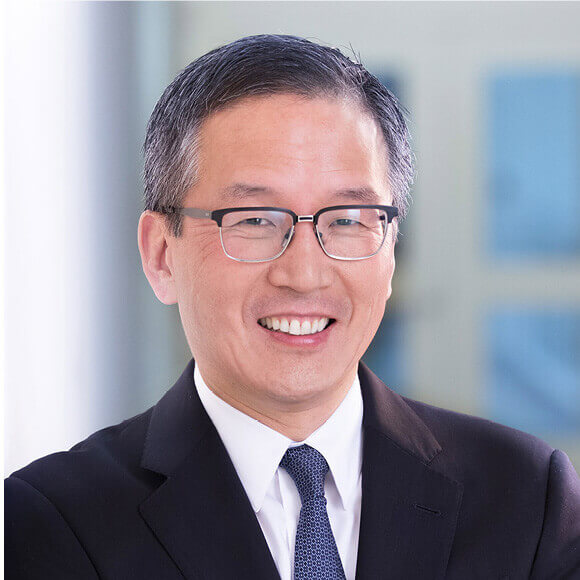
David Chang
About David Chang
David Chang, M.D., Ph.D., age 65, is co-founder, President and CEO of Allogene Therapeutics and has served on the Board since June 2018; he holds a B.S. in Biology from MIT and M.D./Ph.D. from Stanford, with prior senior roles at Kite Pharma (CMO and EVP R&D, 2014–2018), Amgen, and as Associate Professor at UCLA . Pay-versus-performance disclosures indicate Allogene’s TSR for a hypothetical $100 investment was $42.16 (2022), $21.51 (2023), and $14.28 (2024), with net losses of $340,414k (2022), $327,265k (2023), and $257,590k (2024), framing a challenging operating backdrop during his tenure . He is a non-independent director due to his CEO role; the Board uses a Lead Independent Director and independent committees to mitigate dual-role risks .
Past Roles
| Organization | Role | Years | Strategic Impact |
|---|---|---|---|
| Kite Pharma | Chief Medical Officer & EVP, R&D | 2014–2018 | Clinical leadership for autologous CAR-T programs, foundational experience for Allogene’s platform . |
| Amgen | Senior positions (biopharma) | Not disclosed | Large-cap biopharma operating and development experience . |
| UCLA School of Medicine | Associate Professor | Not disclosed | Academic credibility in immuno-oncology . |
External Roles
| Organization | Role | Years | Strategic Impact |
|---|---|---|---|
| IconOVir Bio, Inc. | Chair, Board of Directors | 2020–2025 | Governance and oncology ecosystem access . |
| 1200 Pharma LLC | Director | Since Jun 2021 | Early-stage biotech oversight . |
| Notch Therapeutics | Director | Nov 2019–Mar 2022 | Cell therapy R&D oversight . |
| Vida Ventures | Venture Partner | Since Nov 2017 | Network access and deal flow in life sciences . |
| Two River | Venture Partner | Since Oct 2017 | Company formation and strategic advisory . |
| Caltech Andrew and Peggy Cherng Medical Engineering Advisory Council | Member | Not disclosed | Scientific advisory role . |
| MIT Corporation Biology Visiting Committee | Member | Not disclosed | Academic advisory role . |
Fixed Compensation
| Metric | 2023 | 2024 |
|---|---|---|
| Base Salary ($) | $724,000 | $724,000 |
| Target Bonus (% of Base) | 65% | 65% |
| Actual Annual Incentive ($) | $270,595 | $329,420 |
| Notes | Salary held flat; bonus paid per corporate score | Salary held flat; corporate payout at 70% of target |
Performance Compensation
Equity Awards and Vesting
| Component | Grant Date | Shares / Value | Vesting / Terms |
|---|---|---|---|
| Stock Options | Jan 25, 2024 | 1,123,535 options; exercise price $3.20; expires Jan 25, 2034 | 1/3 on first anniversary, then 1/24 monthly; 3-year schedule adopted for retention . |
| RSUs | Jan 25, 2024 | 317,800 RSUs; grant-date FV included in $3,418,643 aggregate equity FV | 1/3 annually over three years . |
| PSUs (2023 grant) | Mar 22, 2023 | 1,480,357 PSUs (unearned) | 50% vests upon 30-day WAVG stock price of $18 before Mar 22, 2026; 50% vests upon first FDA approval before Mar 22, 2028 . |
| 2024 Mix | — | 70% options / 30% RSUs (by value); no PSUs in 2024 | — |
| 2025 Mix | — | 50% options / 30% RSUs / 20% PSUs; PSUs tied to ALLO-329 autoimmune milestones (reintroduced) | Standard 4-year vesting resumes for options/RSUs in 2025 . |
2024 Annual Cash Incentive Design and Outcomes
| Metric Category | Core Goals (Weight) | Stretch Goals (Weight) | Outcome / Payout |
|---|---|---|---|
| Cema-cel 1L consolidation (ALPHA3) | Initiate ALPHA3 (20%) | ≥2x–3x enrollment targets (up to 40%) | Initiation achieved; overall corporate score 70% . |
| Cema-cel CLL study | Complete Ph1 enrollment (10%) | Transition to Ph2 (10%) | Not fully disclosed; included in 70% corporate score . |
| Manufacturing | CF1 comparability (2.5%); AutoFill for cema-cel (2.5%); ALLO-329 GMP run (5%) | ALLO-329 GMP in 3Q (5%) | Multiple core goals achieved . |
| Pipeline advancement | Go/No-Go ALLO-316 RCC (5%) | — | Achieved . |
| Operations/Finance | Strengthen financials (10%) | Achieve stretch finance target (10%) | Achieved core and stretch finance goals . |
| Partnerships | Resolve Servier collaboration issues (10%) | Partner an asset(s) (10%) | Resolution achieved . |
| Culture | Maintain staff engagement (5%) | — | Achieved . |
| Payout mechanics | 100% at target; max 165% if all core+stretch met | — | 70% of target for NEOs; CEO $329,420 . |
Equity Ownership & Alignment
| Item | Value |
|---|---|
| Total Beneficial Ownership (shares) | 11,043,100 shares |
| Ownership (% of outstanding) | 4.9% of 218,598,262 shares outstanding |
| Unvested RSUs (Dec 31, 2024) | 317,800; market value $676,914 |
| Unearned PSUs (Dec 31, 2024) | 1,480,357; market value $3,153,160 |
| 2024 Options (Unexercisable) | 1,123,535; exercise price $3.20; expires Jan 25, 2034 |
| CEO Ownership Guideline | 6x base salary requirement; compliance confirmed |
| Hedging/Pledging | Prohibited for officers/directors under Insider Trading Policy |
| Clawback | Exchange Act Rule 10D-1/Nasdaq 5608 policy adopted Nov 2023; no recoupment triggered by Feb 2024 restatement |
Employment Terms
- Employment letter agreement (June 2018); at-will; current base salary $724,000; target bonus 65% of base .
- Change-in-Control and Severance: If terminated without cause or resigns for good reason, CEO receives cash severance for 24 months and COBRA premiums for severance period; if within 3 months pre-/12 months post-CIC, CEO also receives 200% of annual target bonus and accelerated vesting of equity awards; other executives receive 12 months severance (18 months if CIC window) and 150% of target bonus in CIC window .
- Definitions: “Cause” includes fraud/dishonesty; material contract/statutory violations; gross insubordination/neglect causing material harm; “Good Reason” includes ≥10% salary reduction (outside broad program), material reduction in duties, or >50-mile relocation increasing commute .
- Perquisites and tax gross-ups: No material perquisites; no tax gross-ups (except occasional HSR fee reimbursement) .
- Clawback and trading restrictions: Clawback policy in place; hedging, short sales, options, and pledging are prohibited .
- Section 16 reports: One late Form 4 filing by David Chang on Jan 31, 2024 covering Jan 25, 2024 grants (administrative oversight) .
Board Governance
- Role and independence: David Chang is a Class I director nominated through 2028; non-independent due to CEO role .
- Committee service: No committee memberships; Board committees are comprised of independent directors (except specific non-required committee exceptions) .
- Board structure: Executive Chair (non-independent) with consulting agreement; Lead Independent Director (Dr. Franz Humer) presides over executive sessions; independent directors meet at least twice per year .
- Attendance: Board met six times in 2024; all directors attended at least 75% of meetings and committee meetings served .
- Say-on-Pay: Support improved from below 70% in 2023 to ~87% in 2024 after program changes (salary freezes; equity mix adjustments; enhanced disclosure) .
Investment Implications
- Alignment: Significant equity ownership (4.9%), strict stock ownership guidelines (6x salary) with confirmed compliance, and prohibitions on hedging/pledging support long-term alignment; 2023 PSUs link outcomes to stock price ($18 30-day WAVG) and FDA approval milestones, creating high-leverage value creation incentives .
- Retention and pressure: 2024 equity moved to 3-year vesting to strengthen retention during transition; RSU and option vesting schedules imply periodic vesting events, but pledging is prohibited and bonus payouts were strictly performance-based at 70% of target, reducing discretionary windfalls .
- Downside protections and governance: Double-trigger CIC, defined “cause/good reason,” no tax gross-ups, and clawback policy mitigate excessive payouts and governance risk; a late Form 4 and a 2024 restatement (no clawback impact) are minor process risks to monitor .
- Pay-for-performance trajectory: Equity-heavy mix (77% of CEO 2024 total comp as long-term incentives) and the reintroduction of PSUs in 2025 (20% of grants) indicate investor-responsive design; however, TSR and net losses reflect execution and financing risk typical for clinical-stage biotech, requiring continued delivery on ALPHA3 and autoimmune ALLO-329 milestones to unlock PSU vesting and shareholder value .