ASML HOLDING (ASML)·Q4 2025 Earnings Summary
ASML Posts Record Quarter as AI Demand Drives €13.2B in Bookings
January 28, 2026 · by Fintool AI Agent
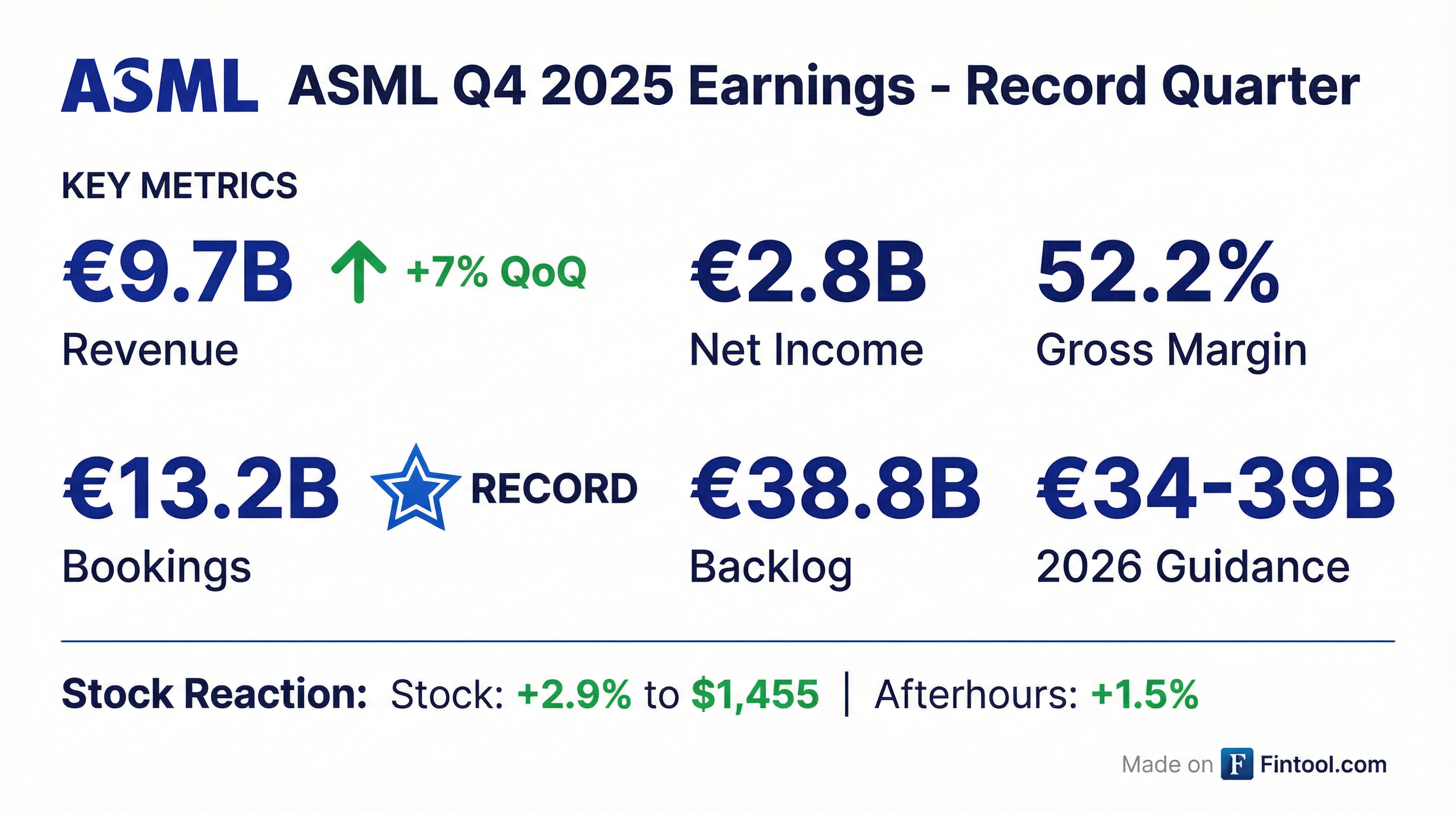
ASML delivered a record-breaking Q4 2025, beating revenue estimates by ~7% with €9.7 billion in quarterly revenue . The Dutch lithography giant posted record order intake of €13.2 billion—including €7.4 billion for EUV systems—as semiconductor customers accelerated AI-driven capacity expansion plans . Full-year 2025 revenue rose 16% to €32.7 billion, with gross margins of 52.8% .
The stock rose 2.9% to $1,455 in regular trading, with aftermarket trading pushing shares to $1,477—a new 52-week high at $1,474.
Also announced: ASML is cutting 1,700 jobs—primarily leadership positions in its technology organization—to streamline engineering and boost innovation agility .
Did ASML Beat Earnings?
Yes — across the board. ASML exceeded expectations on revenue, delivered record bookings, and demonstrated its ability to ramp output for 2026.
CFO Roger Dassen emphasized the quarter's significance: "It was a record quarter in terms of revenue. It was a record quarter in terms of order intake. It was a record quarter in terms of free cash flow generation."
The €13.2 billion in bookings—more than double typical quarters—signals a dramatic shift in customer sentiment on AI infrastructure investment . ASML exits the year with a record €38.8 billion backlog .
What Did Management Guide?
ASML provided bullish guidance for both Q1 2026 and the full year:
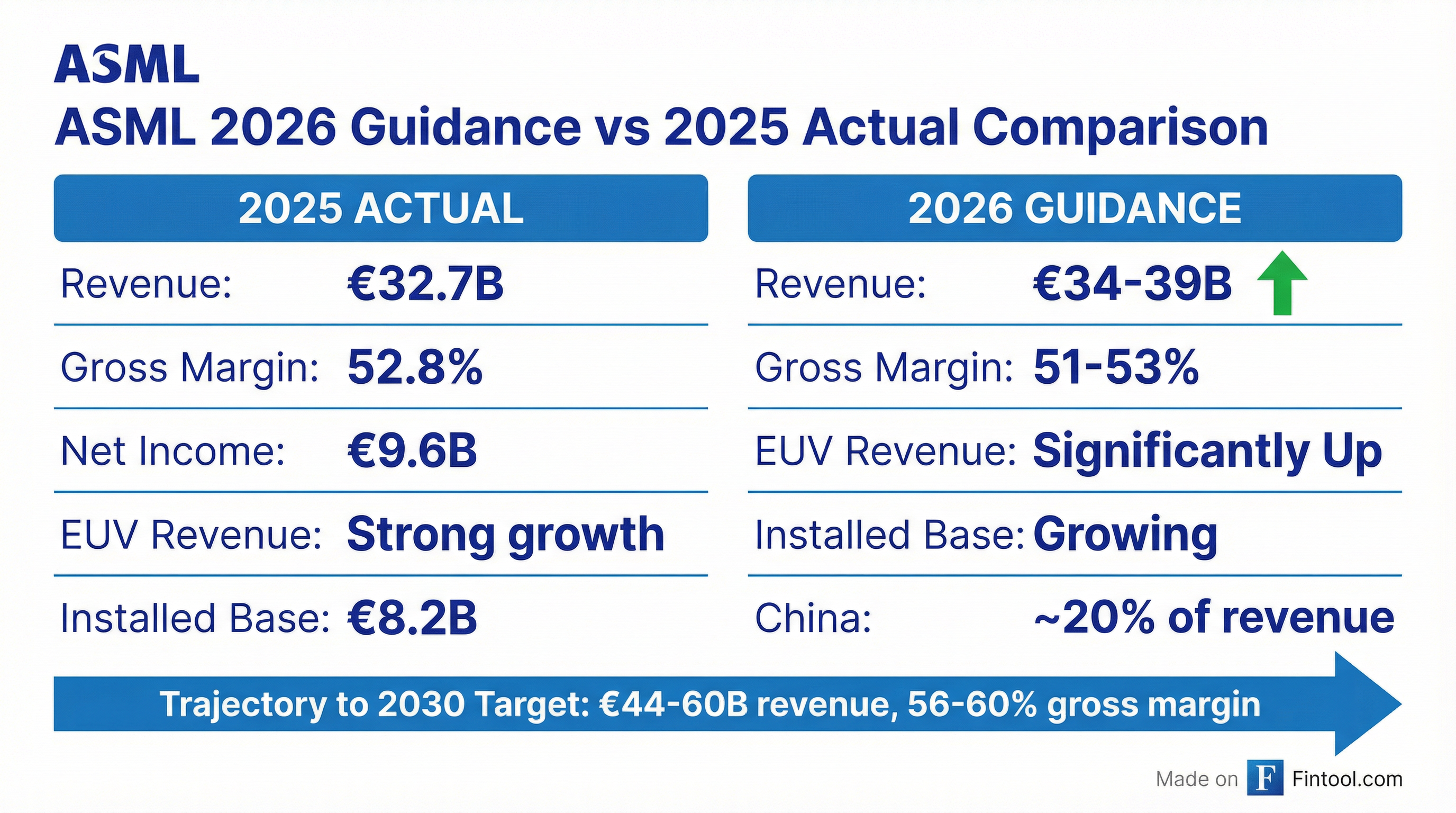
The midpoint of 2026 guidance (€36.5B) represents 12% growth over 2025, with EUV revenue expected to "increase significantly" .
Key guidance details:
- EUV systems: Significantly higher revenue vs. 2025
- Non-EUV systems: Flat overall, but with advanced logic and memory up
- China: Expected at ~20% of revenue (matching backlog mix)
- Installed base: Expected to grow on EUV service expansion and upgrade demand
 Ask Fintool AI Agent
How Did the Stock React?
ASML shares hit a new 52-week high following the results:
The stock has recovered substantially from October 2024 lows, when shares dropped on weaker-than-expected Q3 2024 guidance. Today's results validate the recovery thesis.
What Changed From Last Quarter?
The most striking change is customer sentiment on AI. Management noted a decisive shift in the past few months:
"Customers over the past couple of months have actually become more positive in their assessment of the medium-term market perspectives... It's primarily on the basis of the more robust view that they have when it comes to demand for AI, which seems to be more sustainable from their vantage point."
Key shifts from Q3 2025:
*Values retrieved from S&P Global
The surge in bookings—from ~€2.6B to €13.2B—represents the largest sequential jump in recent memory. CEO Christophe Fouquet attributed this to:
- Logic customers accelerating 3nm/2nm capacity for mobile and HPC
- DRAM customers expanding for HBM and DDR, with tight supply expected through 2026+
- More EUV layers being added at 1b and 1c nodes
What's Driving Demand?
CEO Christophe Fouquet outlined the demand drivers across logic and memory:
Logic
- Customers more confident in long-term AI demand sustainability
- Transition from 4nm to 3nm technology (more EUV-intensive)
- 2nm ramp accelerating for mobile and HPC applications
DRAM
- Very strong demand for HBM and DDR
- Tight supply expected in 2026 and beyond
- Customers ramping 1b and 1c nodes with increased EUV layers
"We see a very positive dynamic... a strong belief that the AI demand is real, and a preparation for that with, on the short term, a major addition of capacity. This will start in 2026 and will last beyond that."
Ask Fintool AI AgentWhy Is AI Demand So Powerful for ASML?
CEO Christophe Fouquet provided a striking example of why AI is driving unprecedented chip demand:
"Today, on the Blackwell system, you need about 2.5 wafers to create the product. If you look at 2027 on the Rubin product, this number will go up to 10 wafers. So to provide the same product to their customer, NVIDIA will need four times more wafer than today."
This 4x increase in wafers per product explains why customers are building "mega fabs" and talking about "hypercycles." Advanced AI is driving both technology scaling (smaller transistors) and volume scaling (more wafers) simultaneously—a new dynamic for the industry .
Key AI demand dynamics:
- Advanced logic and memory growing >20% YoY for the foreseeable future
- AI requirements growing 16x every 2 years vs. Moore's Law's historical 2x
- Capacity = market share for customers in 2026
ASML Announces 1,700 Job Cuts
In a surprise announcement, ASML disclosed plans to cut approximately 1,700 positions—focused primarily on leadership roles in its technology and engineering organization .
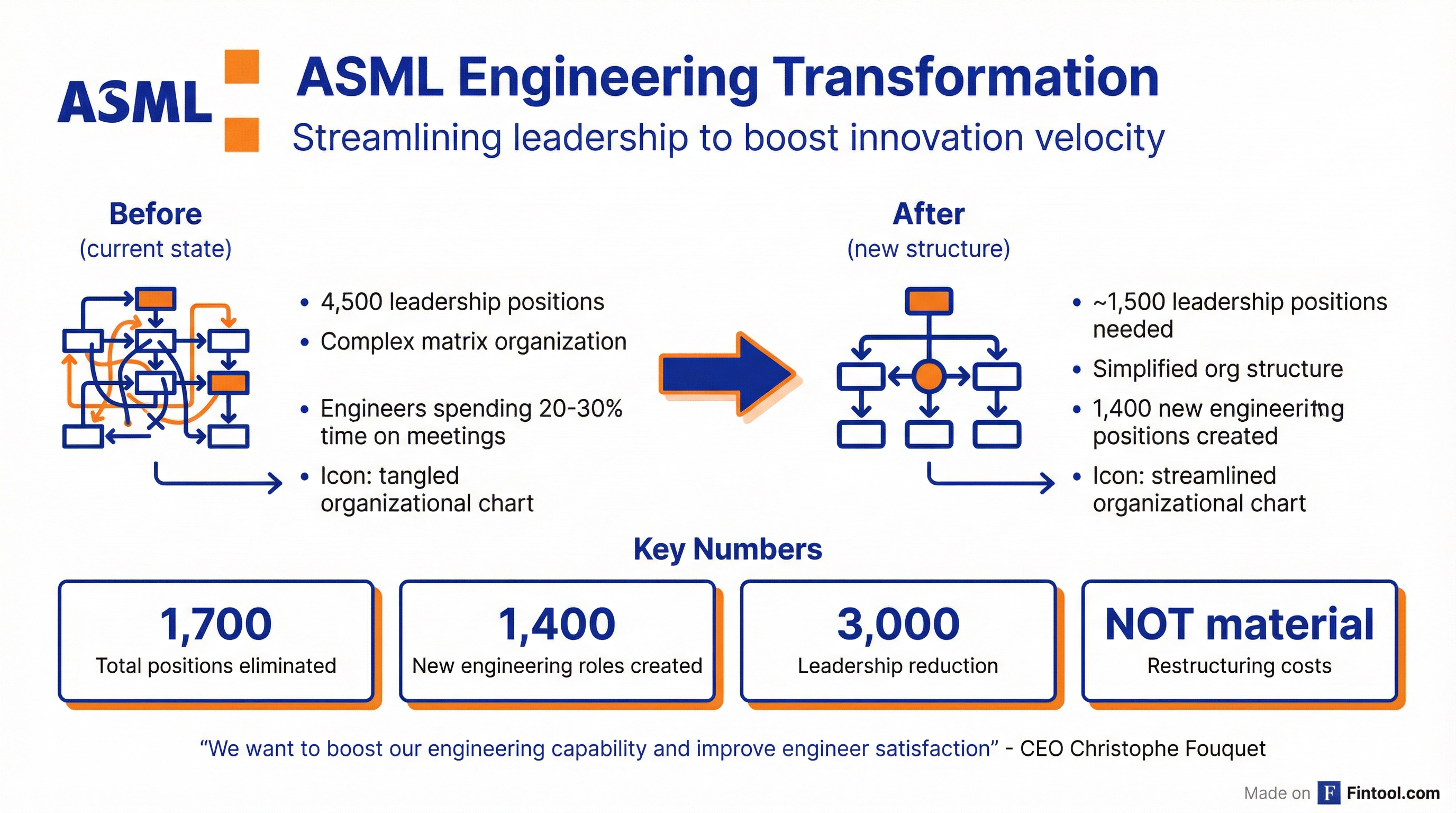
The rationale: Organizational complexity has hampered agility. CEO Fouquet explained:
"Our engineers tell us today, 'Well, maybe we spend 20%-30% of our time not doing engineering, but doing meetings, talking to many different managers.' If we take that away from them, we give them more bandwidth for development."
The restructuring math:
- Current technology organization leaders: ~4,500
- Leaders needed after simplification: ~1,500
- Positions being freed: ~3,000
- New engineering positions created: 1,400
- Net job reduction: ~1,600 (technology) + ~100 (IT) = 1,700
Management emphasized this is not a cost-cutting measure—it's about boosting innovation velocity. CFO Dassen noted restructuring costs would "not be considered material" .
"This is most probably the most difficult decision the management team ever had to make in ASML. But we do it because we truly believe that this is the right thing to do for the company."
Technology Roadmap Update
ASML provided updates across its product portfolio:
Low-NA EUV (NXE 3800)
- Reached 220 wafers per hour throughput, with some customers achieving 230 WPH
- Critical for next-generation DRAM and logic nodes
- Strong upgrade demand as customers seek quick capacity additions
- Unit shipments ramping from 44 in 2025 to ~80 in 2026 — CFO Dassen noted "you cannot move from 44 units to 80 units; you gradually need to crank up your move rate"
High-NA EUV
- Customers finalizing R&D phases with the 5000 system
- First 5200B (high-volume manufacturing tool) accepted by customer — a "very significant moment for the company"
- High-NA expected for production use around 2028-2029
- Q4 included revenue recognition for two High-NA systems
High Productivity Platform (Next-Gen EUV)
Management disclosed a major platform initiative for early next decade:
"We're designing a platform that will be able to receive Low-NA optics, High-NA optics, and potentially Hyper-NA optics. This gives us full flexibility over time to decide exactly when and how we should introduce Hyper-NA."
- Target: >400 wafers per hour productivity
- Expected launch: Early next decade
- Technical presentation at SPIE conference in coming weeks
Metrology & Inspection
- ~30% growth in 2025
- Multi-beam e-beam inspection gaining traction
- Strong demand for process control expected to continue
R&D Investment Focus
CFO Dassen confirmed the lion's share of R&D is focused on EUV, with three major work streams :
- High-NA — Next-generation EUV for 2028+ production
- Low-NA platform — Continued productivity improvements on the 3800 series
- High Productivity Platform — Future architecture for >400 WPH
What's Happening With China?
China revenue is normalizing after outsized contributions in 2024-2025:
CFO Dassen explained the decline reflects backlog normalization, not a dramatic market shift:
"What was going on in previous years is that over the COVID period, we built up a huge backlog because we underserved the Chinese market during the COVID days. We have been executing on that backlog in the past couple of years."
The decline is primarily in DUV dry systems, with advanced logic/memory demand outside China more than compensating .
Capital Allocation
ASML announced enhanced shareholder returns:
The dividend increase and new €12 billion buyback authorization signal confidence in cash generation and long-term growth.
Full Year 2025 Summary
Segment growth highlights:
- EUV revenue: +39% YoY
- Metrology & Inspection: +28% YoY
- Installed Base Management: +26% YoY
- DUV: -6% YoY (mostly China decline)
Technology and end-use mix:
- 90% of system revenue came from leading technology (EUV + immersion combined)
- Memory: 34% of end-use | Logic: 66%
- Memory expected to increase share in 2026 as DRAM customers accelerate capacity additions
Fun fact from CFO Dassen: The €8.2B installed base revenue is close to ASML's total revenue in 2017—illustrating how rapidly the company has grown .
Q&A Highlights
On 2026 Guidance Range (4%-19% Growth):
"It's obviously to a very large extent driven by the progress that our customers are making in completing the fabs and their ability to take in the tools. So that's a significant one... And then, of course, there is our ability to execute." — CFO Dassen
On Memory vs. Logic Bottlenecks for AI:
"It's difficult to say if logic or DRAM is the bottleneck for AI today. I would still pick most probably memory at this point of time... the demand for high-bandwidth memory, which is the AI memory, is extremely high. But the demand for DDR memory is also very high, and as a result, we have seen basically the price of DRAM going up significantly." — CEO Fouquet
On 4F² DRAM Transition—No "Cliff" for EUV:
"If you look at 4F², the structure requires a more advanced litho mask... you get basically to look at a more complex structure, and that structure is going to require more lithography. This is why we mentioned that both immersion and EUV will go up." — CEO Fouquet
CEO Fouquet emphasized that customers hate "cliffs" and plan for optimized technology transitions: "Cliff is never good for customers when it comes to operations... EUV has become a very handy tool to simplify processes, simplify cycle time, and even bring more capacity."
On 2026 Gross Margin Drivers: CFO Dassen outlined the puts and takes for 51-53% margin guidance :
- Headwinds: Immersion supply constraints, more dry tool sales (lower margin), EUV mix (some 3600s vs 3800s), High-NA dilution
- Tailwinds: Significantly higher EUV unit volume (margin accretive), upgrade demand from installed base
- Swing factor: Installed base upgrades—if upgrade demand is strong (likely given capacity appetite), gross margin benefits
On Memory Share Shift in 2026:
"If we look at the composition of our sales in 2026, you will see a major memory play in there. So the demand in 2026 is far more balanced in terms of logic versus memory than it was in 2025... this is not just DUV, this is definitely also EUV." — CFO Dassen
On Logic Roadmap (A14, A10):
"We see EUV layers increasing again at A14—most probably 10%-20%. We see that being even more true for A10, where the structure change could call for even more EUV layers." — CEO Fouquet
On Order Backlog Timing:
"The lion's share of the orders that came in in Q4, some of it is 2026, but the lion's share really is for 2027." — CFO Dassen
H2 2026 expected stronger than H1 due to customer fab completion timing and ASML's gradual move rate increase .
On Manufacturing Capacity:
"70 would not be the limit that I would currently be looking at. I think that is higher." — CFO Dassen
Dassen explained the ramp approach: "You cannot go from one year to the other from 44 to 80... that needs to be a gradual approach. So this is the process that we're in right now." ASML has put in place the long lead time infrastructure (clean rooms, equipment) that takes >12-18 months, and is now gradually ramping headcount and supply chain quarter-over-quarter .
On Non-China DUV Recovery:
"We could see the non-China DUV business come back in the last months of the year. And we frankly see that trajectory continue into 2026." — CFO Dassen
On Supply Chain Readiness:
"We've put in the long lead time items—everything that takes longer than 12, 18 months to realize is in place. We're now making sure that every quarter we increase our move rate... We have a very solid understanding with our supply chain. They're doing the same thing." — CFO Dassen
On Energy as the Industry Constraint:
"We worry a lot more about energy costs than gold or silver, because energy is most probably the one thing to watch to make sure that this industry keeps going. The good news for us is, one way to reduce energy consumption is to move to more advanced chips." — CEO Fouquet
Looking Ahead: Key Catalysts
- Q1 2026 results (April 2026) — First quarter of accelerated EUV shipments
- New campus groundbreaking — May/June 2026 at Brainport Industries Campus in Eindhoven; move-in expected 2028
- High-NA ramp — Additional customer acceptances expected in 2026; first HVM production use ~2028-2029
- HBM capacity expansion — Memory customers adding EUV layers at 1b/1c nodes, with tight supply expected through 2026+
- SPIE Conference — High Productivity Platform technical presentation in coming weeks
- Restructuring completion — Timeline depends on union negotiations; management targeting "as soon as possible"
Ask Fintool AI AgentThe Bottom Line
ASML delivered a blockbuster Q4 2025 that exceeded expectations across all metrics. The €13.2 billion in bookings—a record—signals that customers are committing to major AI infrastructure buildouts. With a €38.8 billion backlog, raised 2026 guidance of €34-39 billion, and continued progress on High-NA EUV, ASML remains the critical enabler of advanced semiconductor manufacturing.
The key message: AI demand is real, and chipmakers are investing accordingly.
Read the full Q4 2025 earnings call transcript or explore ASML's company profile. ts/Q4%202025) or explore ASML's company profile.* explore ASML's company profile.*