Bloom Energy (BE)·Q4 2025 Earnings Summary
Bloom Energy Crushes Q4, Guides 2026 Revenue 63% Above Street
February 5, 2026 · by Fintool AI Agent
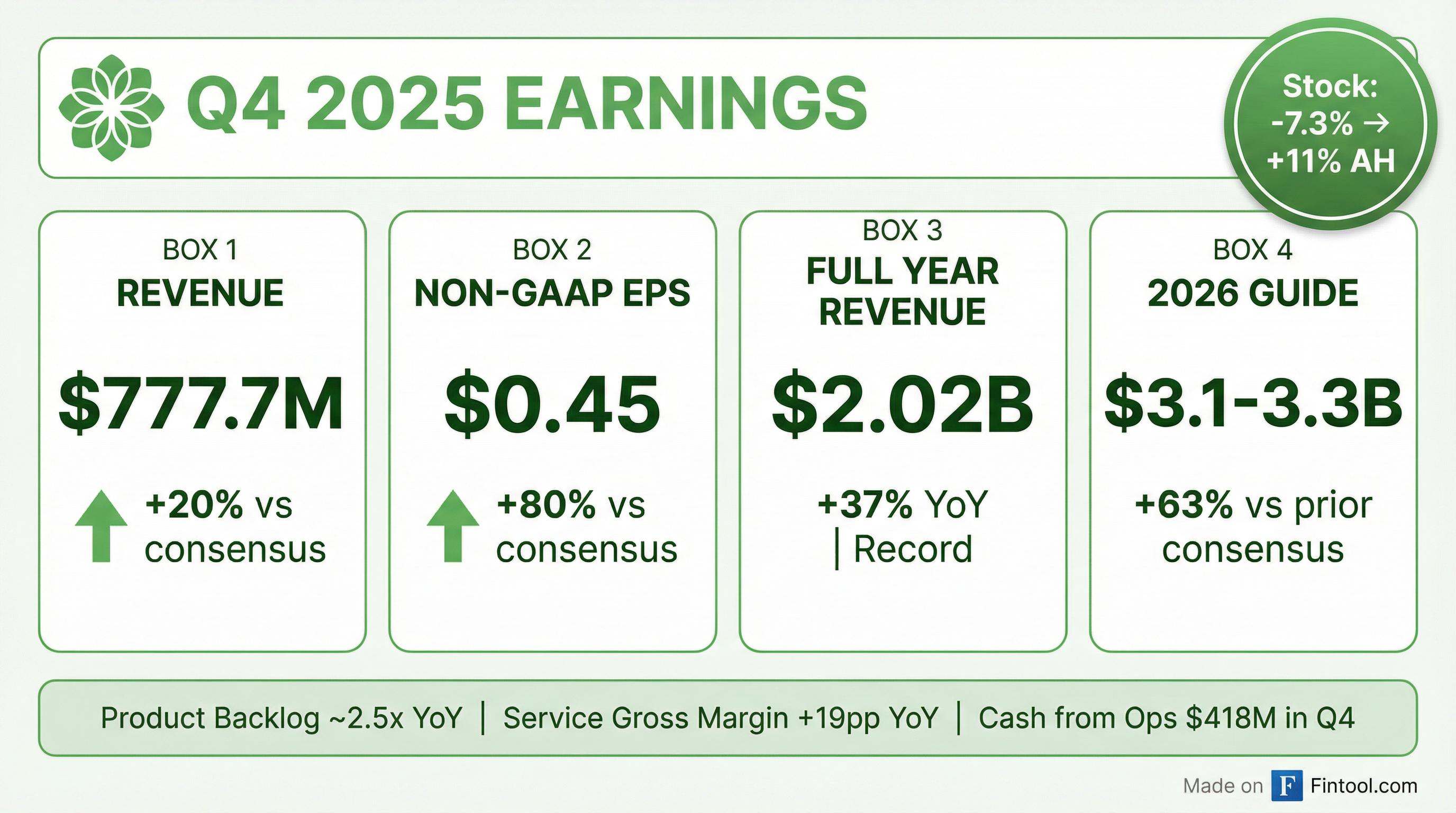
Bloom Energy delivered a blockbuster Q4 2025, with revenue of $777.7 million crushing consensus estimates of ~$647 million by 20% . Non-GAAP EPS of $0.45 blew past the $0.25 Street estimate by 80% . More importantly, FY2026 guidance of $3.1-3.3 billion in revenue—63-74% above prior consensus of ~$1.9 billion—signals that Bloom's AI data center opportunity is accelerating faster than the market anticipated .
The stock initially dropped 7.3% during regular trading on gross margin compression concerns but recovered 11% in after-hours trading to $152 as investors focused on the transformative guidance .
Did Bloom Energy Beat Earnings?
Yes—and it wasn't close. This marks Bloom's fifth consecutive earnings beat, extending a streak that has seen the stock surge 469% over the past year.
The full year delivered record revenue of $2.02 billion, up 37.3% YoY, driven by "significant growth from the AI data center industry and continued strong demand from the C&I business" .
Beat/Miss History (Last 8 Quarters):
The turnaround from consistent misses in early 2024 to a streak of massive beats reflects execution on AI data center contracts and operational improvements.
 Ask Fintool AI Agent
What Did Management Guide?
The guidance is the headline. Bloom's 2026 outlook crushes prior Street expectations across every metric:
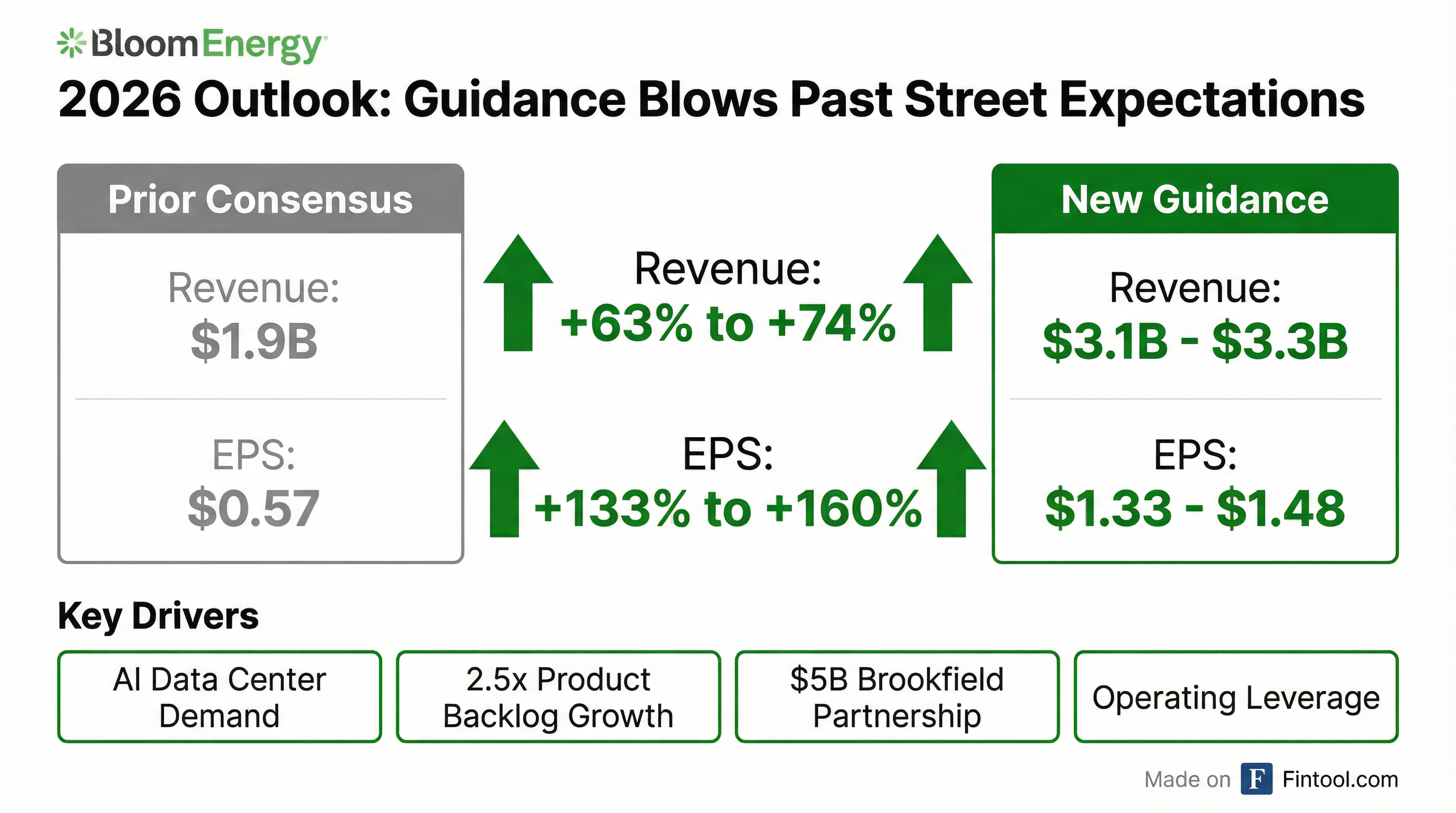
*Prior consensus from Yahoo Finance estimates
This guidance implies:
- >50% revenue growth in 2026, accelerating from 37% in 2025
- Non-GAAP operating income doubling from $221M in 2025 to $425-475M
- Operating leverage with OpEx as % of revenue declining from 19% to 15%
CEO KR Sridhar emphasized the secular shift: "Bring-your-own-power has shifted from a slogan to a business necessity for AI hyperscalers and manufacturing facilities. This shift is secular and growing."
What Changed From Last Quarter?
Several key developments distinguish Q4 from prior quarters:
1. Backlog Explosion
The 2.5x product backlog growth signals extraordinary demand visibility extending through 2028.
2. AI Data Center Traction
Q4 saw major announcements:
- Oracle collaboration to power AI data centers
- $5 billion strategic partnership with Brookfield Asset Management for AI infrastructure
- 6 hyperscale and neocloud end customers in backlog vs. just 1 a year ago
Related party revenue (largely Brookfield JV) surged to $574M in Q4 alone vs. just $3M in Q4 2024 .
3. Geographic Mix Shift
A dramatic shift in the US backlog composition highlights expanding addressability:
CEO Sridhar explained: "Companies are locating factories and data centers in states where they can quickly secure reliable and affordable power... The states where we are growing fastest have robust natural gas infrastructure and favorable regulatory and policy frameworks for on-site power generation."
4. Balance Sheet Transformation
Bloom's cash position more than tripled:
This followed a convertible debt transaction that raised $2.5B in gross proceeds .
5. Service Business Turnaround
Service gross margin swung from negative to +19.5% (non-GAAP):
This +19 percentage point improvement represents a fundamental shift in the service business economics.
What Technology Advantages Did Management Highlight?
The Q&A session revealed several technology differentiators that management emphasized as key competitive moats:
800 Volts DC Architecture
AI compute racks will require 800 Volts DC power—a fundamental shift from the high-voltage AC architecture that dominates today's grid infrastructure. CEO Sridhar explained the significance:
"Bloom, and only Bloom, natively produces 800 Volts DC today. No Band-Aids or adapters needed. Starting now, every Bloom server we ship will be 800 Volts DC ready with a removable adapter that allows customers to deploy in legacy AC environments and migrate to DC on their own timeline."
This matters because competitors using grid, turbines, or engines must install "numerous transformers, rectifiers, and power conditioning tools to convert high voltage AC to 800 Volts DC—adding significant cost, reducing reliability, and increasing emissions."
Absorption Chillers (Combined Heat & Power)
Bloom disclosed a heat recovery solution that could reduce data center electricity consumption by 20%:
"With on-site power generation... in addition to our extremely high electrical efficiency, we have high-quality heat, and that heat is allowed to drive a very well-established technology called absorption chilling to provide cooling. We think we can reduce electricity usage in the data center by at least 20%."
This eliminates the need for hydrofluorocarbons (an environmental win) and avoids vapor compression chiller supply chain constraints.
Load Following Without Batteries
Perhaps the most underappreciated capability: Bloom's servers can follow AI workload swings in milliseconds without requiring battery backup:
"The ability to, in an islanded mode, operate our systems without needing any backup... not needing batteries to keep up with the wild swings that the AI load has in terms of power, is a super important application."
This eliminates battery cost, maintenance, fire risk, and supply chain constraints—advantages that compound as AI data centers scale.
How Did the Stock React?
The stock reaction tells a nuanced story:
Why the initial selloff? Q4 non-GAAP gross margin of 31.9% was down 740 bps from 39.3% in Q4 2024 . Product gross margin declined from 46.9% to 37.5% YoY , reflecting mix shift toward larger AI infrastructure deals that carry different margin profiles.
Why the after-hours recovery? As investors digested the blowout 2026 guidance and massive backlog growth, the margin concerns faded. The stock is still up ~469% over the trailing 12 months.
Ask Fintool AI AgentKey Segment Performance
Revenue Mix
Product remains the dominant driver, with the massive installation revenue growth (+86%) reflecting the ramp in AI data center deployments.
Profitability Evolution
The trajectory from cash-burning to cash-generating—with 2025 marking the second consecutive year of positive operating cash flow—validates the margin improvement thesis .
Management Commentary Highlights
CEO KR Sridhar on the secular shift:
"'Bring your own power' has become the mantra for data centers and power-hungry factories. On-site power has moved from being a decision of last resort to a vital business necessity."
On market acceleration:
"Just take the last three days... Amazon came out today and said they're upping their capital expense almost 100% to $200 billion for 2026. Google did the same yesterday... $175-185 billion. This is all for digital infrastructure."
On the Bloom advantage:
"Very large mechanical equipment with its inertia cannot swing up and down in milliseconds and seconds like our solid-state digital platform does. It cannot follow a load that way. You need band-aids for that."
CFO Maciej Kurzymski on 2025 execution:
"I would like to highlight the $271.6 million in Adjusted EBITDA, proving just how much operating leverage there is in the business as we start to scale."
On the service business:
"What you're looking from the last eight quarters is eight continuous quarters of profits in the service business. On top of that, Q4 2025, we had a 20% gross margin."
Q&A Highlights
On repeat customer business (Morgan Stanley): CEO Sridhar emphasized the flywheel effect: "Over two-thirds of our business, year-over-year, comes from repeat customers bringing in multiple repeat orders to us. This is how it operates. Once people get used to Bloom, they love Bloom because we keep our promise." Oracle was cited as an example of expanding engagement.
On capacity expansion (RBC Capital): Management dismissed capacity constraints: "The return on investment for us is a few months... We can ramp up and provide that additional power to that customer before they're ready." The 55-day delivery for a hyperscale AI factory was highlighted as proof of execution.
On book-and-ship business (J.P. Morgan): A significant double-digit percentage of 2025 revenue came from book-and-ship—orders booked, shipped, and energized within a single quarter . This reflects Bloom's ability to rescue customers when other vendors miss commitments.
On AEP order (BTIG): The utility exercised its option for fuel cells under the gigawatt agreement, and the sale is unconditional—AEP will take delivery regardless of when offtake is finalized .
On CNI momentum: CNI backlog grew over 135% YoY across telecom, manufacturing, logistics, retail, healthcare, and education verticals . Drivers include digitization, automation, electrification, and reshoring.
Risks and Concerns
Despite the blowout results, several concerns warrant monitoring:
-
Gross Margin Pressure: Q4 product gross margin of 37.5% was down ~950 bps YoY . Management expects FY2026 gross margin of ~32%—only 200 bps above 2025—suggesting mix headwinds persist.
-
Customer Concentration: Related party revenue (Brookfield JV) was $574M of $778M Q4 revenue—over 70% . While this reflects strategic partnership success, it creates concentration risk.
-
Debt Load: Total recourse debt rose to $2.6B from $1.0B YoY following the convertible raise .
-
Policy Risk: The 10-K cites dependency on ITC tax credits and the Inflation Reduction Act . Changes to the regulatory landscape could impact economics.
-
AI Slowdown Risk: Management explicitly calls out "any actual or perceived slowdown in the adoption of AI resulting in a slower expansion of AI data centers" as a forward-looking risk .
Forward Catalysts
Key events to watch:
Ask Fintool AI AgentThe Bottom Line
Bloom Energy delivered a quarter that resets expectations. The 20% revenue beat and 80% EPS beat are impressive, but the real story is the 2026 guidance—at $3.1-3.3B revenue, Bloom is signaling growth acceleration that the Street hadn't modeled. The 2.5x backlog growth and $5B Brookfield partnership provide visibility, while the Oracle collaboration validates the AI data center opportunity.
The margin compression is real and warrants monitoring, but management's ability to guide to ~32% gross margin and $1.33-1.48 EPS while growing revenue 50%+ suggests confidence in the unit economics as scale builds.
With the stock recovering 11% after-hours to $152, the market appears to be looking past near-term margin noise to focus on the transformative demand picture.
Data as of February 5, 2026. Values retrieved from S&P Global where noted with asterisk.