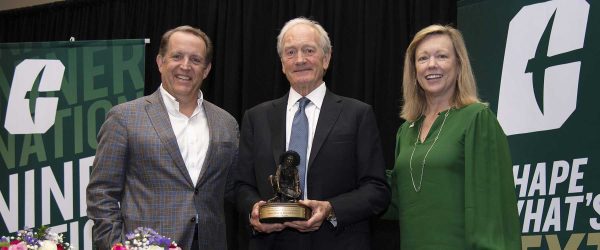
John Cato
About John Cato
John P. D. Cato, 74, is Chairman, President and CEO of The Cato Corporation; he has been an officer since 1981 and a director since 1986, serving in the combined CEO/Chairman role since January 2004 . 2024 pay-versus-performance shows TSR of 28.14, net income of -$18.1 million, and pre-tax, pre-bonus income of -$16.1 million, highlighting operating pressure and no annual bonus payout for 2024 . Mr. Cato beneficially owns 1,404,251 Class A shares (7.8%), all 1,763,652 Class B shares (100%), and controls 53.3% of total voting power, qualifying Cato as a “controlled company” under NYSE rules .
Past Roles
| Organization | Role | Years | Strategic Impact |
|---|---|---|---|
| The Cato Corporation | Chairman, President & Chief Executive Officer | 2004–present | Combined leadership role for strategy and execution in a volatile retail segment; continuity and oversight of long-term plan . |
| The Cato Corporation | President, Vice Chairman & Chief Executive Officer | 1999–2004 | Transition to CEO; led corporate operations and strategic initiatives . |
| The Cato Corporation | President, Vice Chairman & Chief Operating Officer | 1997–1999 | Oversaw operations, cost discipline, and store performance . |
| The Cato Corporation | Vice Chairman & Chief Operating Officer | 1996–1997 | Operational leadership during concept expansion . |
| The Cato Corporation | EVP; President & GM, It’s Fashion! concept | 1989–1996 (GM 1993–1996) | Built and managed off-price It’s Fashion! concept, driving format diversification . |
External Roles
| Organization | Role | Years | Strategic Impact |
|---|---|---|---|
| Harris Teeter Supermarkets, Inc. (Ruddick Corp) | Director | Not disclosed | External board experience in grocery retail; governance perspective . |
Fixed Compensation
| Year | Salary ($) | Bonus ($) | Stock Awards ($) | Non-Equity Incentive ($) | All Other Comp ($) | Total ($) |
|---|---|---|---|---|---|---|
| 2022 | 1,373,925 | — | 1,508,226 | — | 307,989 | 3,190,140 |
| 2023 | 1,416,816 | — | 1,190,909 | — | 337,580 | 2,945,305 |
| 2024 | 1,453,968 | — | 681,299 | — | 266,649 | 2,401,916 |
- CEO base salary represented 60% of total compensation in 2024; for NEOs (other than CEO), base salary was 81% .
Performance Compensation
Annual Cash Incentive Program (2024)
| Metric | Threshold / Minimum | Target | Maximum | Actual (FY2024) | Payout |
|---|---|---|---|---|---|
| Consolidated pre-tax, pre-bonus income | Positive net income triggers 20% payout minimum | $14.2 million corresponds to 20% of bonus potential | $24.6 million corresponds to 100% payout cap | -$16.113 million | $0; threshold not met |
- CEO maximum annual incentive opportunity: 150% of base salary (payout capped at that level; realized payout depends on company performance and individual evaluation) .
Long-Term Equity Incentives
| Grant Date | Type | Shares Granted (#) | Grant-Date Fair Value ($) | Vesting | Ownership/Sale Restrictions |
|---|---|---|---|---|---|
| May 1, 2024 | Restricted Stock (Class A) | 143,130 | 681,299 (FMV based on $4.85/$4.66 average) | 33% on 3rd anniversary (2027), 33% on 4th (2028), 34% on 5th (2029) | CEO must maintain stock worth ≥600% of base salary; up to 45% of vesting shares may be sold to cover taxes |
| March 2025 | LTI Decision | — | — | No LTI grants made for 2025 due to consecutive pre-tax losses | — |
- Company currently does not grant stock options; LTI grants are full-value restricted stock with time-based vesting starting year three .
Outstanding Equity and Vesting Cadence
| As of FY-end (Jan 31, 2025) | Unvested RSUs (#) | Market Value ($) | Expected Vesting Mix (next 5 years) |
|---|---|---|---|
| CEO | 525,898 | 1,761,758 (at $3.35) | 21% in 2025, 25% in 2026, 26% in 2027, 19% in 2028, 9% in 2029 |
- Shares acquired on vesting in 2024: 118,329 shares; value realized $563,246 (FMV based on $4.85/$4.66 average) .
Equity Ownership & Alignment
| Category | Detail |
|---|---|
| Beneficial Ownership | Class A: 1,404,251 (7.8% of Class A); Class B: 1,763,652 (100% of Class B); Total voting power: 53.3% . |
| Spousal Holdings | Includes 13,011 Class A and 3,000 Class B shares held by spouse; Mr. Cato disclaims beneficial ownership of spouse’s shares . |
| Ownership Guidelines | CEO must hold vested stock equal to ≥600% of base salary; requirement achieved . |
| Hedging/Pledging | Hedging, short sales, and derivative transactions prohibited by Insider Trading Policy; pledging not disclosed . |
| Vested vs Unvested | Unvested restricted shares: 525,898 at FY-end; vest cadence as above . |
- ESPP one-year holding period applies to shares bought under the plan; restricted stock selling is limited by ownership guidelines (sale allowed only once guideline met, except tax sales up to 45% at vest) .
Employment Terms
| Term | Status |
|---|---|
| Employment agreement | None; Company does not have employment or change-of-control agreements with NEOs . |
| Severance provisions | Not disclosed; no specific severance multiples cited . |
| Change-of-control (COC) | Single-trigger immediate vesting of all unvested restricted stock upon COC, unless the holder is materially affiliated with the acquirer (then no acceleration) . |
| Clawback | SEC/NYSE-compliant clawback effective Dec 1, 2023; three-year lookback for incentive comp tied to financial reporting measures (including TSR) after a restatement; mandatory recovery subject to narrow exceptions . |
| Non-compete / Non-solicit / Garden leave | Not disclosed . |
| Deferred Compensation | Plan available; no CEO deferrals for 2024 . |
| Perquisites | None exceeding $10,000; company provides core benefits similar to other salaried associates . |
Board Governance
- Board service history: Director since 1986; Chairman & CEO since 2004; term expires in 2027 . Committee memberships: Not on standing committees; Audit, Compensation, and Corporate Governance & Nominating committees are composed of independent directors .
- Controlled company: More than 50% combined voting power beneficially owned by Mr. Cato; despite exemption, board and committees meet independence standards .
- Board leadership structure: Combined Chair/CEO with Lead Independent Director (Bryan F. Kennedy, III) providing oversight and presiding over executive sessions; independent directors meet without management .
- Attendance: Board held 4 meetings; committees held 7 (Audit), 3 (Compensation), 3 (Governance); all directors attended 100% of meetings and the 2024 annual meeting .
Director Compensation (for context; CEO is employee director)
- Non-employee directors: Annual cash retainer $66,000; meeting fees $1,500 for certain meetings; chair fees: Audit $10,000; Compensation and Governance $5,000; annual stock award valued at $60,000 (4,298 shares granted June 1, 2024) .
- CEO as employee director does not receive separate director compensation .
Compensation Peer Group and Benchmarking
| Year | Peer Group Composition | Target Positioning |
|---|---|---|
| 2024 | Boot Barn, The Buckle, Chico’s FAS, The Children’s Place, Citi Trends, J.Jill, Shoe Carnival, Express | Target total direct compensation set between 25th–75th percentile; CEO’s base ~26% of target TDC; NEOs’ base 45–47% . |
| 2025 | Boot Barn, The Buckle, The Children’s Place, Citi Trends, J.Jill, Shoe Carnival, Tilly’s, Zumiez (Chico’s and Express removed) | Continued 25th–75th percentile target range . |
- Independent consultant Aon Hewitt supports peer selection and program design; no conflicts identified .
Say-on-Pay & Shareholder Feedback
- Most recent advisory vote: fiscal 2023; Committee reviewed results and shareholder feedback; no direct changes implemented for fiscal 2024; next say-on-pay vote at the 2026 annual meeting .
Performance & Track Record (Pay vs Performance)
| Metric | FY 2020 | FY 2021 | FY 2022 | FY 2023 | FY 2024 |
|---|---|---|---|---|---|
| PEO SCT Total ($) | 2,814,652 | 5,466,540 | 3,190,140 | 2,945,305 | 2,401,916 |
| PEO Compensation Actually Paid ($) | 2,338,868 | 6,360,497 | 2,408,943 | 2,408,141 | 1,861,698 |
| Avg SCT Total Non-PEO NEOs ($) | 539,985 | 714,357 | 495,217 | 581,347 | 556,674 |
| Avg Compensation Actually Paid Non-PEO NEOs ($) | 482,439 | 820,325 | 418,992 | 479,421 | 489,776 |
| TSR ($) | 72.54 | 108.40 | 69.39 | 51.47 | 28.14 |
| Peer Group TSR ($) | 106.91 | 118.34 | 129.27 | 144.65 | 184.45 |
| Net Income (Loss) ($000) | (47,483) | 36,844 | 29 | (23,941) | (18,057) |
| Pre-tax, Pre-bonus Income (Loss) ($000) | (72,556) | 80,312 | 3,251 | (12,351) | (16,113) |
Compensation Structure Analysis
- Shift toward fixed pay: Salary share of CEO compensation rose to 60% in 2024, as equity grants declined and no annual bonus was paid, reflecting pay-for-performance discipline during losses .
- Equity mix: Company has moved away from options; RSUs vest over five years with vesting beginning only in year three, enhancing retention and ownership alignment but limiting immediate performance linkage .
- Bonus governance: Performance metric targets set with caps; no payout below threshold; 2024 threshold missed; 2025 goals remain tied to consolidated pre-tax, pre-bonus income .
- Clawback and hedging restrictions strengthen alignment and risk controls; pledging not disclosed .
Related Party Transactions and Compliance
- No related person transactions requiring disclosure in fiscal 2024 .
- Section 16(a) compliance: All filings met during fiscal year ended Feb 1, 2025 .
Investment Implications
- Alignment vs. entrenchment: Mr. Cato’s 53% voting control aligns incentives with long-term value but reduces external governance leverage; combined CEO/Chair mitigated by Lead Independent Director and independent committees .
- Near-term selling pressure: Significant unvested RSUs with a scheduled vesting cadence through 2029 could create supply around vest dates, but ownership guidelines and tax-only sales up to 45% moderate potential net disposals; 2025 LTI awards were withheld, limiting incremental supply .
- Pay-for-performance: With negative pre-tax results and no bonus payout in 2024, the program shows downside sensitivity; however, equity awards remain time-based, reducing direct linkage to operating metrics; continued losses drove no 2025 LTI grants .
- Risk indicators: Controlled company status, persistent losses, and underperforming TSR vs. peer group underscore execution risk; governance mitigants include clawback and hedging prohibitions; no repricing or options granting observed .