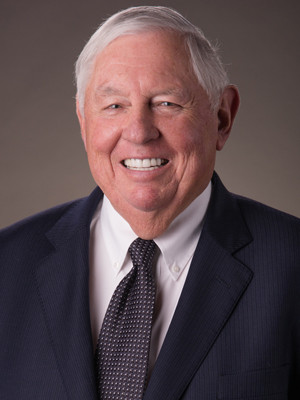
William Dillard, II
 DILLARD'S
About William Dillard, II
William Dillard, II, age 80, is Chairman and Chief Executive Officer of Dillard’s, Inc., serving on the Board since 1967 and as CEO since 1997; he previously served as President and Chief Operating Officer and has been involved in nearly all facets of the Company’s operations for 55+ years . Dillard’s operates as a controlled company with a dual‑class structure; W.D. Company, Inc. controls essentially all Class B votes, and William Dillard, II holds 27.4% of W.D. Company’s voting stock, acting by majority with two family executives for voting/dispositive decisions on those shares . Recent performance metrics used by the Board include pre‑tax income (FY2024: $729.7 million) and cumulative shareholder return (value of initial fixed $100 investment at $965.99 for 2024 in their pay‑versus‑performance table), indicating strong multi‑year TSR, though pre‑tax income declined year over year .
Past Roles
| Organization | Role | Years | Strategic Impact |
|---|---|---|---|
| Dillard’s, Inc. | President and Chief Operating Officer (prior to CEO) | Not disclosed | Deep operating experience across merchandising, real estate and store location; informs Board leadership and strategy . |
External Roles
| Organization | Role | Years | Strategic Impact |
|---|---|---|---|
| Other public companies (unspecified in 2025 proxy) | Director | Not disclosed | Proxy notes prior service on other public company boards, contributing external perspective; specifics not provided . |
Fixed Compensation
| Metric | FY 2022 | FY 2023 | FY 2024 |
|---|---|---|---|
| Base Salary ($) | 1,120,000 | 1,170,000 | 1,170,000 |
| All Other Compensation ($) | 703,760 | 396,991 | 338,052 |
| Pension Change ($) | 15,186,742 | 6,948,705 | — (0) |
| CEO Pay Ratio (disclosed) | — | — | 132:1 |
Notes: All other compensation for 2024 includes $231,953 in company contributions under retirement/stock purchase plans, $71,237 for personal use of aircraft (incremental cost basis), and $34,862 insurance premiums . Base salary for 2024 unchanged vs. 2023; Compensation Committee sets base annually; CEO base below peer median per Committee commentary .
Performance Compensation
-
Annual Cash Bonus Plan mechanics:
- Eligibility: CEO participates; bonus requires positive company pre‑tax income .
- Bonus pool: 1.5% of pre‑tax income + 3.5% of the increase vs. prior year (increase negative in 2024, so pool = 1.5% only) .
- Individual cap: 1% of pre‑tax income .
- CEO allocation: 28% of the 2024 pool (increased from 26% in 2023 following a participant retirement) .
-
2024 Cash Bonus Outcome | Metric | Weighting | Target | Actual | Payout | Vesting | |---|---|---|---:|---:|---| | Pre‑tax Income | Not stated (pool‑based) | Positive pre‑tax income required | $729,701,000 | $3,064,700 to CEO (28% allocation) | Cash paid after FY end |
-
Equity Awards (Stock Bonus Plan):
- Formula: Annual stock award = 6% of total cash comp above $15,000 divided by market price; no vesting .
- 2024 CEO award: 605 shares, grant date fair value $283,788; treated as vested upon grant .
-
Mix of Total Direct Compensation (FY2024): For CEO, Base 24.1%, Annual Cash 63.1%, Equity 5.8%, Other 7.0% .
Multi-Year CEO Compensation (Summary Table)
| Component ($) | FY 2022 | FY 2023 | FY 2024 |
|---|---|---|---|
| Salary | 1,120,000 | 1,170,000 | 1,170,000 |
| Stock Awards (value) | 719,028 | 361,008 | 283,788 |
| Non‑Equity Incentive Plan (Cash Bonus) | 4,866,600 | 3,574,800 | 3,064,700 |
| Change in Pension Value | 15,186,742 | 6,948,705 | — (0) |
| All Other Compensation | 703,760 | 396,991 | 338,052 |
| Total Compensation | 22,596,130 | 12,451,504 | 4,856,540 |
Equity Ownership & Alignment
| Item | Detail |
|---|---|
| Direct beneficial ownership | 908,298 Class A shares (plus 7,300 in trust); 7.8% of Class A . |
| Class B ownership | None directly; W.D. Company, Inc. owns 3,985,776 Class B (99.99% of Class B); CEO owns 27.4% of W.D. Company voting stock; decisions made by majority with Alex and Mike Dillard; management disclaims beneficial ownership of W.D. Company shares . |
| Vested vs. unvested | 2024 stock bonus shares vest immediately; no outstanding unvested awards; no options outstanding . |
| Options (exercisable/unexercisable) | None outstanding as of FY2024 year‑end . |
| Pledging | Proxy does not indicate any pledged shares for CEO (notes pledging only for one director, J.C. Watts, Jr., 500 shares) . |
| Ownership guidelines | Not disclosed for executives in the 2025 proxy; equity awards smaller due to significant incumbent ownership . |
| Anti‑hedging policy | Directors and associates prohibited from hedging company stock . |
Employment Terms
- Tenure: CEO since 1997; Director since 1967 .
- Employment agreement/term: Not disclosed; Compensation Committee controls pay program .
- Severance: Company has not entered into severance or change‑in‑control arrangements for executives beyond pension plan provisions .
- Change‑in‑Control economics: Pension plan pays lump sum within 60 days of a change in control; CEO estimated lump sum $54,796,158 if CoC occurred on Feb 1, 2025; normal present value of accumulated pension benefit $38,431,853 at FY2024 year‑end .
- Non‑compete/non‑solicit: Not disclosed.
- Clawback: Company has a recovery policy compliant with SEC/NYSE applicable to current/former Section 16 officers (3‑year lookback on restatements; fault not required) .
Board Governance and Service
- Roles: Chairman of the Board and CEO; member of the Executive Committee (which performs nominating functions) alongside President Alex Dillard .
- Controlled company: DDS qualifies as an NYSE “controlled company” and avails itself of related exemptions; Compensation Committee remains fully independent .
- Board structure: No Lead Independent Director; non‑management directors hold executive sessions with a presiding independent director selected each session .
- Independence/family: Proxy notes extensive family relationships among executives/directors, including CEO’s siblings and son on the Board .
- Board meetings and attendance: Board met 4 times in FY2024; all directors met the 75%+ attendance standard; nearly all attended the 2024 annual meeting .
- Director compensation: Employee‑directors (including CEO) are not separately compensated for board service; non‑management directors receive $100,000 cash retainer, $30,000 chair retainer, and 400 restricted shares that vest in 6 months (FY2024 grant value $173,400) .
Compensation Structure Analysis
- Cash vs equity mix: CEO’s FY2024 total direct compensation was heavily cash‑based (annual cash bonuses 63.1% vs. equity 5.8%), reflecting the company’s model of formula‑driven cash bonuses and modest stock awards due to existing insider ownership .
- Shift in plan design: Company does not grant stock options; stock bonus plan awards are fully vested on grant, limiting retention leverage from equity .
- Bonus metric rigor: Bonuses require positive pre‑tax income and are formulaically tied to company results with individual caps; Compensation Committee retains downward discretion .
- Clawback and anti‑hedging: Policies in place to deter misconduct and misalignment .
- Say‑on‑pay: 98% approval at 2023 annual meeting; next vote scheduled for 2026 .
Related Party Transactions (Governance Risk Indicators)
- Payments to The Connor Group (director William “Chip” Connor’s company): $3,120,702 agent/design fees; $5,000 merchandise in FY2024 .
- Commissions/fees to Stephens Insurance (director Warren Stephens’ firm): ~$1,031,633 commissions (incl. ~$87,563 from company‑paid premiums) and $70,430 agency fee in FY2024 .
- Family employment/compensation for multiple insiders and relatives disclosed (e.g., siblings/children in executive or VP roles) .
Peer Group and Benchmarking
- Compensation peer group used in 2024 included Abercrombie & Fitch, American Eagle, The Children’s Place, DICK’S, Gap, Macy’s, Nordstrom, Shoe Carnival, Starbucks, TJX, Ulta, Urban Outfitters, Williams‑Sonoma (Chico’s removed after going private) .
Pay‑Versus‑Performance and Track Record
| Metric | 2020 | 2021 | 2022 | 2023 | 2024 |
|---|---|---|---|---|---|
| Value of initial fixed $100 (Company TSR) | 146.97 | 440.50 | 700.04 | 761.22 | 965.99 |
| Net Income ($000s) | (71,654) | 862,473 | 891,637 | 738,847 | 593,476 |
| Pre‑Tax Income ($000s) | (153,404) | 1,088,363 | 1,109,467 | 916,617 | 729,701 |
Notes: Company uses pre‑tax income and changes therein to fund the bonus pool; cumulative TSR is not a compensation metric but is disclosed for context .
Director Compensation (for reference; CEO as employee receives none)
| Director Pay Element | FY2024 Amount |
|---|---|
| Annual cash retainer (non‑management) | $100,000 |
| Committee chair retainer | $30,000 |
| Equity grant | 400 restricted shares; $173,400 grant value; 6‑month vest |
Risk Indicators & Red Flags
- Dual role and control: CEO also serves as Chairman; no Lead Independent Director; controlled company exemptions from certain NYSE requirements—potential independence/oversight concern .
- Family governance: Multiple family members in executive and board roles; related‑party transactions with director‑affiliated firms present potential conflicts (managed via disinterested director review) .
- Pledging: Proxy discloses pledging by one director (J.C. Watts, Jr.) but none for CEO; continued monitoring warranted .
- Pay leverage: Equity grants are fully vested and modest; primary at‑risk pay is annual cash tied to a single company‑level metric (pre‑tax income), which the Compensation Committee reviews for risk but may encourage short‑term focus absent multi‑year equity performance vehicles .
Investment Implications
- Alignment: CEO’s sizable direct Class A ownership (7.8% of Class A) and substantial long‑tenured involvement support strong insider alignment; anti‑hedging and clawback policies further align incentives .
- Retention risk: Defined‑benefit pension is significant (present value $38.4m; CoC lump sum $54.8m), which can be a retention anchor but also a potential overhang in change‑in‑control scenarios .
- Pay‑for‑performance: Annual cash bonuses are formulaic, capped, and funded by pre‑tax income; 2024 payout fell with lower pre‑tax income. However, limited use of performance‑vesting equity may reduce long‑term incentive alignment relative to peers that emphasize PSUs/TSR .
- Governance: Concentrated family control and dual Chair/CEO role without a lead independent director, plus recurring related‑party dealings, warrant governance discount considerations and active engagement on board independence and committee oversight .
- Signals: 98% say‑on‑pay approval in 2023 reflects shareholder support for the pay model; continued TSR outperformance as disclosed alongside moderating profitability should be watched for potential bonus trend and capital allocation discipline implications .