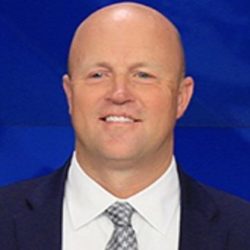
Barry Port
 ENSIGN GROUP
About Barry R. Port
Barry R. Port, age 50, is Chief Executive Officer of The Ensign Group, Inc. (since May 2019) and a director serving on the Quality Assurance & Compliance Committee . He holds a Bachelor’s degree from Brigham Young University and dual master’s degrees in Business Administration and Health Services Administration from Arizona State University’s W.P. Carey School of Business . Under his leadership, Ensign delivered strong operating results: 2024 revenue rose 14.2% YoY, five-year revenue CAGR was 15.9%, and diluted EPS CAGR was 25.6% over the last five years, with management highlighting alignment of pay with performance in the proxy’s PvP narrative .
Past Roles
| Organization | Role | Years | Strategic Impact |
|---|---|---|---|
| Ensign Services, Inc. | Chief Operating Officer | Jan 2012–May 2019 | Oversaw field support and back-office services for affiliated skilled nursing and senior living operations nationwide . |
| Keystone Care, Inc. | President | Mar 2006–Dec 2011 | Supervised facilities across Texas, building multi-site operational oversight experience . |
| Affiliated skilled nursing campuses (AZ, TX) | Operational roles | Earlier career (dates not specified) | Hands-on operating leadership in campus management across multiple geographies . |
External Roles
| Organization | Role | Years | Notes |
|---|---|---|---|
| American Health Care Association (AHCA) | Board of Directors | Current | Industry influence across long-term/post-acute care . |
| Partners Advancing Post-Acute Care (formerly CPAC) | Co-Chair | Since 2024 | Advocacy across >14,000 post-acute facilities . |
Fixed Compensation
| Year | Base Salary ($) | Perquisites (selected) |
|---|---|---|
| 2024 | 533,266 | Car allowance $11,000; third‑party tax service payments $5,745 . |
| 2023 | 517,734 | Perqs totaled $22,864 . |
| 2022 | 502,654 | Perqs totaled $22,694 . |
| CEO Pay Ratio (2024) | — | 233:1 (CEO total comp $10,959,932 vs median employee $47,120) . |
Notes:
- Company operates a non‑qualified Deferred Compensation Plan permitting deferral of base salary and up to 100% of eligible bonuses .
- No separate board fees for CEO-director (management directors do not receive incremental director compensation) .
Performance Compensation
| Component | Metric/Structure | Target/Thresholds | Actual/Payout | Vesting/Restrictions |
|---|---|---|---|---|
| Annual cash bonus (2024) | Adjusted EBT-driven pool; clinical and governance overlays | Tiered schedule from $44m EBT up, with increasing % allocations; see schedule | Total executive pool calculated at $48.8m; reduced by ~$18.0m allocations to other employees/charity; final pool $30.8m; Port cash bonus $6,906,150 . | Cash; plus portion may be paid in stock if pool exceeds stated amount . |
| Bonus stock (fully vested) | Equity in lieu of cash bonus | Triggered when pool exceeds stated threshold | Port bonus stock $1,829,121; 12,125 shares issued 2/6/2024 (fully vested on grant) . | Fully vested; one‑year transfer restriction . |
| Time‑vested RSUs (2024 grant) | Long-term equity | 5,400 RSUs granted 11/6/2024 | Grant-date fair value $772,200 . | Vests 20% annually over five years from grant date . |
| Stock options (2024 grant) | Long-term options | 13,500 options @ $143.00 strike (11/6/2024) | Grant-date fair value $882,590 . | Vests in 5 equal annual tranches; expires 11/6/2034 . |
| Performance measures (non-financial) | Clinical/governance | Compliance audits, reduced readmissions, CMS five-star quality metrics; succession planning, culture, ESG enhancements . | Considered in discretionary allocation of pool among executives . | n/a |
Adjusted EBT bonus pool schedule (2024):
| EBT band | Pool % application |
|---|---|
| ≤ $44.0m | $0 |
| $44.0m–$54.0m | 2.5% of band |
| $54.0m–$64.0m | 5.0% of band |
| $64.0m–$74.0m | 7.5% of band |
| $74.0m–$89.0m | 10.0% of band |
| $89.0m–$119.0m | 12.5% of band |
| > $119.0m | 15.0% of excess |
Additional policy signals:
- Clawback policy for incentive-based compensation tied to financial reporting measures (SEC/Nasdaq compliant) .
- No option repricing without stockholder approval; transfer restrictions and change-in-control treatment defined in the plan .
Equity Ownership & Alignment
| Item | Detail |
|---|---|
| Beneficial ownership | 279,713 shares (<1%); composed of 155,300 in Barry & Michelle Port Trust, 58,799 direct, and 65,614 options exercisable within 60 days of 3/20/2025 . |
| Unvested RSUs at 12/31/2024 | 400 (2020), 2,000 (2021), 3,000 (2022), 4,320 (5/18/2023), 5,400 (11/6/2024); per-grant market values at $132.86: $53,144; $265,720; $398,580; $573,955; $717,444, respectively . |
| Outstanding unexercisable options (selected) | 1,000 (2020 @ $44.84), 5,000 (2021 @ $82.20), 7,500 (2022 @ $80.60), 10,000 (2/7/2023 @ $89.86), 10,800 (5/18/2023 @ $90.85), 32,000 (11/2/2023 @ $98.83), 13,500 (11/6/2024 @ $143.00) . |
| 2024 option exercises/vests | Exercised 14,118 options (realized $1,797,326); 16,885 RSUs vested (realized $1,991,882) . |
| Hedging/pledging | Hedging prohibited for directors and officers; no pledging disclosure found; director automatic grants require 33% retention of cumulative shares . |
| Ownership guidelines (execs) | No explicit executive stock ownership guideline disclosed in proxy; director automatic grant retention noted above . |
| Subsidiary equity (Standard Bearer REIT) | 2024 restricted stock award $13,620; 5‑year 20% annual vest; quarterly valuation with put window for vested shares; no hedging allowed; one-year holding from end-of-year earned . |
Upcoming vesting cadence (examples from footnotes):
- RSUs/Options granted 11/6/2024, 11/2/2023, 5/18/2023, 5/26/2022, 5/27/2021: each vests 20% on successive anniversaries (e.g., for 11/6/2024 grant, on 11/6 in 2025–2029) .
Employment Terms
- Severance/change in control: Company “has not entered into any arrangements” providing for payments or benefits upon resignation, severance, retirement, termination, compensation changes, or change in control for NEOs; equity plan administrator may accelerate vesting in certain circumstances per plan terms .
- Employment agreements/non-compete: Plan states no right to employment or continued service; no non-compete/non-solicit/garden leave disclosures found in proxy .
- Deferred compensation: Non‑qualified DCP permits deferral of base salary and up to 100% of eligible bonuses into a rabbi trust; assets invested in life insurance contracts .
- Clawbacks: Company may cancel/recoup awards under Clawback Policy and to comply with law (Section 954) .
Board Governance
| Attribute | Detail |
|---|---|
| Board service | Director since 2019; Class III nominee for term ending 2028 . |
| Committee roles | Quality Assurance & Compliance member (with independent directors as majority) . |
| Independence | CEO-director is not independent; majority of board (six members) are independent under Nasdaq rules . |
| Chair structure | CEO is not Chair; Executive Chairman role held by co-founder Christopher R. Christensen; Lead Independent Director in place . |
| Attendance | Board met 5 times in 2024; all directors attended at least 75% of Board/committee meetings for which they served; all eight directors attended the 2024 annual meeting . |
| Director compensation | Management directors (Executive Chairman, CEO, CFO) receive no incremental fees for board service . |
Dual-role implications:
- Separation of Chair and CEO plus Lead Independent Director mitigates concentration of power; CEO’s presence on Quality Assurance & Compliance aligns operating accountability but reduces independence mix on that committee (majority still independent) .
Compensation Peer Group and Process
- Compensation Committee: Independent directors; 6 meetings in FY2024; uses national consultant (Willis Towers Watson) for benchmarking and program validation .
- Executive benchmarking: Reviewed NEO packages vs healthcare and REIT companies including National Healthcare, Amedisys, Encompass, LTC Properties, Omega Healthcare Investors, Welltower, Select Medical, CareTrust REIT, PACS Group, National Health Investors .
- Director compensation benchmarking: Similar companies (plus REITs) reviewed; automatic quarterly restricted stock grants vest over three years; directors must retain minimum 33% of cumulative grants .
Say‑on‑Pay & Shareholder Feedback
- 2024 advisory approval of NEO compensation: ~97.7% support; company conducts annual advisory votes and considers investor feedback .
Risk Indicators & Red Flags
- Clawback policy present and aligned with SEC/Nasdaq; positive risk control .
- No golden parachutes/severance arrangements for NEOs; reduces change‑of‑control windfall risk .
- No option repricing without stockholder approval; avoids pay inflation via repricing .
- Hedging prohibited; alignment with shareholders preserved; pledging not disclosed .
- 2024 CEO pay ratio of 233:1 could attract scrutiny; company notes unique workforce composition and methodology .
- Insider activity: 2024 option exercises (14,118 shares; $1.80m value realized) could indicate liquidity events; RSU vesting (16,885 shares; $1.99m value realized) adds supply overhang if shares are sold; actual dispositions not specified in proxy .
Performance & Track Record Highlights
- Operational: Same facility occupancy improved to 81.3% (from 79.2% in 2023); skilled mix remained strong; third‑party agency usage down 61% from peak; 31 operations added across ten states (expanded into Tennessee) .
- Financial: Record consolidated revenue up 14.2% YoY; cash from operations $347.2m; continued dividend increases .
- Multi‑year growth: Revenue +109.2% over five years (CAGR 15.9%); diluted EPS CAGR 25.6% .
Director Compensation (for completeness; CEO receives none)
| Component | Chair Retainer ($) | Member Retainer ($) |
|---|---|---|
| Audit | 30,000 | 10,000 |
| Quality Assurance & Compliance | 30,000 | 6,000 |
| Nominating & Corporate Governance | 12,000 | 2,000 |
| Compensation | 15,000 | 3,000 |
| Non‑employee director annual retainer | 30,000 | — |
Investment Implications
- High at‑risk pay with large EBT‑linked cash bonus and annual equity grants ties CEO compensation to earnings and clinical/governance execution; absence of severance/change‑in‑control payouts enhances discipline but equity plan permits vesting acceleration at the committee’s discretion, which could create transaction‑related dilution .
- Ownership alignment is meaningful via RSUs, options, and subsidiary REIT awards; hedging prohibition is positive; lack of explicit executive ownership guidelines and unknown pledging status warrant monitoring; recurring vesting plus periodic option exercises may create incremental selling pressure, particularly around vest dates .
- Governance structure separates CEO and Chair and includes a Lead Independent Director; CEO’s committee role on Quality Assurance & Compliance ensures operational accountability but reduces independence mix; say‑on‑pay support (97.7%) and no repricing policy suggest shareholder-friendly compensation governance .
- Track record of revenue/EPS growth, occupancy improvement, reduced agency spend, and portfolio expansion underpins confidence; continued emphasis on clinical quality metrics in bonus allocation should support durable fundamentals .