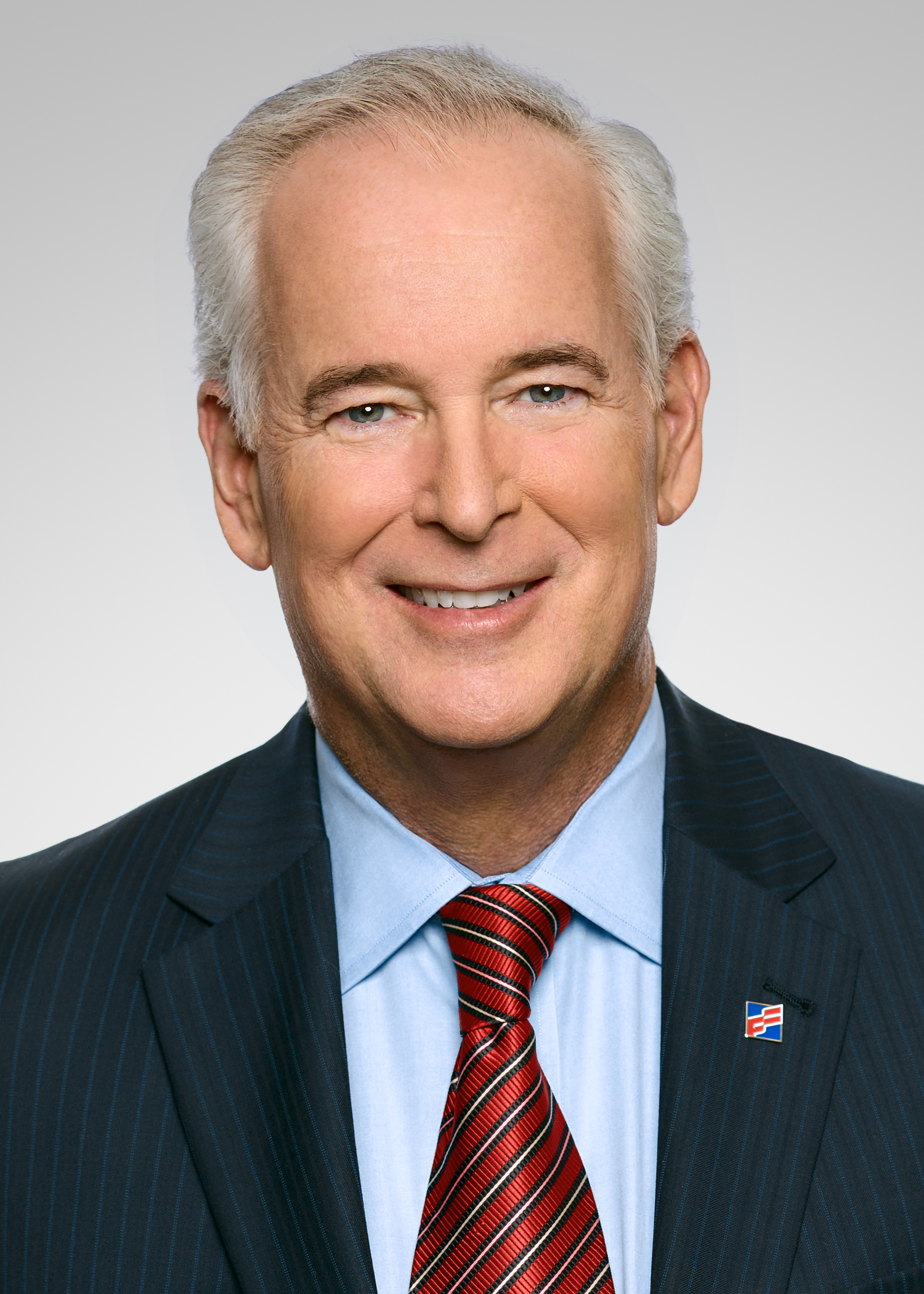
Frank B. Holding, Jr.
 FIRST CITIZENS BANCSHARES INC /DE/
About Frank B. Holding, Jr.
Chairman and Chief Executive Officer of First Citizens BancShares, Inc. (FCNCA) and First-Citizens Bank & Trust Company; Chairman since 2009, CEO since 2008, prior President 1994–2009; age 63; employed by the bank since 1983 and a director since 1993 . Under his tenure, 2024 net income was $2.78B (down from 2023’s SVB gain-driven peak), CET1 ratio was 12.99%, loans grew 5% to $140.22B and deposits grew 6% to $155.23B; NIM was 3.54% and liquidity stood at $59.34B . Pay-versus-performance data show “compensation actually paid” aligned with Company TSR and net income; a $100 investment in Class A shares on 12/31/2019 was worth $400 by 12/31/2024, outpacing the peer index over the period .
Past Roles
| Organization | Role | Years | Strategic Impact |
|---|---|---|---|
| First Citizens BancShares | Chairman | 2009–present | Led board/strategic agenda; combined Chair/CEO structure with Lead Independent Director |
| First Citizens BancShares | Chief Executive Officer | 2008–present | Oversaw CIT merger (2022) and SVB acquisition (2023), scaling to a top-20 U.S. bank |
| First-Citizens Bank & Trust Company | President | 1994–2009 | Managed growth and operations pre-chairmanship |
| First-Citizens Bank & Trust Company | Employee | 1983–present | 40+ years institutional knowledge and culture stewardship |
External Roles
| Organization | Role | Years | Strategic Impact |
|---|---|---|---|
| Mount Olive Pickle Company | Director | — | Industry/commercial network; governance experience |
| Wake Forest University | Trustee | — | Academic ties and talent network |
| Blue Cross and Blue Shield of North Carolina | Past Chairman/Trustee | — | Health-sector governance; statewide business leadership |
| Duke Energy Corporation | Past Advisory Board Member | — | Energy/regulatory insight |
| NC Chamber/NC Chamber Foundation | Past Chairman/Director | — | Policy advocacy; business climate influence |
Fixed Compensation
| Metric | 2022 | 2023 | 2024 | 2025 (set in Jan) |
|---|---|---|---|---|
| Base Salary ($) | $1,010,000 | $1,010,000 | $1,040,000 (+3.0%) | $1,040,000 (no change) |
Multi-year CEO compensation components (Summary Compensation Table):
| Component ($) | 2022 | 2023 | 2024 |
|---|---|---|---|
| Salary | $1,010,000 | $1,010,000 | $1,040,000 |
| Bonus | $0 | $0 | $0 |
| Stock Awards | $0 | $0 | $0 |
| Non-Equity Incentive (LTIP + MPP) | $7,008,250 | $8,506,875 | $9,706,250 |
| Change in Pension Value & NQDC Earnings | $0 | $429,578 | $191,869 |
| All Other Compensation | $13,725 | $14,850 | $68,209 |
| Total | $8,031,975 | $9,961,303 | $11,006,328 |
Notes: Other compensation includes 401(k) matching and personal security-related costs; no director pay as he is compensated as an associate .
Performance Compensation
Long-Term Incentive Plan (LTIP) and Merger Performance Plan (MPP) structure:
- LTIP metric: TBV+D Growth Rate over 3-year period; Threshold 12%, Target 30%, Stretch 48%; award opportunities equal 50%, 100%, 150% of Target Amount respectively .
- CEO LTIP Target Amount for 2024–2026: 550% of base salary; grant date Jan 23, 2024 .
- 2022–2024 LTIP payments were made in Feb 2025 at 150% of Target after adjustments to exclude CIT/SVB bargain gains and spread repurchases/intangibles .
Detailed 2024 awards and outcomes:
| Plan | Metric | Target / Range | Actual Performance Level | Payout ($) | Grant Date | Performance Period | Payment Timing |
|---|---|---|---|---|---|---|---|
| LTIP (cash) | TBV+D Growth Rate | Target Amount = 550% of salary; 12%/30%/48% → 50%/100%/150% | 2022–2024 exceeded Stretch after committee adjustments | $7,196,250 | 01/23/2024 | 2022–2024 (payout) / 2024–2026 (new grant) | Feb 2025 |
| MPP – CIT | Integration synergies, risk mgmt., individual & company performance | Target $1,010,000 | Target achieved | $1,010,000 | 01/23/2024 | 2024 | Feb 2025 |
| MPP – SVB | Timely integration, risk mgmt., individual & company performance | Threshold $500,000; Target $1,000,000; Max $1,500,000 | Maximum achieved | $1,500,000 | 01/23/2024 | 2024 | Feb 2025 |
Clawbacks: Nasdaq Recovery Policy (restatements) + Incentive Compensation Policy (material inaccuracies, Code violations); LTIP/MPP awards subject to clawback; executive acknowledgements required .
Equity Ownership & Alignment
| Item | Detail |
|---|---|
| Class A Common Beneficial Ownership | 604,916 shares (4.83% of Class A) |
| Class B Common Beneficial Ownership | 159,966 shares (15.91% of Class B) |
| Depositary Shares | 35,500 (non-voting preferred depositary shares) |
| Voting Power | 11.06% of total votes (A + B) |
| Pledged Shares | 198,052 Class A shares (grandfathered); Audit Committee deems low risk |
| Hedging/Pledging Policy | Hedging prohibited; pledging generally prohibited with grandfathered exceptions; no exceptions approved to policy |
| Ownership Guidelines | No stock ownership requirements for executive officers due to cash-based incentives; directors encouraged to own significant stock |
| Trading Controls | Preclearance required; trading window restrictions under Insider Trading Policy |
Alignment signals: Large beneficial ownership and no equity grants reduce dilution; grandfathered pledges introduce collateral risk but deemed remote by Audit Committee .
Employment Terms
| Term | Key Provisions |
|---|---|
| Employment/CIC Agreements | None; no change-in-control or severance arrangements beyond plan terms |
| Separation from Service Agreement | 10-year monthly payments begin ~6 months post-separation; vest at age 65; non-compete and consulting obligations during payment term |
| Monthly Payment Amount | $33,056 per month for 10 years |
| Present Value of Benefits (12/31/2024) | Pension: $1,932,513; Separation Agreement PV: $2,769,907 |
| Pension Plan | Defined benefit; normal retirement at 65; formula per years of service and covered comp; max annual 2024 benefit $275,000 |
Board Governance
- Board service: Director since 1993; Chairman and CEO; Executive Committee Chair; 100% attendance in 2024 board/committee meetings .
- Independence: Not independent; combined Chair/CEO structure offset by annual selection of a Lead Independent Director (Robert T. Newcomb) with broad authorities; majority independent board; independent Audit and CNG Committees .
- Committee roles: Chairs Executive Committee; independent directors chair Audit (Durham), Risk (Hoppe), CNG (Newcomb); quarterly committee cadence .
- Dual-role implications: Combined Chair/CEO and significant family ownership emphasize lead director oversight, executive sessions, and independent committee control to mitigate influence concerns .
Director Compensation
- Receives no additional director compensation; compensated solely as an associate .
Compensation Committee Analysis
- Peer group: 12 regional banks (e.g., PNC, Truist, M&T, Regions); positioning generally at 50th percentile with adjustments for performance and roles .
- Say-on-Pay: 2024 approval over 98% of votes cast; annual frequency selected by shareholders in 2023 .
- Program evolution: Increased weighting of performance-based cash (LTIP overlapping 3-year cycles; MPP for M&A integration) with controlled salary growth; continued use of TBV+D as primary LTIP measure .
Performance & Track Record
- Strategic outcomes: CIT merger (Jan 2022) and SVB acquisition (Mar 2023) materially expanded scale, footprint, and capabilities; 2024 reflected normalized net income post one-time SVB gain .
- Capital/returns: CET1 12.99% (12/31/2024); repurchased 814,641 Class A shares for $1.66B (6.02% of Class A outstanding at June 30, 2024) in 2H 2024 .
- Growth: Loans +5% to $140.22B; deposits +6% to $155.23B; liquidity $59.34B; net charge-offs 0.39%; allowance for credit losses 1.20% .
- Pay-versus-performance linkage: CAP aligned with TSR and multi-year TBV+D performance; CAP for CEO $10.86M in 2024 vs TSR value $400 on $100 baseline .
Risk Indicators & Red Flags
- Pledging: Grandfathered pledges of 198,052 Class A shares by the CEO (risk deemed remote), but collateral pledging remains a monitoring point .
- Family ties/related party transactions: Multiple family members in management and external holdings; Audit Committee annually reviews and approves related transactions (e.g., leases, card programs, brokerage) on arm’s-length terms .
- Combined Chair/CEO: Governance mitigants include Lead Independent Director and fully independent CNG/Audit Committees .
- Clawbacks: Robust recovery policies for restatements, metric inaccuracies, and Code violations .
- No CIC severance/golden parachutes: Reduces perverse incentives around control transactions .
Investment Implications
- Pay-for-performance alignment is strong: Large proportion of variable cash tied to three-year TBV+D and M&A integration milestones; no equity grants mitigates dilution but reduces direct equity vest-driven selling pressure .
- Ownership alignment and control risk: Significant beneficial ownership and voting power (11.06%) align long-term interests; grandfathered share pledges and family governance network warrant ongoing monitoring for independence and potential collateral-driven trading pressure under stress .
- Retention risk appears low: Long-tenured CEO with vested separation agreement (age 65 vesting, monthly $33,056 for 10 years) and pension; absence of CIC/severance minimizes exit optionality linked to corporate events .
- Trading signals: Award payments (LTIP/MPP) occur after multi-year/performance periods (e.g., Feb 2025), not linked to equity vesting; insider trading governed by preclearance and windows; monitor Form 4 filings and any changes in pledged shares for signal of liquidity needs .
