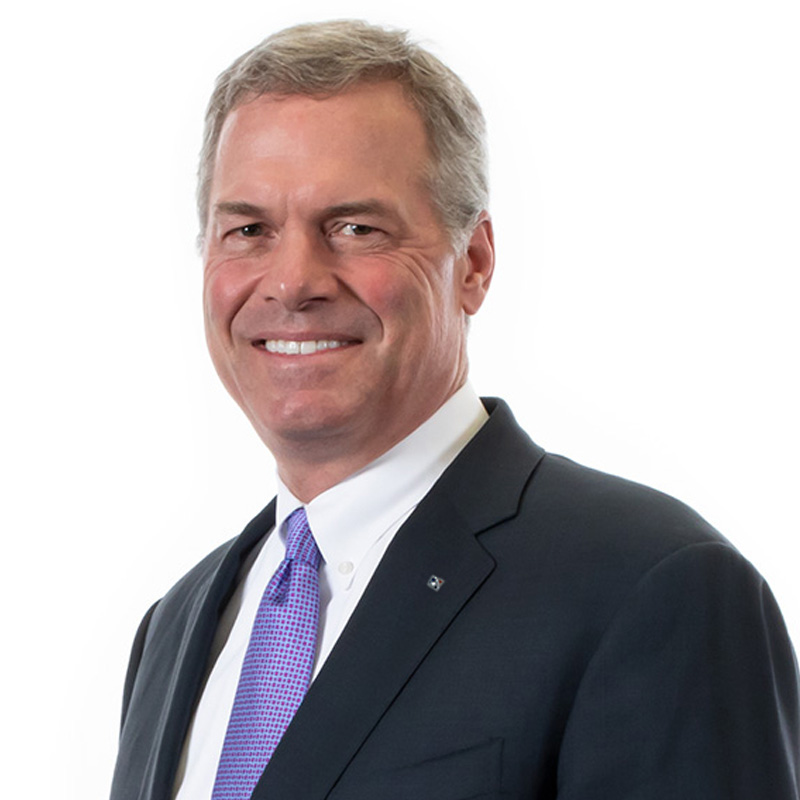
D. Bryan Jordan
 FIRST HORIZON
About D. Bryan Jordan
D. Bryan Jordan is Chairman, President & CEO of First Horizon Corporation and First Horizon Bank. He has served as CEO and director since 2008, and as Chairman since 2012 (except for a two‑year period post‑IBERIABANK merger when the former IBKC CEO was Executive Chairman) . Age 63, Jordan previously served as First Horizon’s CFO (2007–2008) and held senior finance roles at Regions Financial/Regions Bank beginning in 2002, and earlier at Wachovia . 2024 performance highlights included CET1 ratio of 11.2%, net interest margin of 3.35%, loan growth of 3%, deposit growth of 2%, and a one‑year total shareholder return of +47.66% . The Compensation Committee reports that 86% of his 2024 total direct compensation was at risk, aligning incentives to performance .
Past Roles
| Organization | Role | Years | Strategic Impact |
|---|---|---|---|
| First Horizon Corporation | Chairman, President & CEO | 2012–present (CEO since 2008) | Led transformation, credit discipline, capital strength; strong 2024 TSR and margin resilience |
| First Horizon Corporation | Chief Financial Officer | 2007–2008 | Finance leadership through transition; positioned to assume CEO role |
| Regions Financial/Regions Bank | Senior finance roles including CFO | Began in 2002 | Large‑bank finance and risk experience; foundation for later CEO tenure |
External Roles
| Organization | Role | Years | Strategic Impact |
|---|---|---|---|
| AutoZone, Inc. | Director | 2013–2024 | Exposure to Fortune 100 retail operations and governance best practices |
| Multiple non‑profits | Board member/advisory roles | Various | Community engagement and sector visibility |
Fixed Compensation
| Metric | FY 2022 | FY 2023 | FY 2024 |
|---|---|---|---|
| Base Salary ($) | $1,060,900 | $1,087,418 | $1,200,000 |
| Target Bonus (% of Salary) | 150% (Committee practice) | 150% (fixed in employment agreement) | 150% (fixed in employment agreement) |
| Actual Annual Incentive Paid ($) | $1,830,053 | $1,434,375 | $1,800,000 |
Performance Compensation
Long‑Term Incentives and Mix
- 2024 regular annual LTI mix: 60% PSUs, 40% RSUs; no compensatory options granted .
- CEO incentive mix targets (as % of salary): PSUs 270%, RSUs 180% (total LTI 450%); annual cash incentive 150% .
- PSU design: ROTCE rank vs KBW Regional Bank Index (KRX) with TSR modifier; typical maximum 187.5% of target .
- Special equity awards (Aug 3, 2023): $3M PSUs + $2M RSUs; five‑year cliff vesting through 8/3/2028; PSU payout range 37.5%–187.5% of target (ROTCE × TSR) .
Annual Cash Incentive Structure and Outcomes (2024)
| Metric | Weighting | Target | Actual | Payout Factor |
|---|---|---|---|---|
| Adjusted PPNR | 50% | $1,313–$1,451mm | $1,298mm | 97% |
| Credit Quality (NPA) | 12.5% | 0.850%–0.700% | 0.960% | Included in 102% credit factor |
| Credit Quality (NCO) | 12.5% | 0.30% | 0.18% | Included in 102% credit factor |
| Strategic Initiatives | 25% | Committee assessment | Achieved | 100% |
| Corporate Rating | — | — | — | 100% (after modest round‑up) |
| Individual Rating (CEO) | — | — | — | 100% |
2024 annual incentive paid at $1,800,000, equal to target, for Jordan .
PSU Vesting Evidence
| Grant | 3‑yr Performance Period | Outcome | CEO Shares Vested | Value Realized |
|---|---|---|---|---|
| 2021 PSUs | 2021–2023 | ROTCE top quartile (150%) × TSR 2nd quartile (108.33%) = 162.5% | 260,000 | $4,612,400 |
| 2020 special retention units | 2016–2023 (all‑or‑none) | Vested and paid in 2023 | 155,238 | $2,064,665 |
Equity Ownership & Alignment
| Item | Detail |
|---|---|
| Beneficial Ownership | 1,835,272 shares as of Jan 31, 2025 |
| Options (exercisable within 60 days) | 242,441 as of Jan 31, 2025 (CEO) |
| Unvested PSUs (target units) | 140,749 (2022–2024), 103,376 (2023–2025), 221,766 (2024–2026), 223,713 (special 7/2023–6/2028) |
| Ownership Guidelines | CEO minimum 6× salary; mandatory retention of 50% net after‑tax shares (75% if below minimum); hedging prohibited unless approved |
| Compliance | All active NEOs except CFO exceeded guideline ownership as of 2024 assessment (includes CEO) |
| Hedging/Pledging | Hedging banned for pre‑clearance persons; no approvals to date; no pledging disclosed for Jordan in ownership tables |
Ownership as % of shares outstanding: 1,835,272 / 514,158,234 = ~0.36% (derived from 2025 record shares outstanding) .
Vesting calendar components likely to create event windows:
- Annual RSUs/PSUs granted 2021–2024 vest on typical March cycles (e.g., 3/2 in 2024–2026); special 2023 awards cliff vest at 8/3/2028 .
- No option exercises in 2024; significant option exercise occurred in 2023 (137,249 options; $1.81mm value) .
Employment Terms
| Provision | Term |
|---|---|
| Agreement | 5‑year employment term expiring 8/3/2028; mandatory retirement waived during term |
| Base Salary | Raised ~6% to $1,125,000 effective 8/3/2023; may be raised, not lowered during term; 2024 salary set at $1,200,000 |
| Target Bonus | Fixed at 150% of salary during term |
| Target LTI | 450% of salary (from 2024 grant cycle; was 400% in 2023) |
| Special Equity | $3mm PSUs + $2mm RSUs, five‑year service vest (cliff at end of employment term) |
| PSU Metrics | 5‑yr average adjusted ROTCE vs KRX banks with TSR modifier; payout range 37.5%–187.5% |
| CIC Protection | Participation in Executive CIC Severance Plan; 3.0× salary+bonus; double‑trigger; no tax gross‑up |
| Post‑term Treatment | Non‑performance awards accelerate; remaining service requirements on performance awards waived (special equity maintains five‑year vest condition) |
Illustrative CIC economics at 2024 year‑end (hypothetical): Total $34,239,614 including $8.19mm cash severance, $1.8mm pro‑rated bonus, $22.11mm stock awards, and benefits; no tax gross‑up .
Performance & Track Record
- 2024 financial highlights: CET1 11.2%, NIM 3.35%, loan growth +3%, deposit growth +2% .
- One‑year TSR +47.66% for 2024; CAP framework shows CEO CAP aligned with TSR volatility and recovery in 2024 .
- Strategic initiatives: operational quality (300+ projects), IT transformation roadmap, retail strategy deployment .
- PSU results indicate sustained ROTCE outperformance vs KRX peers (e.g., 2021 grants paid at 162.5%) .
Board Governance
| Item | Detail |
|---|---|
| Roles | Combined Chairman & CEO (not independent); Lead Independent Director in place (Colin Reed) |
| Independence | 92% independent nominees (11 of 12); 100% independence on key committees |
| Committees (Jordan) | Executive; Risk |
| Meetings/Attendance | Board met 4 times; committees 45 meetings; average attendance >96% |
| Rationale | Board evaluated leadership structure; combined role deemed appropriate with strong Lead Director counterbalance |
Director compensation: employee directors (Jordan) do not receive Board fees; compensated only as officers .
Compensation Governance and Peer Benchmarking
- Independent compensation consultant: Meridian Compensation Partners; Committee assessed adviser independence and conflicts; best practice policies include clawbacks, ownership guidelines, double‑trigger CIC, no tax gross‑ups, no option repricing .
- Peer group methodology updated in 2024 to 17 banks; CEO TDC targeted around peer medians; 2024 TDC increased to reflect market benchmarking .
Say‑on‑Pay & Shareholder Feedback
- Advisory “Say‑on‑Pay” outcomes: FOR votes consistently >90% (2020: 94%; 2021: 97%; 2022: 94%; 2023: 96%; 2024: 97%) .
- 2024 shareholder outreach included senior management and independent directors engaging a >5% holder on governance, performance, and risk .
Risk Indicators & Red Flags
- Hedging prohibited for directors/executives; no approvals granted to date .
- No tax gross‑ups under CIC plan; double‑trigger required; below‑market options only in limited substitution contexts (merger), capped at 5% .
- Combined CEO/Chairman role: mitigated by independent Lead Director and executive sessions each Board meeting .
- Clawback policies: misconduct, erroneous data, and SEC‑mandated restatement recovery; 2‑year stock award clawback lookback for misconduct .
Compensation Structure Analysis
- High proportion of at‑risk pay (86% of TDC) reflects strong pay‑for‑performance orientation .
- Shift away from options; LTI emphasized PSUs/RSUs aligned to ROTCE and TSR peer benchmarking .
- 2023 five‑year special equity award creates significant 2028 vesting event; aligns retention through term end .
- 2024 annual incentive outcomes aligned with budgeted PPNR and credit metrics, capped by corporate and individual ratings at 100% .
Equity Vesting & Insider Selling Pressure
| Instrument | Vesting Schedule | Potential Pressure Window |
|---|---|---|
| 2021 RSUs/PSUs | March cycles (e.g., 3/2/2024) | Annual spring vest dates |
| 2022–2024 PSUs | End of each 3‑yr period (e.g., 2024–2026 grants) | Spring settlements by cycle |
| Special 2023 PSUs/RSUs | Cliff vest at 8/3/2028 | August 2028 event risk |
Notably, Jordan had no option exercises in 2024 (reducing near‑term selling signals); significant option exercises occurred in 2023 concurrent with award vestings .
Employment & Contracts (Retention Risk)
- Five‑year term through August 2028 reduces near‑term turnover risk; ownership guidelines and five‑year cliff awards strengthen retention .
- CIC plan at 3.0× salary+bonus and accelerated equity could be costly in change‑in‑control scenarios; double‑trigger mitigates windfall risk .
Investment Implications
- Strong alignment: 2024 TSR +47.66% and PSU design tether payouts to long‑term ROTCE vs peers with TSR modifier, making equity compensation sensitive to value creation .
- Retention/support: Five‑year cliff awards and ownership retention requirements reduce near‑term selling and signal high alignment; monitor August 2028 vesting for potential liquidity events .
- Governance watchpoint: Combined CEO/Chair role balanced by independent Lead Director and robust committee independence; minimal red‑flags (no tax gross‑ups, hedging banned, strong clawbacks) .
- CIC exposure: Illustrative 2024 CIC package ~$34.2mm underscores potential dilution/expense in transaction scenarios; double‑trigger reduces risk of unearned payouts .
Appendix: Key Tables
CEO Summary Compensation (Multi‑Year)
| Component ($) | FY 2022 | FY 2023 | FY 2024 |
|---|---|---|---|
| Salary | $1,060,900 | $1,087,418 | $1,200,000 |
| Stock Awards (grant‑date) | $4,243,600 | $9,243,562 | $5,200,413 |
| Non‑Equity Incentive (Bonus) | $1,830,053 | $1,434,375 | $1,800,000 |
| Change in Pension Value | — | $1,134,668 | $1,081,500 |
| All Other Compensation | $103,216 | $143,018 | $148,067 |
| Total | $7,237,769 | $13,043,041 | $9,429,980 |
Pay Versus Performance (Selected CEO Metrics)
| Year | CEO CAP ($) | FHN TSR ($100 basis) | Peer TSR ($100 basis) | Net Income ($mm) | ROTCE (Company‑Selected Measure) |
|---|---|---|---|---|---|
| 2024 | $15,729,053 | $149.23 | $130.96 | 794 | 10.99% |
| 2023 | $(11,688,459) | $101.06 | $115.69 | 916 | 14.11% |
| 2022 | $17,866,977 | $167.06 | $116.15 | 912 | 15.58% |
Outstanding PSUs (Target Units, Year‑End 2024)
| Grant | Performance Period | Units (CEO) |
|---|---|---|
| 2022 PSUs | 2022–2024 | 140,749 |
| 2023 PSUs | 2023–2025 | 103,376 |
| 2023 Special PSUs | 7/2023–6/2028 | 223,713 |
| 2024 PSUs | 2024–2026 | 221,766 |
Board Service Summary (Jordan)
| Role | Independence | Committee Assignments |
|---|---|---|
| Chairman & CEO | Not independent | Executive; Risk |
Policies
| Policy | Summary |
|---|---|
| Clawbacks | Misconduct/erroneous data recovery; SEC restatement recovery; 2‑year stock award clawback lookback for misconduct |
| Ownership | 6× salary min for CEO; 50% retention of net shares (75% if below min); hedging prohibited |
| CIC Plan | Double‑trigger; 1.5–3.0× salary+bonus (CEO at 3.0×); no tax gross‑ups |