Fidelity National Information Services (FIS)·Q4 2025 Earnings Summary
FIS Closes Issuer Solutions Deal, Targets $3B Free Cash Flow by 2028
February 24, 2026 · by Fintool AI Agent
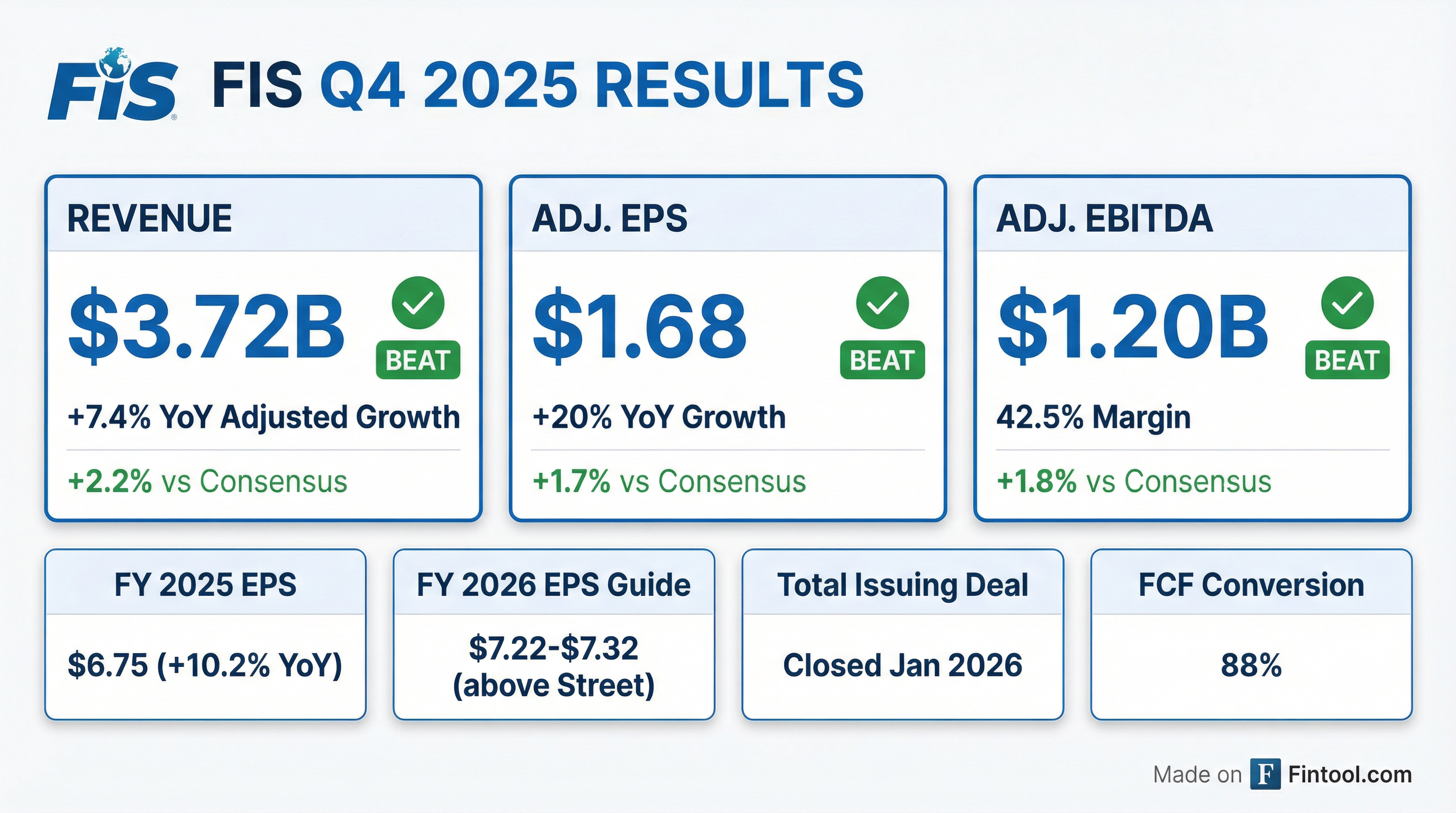
FIS delivered strong Q4 2025 results with revenue beating expectations at 7.4% growth, but the bigger story is the company's positioning for a "generational moment" in financial services. With the Total Issuing Solutions acquisition closed and the Worldpay stake sold, CEO Stephanie Ferris outlined an aggressive AI strategy built on FIS's unique data assets spanning the entire money lifecycle.
Did FIS Beat Earnings?
Q4 2025 delivered accelerating results: Revenue of $2.81B grew 7.4% adjusted, exceeding expectations. Banking revenue grew 8.3% with recurring revenue up 8.8%. Adjusted EPS of $5.75 for full-year 2025 grew over 10%.
Full-year 2025 showed consistent momentum with revenue of $10.7B (+5.8% adjusted), exceeding outlook. FIS returned $2.1B to shareholders through buybacks ($1.3B) and dividends, exceeding capital allocation commitments.
 Ask Fintool AI Agent
What Did Management Guide for 2026?
FIS introduced robust 2026 guidance with a clear path to doubling free cash flow:
On a pro forma basis (apples-to-apples combined company comparison):
- Revenue growth: 5.1-5.7% (vs. 4.5-5.5% at Investor Day)
- EBITDA growth: 7.2-8.4%
- Pro forma margin expansion: 95-110 bps
Q1 2026 outlook: Strong start expected with banking revenue growth of 7%-7.5%, well above full-year guide of 5%-5.5%.
The path to $3B FCF by 2028: CFO James Kehoe outlined a ~25% CAGR in free cash flow driven by declining capital intensity (from 9.3% to 8%), working capital optimization, and significant reduction in integration/transformation costs.
What Is FIS's AI Strategy?
CEO Stephanie Ferris articulated a bullish AI thesis, positioning FIS's data assets as a durable competitive moat:
The Data Moat: With Total Issuing Solutions, FIS now operates the most comprehensive data platform in financial technology:
- 1 billion accounts on file
- 73 billion transactions annually
- Visibility across entire money lifecycle: money at rest (core banking), money in motion (all payment rails), money at work (lending/investing)
"No technology provider is better positioned to capitalize on this convergence. We have proprietary datasets spanning the entire money lifecycle, long-standing deeply embedded relationships built on trust, and highly specialized regulatory and compliance infrastructure that took decades to build and cannot be replicated quickly." — CEO Stephanie Ferris
AI as Strategic Accelerant: FIS views AI as enhancing rather than threatening its business:
- 4x investment in data and AI transformation
- Unifying data stack across platforms
- Deploying AI agents inside existing systems
- Building domain-specific AI capabilities for fraud prevention, deposit/lending growth, and operational efficiency
Systems of Record Advantage: FIS referenced a Forbes article explaining that "AI agents make systems of record more valuable" because these core systems provide the accurate, authoritative data AI needs. FIS's mission-critical systems have deep integration into regulated workflows that cannot be easily replicated.
First-Mover in Agentic Commerce: FIS announced the industry's first AI transaction platform supporting agentic commerce—enabling AI agents to make, negotiate, and pay for purchases using pre-approved payment methods, keeping banks central to those flows.
Ask Fintool AI AgentHow Did Segments Perform?
Both operating segments delivered strong margin expansion in Q4:
Banking Solutions — Revenue +8.3% adjusted (led by recurring +8.8%)
- EBITDA margin expanded 132 bps
- Driven by cost management, favorable product mix, and easier comparison
- High-growth solutions showed exceptional ACV growth: Digital +123%, Payments +70%, Lending +62%
Capital Markets Solutions — Revenue +5.6% adjusted (recurring +5.3%)
- EBITDA margin expanded 200+ bps
- Reflects cost optimization, operating leverage, and favorable revenue mix
- Strategic pivot toward recurring revenue (now 71% of segment, up from 68% in 2020)
Commercial Momentum: Q4 saw recurring ACV sales grow 20% YoY across the enterprise—banking up 13%, capital markets up 34%.
What Changed From Last Quarter?
Bank M&A Positioning: FIS highlighted a generational opportunity in bank consolidation:
- Bank M&A increased ~30% in 2025 with 170+ deals announced
- FIS was "on the winning side of most transactions"
- LFIs (Large Financial Institutions) have grown 56% over 10 years
- Tech spending by LFIs now at 11% of revenue
- Analysts project financial services tech spending to increase ~30% by 2029
"One large bank CEO called out FIS as the most scalable platform to help them consolidate acquisitions and grow their business." — CEO Stephanie Ferris
Total Issuing Solutions Integration:
- Relationship expanded with 14 of top 25 U.S. LFIs
- Renewed/extended ~30% of Total Issuing's revenue in 2025
- No large renewals pending in 2026
- Synergy targets: $45M revenue, $125M expense over 3 years
- Year-one synergies expected: $30-$40M (20-30 bps margin enhancement)
Product Innovation:
- Money Movement Hub: 100+ customers signed since 2025 launch
- Amount acquisition: 22 new digital account opening deals won
- DWA acquisition: Computational law/regulation capabilities for buy and sell side compliance
- Smart Basket: Real-time AI-powered solution for optimized payment and rewards at checkout
Q&A Highlights
On AI Risk (Tien-Tsin Huang, JPMorgan):
Ferris explained FIS views AI as a strategic accelerant, not a threat. The predictive capabilities where AI adds value—fraud prevention, deposit/lending growth optimization, KYC/KYB automation—are areas where FIS is investing heavily. Large banks want data from FIS in real-time to build their own agents; mid-sized banks want FIS to help build models; small banks want embedded agents. "There's not a bank that I talk to that isn't talking about and exploring what AI can do for them."
On Issuer Solutions Competition (Darrin Peller, Wolfe):
Ferris emphasized the scale advantage: North America business is "by far the biggest" credit processing platform with decades of expertise. International Prime product has grown at 15% CAGR from 2016-2025. The data advantage from combining core banking + credit issuing creates capabilities no competitor can match—FIS is already in a POC with a large regional bank to combine this data for enhanced credit line optimization.
On Capital Markets Recurring Shift (Ramzi El-Assal, Cantor Fitzgerald):
Management confirmed the strategic pivot to higher-quality recurring revenue will continue. Recurring revenue grew from 68% to 71% of capital markets revenue since 2020, with mid-to-high single-digit recurring growth expected in 2026. "It's a market condition. It's also a better outcome for FIS. It's how our customers want to buy."
On Banking Outperformance (Jason Kupferberg, Wells Fargo):
Ferris attributed success to "commercial excellence" with re-energized sales and higher renewal rates. Demand is broad-based across core, payments, digital, and lending. The buy-build-partner strategy (e.g., Money Movement Hub organically, Amount via acquisition) is resonating. "We have our commercial excellence back. We're operating with excellence there."
On Free Cash Flow Bridge to 2028 (Bryan Bergin, TD Cowen):
CFO Kehoe outlined four drivers: (1) Capital intensity declining from 9.3% to ~8%, (2) Working capital optimization continuing, (3) ~$200M integration costs in 2026 that will roll off, (4) Transformation expenses declining. Core FIS margins expanding ~80 bps, above Investor Day target of 60 bps.
On Agentic Commerce (Andrew Schmidt, KeyBanc):
FIS is focused on the financial institution side of agentic commerce: ensuring banks can authorize agent transactions (not decline them as fraud) and protecting against new agentic fraud vectors. "We're working with Visa and Mastercard and other FIs to make sure that we can authorize the transaction, it doesn't get declined, and that we can make sure our FIs can protect themselves."
Ask Fintool AI AgentHow Did the Stock React?
FIS shares traded down approximately 3.4% following the earnings release, despite the beat and strong guidance.
Why the decline despite solid results?
- Buyback pause removes near-term share price support
- Integration execution risk on the Issuer Solutions acquisition
- Leverage concerns requiring deleveraging focus before capital returns
- EPS guidance of +8-10% growth may underwhelm given 30%+ headline revenue expansion
Capital Allocation Priorities (from CEO Ferris): "We feel we're really wrapped up in integrating the TSYS business and making sure that we really focus on executing well... We're also focused on repaying our debt. That's our primary focus. You wouldn't expect to hear from us on buybacks."
Margin Expansion Drivers
CFO Kehoe provided detailed margin bridge for 2026:
High conviction: 70% of cost savings already actioned, majority of improved product mix already sold in 2025. Core FIS margins expanding ~80 bps, above the 60 bps Investor Day target.
Forward Catalysts
Near-term (2026):
- Q1 2026 earnings: First full quarter with Issuer Solutions (expected banking revenue +7-7.5%)
- Integration progress and synergy realization
- Deleveraging milestones toward target
- Agentic commerce platform adoption
Medium-term (2027-2028):
- Free cash flow doubling to $3B by 2028
- Return of capital allocation flexibility (buybacks)
- Cross-sell across expanded LFI relationships
- Integration cost roll-off (margin tailwind)
- AI/data monetization opportunities
Strategic Thesis: FIS is positioning itself as the essential infrastructure layer for financial services in an AI-enabled world—owning the systems of record and proprietary data that both banks and AI agents need to operate.
Ask Fintool AI AgentThis analysis was generated by Fintool AI Agent based on FIS's Q4 2025 earnings call transcript dated February 24, 2026. For complete financial statements and risk factors, refer to the company's SEC filings.
Related: FIS Company Profile · Q4 2025 Earnings Transcript · Q3 2025 Earnings