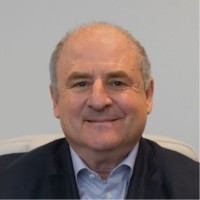
Leonard Livschitz
About Leonard Livschitz
Leonard Livschitz is 59 and has served as CEO of Grid Dynamics since 2014 and as a director since 2006, with over 30 years in high-tech across sales, marketing, business development, and R&D; he holds an M.S. in Systems and Control Engineering (Case Western Reserve University) and an M.S. in Mechanical Engineering (Kharkov State Polytechnic University) . Under his leadership, 2024 revenue was $350.6 million (+12% YoY), GAAP net income was $4.0 million, and non-GAAP EBITDA was $52.5 million; the company’s cumulative TSR since March 6, 2020 reached 189.92 by year-end 2024, and 2024 say-on-pay support was 98% .
Past Roles
| Organization | Role | Years | Strategic Impact |
|---|---|---|---|
| Luxera (LED solutions) | Co-founder; President & CEO | 2010–2014 | Founded and led an LED solutions company; executive leadership in scaling operations |
| Ledengin | VP Sales & Marketing | Not disclosed | Executive role driving commercial growth in LED components |
| Philips Lumileds Lighting | Executive/management roles | Not disclosed | Leadership across sales, marketing, BD, and R&D in solid-state lighting |
| Visteon Lighting | Executive/management roles | Not disclosed | Roles spanning product and operations in automotive lighting |
| Ford Motor Company | Executive/management roles | Not disclosed | Engineering and management experience in automotive technology |
External Roles
No external public-company directorships or committee roles for Mr. Livschitz are disclosed in the proxy .
Fixed Compensation
Multi-year CEO compensation summary:
| Metric | 2022 | 2023 | 2024 |
|---|---|---|---|
| Salary ($) | $733,333 | $800,000 | $800,000 |
| Non-Equity Incentive Plan Compensation ($) | $1,342,500 | $1,022,000 | $896,000 |
| Stock Awards ($) | $22,579,813 | $3,989,003 | $24,596,800 |
| Option Awards ($) | — | — | — |
| All Other Compensation ($) | $6,841 | $11,317 | $12,085 |
| Total ($) | $24,662,487 | $5,822,320 | $26,304,885 |
CEO annual base salary and bonus target:
| Item | 2024 Value |
|---|---|
| Base Salary ($) | $800,000 |
| Target Bonus (% of Salary) | 100% |
| Bonus at Target ($) | $800,000 |
| Actual Bonus Paid ($) | $896,000 (sum of quarterly Corporate Bonus Plan payouts) |
Performance Compensation
Annual cash incentives (Corporate Bonus Plan; equal weighting revenue and non-GAAP EBITDA):
| Quarter | Revenue ($mm) | Non-GAAP EBITDA (% of revenue) | Total Achievement vs Target | CEO Bonus Paid ($) |
|---|---|---|---|---|
| Q1 2024 | $79.8 | 12.1% | 85% | $170,000 |
| Q2 2024 | $83.0 | 14.1% | 122% | $244,000 |
| Q3 2024 | $87.4 | 17.0% | 128% | $256,000 |
| Q4 2024 | $88.1 | 15.1% | 113% | $226,000 |
Long-term equity incentives (2024 grants; 55% PSUs, 45% RSUs):
| Metric | Weighting | Target | Actual/Payout | Vesting Mechanics |
|---|---|---|---|---|
| YOY Revenue Growth (%) | 50% (PSUs) | Ambitious, double-digit growth required (company-set) | 160% of target (for 2024 tranche before modifiers) | One-third vests annually after Board certification; 3-year period (2024–2026) |
| Contribution Margin (%) | 50% (PSUs) | Company-set (balanced with growth) | 160% of target (included in overall 160%) | One-third vests annually after Board certification; 3-year period |
| rTSR vs Russell 2000 | Modifier | Up to ±20% | ~83rd percentile → +20% modifier | Applied to earned PSUs each year; assessed 1-, 2-, 3-year |
| rCAGR (Revenue) vs Russell 2000 | Modifier | Up to ±20% | ~60th percentile → +10% modifier | Applied to earned PSUs; assessed 1-, 2-, 3-year |
| 2024 PSU Result | — | — | 208% of target (160% initial × 1.30 modifiers) | 665,600 CEO PSUs vested for 2024 tranche |
2024 CEO long-term award sizing:
| Instrument | Shares at Target (#) | Grant-Date Value ($) |
|---|---|---|
| RSUs | 800,000 | $10,664,000 (at $13.33 close on 12/29/2023) |
| PSUs | 960,000 | $13,932,800 (probable outcome per ASC 718) |
RSU vesting schedule: one-third on first anniversary of grant and one-twelfth quarterly thereafter . PSUs vest annually over three years after goal certification, subject to rTSR and rCAGR modifiers .
Equity Ownership & Alignment
| Item | Value |
|---|---|
| Total beneficial ownership (shares) | 2,587,101 |
| Ownership (%) of common stock | 3.0% (of 84,805,201 shares outstanding) |
| RSUs unvested (#) | 800,000 (CEO) |
| RSUs market value ($) | $17,792,000 (at $22.24 as of 12/31/2024) |
| PSUs unearned (#) | 1,331,200 (CEO; remaining two years based on year-one actual) |
| PSUs payout value ($) | $34,318,336 (ASC 718 basis × unearned shares) |
| PSUs vested Feb 2025 (#) | 665,600 (CEO 2024 tranche) |
| Options outstanding | None for CEO (no option awards; none listed) |
| Anti-hedging/pledging policy | Hedging, short sales, margin accounts, and pledging prohibited |
| 10b5-1 trading plans | Allowed only in open windows with cooling-off periods per SEC rules |
Employment Terms
| Provision | CEO Terms |
|---|---|
| Employment Agreement date | January 24, 2020 (amended effective April 28, 2022) |
| Role and reporting | CEO, reporting to Board |
| Base salary | $800,000 |
| Target annual bonus | $800,000 (actual based on Company and individual objectives) |
| Term | Initial 4-year term; automatic annual renewals unless 90-day notice |
| Severance (no CIC; termination w/o cause or good reason) | 24 months base salary; 100% of annual max bonus target; 24 months COBRA; 1 year accelerated vesting of unvested equity |
| Change-in-control (double-trigger) | Full accelerated vesting of unvested equity; same cash severance as above |
| 280G cutback | Greatest after-tax benefit (full pay or cutback to avoid excise tax) |
| Clawback policy | Adopted Nov 2023; recoup performance-based cash and equity for restatements within 3 fiscal years |
| Insider trading controls | Quarterly blackout periods; pre-clearance required |
| Restrictions | Confidentiality and conflict-of-interest adherence |
Illustrative severance values (company estimates as of 12/29/2024 price): $15.54M outside CIC; $41.63M in CIC (includes equity acceleration valuation methodology described) .
Board Governance
| Item | Details |
|---|---|
| Board leadership | Roles separated: CEO (Livschitz) and Chairman (Lloyd Carney) |
| Board class and term | Class I director; current term expires 2026 |
| Independence status | Majority independent; independent directors listed exclude CEO |
| Committee memberships (current) | CEO is not listed as a member of Audit, Compensation, or Nominating committees |
| Committee chairs | Audit: Southworth; Compensation: Benhamou; Nominating: Carney |
| Board/committee attendance | Each director attended 95% of aggregate board and committee meetings in 2024 |
| Anti-hedging/pledging for directors | Prohibited |
Compensation Committee Analysis
- Program design emphasizes pay for performance with 55% PSUs and 45% RSUs for NEOs; PSU max 200% with rTSR and rCAGR modifiers up to ±20% each .
- Annual incentives balance revenue and non-GAAP EBITDA (50/50 weighting) to drive profitable growth .
- Independent compensation consultant (Pearl Meyer) advises the committee; compensation decisions follow governance best practices .
- 2024 Compensation Peer Group updated; Grid Dynamics positioned at 35th percentile in revenue and 32nd percentile in market cap (Sept 2024) .
- 2024 say-on-pay support was 98%, reflecting shareholder alignment .
Risk Indicators & Red Flags
- Related-party employment: spouse and family members employed in non-executive roles; compensation disclosed and governed by standard practices .
- Anti-hedging/pledging policy mitigates alignment risks; clawback adopted per Nasdaq/Dodd-Frank .
- Burn rate averaged 3.5% (2022–2024); overhang 13.0% as of Nov 4, 2025; options WAE $9.65, term 4.67 years .
- CEO pay ratio: 483:1 for 2024; annualized equity view reduces to 182:1 .
- No tax gross-ups except qualified relocation; double-trigger CIC vesting only (no single-trigger) .
Say-on-Pay & Shareholder Feedback
- 2024 say-on-pay approval: 98% .
- Ongoing engagement with large shareholders informed 2024 changes to metrics, PSU structure, and emphasis on performance-based equity .
Equity Plan Overhang and Share Reserve
- As of Nov 4, 2025: 7,799,534 equity awards outstanding; 3,226,924 shares remaining; overhang 13.0% (assuming max PSU vesting) .
- Proposal to increase 2020 Plan shares by 3,500,000 (to 19,800,000) adopted by Board, subject to stockholder approval .
Investment Implications
- Strong pay-for-performance architecture aligns CEO incentives with revenue growth, contribution margin, and market-relative TSR/CAGR; 2024 PSU vesting at 208% indicates execution against ambitious goals, with potential incremental supply from vesting (665,600 shares for CEO) to monitor for post-vesting liquidity events .
- Robust clawback and anti-hedging/pledging policies reduce misalignment risk; double-trigger CIC vesting mitigates windfall concerns, but CIC severance and equity acceleration could be material (illustrative CIC total ~$41.6M) .
- Governance separation of Chair/CEO, majority independent board, and high meeting attendance support oversight quality; family employment is disclosed and controlled, but should be monitored as a related-party sensitivity .
- Equity overhang and three-year consolidated grant sizing concentrate retention and performance focus but add dilution risk; shareholder support (98% say-on-pay) and peer-informed design reduce inflation risk .