CGI (GIB)·Q1 2026 Earnings Summary
CGI Beats on EPS but Stock Drops 8% as Organic Growth Disappoints
January 28, 2026 · by Fintool AI Agent
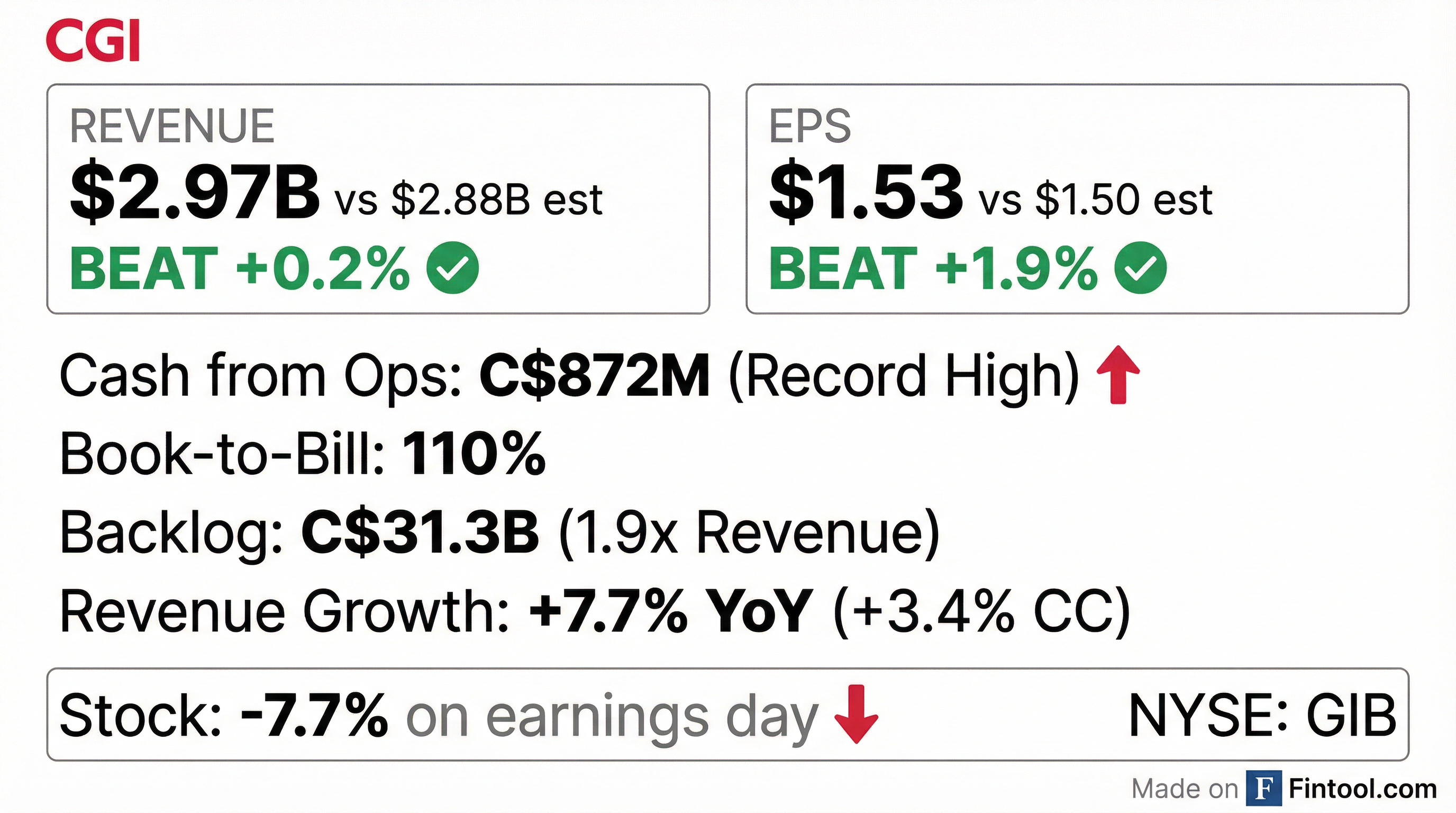
CGI Inc (GIB) reported Q1 fiscal 2026 results this morning that beat analyst expectations on both revenue and earnings, but shares tumbled nearly 8% as investors focused on tepid organic growth and ongoing headwinds from the US federal government shutdown. Revenue came in at C$4.1 billion (+7.7% YoY), but organic constant currency growth was just 3.4%, with acquisitions driving most of the headline number.
The IT services giant posted adjusted EPS of C$2.12, up 8% year-over-year, while generating record cash from operations of C$872 million. However, EBIT margin compressed 10 basis points to 16.1%, and management flagged the possibility of another US government shutdown this week.
Did CGI Beat Earnings?
CGI delivered a modest beat on both metrics, though the magnitude underwhelmed given recent acquisition activity:
In Canadian dollar terms, the company reported:
The 3.4% constant currency organic growth was the key disappointment. Investors had hoped that CGI's acquisition-heavy strategy would be complemented by stronger underlying momentum.
 Ask Fintool AI Agent
How Did the Stock React?
CGI shares dropped sharply on the results, falling from a $91.57 open to an intraday low of $84.36 — a decline of nearly 8%:
The stock is now trading near its 52-week low, reflecting investor concerns about organic growth trajectory and margin sustainability amid macro uncertainty.
What Changed From Last Quarter?
Several notable shifts from Q4 FY25:
Positive Changes:
- Cash generation surged: Record C$872M in cash from operations (21.4% of revenue), up from C$476M in Q4
- DSO improved: 37 days, down 8 days sequentially due to strong collections
- SI&C bookings recovered: Book-to-bill reached 100%, up from 96% on trailing 12-month basis
- Pipeline strength: SI&C advanced-stage pipeline up 40% YoY
Negative Changes:
- EBIT margin compressed: 16.1% vs 16.2% YoY, impacted by US federal shutdown and C$8M one-time India regulatory cost
- Organic growth slowed: 3.4% constant currency vs expectations for acceleration
- US federal remains challenged: Segment still "operating in a very dynamic environment"
What's Driving Regional Performance?
CGI's geographic segments showed divergent performance, with acquisitions driving most of the growth:
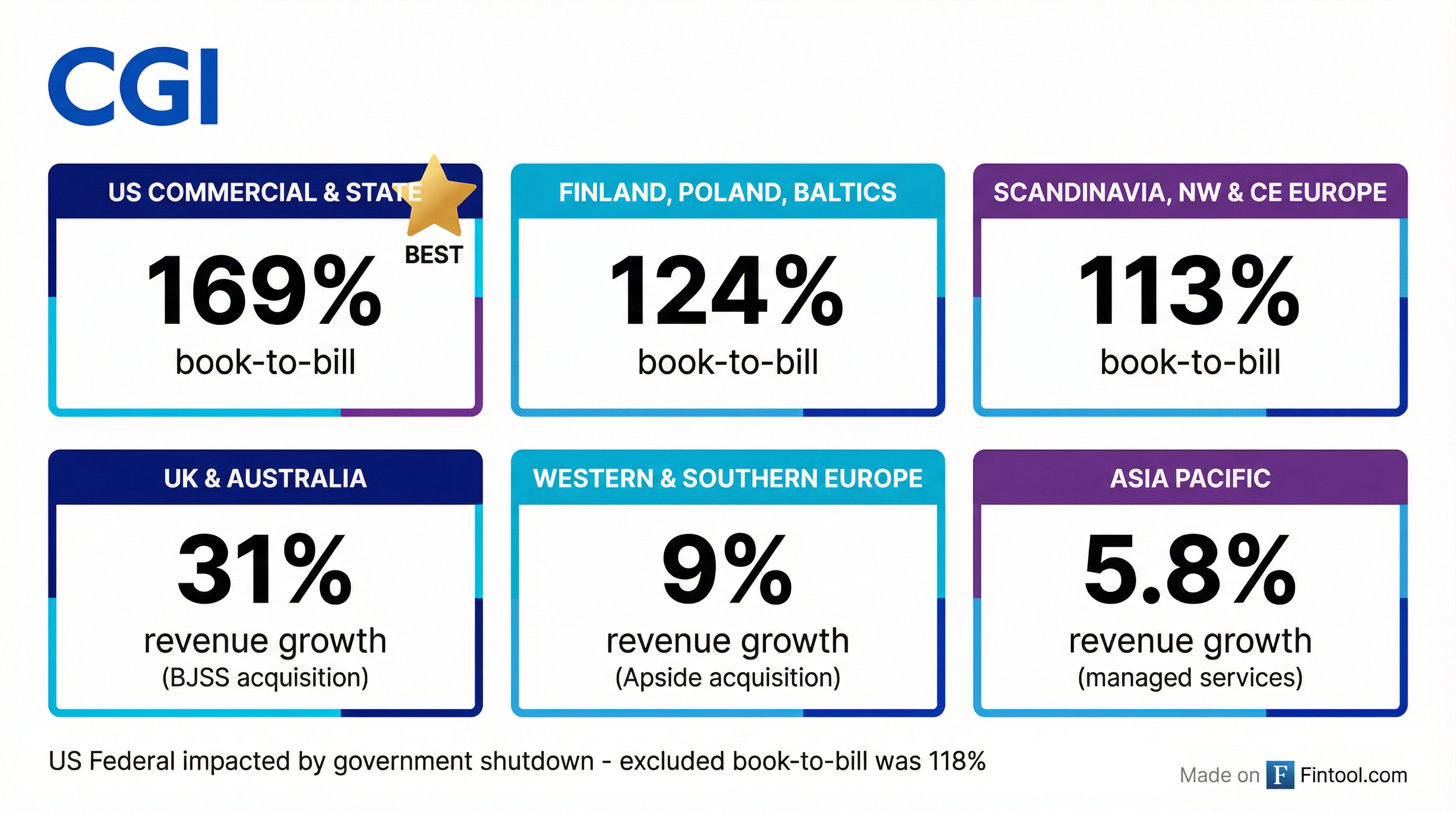
The US federal segment was notably excluded from the 118% combined book-to-bill figure due to shutdown impacts. CEO François Boulanger noted that while "state and local in the US is going pretty well," the federal business faces "lumpiness" with ongoing uncertainty.
Ask Fintool AI AgentVendor Consolidation: A Tailwind for CGI
A notable theme from the Q&A was the vendor consolidation trend benefiting CGI. CEO Boulanger shared specific wins:
"We won one, a big one that I think I announced last quarter, with a large bank in Europe that was actually a vendor consolidation. They went from hundreds of suppliers to four or five suppliers, and we were one of these suppliers. Same thing happened in Germany with an automobile company, where they had thousands of suppliers, and they wanted to reduce, and we were one that gained some activities with this vendor consolidation."
This trend toward fewer, larger IT partners plays to CGI's strengths as a scaled global provider with local presence. Boulanger noted: "The fact that we're very close to our clients, I think that's a tailwind, or at least opportunities to us to win new business in our existing clients."
What Did Management Say About AI?
AI featured prominently in management commentary, with CFO Steve Perron and CEO François Boulanger highlighting significant internal adoption:
"Approximately 40% of our consultants have expertise in advanced AI and data, more than double the numbers since this time last year."
Key AI initiatives:
On AI monetization, Boulanger was candid that clients are still working through implementation challenges:
"AI will be as good as your data is good. And I think that's also one of the challenges that a lot of these companies have... The CFO is seeing the cost coming in of these tools on a monthly basis, but they don't necessarily see the outcome."
He noted that AI is creating new demand for legacy application modernization — work that clients previously avoided:
"A lot of these clients will have old solutions or old applications that they didn't touch for the last 15, 20, 25 years because it's too complicated... Now with tools like AI... they can see it in another way, and having these tools helping to do the conversion or the refreshment of these applications. So that's brand-new demand and services that were not existing in the past."
The Cloud Deployment Lesson: Boulanger offered a useful analogy comparing AI deployment challenges to the early cloud era:
"I think cloud, when cloud went out, everybody said, 'Hey, it's way cheaper, it's way easier, let's deploy it.' And you saw that happening, and to realize at a certain point in time that the savings were not there anymore because it was not managed. Everybody was able to buy cloud computing, and so at a certain point, it was even more costly than before. So I think that's the same thing here. If people are leaving it to only the employees, and they can do what they want with it, I think it will just create more cost in the machine."
This creates consulting demand as companies need help implementing governance and processes to avoid the chaos of unmanaged AI proliferation.
What Did Management Guide?
CGI doesn't provide explicit numerical guidance, but management offered directional commentary:
On Organic Growth:
"The idea is to improve the growth, overall growth on a constant currency basis, including the organic side of the equation. So that's the goal, that's what the team is working on, and we're seeing some positive movement on that side."
On US Federal:
"We still think that the federal government is a very good market... But sure, we are living in a geopolitical environment that is very dynamic. We finish the—we had a shutdown. Now, we're talking perhaps another shutdown at the end of this week, we'll see. But that's short-term headwinds."
On Sequential Improvement (and Hitting Bottom): CEO Boulanger was explicit that the organic growth trough may be behind them:
"For us, yes, we're seeing that we perhaps hit the bottom this quarter, and that we're expecting some gradual improvement in the future quarters. Again, that's a caveat on the shutdown, if we have another one... The SI&C bookings, it's short-term bookings, so when we see that it's going back to a 100% mark, it's quite—it's giving us confidence on the forecast."
On Capital Allocation: The board renewed the NCIB program through February 2027, authorizing repurchase of up to 19 million shares. Management indicated they expect to "remain very active in our repurchase program" at current share price levels.
On AI-Driven Productivity and Revenue Per Headcount: Headcount was flat quarter-over-quarter while revenue grew, and Boulanger confirmed this efficiency trend will continue:
"A lot—most of our managed services are outcome-based, and so with the fact that we're using more and more AI in our delivery of managed services, I don't need necessarily the same headcount number or the same number of people to deliver the services. So you can still expect this headcount versus revenue, or at least the revenue by headcount, continue to grow because of the new technologies that we're deploying."
What's the Acquisition Pipeline?
CGI completed two acquisitions in Q1 and has a "robust" pipeline of additional targets:
On M&A criteria, Boulanger emphasized discipline:
"We are committed to making sure that we acquire the right companies at the right time and at the right price, all three without exception."
When asked if AI uncertainty is changing M&A evaluation, he was unequivocal: "No, not at all... AI is actually an enabler and not something that is asking us to change our philosophy on M&A."
Ask Fintool AI AgentKey Risks and Concerns
US Federal Shutdown Risk: Management explicitly flagged the possibility of another shutdown: "We're talking perhaps another shutdown at the end of this week." This creates near-term revenue and margin volatility.
Organic Growth Weakness: At 3.4% constant currency, organic growth trails headline figures significantly. The question is whether the SI&C pipeline strength (up 40% in advanced stages) will convert to meaningful acceleration.
Margin Pressure: The combination of US federal impacts, India regulatory costs, and integration expenses compressed margins. Management expects improvement but didn't quantify.
AI ROI Uncertainty: While CGI is investing heavily in AI capabilities, Boulanger acknowledged that client ROI realization is taking longer than expected: "For now they put a lot of money in the tools without necessarily seeing the return."
Tariff/Macro Concerns:
"We're restarting to talk about tariff, for example, in some places. So it's for sure a concern in some places, especially when I'm talking to some clients in Europe."
What's the Verdict?
CGI delivered a modest beat but the stock reaction reflects deeper concerns about quality of growth. The 7.7% headline revenue growth masks just 3.4% organic expansion, with acquisitions doing the heavy lifting. While bookings momentum is encouraging (110% book-to-bill) and cash generation was exceptional (C$872M record), margin compression and US federal uncertainty weigh on sentiment.
CGI's Differentiation: The Proximity Model When asked why CGI's SI&C trends appear better than peers, Boulanger pointed to their business model:
"Our proximity model, I think that's really the differentiator with the competition. We are close to our clients. We are building relationships with them. We know their business, we know their industry, so I think that's helping us to be there and we're top of mind of these clients when it's time to find the right expertise."
The bull case centers on:
- Leading indicators improving (SI&C pipeline +40%, book-to-bill 100%)
- Record cash generation funding buybacks and M&A
- AI positioning as implementation partner vs. tool provider
- Valuation at 52-week lows
- Proximity model driving vendor consolidation wins
The bear case focuses on:
- Organic growth remains tepid despite acquisition activity
- US federal business faces ongoing disruption
- Margin expansion unlikely near-term given integration costs
- AI monetization timeline uncertain
Management's tone was cautiously optimistic — expecting "gradual improvement" but hedging on federal shutdown risks. At current prices, the stock appears to be pricing in continued organic growth challenges.
Historical Earnings Performance
Values retrieved from S&P Global
Related Links:
Ask Fintool AI Agent