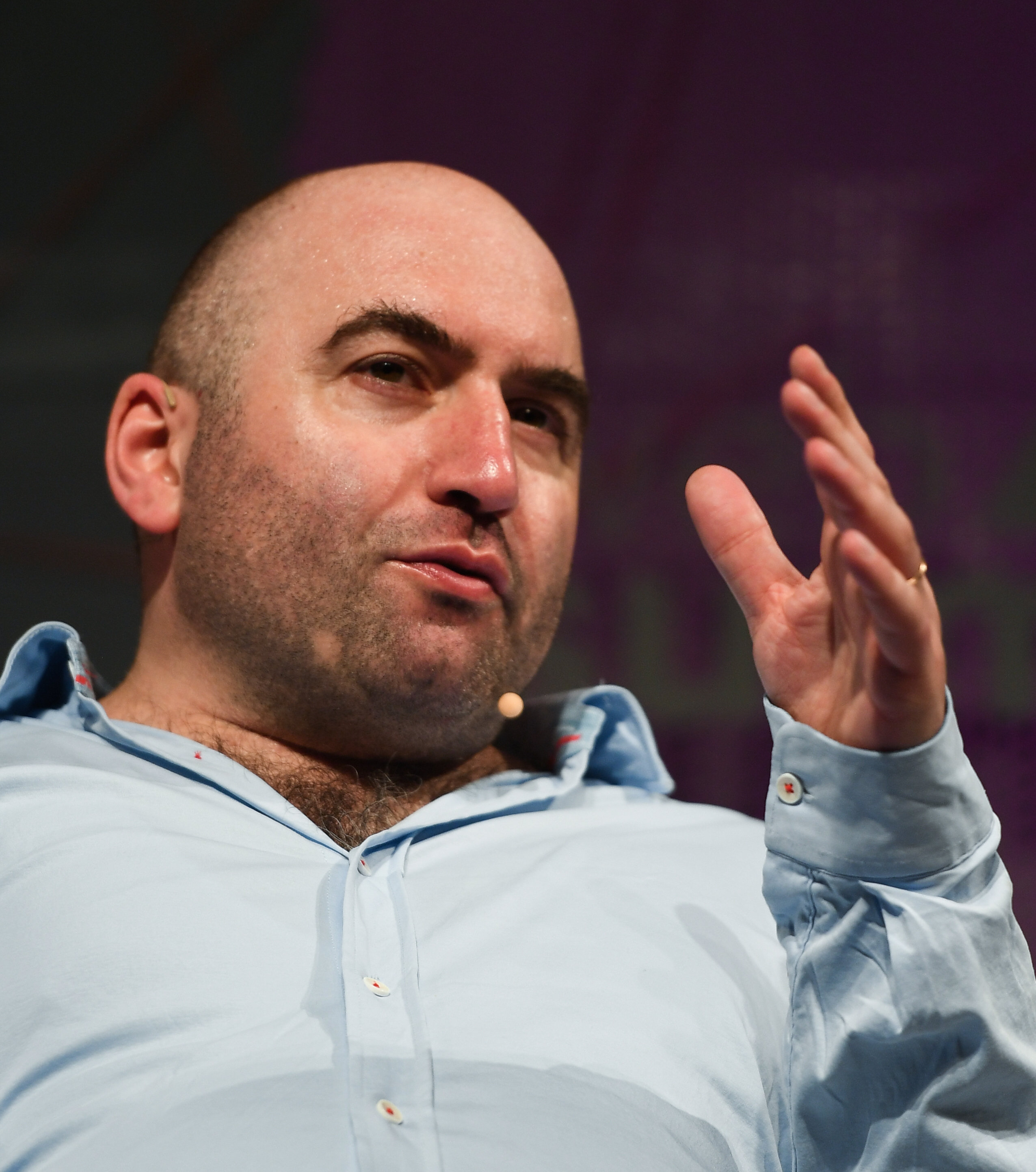
George Arison
About George Arison
George Arison (age 47) is Chief Executive Officer and a director of Grindr Inc., serving since November 2022 (CEO of Legacy Grindr since October 2022). He holds a bachelor’s degree from Middlebury College and previously founded Shift Technologies and Pulsar AI, with earlier roles at Google, Taxi Magic (Curb), and Boston Consulting Group . Under his tenure, Grindr reported rising engagement and scale in 2024, including 14.2M average MAUs (+7.4% YoY) and 1.076M average paying users (+14.8% YoY) , and his annual bonus plans have emphasized revenue growth and Adjusted EBITDA margin performance .
Past Roles
| Organization | Role | Years | Strategic impact |
|---|---|---|---|
| Shift Technologies (NASDAQ: SFT) | Founder & CEO; Director | CEO 2013–Sep 2022; Director through Aug 2023 | Took company public; marketplace leadership experience leveraged at Grindr |
| Pulsar AI (acquired by Impel) | Conceived and created platform | 2018 | Built AI platform for auto sales; AI expertise now applied to Grindr product roadmap |
| Alphabet (Google) | Various roles | 2010–2013 | Large-scale consumer/ads experience |
| Taxi Magic (now Curb) | Co-founder | 2007–2010 | Pioneered on-demand mobility; informs marketplace execution |
| Boston Consulting Group | Consultant | 2005–2007 | Strategy and operations grounding |
External Roles
| Organization | Role | Years | Notes |
|---|---|---|---|
| Shift Technologies | Director | Through Aug 2023 | Public company board experience |
| Various startups (e.g., Shipper, Carrot, Fathom, AutoLeap) | Angel/Investor | n/a | Early-stage investing activity |
Fixed Compensation
| Metric | 2023 | 2024 |
|---|---|---|
| Base Salary | $1,000,000 | $1,000,000 |
| Target Annual Bonus | $1,000,000 | $1,000,000 |
| Non-Equity Incentive Plan (formulaic) | $1,300,000 | $1,500,000 |
| Additional Cash Bonus (individual/discretionary; make-whole) | $846,000 (2022 make‑whole per employment agreement, paid 2023) | $1,350,000 (incremental based on 2024 individual performance) |
| Other Compensation (401k match, etc.) | $22,500 | $20,700 |
Notes:
- 2024 cash bonus outcome totaled $2.85M = $1.5M formulaic + $1.35M incremental .
- 2024 bonus plan metrics were weighted to two corporate goals: 2024 Adjusted EBITDA margin ≥40% and YoY revenue growth ≥23%, with payout scaled by revenue growth and individual performance adjustments .
Performance Compensation
| Award/Metric | Structure | Target/Trigger | 2023 Outcome | 2024 Outcome |
|---|---|---|---|---|
| KPI RSUs (annual performance) | Fully vested RSUs granted post-year on KPI certification | Board-set KPIs annually | 247,898 RSUs granted Mar 2024 for FY’23 KPI achievement | 176,159 RSUs granted Mar 7, 2025 for FY’24 KPI achievement |
| CEO Market-Cap RSUs (amended Mar 18, 2025) | Fully vested RSU awards upon 90-trading-day average market cap thresholds | $20M at $5B; $30M at $7.5B; shares = value/90D VWAP; Second threshold must be met by Oct 19, 2027 unless extended | n/a | Terms in effect as amended |
| Time-based RSUs (CEO new-hire grant) | 3,750,000 RSUs vesting over 5 years (20% year 1, then semiannual) | Service-vesting; double-trigger acceleration on CIC-related termination | Outstanding 3,000,000 at 12/31/23 | Outstanding 2,250,000 at 12/31/24; vest Apr 14/Oct 14 semiannually |
Additional details:
- 2024 KPI framework applied to NEOs; for Arison and other NEOs, Board-certified on Mar 7, 2025 .
- CEO time-based award vests in equal semi-annual installments on Apr 14 and Oct 14; accelerated vesting possible upon double-trigger after change in control .
Equity Ownership & Alignment
| Item | Detail |
|---|---|
| Beneficial ownership | 418,896 shares (<1% of 196,195,509 outstanding as of Jun 4, 2025); includes 318,896 held directly and 100,000 by the George Arison 2024 GRAT |
| Outstanding/Unvested equity (12/31/24) | 2,250,000 unvested time-based RSUs (market value $40.14M at $17.84); performance award valuations at year-end also carried (market cap arrangements) |
| Recent vested KPI awards | 176,159 RSUs (granted Mar 7, 2025 for FY’24) |
| Hedging/derivatives policy | Hedging discouraged and requires pre-clearance; trading in derivatives (other than company-issued warrants) prohibited absent pre-clearance; pre-clearance required for any pledge/margin use |
| Pledging | No pledges disclosed for Arison; company policy restricts pledging unless pre-cleared . Notably, a large stockholder (Zage via Tiga 88) has pledged 85,926,333 shares; this is not attributed to Arison . |
| Ownership guidelines | Not disclosed in proxy; N/A |
Insider selling pressure indicators:
- KPI RSUs are fully vested at grant and could create event-driven liquidity; sales (if any) are subject to pre-clearance and blackout windows under the Insider Trading Policy .
Employment Terms
- Role, start date and pay: CEO and Executive Director as of Oct 19, 2022; base salary $1,000,000; target annual bonus $1,000,000 .
- Time-based award: 3,750,000 RSUs vest over five years; double-trigger acceleration if terminated without Cause or resigns for Good Reason within 12 months following a change in control .
- Market-cap awards: CEO eligible for fully vested RSUs upon 90-day average market cap ≥$5B ($20M value) and ≥$7.5B ($30M value); second threshold deadline Oct 19, 2027 unless extended .
- Severance (Involuntary Termination without Cause/for Good Reason): Lump-sum cash = 2x (base salary + target bonus). Acceleration of time-vesting awards scheduled to vest within 12 months post-termination and performance awards eligible to vest based on actual performance for 12 months post-termination .
- 280G cutback: If payments are “excess parachute payments,” reduction applies if it yields a greater net after-tax benefit .
- Clawback: Incentive Compensation Recoupment Policy adopted Nov 2023 (Rule 10D-1 compliant) .
- Trading policy: Quarterly and event-driven blackout periods; pre-clearance for Covered Insiders .
Board Governance (service history, committees, dual-role implications)
- Board leadership structure: Independent Chairperson (James Fu Bin Lu); CEO is not Chair, mitigating CEO/Chair concentration risk .
- Board/committee service: Arison serves as CEO and director; not listed as a member of standing committees (Audit; Compensation; Nominating & Corporate Governance; Privacy & Trust) .
- Committee composition highlights (2025 record date): Audit (Chair: Chad Cohen); Compensation (Chair: J. Michael Gearon, Jr.); Nominating & Corporate Governance (Chair: James Lu); Privacy & Trust (Chair: Daniel Baer) .
- Independence: Majority independent; named independent directors include Lu, Baer, Cohen, Gearon, Stabler, Richardson (Arison not independent as CEO) .
- Meeting cadence/attendance: Board held six meetings in 2024; committees (Audit 4; Compensation 4; Nominating 1; Privacy & Trust 2) .
- Executive sessions: Corporate Governance Guidelines provide for periodic executive sessions without management .
Dual-role implications: Arison’s combined CEO/director role is balanced by an independent Chairperson, a majority-independent board, and fully independent key committees (including Compensation overseeing CEO pay), supporting governance independence .
PERFORMANCE & TRACK RECORD
- Operating scale/engagement: 2024 Average MAUs 14.2M (+7.4% YoY); Average Paying Users 1.076M (+14.8% YoY) .
- Strategy and innovation: Management cites significant growth/profitability and product innovation under Arison .
- Labor relations headline risk: A 2025 stockholder proposal references an NLRB complaint alleging RTO policy changes discouraged organizing; Board opposed adopting a separate human-rights policy, citing existing practices and compliance .
Compensation Structure Analysis
- Pay-for-performance design: Annual cash plan tied to Adjusted EBITDA margin and revenue growth, scaled by revenue growth and individual performance; 2024 payout at $2.85M suggests strong target attainment plus individual performance .
- Equity mix evolution: Heavy use of RSUs (KPI-based and time-based) and market-cap RSUs (value on achievement, fully vested on grant), shifting risk from options to RSUs and market-based awards; aligns with growth/dilution trade-offs and may create event-driven liquidity upon vesting/grant .
- Governance guardrails: Clawback policy in place; hedging/pledging restricted with pre-clearance; independent Compensation Committee .
- CIC protections: Double-trigger equity acceleration and 2x cash severance support retention but increase potential change-of-control costs; 280G cutback mitigates excise-tax inefficiency .
RELATED PARTY TRANSACTIONS (select)
- Significant shareholders: Tiga Investments entities (Raymond Zage) and others; note pledge disclosed at Tiga 88 (not related to Arison) .
Equity Awards & Vesting Schedules (detail)
| Award type | Grant/Arrangement | Vesting/Terms | Status/Values |
|---|---|---|---|
| Time-based RSUs (CEO) | 3,750,000 RSUs (Nov 15, 2022) | 20% at first anniversary; then equal semiannual on Apr 14 and Oct 14; double-trigger acceleration on CIC-related termination | 2,250,000 unvested at 12/31/24 ($40.14M at $17.84) |
| KPI RSUs | Annual, fully vested upon KPI certification | Shares = target value ÷ 90-day VWAP preceding grant | 247,898 for FY’23 (granted Mar 2024); 176,159 for FY’24 (granted Mar 7, 2025) |
| Market-cap RSUs (CEO) | Amended Mar 18, 2025 | $20M at $5B; $30M at $7.5B; fully vested on grant; 2nd threshold deadline Oct 19, 2027 unless extended | In effect; shares determined by 90-day VWAP on achievement |
Investment Implications
- Alignment and upside leverage: CEO compensation meaningfully tied to objective performance (Adjusted EBITDA margin and revenue growth) and market capitalization milestones, aligning incentives with value creation. Event-driven fully vested KPI/market-cap RSUs can create inflection points for ownership and potential liquidity, but strong insider trading controls temper ad hoc selling .
- Retention risk vs. protection: Robust severance (2x cash) and equity acceleration on double-trigger provide retention amid strategic shifts or potential M&A; they also raise change-of-control costs and potential dilution if market-cap thresholds are reached .
- Governance quality: Independent Chair, independent committees, clawback and hedging/pledging guardrails, and regular executive sessions support oversight of a CEO-director structure .
- Watch items: Event-driven dilution from market-cap awards if thresholds are met; potential stock supply at KPI/RSU vestings; and labor/governance headlines (e.g., union-related complaint) that could influence sentiment despite management’s stated compliance .