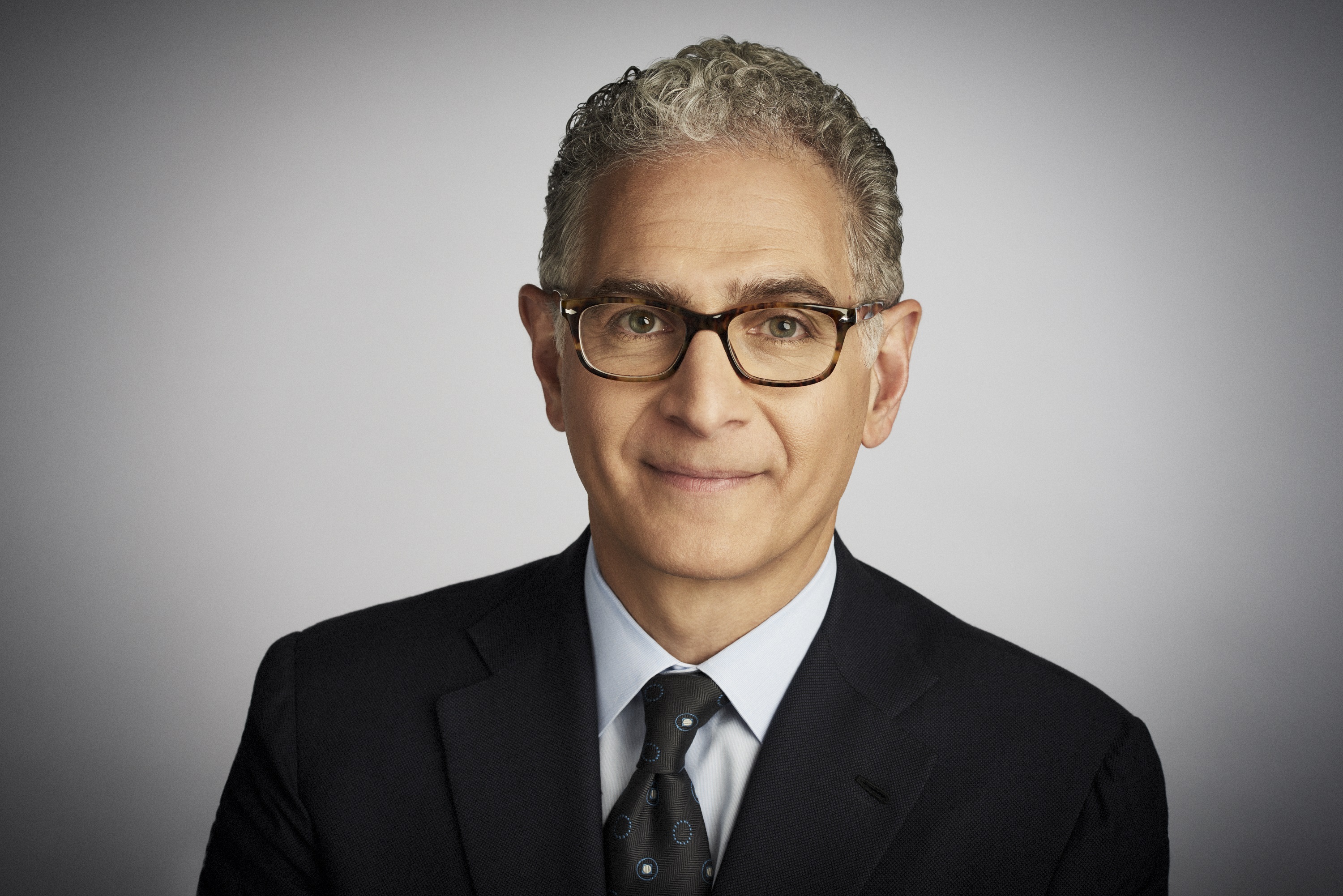
Mark Hoplamazian
 Hyatt Hotels
About Mark Hoplamazian
Mark S. Hoplamazian is President and Chief Executive Officer of Hyatt Hotels Corporation and has served on Hyatt’s Board since November 2006; he was named CEO in December 2006 and is 61 years old . Prior to Hyatt, he was President of The Pritzker Organization, advising Pritzker family businesses, and earlier worked in international M&A at First Boston, bringing deep corporate finance and transaction experience to Hyatt . Hyatt’s executive compensation program emphasizes pay-for-performance with significant long-term equity and prohibits hedging and pledging (with limited exceptions); 2024’s say-on-pay received approximately 99.7% support, indicating strong investor alignment . Key 2024 performance drivers included Adjusted Compensation EBITDA of $1,189 million versus a target of $1,287 million (financial component paid at 75% of target) and the CEO PSUs Tranche I performance goals were achieved and banked, reflecting delivery on the asset-light transformation .
Past Roles
| Organization | Role | Years | Strategic Impact |
|---|---|---|---|
| The Pritzker Organization (TPO) | President | 17 years | Advised Pritzker family companies including Hyatt; led investments and corporate finance, adding M&A rigor and capital allocation discipline |
| The First Boston Corporation | International M&A | Prior to TPO | Transaction execution and corporate finance experience; foundational skill set for Hyatt’s transformation initiatives |
External Roles
| Organization | Role | Years | Strategic Impact |
|---|---|---|---|
| VF Corporation | Director; Talent & Compensation and Finance Committee member | Current | Cross-industry governance and compensation oversight; finance committee exposure enhances capital allocation perspective |
| American Hotel & Lodging Association | Executive Committee | Current | Industry advocacy and policy influence relevant to lodging cycle and regulatory environment |
| World Business Chicago | Executive Committee | Current | Civic and economic development engagement in Hyatt’s HQ city |
| Aspen Institute | Board of Trustees | Current | Thought leadership and governance experience |
| World Travel & Tourism Council | Executive Committee | Current | Global travel industry collaboration and strategy |
| Henry Crown Fellowship (Discovery Class) | Member | Current | Leadership development network |
| Commercial Club of Chicago (Civic Committee) | Member; Co-chair, Public Safety Task Force | Current | Public safety initiatives with potential brand, workforce, and market perception impacts |
Fixed Compensation
Multi-year CEO compensation detail:
| Metric ($) | FY 2022 | FY 2023 | FY 2024 |
|---|---|---|---|
| Salary | $1,319,917 | $1,354,167 | $1,403,805 |
| Stock Awards (RSUs/PSUs) | $9,125,041 | $14,307,053 | $10,777,803 |
| Option Awards (SARs) | $2,374,976 | $2,499,956 | $2,499,974 |
| Non-Equity Incentive (EIP) | $3,756,400 | $2,585,200 | $1,816,500 |
| All Other Compensation | $84,308 | $43,891 | $117,128 |
| Total | $16,660,642 | $20,790,267 | $16,615,210 |
Additional fixed elements:
- Deferred compensation plan: 2024 executive contributions $1,292,600; registrant contributions $12,000; aggregate earnings $2,474,028; year-end balance $15,312,891 .
Performance Compensation
Annual Incentive (EIP) structure and 2024 outcomes:
| Component | Metric | Weighting | Target | Actual | Payout | Notes |
|---|---|---|---|---|---|---|
| Financial | Adjusted Compensation EBITDA | 60% | $1,287 million | $1,189 million | 75% of target for this component | Threshold $1,094m; max $1,544m; interpolation applied |
| Strategic Priorities | Culture/talent; personalization; operating excellence; intentional growth | 20% | Dashboard goals | Not disclosed | Not disclosed | Qualitative/operational dashboard |
| Individual/Other | Not detailed | 20% | Not disclosed | Not disclosed | Not disclosed | Per CD&A design |
Long-Term Incentives (2024 annual LTIP mix):
- CEO mix: 50% PSUs ($5,000,000 target), 25% SARs ($2,500,000), 25% RSUs ($2,500,000) .
2024-2026 PSUs (NEOs including CEO):
- Metrics: Three-year relative net rooms growth and three-year Adjusted Compensation EBITDA; subject to relative TSR modifier; vest after three-year period ending December 31, 2026 with continued employment .
Special CEO PSUs (five annual tranches granted March 19, 2024):
| Tranche | Performance Period | Grant Date Fair Value | Performance Conditions | Status |
|---|---|---|---|---|
| I | Jan 1–Dec 31, 2024 | $3,000,000 | Asset-Light Earnings Mix ≥80% (50% weight); complete $2B asset dispositions at ≥13x multiple | Performance goals achieved; banked; service vesting March 16, 2029 |
| II | 2025 | $3,000,000 | Set annually by Talent & Compensation Committee | TBD |
| III | 2026 | $3,000,000 | Set annually | TBD |
| IV | 2027 | $3,000,000 | Set annually | TBD |
| V | 2028 | $3,000,000 | Set annually | TBD |
Key vesting mechanics and schedules:
- RSUs from 3/19/2024 grant vest pro rata annually over four years, beginning March 16, 2025 .
- SARs exercise price equals closing price on grant date; 3/19/2024 SARs at $157.11; expiration 3/19/2034 .
- CEO PSUs require both annual performance achievement and continued employment through March 16, 2029; accelerated vesting possible upon death, disability, qualifying retirement, or qualifying termination including post-change-in-control scenarios .
Realization events (2024):
| Item | Quantity/Value |
|---|---|
| SARs exercised (shares) | 530,364 |
| Value realized on SARs | $51,135,281 |
| Shares acquired on vesting (RSUs/PSUs) | 245,549 |
| Value realized on vesting | $36,624,032 (includes 134% payout of 2022–2024 PSUs) |
Equity Ownership & Alignment
| Item | Detail |
|---|---|
| Beneficial ownership (Class A) | 677,232 shares; 1.6% of Class A; <1% of total common and voting power |
| Ownership guidelines | CEO must hold 6x base salary; 20% net shares holding until guidelines achieved |
| Compliance status | All NEOs met guidelines as of Dec 31, 2024 |
| Hedging/Pledging | Hedging prohibited; pledging generally prohibited except in very limited circumstances per Insider Trading Policy |
| Clawback | NYSE Rule 10D-1 compliant clawback for restatements; broader misconduct recovery policy also maintained |
Outstanding equity at FY-end 2024 (selected CEO awards):
| Award Type | Grant Date | Status | Count | Price/Terms | Expiration/Value |
|---|---|---|---|---|---|
| PSUs (2024–2026) | 5/15/2024 | Unearned | 31,824 | TSR-modified, performance-based | Market value ~$4,995,732 at $156.98 |
| CEO PSUs Tranche I | 3/19/2024 | Unvested (performance achieved) | 19,094 | Service vesting 3/16/2029 | Market value ~$2,997,376 at $156.98 |
| RSUs | 3/19/2024 | Unvested | 15,912 | 4-year pro rata vesting | Market value ~$2,497,866 at $156.98 |
| SARs | 3/19/2024 | Unexercisable | 36,321 | $157.11 exercise | Exp. 3/19/2034 |
| SARs | 3/21/2023 | Exercisable/Unexercisable | 12,875 / 38,628 | $111.71 exercise | Exp. 3/21/2033 |
| SARs | 3/24/2022 | Exercisable/Unexercisable | 31,490 / 31,490 | $95.06 exercise | Exp. 3/24/2032 |
| SARs | 3/24/2021 | Exercisable/Unexercisable | 62,106 / 20,704 | $80.46 exercise | Exp. 3/24/2031 |
| SARs | 3/24/2020 | Exercisable | 267,454 | $48.66 exercise | Exp. 3/24/2030 |
Employment Terms
| Term | Provision |
|---|---|
| Employment letter | Effective Jan 1, 2013; current term through Dec 31, 2025; auto one-year renewals unless 180 days’ notice; no non-renewal notices provided |
| Current base salary | $1,405,000 (subject to committee adjustment) |
| Annual LTIP target (2024 grants) | $10,000,000 |
| Annual incentive target/max | 175% / 350% of base salary under EIP |
| Severance plan | Double-trigger for CoC; otherwise severance only on qualifying termination; no tax gross-ups; COBRA benefit differential paid during severance period |
| Severance multiples | CEO: 2x base salary + 3-year average bonus (outside CoC); 2x base + 2x target bonus lump sum + prorated target bonus (within 24 months post-CoC) |
| Equity vesting on termination | RSUs/SARs continue vesting post-termination without cause for CEO subject to release and non-compete; PSUs pro-rated on death/disability; CEO PSUs accelerated for completed/uncompleted tranches upon death/disability/qualifying retirement/qualifying termination (post-3 years or post-CoC) |
| Board service linkage | Company to nominate CEO for re-election as director while serving as CEO; failure triggers termination rights under severance plan |
Severance value scenarios (as of Dec 31, 2024, stock price $156.98):
| Item | Retirement/Voluntary | Termination Without Cause | CoC + Termination Without Cause/Good Reason | Death/Disability |
|---|---|---|---|---|
| Cash Severance | — | $8,248,733 | $7,727,500 | — |
| Annual Incentive (YoT) | $1,816,500 | — | $2,458,750 | $1,816,500 |
| Equity Vesting | $49,720,226 | $17,399,636 | $49,720,226 | $42,663,347 |
| Medical Benefits | — | $36,831 | $36,831 | — |
| Total | $51,536,726 | $25,685,200 | $59,943,307 | $44,479,847 |
Board Governance
- Hyatt Board service: Director since 2006; Class I nominee with no board committee memberships listed; not independent given CEO role .
- Leadership structure: Executive Chairman (Thomas J. Pritzker) and separate CEO; nine independent directors; no designated Lead Independent Director; independent directors meet in executive session at least annually; Nominating & Corporate Governance Chair presides .
- Dual-role implications: As CEO and director, Hoplamazian participates in board deliberations, while Executive Chairman sets agendas and presides; separation mitigates combined CEO-Chair power concentration but dual-class voting agreements and Class B control by Pritzker interests materially influence outcomes .
- Say-on-pay: 2024 support ~99.7%; Board recommends “FOR” 2025 say-on-pay; indicates positive shareholder alignment on pay design .
Investment Implications
- Alignment and retention: High equity weighting (50% PSUs; special CEO PSUs with five annual tranches) and stringent stock ownership guidelines (6x salary) align CEO incentives with long-term value creation; special CEO PSUs banked for 2024 reinforce asset-light strategy execution, but service vesting to 2029 introduces retention lock-in and potential future vesting overhang .
- Selling pressure: Significant 2024 SAR exercises ($51.1m realized) and vesting ($36.6m) indicate ongoing liquidity events; monitoring Form 4 activity and 10b5-1 plans is prudent for near-term supply dynamics .
- Change-in-control economics: Double-trigger severance and substantial equity acceleration produce large payouts (total $59.9m scenario), but absence of tax gross-ups and clawback breadth are shareholder-friendly; non-compete requirements to continue vesting reduce adverse incentives post-exit .
- Governance risk: Dual-class structure and voting agreements centralize control with Pritzker interests; lack of a formal Lead Independent Director offsets partially through committee structures and executive sessions but remains a governance consideration for minority shareholders .
- Performance linkage: EIP tied to Adjusted Compensation EBITDA and strategic priorities; multi-year PSUs tied to rooms growth and EBITDA with TSR modifier ensure pay-for-performance continuity through cycles; 2024 financial payout at 75% on the EBITDA component signals disciplined calibration versus macro conditions .


