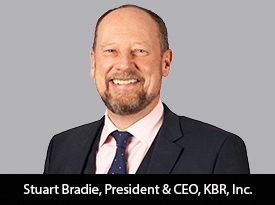
Stuart Bradie
 KBR
KBRAbout Stuart Bradie
Stuart J. B. Bradie, age 58, is President and Chief Executive Officer of KBR (since 2014) and will assume the additional role of Chair of the Board at the conclusion of the 2025 Annual Meeting; he holds a B.S. in Mechanical Engineering (Aberdeen University) and an MBA (Edinburgh Business School, Heriot‑Watt University) and is a U.K. national . Under his leadership, KBR delivered 2024 revenue growth of 11% and adjusted EBITDA growth of 16%, ended 2024 with $21.2B in backlog and options, generated $462M in operating cash flow, and ranked 4th on 3‑year TSR within its peer group (2022–2024) while maintaining a TRIR of 0.050; KBR returned $297M to shareholders in 2024 via buybacks and dividends .
Past Roles
| Organization | Role | Years | Strategic impact |
|---|---|---|---|
| KBR | President & Chief Executive Officer | 2014–present | Led portfolio evolution, 2024 LinQuest acquisition, and 2025 segment realignment; drove growth, safety (TRIR 0.050), and strong cash generation . |
| WorleyParsons | Group Managing Director — Operations & Delivery | — | Global operations leadership across hydrocarbons, mining, chemicals, power, infrastructure (40+ countries) . |
| WorleyParsons | Managing Director across EMEA, Asia & Middle East | — | Regional P&L responsibility in key growth geographies . |
| PT Kvaerner Indonesia | Managing Director | — | Country leadership, project execution . |
| Kvaerner Philippines | Country Manager | — | Country leadership, business development . |
External Roles
| Organization | Role | Years | Notes |
|---|---|---|---|
| Rolls‑Royce Holdings plc | Director | — | Current other public company board . |
Board Governance (KBR)
- Director since 2014; becomes Chair at conclusion of 2025 Annual Meeting; not independent; no Board committees .
- New Lead Independent Director (Lt. Gen. Wendy M. Masiello) created to mitigate combined Chair/CEO structure with robust duties (agenda setting, executive sessions, shareholder liaison) .
- CEO barred from serving on Board committees; 2024 attendance 100% .
- Mr. Bradie receives no additional compensation for Board service .
Fixed Compensation
| Metric | 2022 | 2023 | 2024 |
|---|---|---|---|
| Salary paid ($) | 1,191,360 | 1,226,983 | 1,284,698 |
| Base salary effective Jan 1 ($) | — | — | 1,275,000 (+4% YoY) |
| Target annual bonus (% of base) | — | — | 150% (threshold 37.5%, max 300%) |
| 2024 target STI ($) | — | — | 1,912,500 |
| 2024 target LTI ($) | — | — | 7,650,000 (66⅔% perf cash/stock; 33⅓% RSUs) |
| 2024 RSU grant fair value ($) | — | — | 2,550,048 |
| 2024 TSR‑based performance grant fair value ($) | — | — | 2,269,500 |
Performance Compensation
2024 Short‑Term Incentive (STI) – design and outcome
- Metrics: Adjusted EPS, Adjusted Operating Cash Flow (OCF), individual KPIs, and Zero Harm/Sustainability (10% weighting) .
- Company results: Adjusted EPS $3.34 and Adjusted OCF $462M; financial metrics payout 107.1% .
- CEO results: KPI metric result 87.5% (KPI payout 17.5%); Zero Harm metric result 100% (10% payout) .
- Total CEO STI payout: 134.6% of target = $2,574,225 (on $1,912,500 target) .
| STI Component (2024) | Weighting | Target | Actual/Result | Payout |
|---|---|---|---|---|
| Adjusted EPS | — | — | $3.34 | Included in 107.1% financial payout |
| Adjusted OCF | — | — | $462M | Included in 107.1% financial payout |
| KPIs (CEO) | — | — | 87.5% metric result | 17.5% payout |
| Zero Harm/Sustainability | 10% | — | 100% metric result | 10% payout |
| Total payout | — | — | — | 134.6% of target; $2,574,225 |
Long‑Term Incentive (LTI) – structure and vesting
- Mix: 50% Relative TSR (stock‑settled), 50% Book‑to‑Bill (B2B, cash‑settled), 3‑year performance period (2024–2026); payout 0–200%; sustained TSR methodology; 20% negative discretion feature (not exercised for 2024) .
- 2024 grants: RSUs vest in three equal annual installments beginning 2/22/2025; CEO received 43,017 RSUs (grant date 2/22/2024) .
- 2022–2024 performance awards (certified Feb 2025): average 3‑year TSR 12.5% (4th vs. peers) paying 117.8% in shares; B2B average payout 158.3% in cash .
| 2022–2024 LTI Payouts (granted 2/24/2022) | Target | Result | Payout |
|---|---|---|---|
| TSR component (stock) – CEO | 48,551 shares | Avg TSR rank 4th; 117.8% | 57,193 shares |
| B2B component (cash) – CEO | $2,333,334 | Avg payout 158.3% | $3,693,668 |
Equity Ownership & Alignment
| Item | Detail |
|---|---|
| Beneficial ownership | 732,281 KBR shares as of 3/1/2025 (<1% of outstanding) . |
| Unvested/Unearned equity (1/3/2025) | RSUs unvested: 88,127 shares ($5,200,374); TSR performance units unearned (max basis): 86,405 shares ($10,197,518) . |
| Options | No unvested stock options; KBR last granted options in 2015 . |
| Ownership guidelines (officers) | CEO 5x base salary; direct reports 3x; Level 2 executives 1x; 5‑year compliance window . |
| Compliance status | All NEOs in covered roles ≥5 years are in compliance with guidelines . |
| Hedging/pledging | Prohibited for officers and directors (no hedging, no pledging, no short sales, no derivatives) . |
| Director comp overlap | CEO receives no additional Board fees or equity for serving as a director . |
Employment Terms
- No employment agreement; executives instead have severance and change‑in‑control (CiC) agreements with double‑trigger vesting on equity upon CiC termination; agreements include confidentiality, non‑compete, non‑solicit, mandatory arbitration, and a severance clawback if termination could have been for Cause (determined within two years) .
- Clawbacks: Dodd‑Frank/NYSE policy to recoup erroneously awarded incentive compensation on an accounting restatement; certain award agreements also include broader clawback terms .
- Tax gross‑ups and option repricing: none; no employment contracts; double‑trigger required for CiC benefits .
| Potential Payments (as of 1/3/2025) | Change in Control without Termination | CiC with Involuntary Termination | Retirement/Disability/Death | Involuntary Not‑for‑Cause (no CiC) |
|---|---|---|---|---|
| Stock awards (CEO) | — | $5,200,374 | $5,200,374 | — |
| Performance awards (CEO) | — | $15,263,755 | $10,244,628 | — |
| Cash severance (CEO) | — | $12,365,868 | $2,574,225 | $6,375,000 |
| Total (CEO) | — | $32,829,997 | $18,019,227 | $6,375,000 |
Other benefits/perquisites: NEOs largely receive broad‑based benefits (401(k) match up to 5.5%), executive physicals; CEO receives a global welfare plan due to extensive travel; company‑provided car/driver primarily for business (limited personal use) .
Compensation Structure Analysis
- Pay-for-performance: Majority of CEO target comp is performance‑based; 2024 STI tied to Adjusted EPS, Adjusted OCF, Zero Harm (10%) and KPIs; 2024 LTI emphasizes relative TSR and B2B over three years; negative discretion feature applied in prior years on STIs (2020, 2022, 2023), demonstrating pay discipline .
- Market positioning: Committee targets ~50th percentile for “good” performance and above median for sustained outperformance; Meridian Compensation Partners serves as independent consultant; robust peer set spanning government services, IT consulting, E&C, and industrials .
- Say‑on‑pay: 2024 approval ~98%—a strong endorsement from shareholders .
Performance & Track Record
- 2024 execution: 11% revenue growth, 16% adjusted EBITDA growth; book‑to‑bill TTM 1.1x; OCF $462M; backlog and options $21.2B .
- Capital allocation and returns: $297M returned to shareholders (repurchases and dividends) in 2024; 3‑year TSR ranked 4th in peer group (2022–2024) .
- Strategic moves: Closed LinQuest acquisition (national security space, advanced engineering, digital integration); executed 2025 segment realignment; continued expansion in defense, digitalization, and sustainability solutions .
Director Compensation (as a director)
- Mr. Bradie does not receive additional compensation for Board service; non‑executive director program includes cash retainers, committee/lead director fees, and RSUs that vest after ~6 months; director ownership guideline is 5x annual cash retainer .
Equity Vesting Schedules and Potential Selling Pressure
- Time‑based RSUs vest in equal annual installments over 3 years (e.g., 2024 grant vests in 2025/2026/2027); CEO has 88,127 unvested RSUs and 86,405 unearned TSR performance units outstanding as of 1/3/2025, indicating measurable but programmatic vesting‑related supply over the next 24–36 months; no option overhang .
Employment & Contracts – Compliance and Restrictions
- Anti‑hedging/pledging policies, stock ownership guidelines (CEO 5x base), and clawbacks reduce alignment risk and discourage excessive risk‑taking; no excise tax gross‑ups or option repricing .
Investment Implications
- Alignment: High proportion of at‑risk, multi‑year metrics (TSR, B2B) and strong 2024 results support pay‑for‑performance; ownership of 732k shares plus strict anti‑hedging/pledging and 5x salary ownership guideline align CEO with shareholders .
- Governance: Combined Chair/CEO elevates key‑man influence; mitigations include a robust Lead Independent Director role, CEO barred from committees, frequent executive sessions, and high board engagement—yet dual‑role optics can become a focal point in activism cycles .
- Retention and M&A optics: CiC payments are sizable (~$32.8M total illustrative), potentially creating retention under strategic scenarios but also drawing investor scrutiny in change‑of‑control contexts; no employment agreement reduces entrenchment concerns .
- Flow watch: RSU/PSU vesting over 2025–2027 suggests periodic Form 4 activity around anniversaries/performance certifications; absence of options limits sudden supply shocks .
- Pay discipline and investor support: Negative discretion history and 98% say‑on‑pay vote indicate investor confidence and compensation committee rigor; monitor any future metric calibration changes or discretion use if macro shifts .