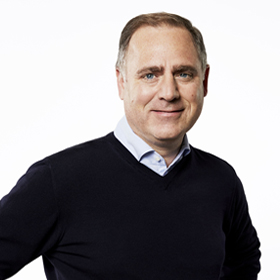
Matthew A. Salem
About Matthew A. Salem
Matthew A. Salem is Chief Executive Officer of KKR Real Estate Finance Trust Inc. (KREF) and a Director since February 2022; he has served as CEO since March 2020, is a KKR Partner and Head of Real Estate Credit, and sits on KKR’s Real Estate Investment Committees . He is 51 and holds a B.A. in Economics from Bates College; prior roles include Managing Director at Rialto Capital, Head of CMBS Trading at Goldman Sachs, and earlier posts at Morgan Stanley, Citigroup Alternative Investments, and Midland Loan Services, with industry leadership at the Commercial Real Estate Finance Council (CREFC) and Chair of the B-Piece Buyer Forum . KREF’s pay-versus-performance disclosures show mixed shareholder returns and earnings during his tenure: 2024 TSR value of an initial $100 investment at $84 (vs. $100 in 2023), net income of $13.1 million in 2024 (vs. $(53.9) million in 2023), and distributable earnings of $(70.7) million in 2024 (vs. $57.6 million in 2023) .
Past Roles
| Organization | Role | Years | Strategic impact |
|---|---|---|---|
| KKR | Partner; Head of Real Estate Credit; Member, Real Estate Investment Committees | 2015–present | Leads KKR’s real estate credit platform and sits on investment committees . |
| KKR Real Estate Finance Trust (Manager) | CEO of Manager | Jan 2021–present | Oversees externally managed platform for KREF . |
| KKR Real Estate Finance Trust (KREF) | Co-CEO & Co-President | Oct 2015–Mar 2020 | Co-led KREF at and post-IPO period . |
| Rialto Capital Management | Managing Director | 2012–2015 | Senior role in real estate credit investing . |
| Goldman Sachs | Managing Director; Head of CMBS Trading | 2006–2012 | Led CMBS trading business . |
| Morgan Stanley | Real estate/credit roles | Pre-2006 | Real estate credit investing roles . |
| Citigroup Alternative Investments (Travelers) | Mezzanine and high-yield CRE credit investing | Pre-2006 | CRE credit investing for Travelers . |
| Midland Loan Services | Analyst | Began 1996 | Commercial loan servicing foundation . |
External Roles
| Organization | Role | Years | Notes |
|---|---|---|---|
| KKR Real Estate Select Trust Inc. | Vice Chairman | Current | External non-traded REIT affiliation . |
| CREFC | Board of Governors; Chair, B-Piece Buyer Forum | Prior service | Industry leadership positions . |
Fixed Compensation
KREF is externally managed; it does not pay cash salary or bonus to Mr. Salem (or other NEOs), except that KREF reimburses the Manager solely for the CFO’s compensation allocation; cash pay to Mr. Salem is set and paid by KKR and not disclosed by KREF in detail . KKR’s 2024 senior employee compensation mix (aggregated for NEOs) was 15.44% fixed (base) and 84.56% performance-based (annual bonus); the Manager did not use fixed performance metrics, instead considering qualitative and quantitative factors including KREF stock performance, portfolio credit quality, market conditions, and business growth .
Multi-year KREF-reported compensation to Mr. Salem (equity awards only):
| Metric | 2022 | 2023 | 2024 |
|---|---|---|---|
| Stock awards ($) | 1,463,000 | 1,027,088 | 915,688 |
Notes:
- KREF reports no option awards, no non-equity incentive plan comp, no pension, and no other compensation for Mr. Salem; KREF has no pension plans .
Performance Compensation
Incentive design and metrics:
- KREF grants time-based RSUs to align executives with shareholders; RSUs vest over multi-year schedules and receive dividend equivalents equal to common dividends; executives must retain at least 15% of shares underlying vested awards (pre-tax) .
- The compensation committee considered Company TSR, net income, and distributable earnings as “most important performance measures” in 2024, but there are no formal weightings and the Manager did not utilize fixed formula metrics for variable compensation; determinations are discretionary within KKR’s framework .
Outstanding RSU vesting detail (as of 12/31/2024):
| Grant date | Shares | Vesting schedule |
|---|---|---|
| 12/19/2022 | 33,334 | Vests 10/1/2025 . |
| 12/18/2023 | 50,834 | Vests 10/1/2025 and 10/1/2026 (equal installments) . |
| 12/16/2024 | 81,250 | Vests 10/1/2025, 10/1/2026, 10/1/2027 (substantially equal) . |
2024 grants of plan-based awards:
| Grant date | Shares (RSUs) | Grant-date fair value ($) |
|---|---|---|
| 12/16/2024 | 81,250 | 915,688 . |
2024 realized/deferrals (potential selling pressure signal):
- Shares vested in 2024: 91,299; Mr. Salem voluntarily deferred delivery of the 33,333 (2012 grant tranche) and 25,416 (2023 grant tranche) RSUs into DSUs per the Deferral Plan, deferring share delivery for five years or until termination; value realized on vesting of deferred tranches was $399,329 and $304,483, respectively .
- 2024 DSU activity: Executive contributions $703,813; DSU account aggregate balance $930,028 at 12/31/2024; aggregate earnings $(181,452) (reflects price changes and dividend equivalents) .
Options and SARs:
- No option or SAR awards historically included; 2024 Option Awards: $0 .
- Omnibus plan permits options/SARs, but KREF has not historically used them for NEOs .
Equity Ownership & Alignment
| Item | Detail |
|---|---|
| Beneficial ownership (common shares) | 364,407 shares; <1% of outstanding . |
| Unvested RSUs (12/31/2024) | 165,418 units (market value $1,670,722 at $10.10) . |
| Dividend equivalents | RSUs earn dividend equivalents equal to declared dividends on common stock and are fully vested upon payment . |
| Executive retention requirement | Must retain at least 15% of shares underlying vested equity awards (pre-tax) . |
| Hedging/margin policy | Hedging, short sales, derivatives, and purchasing on margin are prohibited under the Insider Trading Policy . |
| Ownership guidelines for non-employee directors | 3x annual cash retainer within five years; all non-employee directors are in compliance (informational; N/A to Salem’s status as executive) . |
Employment Terms
| Topic | KREF disclosure |
|---|---|
| Employer/contract | Externally managed structure; Mr. Salem is employed by KKR/Manager; KREF does not pay his cash comp or maintain an employment contract with him . |
| Severance | No KREF severance arrangements disclosed for Mr. Salem; KREF reimburses only CFO’s allocated comp, with no severance for CFO either . |
| Change-in-control | Under the equity plan, the committee may adjust, accelerate, cancel, or cash-out awards in connection with an Adjustment Event (including Change in Control) at its discretion; the Deferral Plan provides a lump-sum distribution trigger upon a Change in Control . |
| Death/disability | Unvested RSUs immediately vest upon death or disability . |
| Clawback | NYSE Rule 10D-1-compliant clawback adopted in 2023, mandating recoupment of excess incentive-based compensation upon financial restatement (covers NEOs) . |
| Non-compete/solicit | Not disclosed. |
Board Governance (Director Service, Committees, Independence)
- Role: CEO and Director since February 2022; not independent (independent directors are Ahern, Langer, Esteves, Madoff, McAneny) .
- Board structure: Chair (Rosenberg) separate from CEO (Salem); Lead Independent Director (McAneny) since 2019 presides over executive sessions; this separation mitigates CEO/Chair concentration risk .
- Committee memberships: Mr. Salem is not listed as a member of Audit, Compensation, Nominating & Corporate Governance, or Affiliate Transaction committees; independent directors populate these committees .
- Meetings/attendance: In 2024, Board met 8 times; each director attended at least 75% of applicable board/committee meetings and the annual meeting .
- Director compensation interplay: KKR employees on the Board (e.g., Rosenberg, Lee) receive no additional board remuneration; Mr. Salem’s compensation is disclosed under NEO tables, and he is excluded from the director compensation table .
Performance & Track Record
Pay versus performance summary (Company TSR, net income, distributable earnings):
| Metric | 2020 | 2021 | 2022 | 2023 | 2024 |
|---|---|---|---|---|---|
| Total Shareholder Return (Value of $100) | 97 | 123 | 91 | 100 | 84 |
| Net Income Attributable to Common ($000s) | 53,553 | 125,635 | 15,371 | (53,919) | 13,071 |
| Distributable Earnings ($000s) | 109,321 | 92,393 | 109,614 | 57,558 | (70,683) |
Say-on-pay support:
- Approximately 97% of votes cast supported 2023 NEO compensation at the 2024 annual meeting; an annual frequency is maintained .
Related Party Transactions and Conflicts Oversight
- Externally managed model: KREF paid the Manager $30.3 million in 2024 (management fees $24.5 million; reimbursements $5.7 million including CFO comp allocation) .
- KKR Capital Markets (KCM) transactions: KREF paid KCM fees on multiple facilities/offerings, including $1.3 million in Q1’25 term loan repricing/upsize fees; historical fees on facilities and the Series A preferred issuance; the KREF Lending IX facility fee arrangement terminated in Dec 2024 .
- Governance: An independent Affiliate Transaction Committee reviews and approves related party transactions and oversees Manager performance and fees; directors with interests recuse themselves from votes .
Compensation Structure Analysis (Alignment, Retention, Risk Flags)
- Cash vs equity mix: For KREF-paid compensation, Mr. Salem’s reported comp is entirely time-based RSUs; cash comp is paid by the Manager and not disclosed by KREF; KKR’s aggregate mix for NEOs skews to performance-based cash bonus (84.56%) vs fixed (15.44%) in 2024 .
- Metric rigor: The Manager used discretionary assessments (no hard weightings), considering TSR, net income, distributable earnings, and qualitative factors; there were no formulaic goals tied to KREF awards in 2024 .
- Equity cadence and vesting: Regular annual RSU grants with 3-year vesting promote retention; 2024 grant: 81,250 RSUs vesting 2025–2027; dividend equivalents amplify realized value even during flat TSR periods .
- Deferrals vs selling: Mr. Salem deferred a substantial portion of 2024 vesting into DSUs (five-year or termination settlement), lowering near-term selling pressure .
- Clawback/hedging: NYSE 10D-1 clawback adopted; hedging, derivatives, and margin transactions prohibited—supporting alignment and reducing risk of misaligned personal hedging .
- Options repricing: New 2025 omnibus plan prohibits repricing without shareholder approval and includes shareholder-friendly features (no liberal share recycling, no evergreen) .
Equity Ownership & Ownership Guidelines (Detail)
| Ownership detail | Value |
|---|---|
| Common shares beneficially owned | 364,407; <1% of outstanding . |
| Unvested RSUs at FY-end | 165,418; $1,670,722 at $10.10 on 12/31/2024 . |
| 2024 RSU vesting realized | 91,299 shares; significant portion deferred into DSUs . |
| 2024 DSU deferral balance | $930,028; contributions $703,813; earnings $(181,452) . |
| Policy constraints | 15% retention of vested shares; hedging and margin prohibited . |
Director Compensation (Mr. Salem context)
- Director fee program applies to independent directors; KKR employees on the Board (e.g., Rosenberg, Lee) receive no additional board pay; Mr. Salem’s compensation is disclosed as an NEO, and he is not included in the Director Compensation table .
Compensation Committee Analysis
- Composition: Compensation Committee members—Jonathan Langer (Chair), Terrance Ahern, Paula Madoff .
- Consultant: Ferguson Partners Consulting (FPL) engaged to advise on size of equity award pool for 2024; committee determined no conflicts and independence per SEC/NYSE rules .
- Role: The committee approves KREF equity awards for NEOs; cash compensation is set and paid by KKR/Manager .
Say-on-Pay & Shareholder Feedback
- 2024 say-on-pay result: ~97% approval, with Company maintaining an annual vote cadence .
- Equity plan refresh: 2025 Omnibus Incentive Plan proposed with 2,750,000 new shares (replacing and superseding remaining under Prior Plan), aligning with governance best practices (no evergreen, no liberal recycling), subject to shareholder approval .
Risk Indicators & Red Flags
- External management and related-party economics: Significant fees paid to the Manager ($30.3m in 2024) and recurrent transactions with KKR Capital Markets could create perceived conflicts, mitigated by an independent Affiliate Transaction Committee .
- Variable performance: 2024 distributable earnings negative and TSR below 2023 levels could weigh on equity-based compensation optics, though awards are time-based rather than performance-vested .
- Governance mitigants: Separate Chair/CEO, Lead Independent Director, clawback policy, and hedging/margin prohibitions reduce certain governance risks .
Investment Implications
- Alignment: Time-based RSUs, 15% post-vest retention, hedging/margin prohibitions, and deferral elections (DSUs) support medium-term alignment and temper near-term selling pressure; Mr. Salem’s 2024 deferrals are a constructive signal .
- Retention: Three-year RSU vesting ladder (2025–2027) and ongoing grant cadence underpin retention through the cycle; death/disability acceleration is standard, with CIC outcomes subject to committee discretion .
- Performance sensitivity: With no formulaic performance metrics for variable pay at KKR, incentive outcomes hinge on discretionary assessments of TSR, net income, and distributable earnings—creating flexibility but also less direct pay-for-performance linkage for KREF shareholders in weak years .
- Governance/related-party oversight: The Affiliate Transaction Committee and strong say-on-pay support (97%) indicate shareholder confidence, but investors should monitor Manager fee levels and KCM fee-bearing financings as potential valuation drags .
Key data to watch: 2025 say-on-pay outcome; execution on credit quality and distributable earnings recovery; size and terms of 2025 omnibus plan grants; any incremental KCM-arranged financings; continued use of DSU deferrals by Mr. Salem.