QUAKER CHEMICAL (KWR)·Q4 2025 Earnings Summary
Quaker Houghton Q4 2025: Revenue Beats, EPS Misses as Stock Slides 4%
February 24, 2026 · by Fintool AI Agent
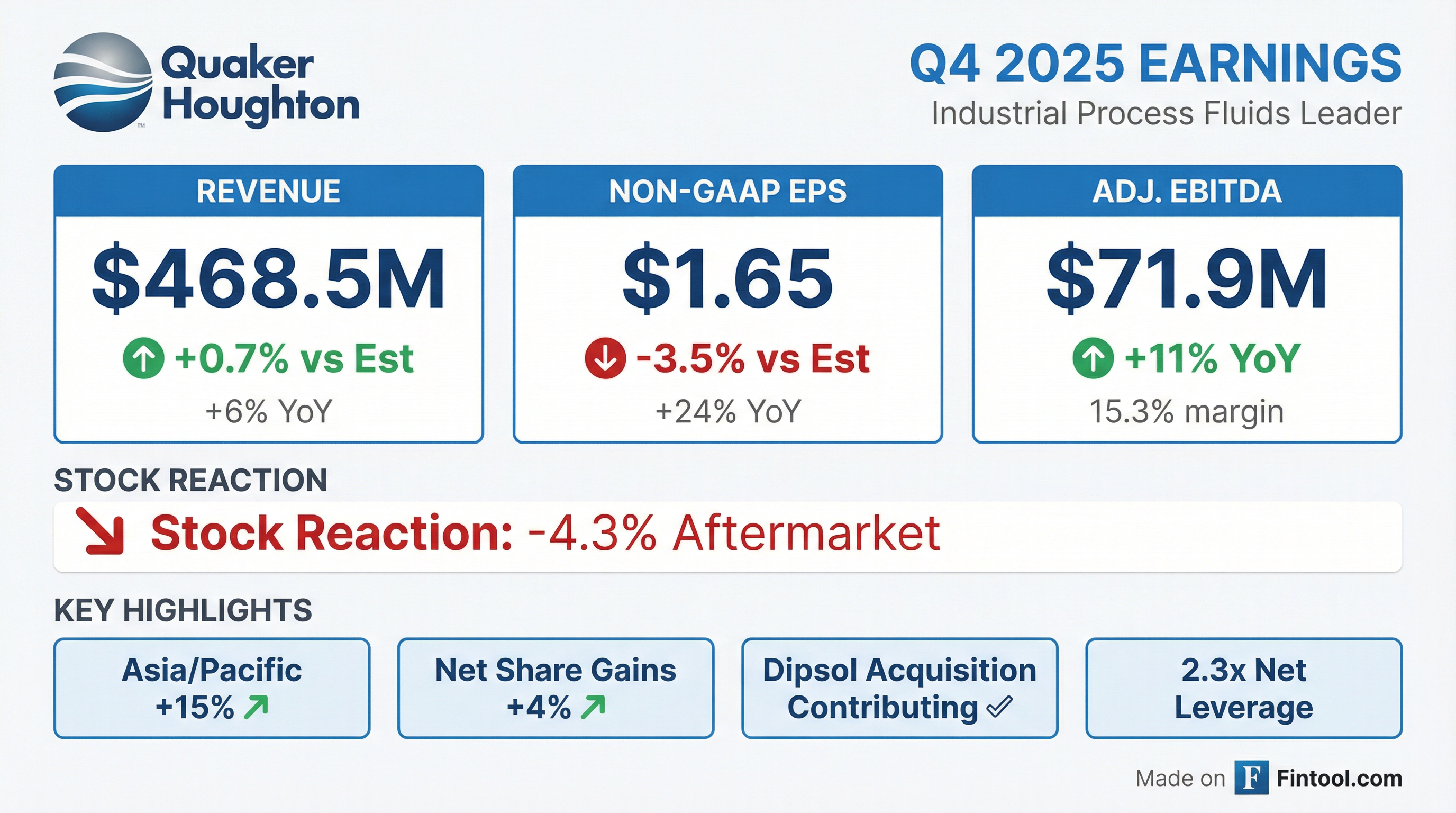
Quaker Houghton (NYSE: KWR), the global leader in industrial process fluids, reported mixed Q4 2025 results that sent shares down 4% in after-hours trading. While revenue edged past expectations on acquisition contributions and Asia/Pacific strength, the industrial fluids maker missed earnings estimates as soft end markets in the Americas and EMEA weighed on volumes.
The quarter marked the company's second consecutive period of year-over-year profitability improvement, with adjusted EBITDA rising 11% to $72M. CEO Joe Bergquist struck an optimistic tone on the earnings call: "I am optimistic as we head into 2026 and excited about our momentum."
Did Quaker Houghton Beat Earnings?
Revenue: Beat — $468M vs $465M consensus (+0.7%)
Non-GAAP EPS: Miss — $1.65 vs $1.71 consensus (-3.5%)
The year-over-year improvement was substantial — Non-GAAP EPS jumped 24% despite organic volumes declining less than 1%. The drivers: acquisition contributions (+6% to revenue from Dipsol), improving operating leverage, and disciplined cost management that reduced organic SG&A by 4%.
 Ask Fintool AI Agent
How Did the Stock React?
Regular Session (Feb 23): $169.97 (-2.6% from prior close of $174.44)
After-Hours: $166.00 (-2.3% from regular close)
The stock opened strong at $173.78 on earnings day before selling off throughout the session, then dropped further aftermarket as investors digested the EPS miss and conservative 2026 outlook. Despite the negative reaction, KWR remains up significantly from its 52-week low of $95.91 and trades above both its 50-day ($154.28) and 200-day ($133.55) moving averages.
What Did Management Guide?
Management provided detailed qualitative guidance on the earnings call, outlining their growth algorithm for 2026:
"The algorithm that we're shooting for is a sort of mid-single digit volume and revenue growth. If we could do a little bit better than that, great, get that leverage to the high single digits on EBITDA as we scale everything into the business." — Joe Bergquist, CEO
Key 2026 Guidance Points:
Tailwinds factored in:
- Full-year benefit of 2025 acquisitions (Dipsol closed April 2025) = 1-2% tailwind
- ~1% FX favorability expected
- Wrap-around effect from new business wins in 2025
Headwinds to watch:
- Variable compensation rebuild
- Inflation in labor and benefits
- New corporate HQ depreciation coming online
What Changed From Last Quarter?
Q4 2025 showed sequential deceleration from Q3 2025's strong results:
*Values retrieved from S&P Global
The sequential decline was driven by:
- Normal seasonality — Q4 typically sees lower industrial activity
- Weather-related operational issues — Frozen pipes, truck delays, boiler issues in December cost about 1% of volume
- Extended customer outage — A major North American metal producer outage impacted Americas volumes
- Gross margin compression — Unfavorable absorption and higher maintenance/disposal costs in North America
CEO Bergquist confirmed on the call that these issues are resolved: "That's really been resolved. As we head into the first quarter... I don't expect that to be anything real impactful at this point."
Segment Performance: Asia/Pacific Leads for 10th Straight Quarter
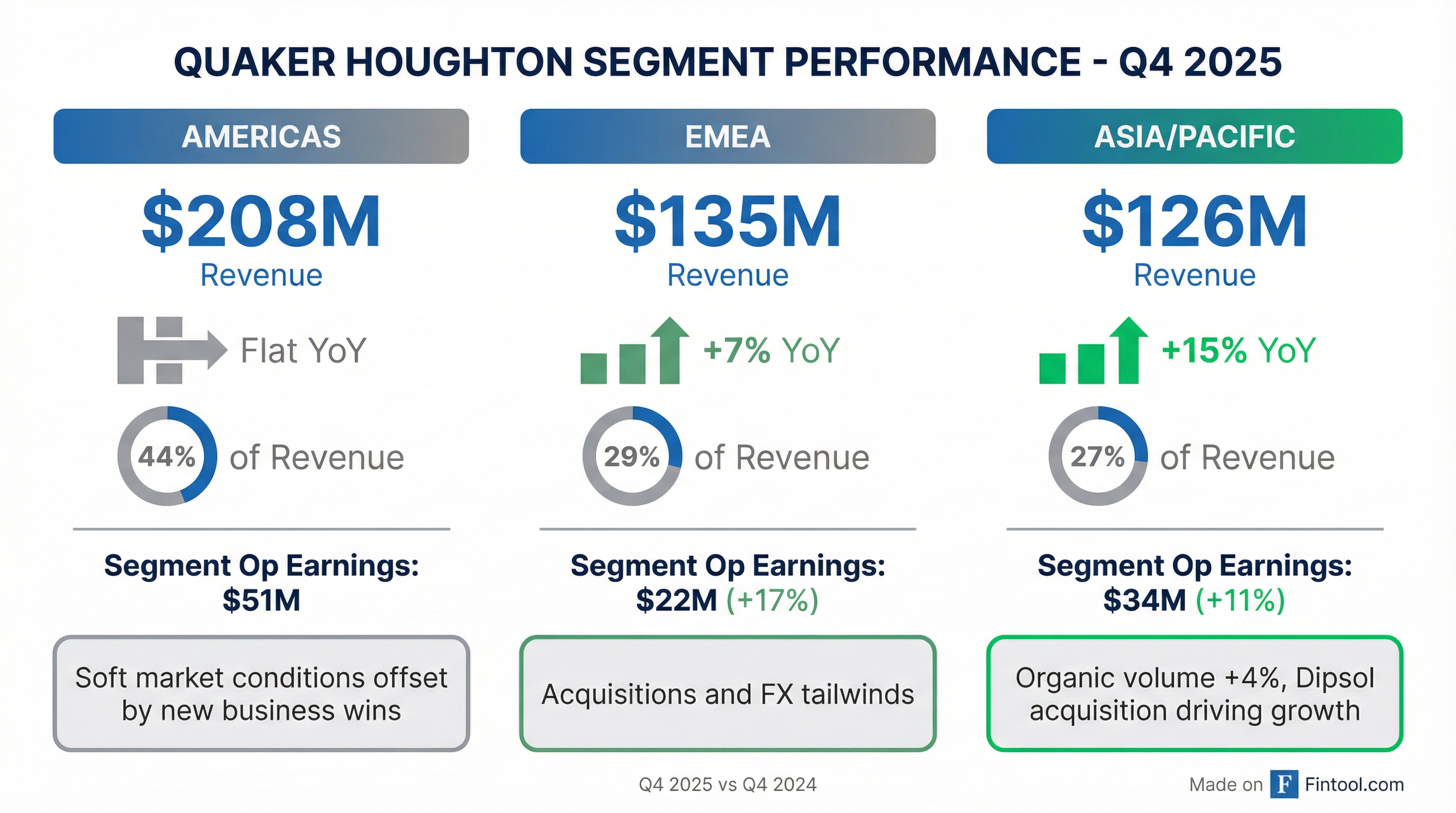
The regional story remains one of divergence — Asia/Pacific thriving while Americas and EMEA struggle with soft end markets.
Asia/Pacific momentum continues: This was the 10th consecutive quarter of year-over-year organic volume growth in the region. Full-year 2025 performance was exceptional — net sales grew 13% while organic volume grew 5%, despite soft market conditions globally.
"Notably, we are winning with new metalworking customers and growing our share in the electric vehicle, OEM, and component sector." — Joe Bergquist, CEO
Share gains are broad-based but higher in Asia: Management noted share gains are occurring across all three regions, but Asia/Pacific is converting at approximately 2x the rate of Americas and EMEA due to new plant startups and capacity additions in markets like India and China.
Ask Fintool AI AgentQ&A Highlights: What Analysts Asked
The earnings call featured questions from Seaport Research, Jefferies, Deutsche Bank, CJS Securities, and RBC Capital Markets. Key themes:
On EBITDA Growth Expectations (Seaport Research)
Q: Sell-side consensus is looking for ~10% EBITDA growth in 2026. Is that achievable?
A: Management didn't confirm the specific number but outlined the algorithm: mid-single digit volume/revenue growth with leverage to high-single digit EBITDA growth. The 2-4% share gain target has been tracking toward the higher end recently.
On M&A Pipeline (Jefferies)
Q: Can you characterize the M&A pipeline and regional mix?
A: The $7M of M&A assessment costs in Q4 related to multiple larger, multi-regional/global opportunities evaluated in H2 2025. None are expected to result in transactions at this time. The overall pipeline remains healthy with a focus on both bolt-on deals and transformational opportunities when they arise.
On Americas Volume Weakness (Deutsche Bank)
Q: Which markets are down in Americas and what's the outlook?
A: PMIs hovering around 50 indicate no broad-based manufacturing recovery yet. The extended customer outage at a major metal producer will carry into Q2. Tariff uncertainty is impacting the USMCA region, particularly Mexico.
On Path to 18% EBITDA Margins (RBC Capital Markets)
Q: Are you still on track for 18% EBITDA margins?
A: "It's definitely still the target." Self-help opportunities include:
- Network rationalization — Dortmund closure example ($2M savings in 2026, $5M annual from 2027)
- Process harmonization — Fixing master data, streamlining global business processes
- Integration completion — Combining R&D operations, sales offices across past acquisitions
- Volume leverage — Will accelerate margin expansion when markets recover
Strategic Initiatives & Investments
Management highlighted several strategic moves:
Manufacturing Network:
- Dortmund closure — German facility closing as part of European network optimization. Volume absorbed by existing excess capacity. Savings: $2M in 2026, $5M annual from 2027
- New China facility — Manufacturing facility opening in H2 2026 to serve Asia/Pacific growth
- New Philadelphia HQ — Corporate headquarters and combined R&D labs relocating
Service Innovation:
"Fluid Intelligence is an evolution and enhancement of Quaker Houghton service offering, empowered by new and innovative measurement, automation, and digital tools. Our Fluid Intelligence offering is amplifying the impact of our technical teams and enabling customers to gain insights to optimize how our fluids perform." — Joe Bergquist, CEO
Cost Savings Program: The complexity and cost reduction plan generated ~$25M of run-rate savings for the full year 2025. Organic SG&A declined 4% YoY in Q4 and 2% for the full year.
Full Year 2025: GAAP Loss Masks Solid Underlying Performance
The full year results show the impact of significant one-time charges:
The GAAP loss was driven by:
- $89M goodwill impairment charge (non-cash)
- $35M restructuring charges (facility closures, workforce actions)
- $29M higher YoY restructuring costs impacting cash flow
2025 Acquisitions: The company completed three acquisitions adding ~$95M of annualized revenue, including Dipsol which contributed $21M in Q4 alone.
Capital Allocation & Balance Sheet
The balance sheet remains strong with flexibility for M&A and shareholder returns:
The company returned $76M to shareholders in 2025 through dividends and buybacks while completing $164M of acquisitions and maintaining leverage well within covenants.
Key Risks & Concerns
Several factors warrant monitoring:
- End Market Weakness: Steel, automotive, and industrial equipment customers facing soft demand with no broad recovery in sight
- Tariff Exposure: "Persistent tariff uncertainty continues to disrupt global trade flows" — particularly impacting USMCA region
- Customer Concentration: Extended outage at major North American metal producer expected to persist into Q2
- Operating Cash Flow Decline: -33% YoY decline driven by restructuring costs and working capital timing
- FX Volatility: ~56% of revenue outside Americas creates currency exposure
The Bottom Line
Quaker Houghton delivered solid year-over-year improvement in Q4 2025, with adjusted EBITDA up 11% and Non-GAAP EPS up 24%. However, the company missed consensus EPS expectations by 3.5%, and the cautious 2026 outlook (flat end markets through H1) disappointed investors hoping for a more robust recovery.
The bull case: Market share gains of 4%, 10 consecutive quarters of Asia/Pacific growth, successful Dipsol integration, disciplined cost management generating $25M in savings, and potential H2 2026 recovery. The 18% EBITDA margin target remains intact with tangible self-help levers.
The bear case: Soft industrial end markets with no recovery in sight, EPS miss despite favorable comps, full-year 2025 Non-GAAP EPS declined 6% despite revenue growth, and operating cash flow down 33%. Customer concentration risk evident in North American outage impact.
The 4% aftermarket decline reflects uncertainty about the pace of recovery in the company's core industrial process fluids business.
Ask Fintool AI AgentExplore more on Quaker Houghton or read the Q4 2025 transcript.