LGI Homes (LGIH)·Q4 2025 Earnings Summary
LGI Homes Q4 2025: Revenue and EPS Fall as Affordability Pressures Persist, Backlog Surges
February 17, 2026 · by Fintool AI Agent
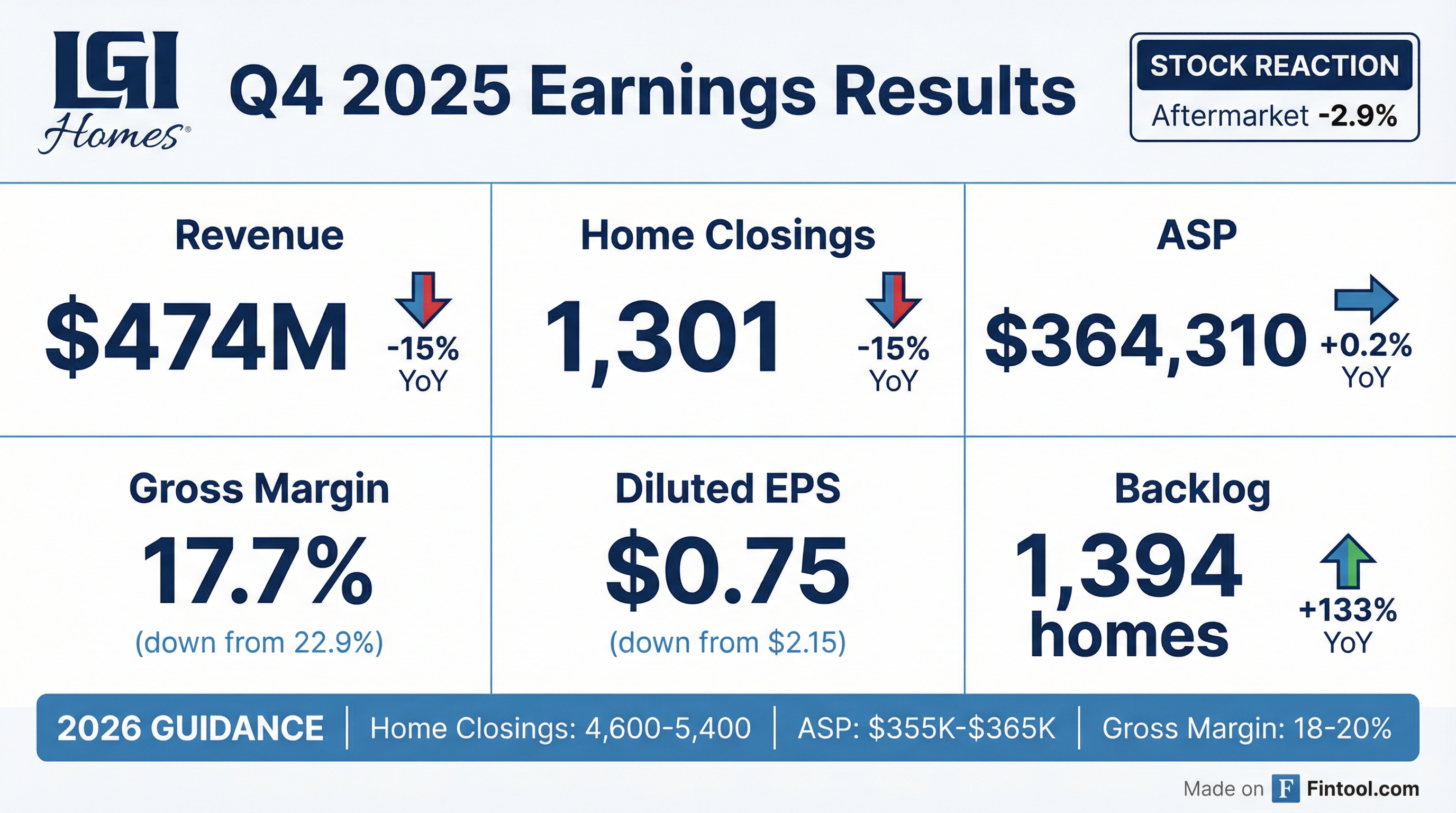
LGI Homes reported Q4 2025 results that reflected the ongoing challenges facing entry-level homebuyers. Revenue fell 15% year-over-year to $474 million on 1,301 closings, while diluted EPS dropped 65% to $0.75 . The quarter included a $6.7 million inventory impairment charge that weighed on margins. However, backlog provided a bright spot, surging 133% to 1,394 homes driven by a new 480-home wholesale contract .
The stock traded down ~2.9% in aftermarket trading following the release.
Did LGI Homes Miss Expectations?
LGI Homes delivered a difficult quarter with significant year-over-year declines across key metrics:
The absorption pace improved sequentially to 3.1 closings per community per month—the highest of the year—but remained below the prior year's 3.6 pace .
 Ask Fintool AI Agent
What Drove the Margin Compression?
Gross margin of 17.7% included a $6.7 million inventory impairment charge. Excluding this impairment, gross margin was 19.2% . Adjusted gross margin, which also excludes capitalized interest and purchase accounting adjustments, came in at 22.3% .
The margin pressure stemmed from:
- Financing incentives — Elevated mortgage rates forced the company to offer compelling rate buydowns to qualify entry-level buyers
- Aged inventory discounts — Price reductions on older spec homes to clear inventory
- Inventory impairment — $6.7 million charge on underperforming communities
CEO Eric Lipar noted that the company's "self-developed land position continued to provide structural margin support, helping offset the impact of financing incentives and price adjustments offered on older inventory" .
How Did Regions Perform?
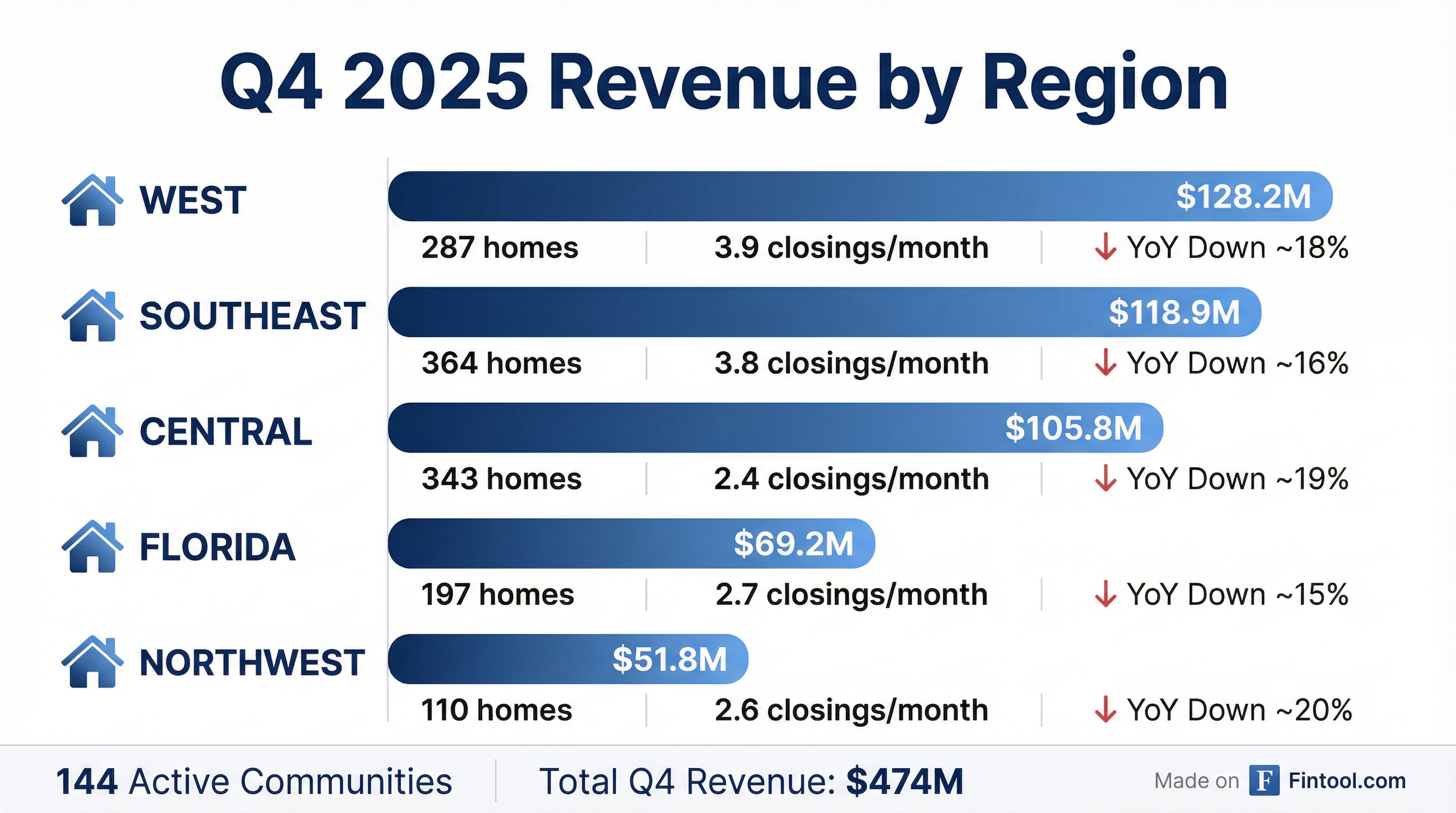
All five regions saw year-over-year declines in closings:
Florida showed the steepest decline at -35% YoY, while West held up best at just -1.7% .
What About the Backlog Surge?
The standout metric was backlog, which jumped 133% to 1,394 homes valued at $501.3 million . This was driven by:
- Wholesale contract — A 480-home agreement with a wholesale buyer to deliver throughout 2026
- Retail improvement — Even excluding wholesale, backlog was up 53% YoY
- Net orders — Increased 39% year-over-year in Q4
Management has increasingly leaned on wholesale sales to institutional buyers as a lever to manage inventory levels and generate cash flow, though these sales carry lower margins than retail closings.
Policy Risk: On the earnings call, CEO Eric Lipar flagged emerging uncertainty around wholesale:
"New orders right now are somewhat on pause until we get more clarification on the policy... We feel really good about the 10%, because that's kind of orders are already created, and that's our backlog, and we feel confident that those will close this year."
Management guided wholesale to represent 10%-15% of 2026 closings, down from 15.7% in 2025 .
Which Markets Led the Quarter?
Top markets by closings per community per month in Q4 :
The company averaged 3.1 closings per community per month in Q4—the highest pace of the year—driven by a strong December finish when the company closed its 80,000th home .
What Did Management Guide for 2026?
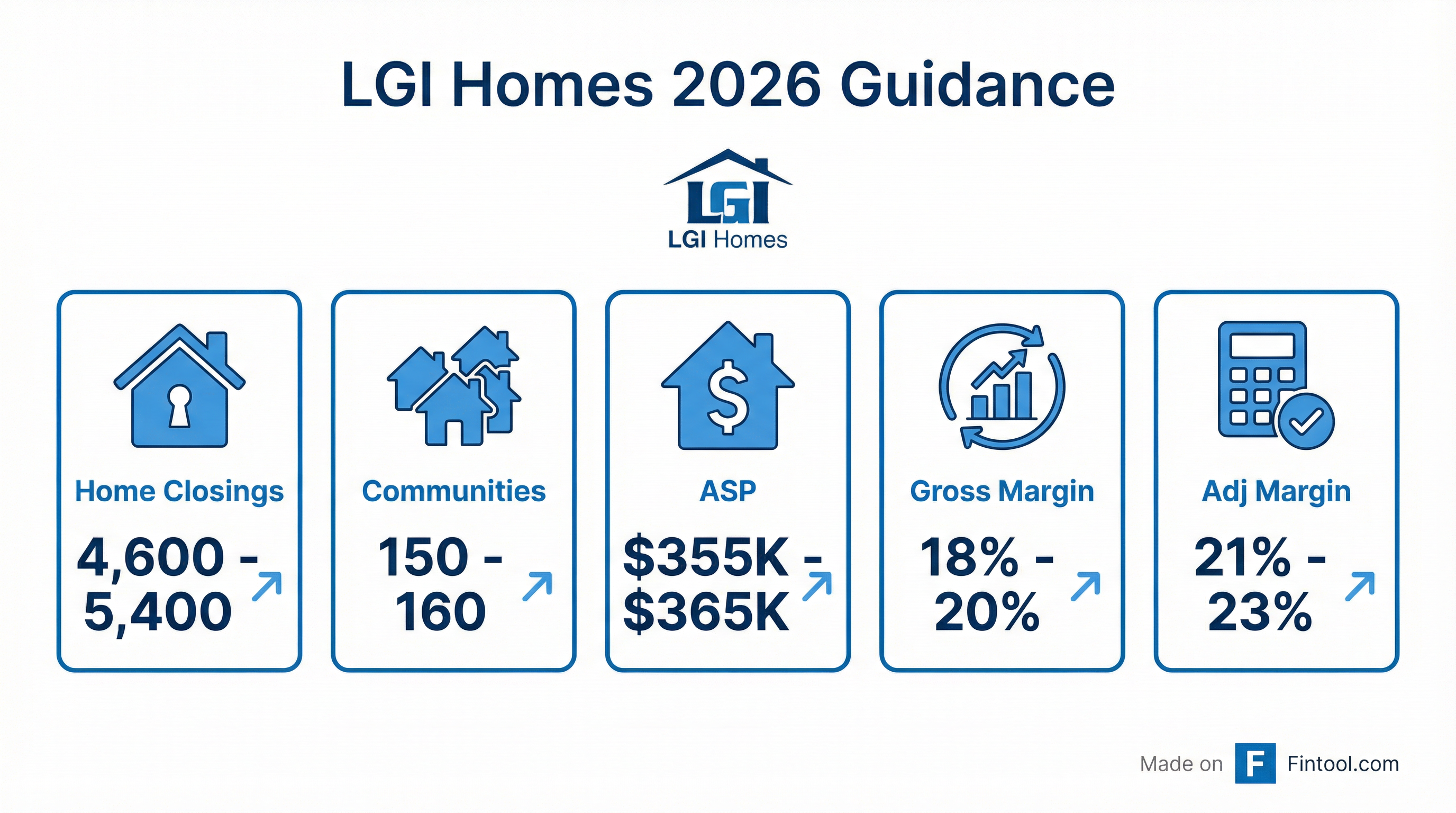
LGI Homes issued 2026 guidance that assumes current challenging market conditions persist:
Key assumptions :
- Market conditions similar to early 2026
- No additional changes to U.S. trade policy or tariffs
- Input costs, labor availability, and mortgage rates consistent with current environment
The guidance implies revenue between ~$1.63B and ~$1.97B, with the midpoint roughly in line with analyst consensus of ~$1.77B.
Ask Fintool AI AgentWhat Changed From Last Quarter?
Comparing Q4 2025 to Q3 2025:
Sequential improvement in volume was offset by the inventory impairment and continued incentive pressure.
Balance Sheet and Liquidity
LGI Homes ended the quarter with solid liquidity:
Leverage ticked up 200 bps year-over-year but remains manageable. The company repurchased shares during the quarter and has $177.7M remaining on its buyback authorization .
CEO Commentary
Eric Lipar struck a cautiously optimistic tone on LGI's long-term positioning:
"I want to reiterate that our long-term outlook for the housing market remains positive. The supply-demand imbalance, favorable demographic trends, and essential need for attainable homeownership all reinforce the strength of our strategy. As we move into 2026, we do so with resilience, focus, and a deep commitment to navigating the market with the same determination that has guided us throughout our history."
On capital allocation, CFO Charles Merdian noted the company's approach to managing leverage:
"Throughout 2026, we expect to continue to work through older inventory, selectively monetize certain lot positions, and use the proceeds to reduce debt as we make progress toward the midpoint of our 35%-45% target leverage range."
Full Year 2025 Summary
The full year painted a picture of significant contraction:
Q&A Highlights
On cancellation rates (43.3% in Q4): Eric Lipar explained the elevated cancellation rate is entirely driven by financing challenges, not buyer sentiment:
"Our cancellation rate is elevated. The reason for cancellation has not changed at all. The reason for cancellation is strictly the ability to get financing... In a more challenging market, we're spending more time with customers. They're taking longer to get across the finish line, but we think that's the right strategy, although it is going to lead to a higher cancellation rate. Net-net, we think it's accretive to our closings."
On buyer mix shift: The share of move-up buyers is growing as entry-level prices rise:
"The entry-level price point now at $360,000 plus is just an elevated price point. So the income needed for a customer to qualify or the household to qualify is elevated, and the odds of that customer being in an ownership situation is higher than it used to be."
The Terrata brand (move-up product) now represents roughly 10-15% of communities .
On competitive dynamics: Lipar confirmed the entire industry continues to lean heavily into incentives:
"All of us are leaning into incentives... We're still battling affordability. Rates have come down somewhat over the last couple of months, 10-year down closer to 4.05% now, as high as 4.25%. So that's helping the mortgage rates, spreads are compressed."
On margin drivers (JP Morgan question): When asked what could push margins toward the higher end of 2026 guidance, Lipar cited lower incentives, reduced costs (land development, labor, materials), and lower wholesale mix as potential tailwinds .
On community count timing: New community openings will be back-half weighted in 2026, with management confident in hitting 150-160 communities by year-end .
Key Risks and Concerns
- Mortgage rate sensitivity — Entry-level buyers are highly rate-sensitive; elevated rates continue to pressure affordability and conversion
- Margin trajectory — 2026 guidance suggests further margin compression; adjusted gross margin could fall 100-300 bps
- Tariff uncertainty — Guidance explicitly excludes any additional tariff impacts; management flagged supplier price increases earlier in 2025
- Wholesale policy risk — New wholesale orders "on pause" pending policy clarification on institutional buyers
- Elevated cancellations — 43.3% cancellation rate expected to persist as buyers need extended time to qualify
Forward Catalysts
- January trends — January leads and retail net orders were up slightly YoY, though compared to a softer comp; Q1 results expected similar to last year
- Interest rate trajectory — Any Fed easing would directly benefit affordability; 10-year recently at 4.05% vs 4.25% highs
- Spring selling season — Historically the strongest period for homebuilders
- Wholesale contract execution — 480 homes to be delivered throughout 2026
- Policy clarity — Resolution of uncertainty around institutional buyer limits could unlock wholesale pipeline
Ask Fintool AI AgentThis marks LGI Homes' 50th earnings call . A webcast replay is available on the company's investor relations page.
Related: LGIH Company Profile | Q3 2025 Earnings | Earnings Transcript