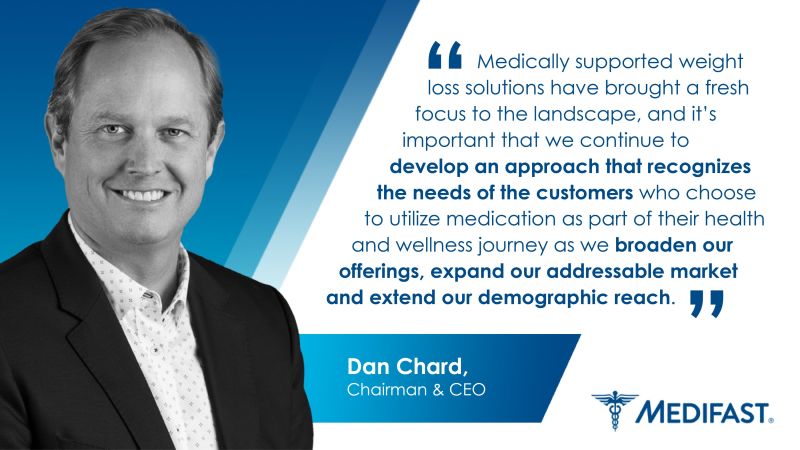
Daniel Chard
 MEDIFAST
About Daniel Chard
Daniel R. Chard is Chairman and Chief Executive Officer of Medifast (MED). He has served as CEO since October 2016 and was appointed Chairman in December 2020; he is 60 years old at the 2025 annual meeting and has been a director since 2016 . Education: BA in Economics (BYU) and MBA (University of Minnesota) . 2024 was an “investment year” focused on transformation amid GLP‑1 pressures; MED reported 2024 revenue of $602M and net income of $2M, with cumulative TSR (from a 2020 baseline) of 19 versus 156 for the S&P 600 Consumer Staples index; management emphasized a strong balance sheet with no debt and internal funding of initiatives .
Board Service at Medifast (Governance and Dual-Role Implications)
- Board roles: Director since 2016; Chairman since 2020; Chair of the Executive Committee .
- Leadership structure: Board combined the CEO and Chairman roles in 2020 and maintains a Lead Independent Director (Jeffrey J. Brown) to balance governance; majority of the Board and all key committees (Audit, Compensation, Nominating/Corporate Governance) are independent .
- Implications: CEO+Chairman concentration is mitigated by a Lead Independent Director with defined authorities (agenda review, executive sessions, succession input), independent committee oversight, and majority‑independent board composition .
Past Roles
| Organization | Role | Years | Strategic impact |
|---|---|---|---|
| PartyLite (Carlyle portfolio co.) | President & COO | 2015–2016 | Operated a direct-selling consumer products platform |
| Nu Skin Enterprises | President, Global Sales & Operations; President, Nu Skin Europe; other roles | 1998–2015 | Led global sales/operations and European business in a scaled direct-selling model |
External Roles
- Not disclosed in the proxy beyond Medifast board leadership .
Fixed Compensation
| Year | Base salary ($) | Target bonus (% of salary) | Actual non‑equity bonus paid ($) |
|---|---|---|---|
| 2024 | 1,000,000 | 115% | 563,500 (49% of target across metrics) |
| 2023 | 1,000,000 | Not stated (no change YoY noted) | 1,322,500 |
| 2022 | 980,624 | Not stated | 943,000 |
Notes: 2024 base salaries were frozen for a second year in light of business conditions; additional equity was granted in lieu of a 4% merit increase to emphasize retention and long-term alignment .
Performance Compensation
Annual Incentive (2024 design and payout)
| Metric | Threshold | Target/Max | Weight | 2024 result | Payout impact |
|---|---|---|---|---|---|
| Q3 Coach Productivity (new customers per AEC) | 0.95 | 1.42 | 20% | 1.05 | Contributed to payout |
| Q4 Coach Productivity (new customers per AEC) | 0.74 | 1.26 | 20% | 0.85 | Contributed to payout |
| Transformation Initiatives | Milestone-based | Milestone-based | 35% | Partially met; 23% achievement | Reduced payout |
| Operating Income Before investments/one‑time items ($M) | 2.70 | 17.60 | 25% | Adj. operating income $49.8M | Drove payout (adjusted) |
- 2024 annual incentive paid at 49% of target for all NEOs, including the CEO .
Long-Term Incentives (granted March 13, 2024)
| Vehicle | Grant date | Target/Units | Vesting | Performance metric(s) | Grant date fair value ($) |
|---|---|---|---|---|---|
| PSUs | 3/13/2024 | 67,631 sh target | Earned over 2024–2026; PSU vesting after 3-year period | Annual revenue growth goals each year; 25–150% earnout in Yr 1; 25–200% in Yrs 2–3; average across 3 years | 2,417,808 |
| RSUs | 3/13/2024 | 45,087 sh | 1/3 annually on 3/13/2025–2027 | Time-based retention | 1,611,860 |
Design notes:
- CEO equity mix is 60% PSUs / 40% RSUs to emphasize pay for performance; for other NEOs, 50%/50% in 2024 .
- For 2024 PSUs, multi-year revenue growth targets were set annually due to transformation and volatility; must be employed through period end (subject to retirement provisions) .
Contingent 2025 Awards (subject to shareholder approval of plan amendment)
| Award | Target units |
|---|---|
| PSUs (target) | 187,430 |
| RSUs | 124,953 |
These awards were granted in Q1’25 contingent on shareholder approval of the Amended & Restated 2012 Plan; PSUs have a three-year performance period ending 12/31/2026 with 50%–211% payout range based on revenue goals (no payout below threshold) .
Multi‑Year CEO Compensation Mix (SCT totals)
| Year | Salary ($) | Stock awards ($) | Non‑equity incentive ($) | All other ($) | Total ($) |
|---|---|---|---|---|---|
| 2024 | 1,000,000 | 4,029,669 | 563,500 | 16,686 | 5,609,855 |
| 2023 | 1,000,000 | 4,604,755 | 1,322,500 | 111,807 | 7,039,062 |
| 2022 | 980,624 | 4,002,009 | 943,000 | 14,603 | 5,940,235 |
Pay-for-performance calibration (SEC “Pay vs Performance”):
- Compensation Actually Paid to CEO: 2024 $0.98M; 2023 $2.93M; 2022 $(0.71)M; alongside cumulative TSR of 19 (vs S&P 600 Consumer Staples 156) and 2024 revenue $602M, net income $2M .
Equity Ownership & Alignment
| Item | Detail |
|---|---|
| Beneficial ownership | 164,949 shares (1.5% of outstanding as of 4/21/2025; base of 10,991,021 shares) |
| Outstanding unvested equity at 12/31/2024 | RSUs: 2,837 ($49,988); 11,205 ($197,432); 45,087 ($794,433). PSUs (target): 25,211 ($444,218); 67,631 ($1,191,658). Market value based on $17.62/share at 12/31/2024 . |
| Scheduled vesting (time-based RSUs) | 2,837 vest 3/16/2025; 11,205 vest 5,602 on 3/17/2025 and 5,603 on 3/17/2026; 45,087 vest 15,029 on 3/13 in 2025, 2026, 2027 . |
| PSU vesting schedules | 25,211 PSUs (target) vest 12/31/2025; 67,631 PSUs (target) vest 12/31/2026 (subject to performance) . |
| Ownership guidelines | CEO required to hold stock worth 5x base salary; until met, must hold at least 50% of shares acquired from awards (net of taxes/option costs) . |
| Hedging/pledging | Strict anti‑hedging; executives and directors prohibited from pledging or holding in margin accounts . |
Vesting-related selling pressure indicators:
- Notable potential share supply aligned to key dates: 3/13/2025–2027 (time‑based RSUs) and 12/31/2025 & 12/31/2026 (PSUs, performance‑contingent) .
- Additional contingent 2025 RSUs/PSUs (subject to approval) would materially increase unvested overhang and future vesting cadence .
- Holding requirements and anti‑pledging policy mitigate forced selling and leverage risk .
Employment Terms (Severance and CIC Economics)
| Scenario | Cash multiple | Bonus treatment | Equity treatment |
|---|---|---|---|
| Termination without Cause / Good Reason (no CIC or >2 years post-CIC) | 1.5x (CEO) of salary + target bonus | Pro‑rated bonus for year of termination based on actual performance | Stock options accelerate; RSUs and PSUs vest pro‑rata (PSUs based on actual performance) |
| Qualifying termination within 2 years following a CIC (double trigger) | 2.5x (CEO) of salary + target bonus | Pro‑rated at greater of target or most recent forecast | Options and time‑based RSUs accelerate; PSUs pro‑rated at greater of target or most recent forecast |
Illustrative payout values as of 12/31/2024 (stock at $17.62):
- Without Cause/Good Reason: cash severance $3,225,000; target bonus $563,500; unvested RSUs $310,136; unvested PSUs $569,524 .
- Post‑CIC double-trigger: cash severance $5,375,000; target bonus $1,150,000; unvested RSUs $1,041,853; unvested PSUs $693,365 .
Policies and protections:
- Clawback policy compliant with NYSE/Dodd‑Frank; recoupment of incentive comp upon restatement, with additional misconduct-based recoupment for non‑Section 16 executives .
- No 280G excise tax gross‑ups for officers; 2012 Plan features include double‑trigger vesting on CIC, minimum vesting, and prohibition on repricing/buyouts without shareholder approval .
Performance & Track Record (Company outcomes through 2024)
| Year | Cumulative TSR (MED) | Cumulative TSR (S&P 600 Cons. Staples) | Net income ($M) | Revenue ($M) |
|---|---|---|---|---|
| 2024 | 19 | 156 | 2 | 602 |
| 2023 | 72 | 154 | 99 | 1,072 |
| 2022 | 117 | 134 | 144 | 1,599 |
| 2021 | 204 | 143 | 164 | 1,526 |
| 2020 | 186 | 111 | 103 | 935 |
Qualitative highlights:
- 2024 transformation priorities (broader acquisition, company-led marketing, GLP-1 access via LifeMD collaboration, product launches) funded through cash and “Fuel for the Future” cost savings; management cites strong balance sheet with no debt .
- Say‑on‑Pay: ~96% approval at 2024 annual meeting, interpreted as support for program design .
Compensation Structure Analysis (alignment, risk, red flags)
- Mix and risk: CEO target equity 60% PSUs/40% RSUs with annual revenue growth as PSU metric; annual bonus weights balanced across productivity, strategic milestones, and adjusted operating income; 2024 payout reduced to 49% of target reflecting under‑achievement on transformation initiative goals .
- Pay calibration vs. outcomes: 2024 SCT total fell to $5.61M from $7.04M in 2023, with Compensation Actually Paid to CEO $0.98M in 2024 reflecting stock price declines and fair value adjustments .
- Governance safeguards: double‑trigger CIC vesting, no repricing, no 280G gross‑ups, clawback, anti‑hedging/pledging, ownership guidelines (5x salary for CEO) .
- Retention lens: Equity awards increased in lieu of cash merit raises to promote stability through transformation; reduces fixed cash while increasing long‑term alignment .
Compensation Committee Analysis (governance of pay)
- Members: Scott Schlackman (Chair), Michael A. Hoer, Andrea B. Thomas; all independent under NYSE/Exchange Act standards .
- Philosophy: target competitive range around market median (50th percentile); emphasize at‑risk pay; annual equity grants with performance orientation .
- Committee asserts no interlocks/insider participation conflicts in 2024 .
Equity Ownership Detail (Outstanding Awards at FY‑end 2024)
| Award type | Unvested units (#) | Market value ($) | Vesting detail |
|---|---|---|---|
| RSU grant (3/16/2022) | 2,837 | 49,988 | Vests 3/16/2025 |
| RSU grant (3/17/2023) | 11,205 | 197,432 | 5,602 on 3/17/2025; 5,603 on 3/17/2026 |
| RSU grant (3/13/2024) | 45,087 | 794,433 | 15,029 on 3/13 in 2025, 2026, 2027 |
| PSU (target, 2023 cycle) | 25,211 | 444,218 | Vests 12/31/2025 (performance‑contingent) |
| PSU (target, 2024 cycle) | 67,631 | 1,191,658 | Vests 12/31/2026 (performance‑contingent) |
Note: Market values based on $17.62 closing price on 12/31/2024; PSUs shown at target .
Investment Implications
- Alignment and incentives: The CEO’s package is heavily performance‑oriented (60% PSUs) with 2024 bonus paying 49% of target, suggesting pay outcomes are responsive to execution and financial performance; ownership guidelines, anti‑hedging/pledging and clawback increase alignment and reduce behavioral risk .
- Near‑term vesting supply: Multiple RSU tranches vest in March 2025–2027 and PSU cliffs in 2025/2026 may create periodic liquidity events; a large contingent 2025 grant (subject to shareholder approval) increases prospective overhang and retention “hold power” .
- Retention vs. dilution trade‑off: Equity in lieu of cash raises supports retention through transformation but raises share-based compensation overhang; plan design restrains repricing and enforces minimum vesting and double‑trigger CIC to protect shareholders .
- Governance of dual role: Combined CEO/Chair is offset by a robust Lead Independent Director mandate and independent committees; investors should monitor board refreshment, succession oversight, and say‑on‑pay outcomes (recently ~96% support) as additional safeguards .
- Execution risk: 2024 outcomes (revenue $602M, net income $2M; cumulative TSR 19 since 2020 baseline) underline the importance of delivering against revenue‑growth PSU goals and customer acquisition initiatives in a GLP‑1‑disrupted market; compensation levers are set to reward tangible operational progress .