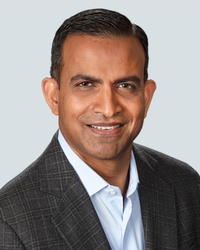
Jugal Vijayvargiya
About Jugal Vijayvargiya
Jugal K. Vijayvargiya, 57, has served as Materion’s President & Chief Executive Officer (CEO) and a member of the Board since March 2017, following a 26‑year international career at Delphi Automotive culminating in leadership of the $3B Automotive Electronics & Safety segment and service on Delphi’s Executive Committee . Under Materion’s pay‑for‑performance design, 2024 adjusted EBIT came in at $131.0M versus a $160.4M target, driving annual bonus funding of 31.43% of target; value‑added sales growth and simplified free cash flow components paid 0%, resulting in a CEO MIP payout of $335,358 . Long‑term performance signals include three‑year PRSU outcomes (2022 grant) of 126.0% on RTSR (58th percentile vs peers) and 54.87% on ROIC (combined 90%), and company cumulative TSR of $170.49 on a $100 base since 12/31/2019; say‑on‑pay support was 94%+ in 2024, evidencing investor alignment with program design .
Past Roles
| Organization | Role | Years | Strategic impact |
|---|---|---|---|
| Materion Corporation | President & Chief Executive Officer; Director | 2017–present | Leads strategic transformation to advanced materials; board leadership as sole management director . |
| Delphi Automotive PLC | Leader, Automotive Electronics & Safety segment; Officer and Executive Committee member; prior roles across engineering, sales, product line, acquisition integration, GM | 26‑year career through 2017 | P&L for ~$3B global segment; deep operating and M&A integration experience . |
External Roles
| Organization | Role | Years | Notes |
|---|---|---|---|
| Sensata Technologies Holding PLC | Director | Since June 2023 | Public company board service adds cross‑industry perspective (no related‑party transactions disclosed) . |
Board Service & Governance
- Materion Board service: Director since 2017; only non‑independent director (8 of 9 directors independent); independent, non‑executive Chair in place since 2018, with regular executive sessions of independent directors .
- Committee roles: Committees (Audit & Risk; Compensation & Human Capital; Nominating, Governance & Corporate Responsibility) are fully independent; as CEO/non‑independent director, he is not listed on standing committees .
- Board attendance & structure: Board met five times in 2024; all directors met 75%+ attendance; declassified board with majority voting policy .
Fixed Compensation
| Component | 2022 | 2023 | 2024 | Notes |
|---|---|---|---|---|
| Base Salary ($) | 821,154 | 881,731 | 944,039 | Base rate increased from $925,000 to $970,000 effective Aug 1, 2024 (+4.86%) . |
| Target Annual Bonus (% of salary) | 110% | 110% | 110% | CEO target unchanged; measures and weights set annually . |
| Actual Annual Bonus ($) | 1,191,471 | 650,793 | 335,358 | 2024 payout at 31.43% of target based on results . |
| Other Compensation ($) | 80,669 | 115,761 | 135,085 | Includes 401(k) match, RDCP employer contribution ($43,580), and dividend equivalents ($73,120) in 2024 . |
Performance Compensation
2024 Annual Incentive (MIP) – Goals, Weights, Results and Payout
| Metric | Weight | Threshold | Target | Max | 2024 Actual | % of Target Earned |
|---|---|---|---|---|---|---|
| Adjusted EBIT ($M) | 70% | 120.3 | 160.4 | 200.5 | 131.0 | 31.43% |
| Value‑Added Sales Growth | 15% | —% | 3.0% | 8.0% | (2.6)% | 0.00% |
| Simplified Free Cash Flow ($M) | 15% | 82.9 | 103.6 | 124.3 | 75.5 | 0.00% |
| Total Payout | — | — | — | — | — | 31.43% |
- CEO’s 2024 MIP payout: Target $1,067,000; Payout $335,358 (31.43% of target) .
2024 Long‑Term Incentive Grants (mix: SARs, RSUs, PRSUs)
| Award | Shares Granted | Vesting/Performance | Grant Date Fair Value ($) |
|---|---|---|---|
| SARs (exercise $135.58) | 19,284 | Vests 1/3 annually over 3 years; 7‑yr term; settled in shares | 973,071 |
| RSUs | 7,479 | Vests 1/3 annually over 3 years | 1,014,003 |
| PRSUs – RTSR | 7,479 target | 3‑yr relative TSR vs peer group; 0–200% payout; cliff vest | 1,442,923 |
| PRSUs – ROIC | 7,479 target | 3‑yr average ROIC with threshold 9.4%, target 11.8%, max 14.2%; 0–200% payout; cliff vest | 1,014,003 |
| Total | — | — | 4,444,000 |
- Design: 75% of CEO’s 2024 target LTI opportunity is performance‑based (PRSUs), with SARs inherently performance‑oriented (value only if price appreciates) .
Performance Outcomes on Outstanding Cycles
| Grant Year | Performance Period | RTSR Percentile | Combined Payout % |
|---|---|---|---|
| 2022 PRSUs | 2022–2024 | 57.8% | 90.0% |
- 2022 PRSUs earned units (incl. dividend equivalents): CEO 12,588 .
Equity Ownership & Alignment
Beneficial Ownership and Guideline Compliance
| Holder | Shares Beneficially Owned | % of Class | Within 60 days: SARs Exercisable | Within 60 days: RSUs/PRSUs Vesting |
|---|---|---|---|---|
| Jugal K. Vijayvargiya | 249,949 | 1.2% | 127,611 | 21,246 |
- Ownership guidelines: CEO 6x salary (raised from 5x in 2025); all covered NEOs met guidelines as of 12/31/2024; anti‑hedging and anti‑pledging policies apply to executives and directors .
- No related‑party transactions in 2024 .
Outstanding Equity and Near‑Term Vesting/Exercise Profile (12/31/2024)
| Instrument | Exercisable | Unexercisable | Key Terms |
|---|---|---|---|
| SARs (total counts) | 106,492 | 41,651 | Multiple grants; 7‑year terms; typical 1/3 annual vesting; settlement in shares . |
| RSUs (unvested) | — | 15,352 | 1/3 vests annually; MV $1,518,006 at $98.88 on 12/31/2024 . |
| PRSUs @ target (unearned) | — | 31,588 | RTSR and ROIC cycles; MV $3,123,421 at $98.88 on 12/31/2024 . |
Selected SAR lots (strike; expiry): 32,122 @ $58.30 exp 2/22/2026; 28,071 @ $50.95 exp 2/19/2027; 24,594 @ $68.82 exp 2/17/2028; 14,030/7,015 @ $80.85 exp 3/1/2029; 7,675/15,352 @ $113.28 exp 3/1/2030; 0/19,284 @ $135.58 exp 3/1/2031 .
2024 Share Delivery and Liquidity Signals
| Item | Shares | Value ($) |
|---|---|---|
| Shares acquired on option/SAR exercise (2024) | 24,791 | 1,750,245 |
| Shares acquired on vesting (2024) | 34,856 | 4,603,626 |
- Near‑term supply: 21,246 RSUs/PRSUs scheduled to vest within 60 days of 1/31/2025 may create incremental selling pressure (personal liquidity or tax) depending on trading plans .
Ownership Policy and Pledging/Hedging
- CEO must retain 75% of net shares until guideline met; hedging and pledging of company stock are prohibited, mitigating misalignment/forced‑sale risk .
Employment Terms
Agreements and Policies
- No employment contract; CEO has a Severance Agreement; double‑trigger vesting applies for equity upon change in control; no excise tax gross‑ups; robust clawback policies compliant with NYSE/SEC plus supplemental misconduct policy .
Severance and Change‑in‑Control (CIC) Economics (as of 12/31/2024)
| Component | Involuntary Not For Cause / Qualifying Resignation | Involuntary or Good Reason Termination after CIC |
|---|---|---|
| Cash (salary/bonus) | 3,049,472 | 4,074,000 |
| Welfare benefits | 33,847 | 45,129 |
| Outplacement | 20,000 | 20,000 |
| Pro‑rata MIP for year of CIC | N/A | 1,067,000 |
| SARs vesting acceleration | 126,480 | 126,480 |
| RSU/PRSU vesting acceleration | 2,935,776 | 4,641,427 |
| Total | 6,165,575 | 9,974,036 |
- Non‑CIC severance terms: Lump sum of 150% of highest salary plus three‑year average annual incentive (or target if within first three years); RSUs vest 100%; PRSUs vest pro‑rata based on actual performance; SARs fully vest and are exercisable; 18 months of benefits; up to $20,000 outplacement .
- Restrictive covenants: Non‑compete and non‑solicit generally for two years post‑termination; confidentiality and IP assignment obligations continue post‑separation .
Deferred Compensation and Retirement
| Plan | 2024 Executive Contributions ($) | 2024 Company Contributions ($) | 2024 Earnings ($) | 12/31/2024 Balance ($) |
|---|---|---|---|---|
| Restoration & Deferred Compensation Plan (RDCP) | 517,575 | 43,580 | 175,275 | 1,400,277 |
- No defined benefit pension/SRBP participation for CEO; perquisites limited to periodic executive physicals .
Compensation Structure Analysis
- High at‑risk pay: ~83% of CEO pay is performance‑based via annual and long‑term incentives; 2024 LTI weighted 75% to PRSUs (RTSR and ROIC), with SARs performance‑contingent on share price appreciation .
- Objective, formulaic MIP: 2024 payouts were strictly formulaic with no positive discretion; EBIT under‑target and negative VAS growth/SFCF led to a 31.43% payout, consistent with pay‑for‑performance alignment .
- Governance protections: Double‑trigger CIC equity vesting, no option/SAR repricing without shareholder approval, robust clawbacks, no excise tax gross‑ups, anti‑hedging/pledging, and ownership/holding requirements support investor alignment .
- Shareholder feedback: 2024 say‑on‑pay received over 94% approval; committee continues to monitor market practices with FW Cook as independent advisor .
Risk Indicators & Red Flags
- Late Section 16 filings: One Form 4 for two transactions filed late in 2024 due to administrative error (also occurred for other NEOs); monitor for remediation of reporting controls .
- No related‑party transactions, no hedging/pledging permitted, no option repricing, and clawbacks in place; committees fully independent .
- Potential selling pressure: Material share deliveries in 2024 (exercises and vesting), plus 21,246 RSUs/PRSUs vesting within 60 days of 1/31/2025, could create episodic liquidity events (subject to trading plans) .
Say‑on‑Pay, Peer Group & Consultant
- 2024 say‑on‑pay approval exceeded 94% .
- Compensation peer group refined for 2024 to align with advanced materials strategy; FW Cook advises as independent consultant with no conflicts .
Expertise & Qualifications
- Deep operating, engineering, and P&L leadership across automotive electronics, product/manufacturing engineering, and acquisition integration; officer‑level experience at Delphi and multi‑industry board exposure (Sensata) .
Investment Implications
- Alignment: High at‑risk mix (RTSR/ROIC PRSUs; SARs) and stringent governance (double‑trigger CIC, clawbacks, anti‑hedging/pledging, higher ownership multiple) support shareholder alignment and disciplined risk‑taking .
- Retention and succession: Meaningful unvested equity (RSUs and PRSUs) and non‑CIC/CIC severance terms (cash + accelerated vesting) create retention hooks; non‑compete/non‑solicit covenants further mitigate transition risk .
- Trading signals: Watch for periodic supply from vesting cliffs (PRSUs/RSUs) and SAR exercises; 2024 saw $6.35M+ value realized from equity; next 60‑day vesting cohort totals 21,246 shares .
- Pay‑for‑performance: 2024 annual plan paid down materially (31.43%) on under‑target EBIT and negative VAS/SFCF, while three‑year PRSU outcomes remain mixed but positive (RTSR above median, ROIC near threshold‑to‑target), reinforcing performance sensitivity across cycles .
- Governance/independence: CEO is a director but not independent; mitigated by an independent Chair and fully independent committees with regular executive sessions, reducing dual‑role governance risk .