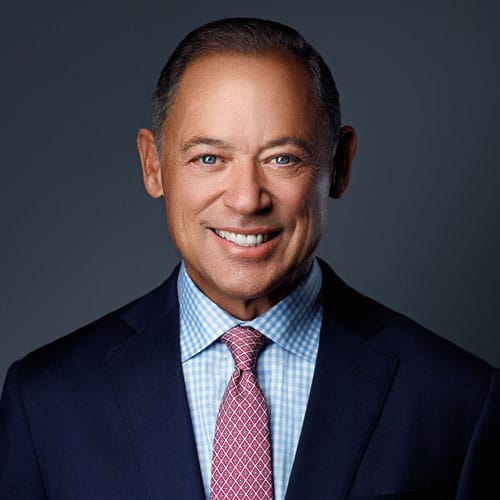
G. Timothy Laney
About G. Timothy Laney
G. Timothy Laney is Chairman and CEO of National Bank Holdings Corporation; he has served as CEO since 2010 and Chairman since 2014, and as a director since 2010 . Age 64 . He was a founder of NBHC and previously Senior EVP and Head of Business Services at Regions Financial (joined in 2007), following a 24-year tenure at Bank of America in senior roles including President of Bank of America, Florida . 2024 operating metrics cited by the Compensation Committee include diluted EPS of $3.08 ($3.22 adjusted), ROAA of 1.20% (1.36% adjusted tangible), Q4 2024 net interest margin of 3.99%, 4.7% average deposit growth, 11% tangible book value per share growth, CET1 of 13.20%, and adjusted efficiency ratio of 58.69%; 5-year diluted EPS CAGR of 3% . Say‑on‑pay approval was 97.7% at the 2024 annual meeting, with proactive shareholder engagement .
Past Roles
| Organization | Role | Years | Strategic Impact |
|---|---|---|---|
| Regions Financial | Senior EVP, Head of Business Services | Joined late 2007 | Led transformation of wholesale businesses |
| Bank of America | Senior management roles; President of Bank of America, Florida | 24-year tenure | Oversaw 800 banking centers and ~$50B assets; member of Management Operating Committee |
External Roles
| Organization | Role | Years | Notes |
|---|---|---|---|
| Federal Reserve Bank of Kansas City, Denver Branch | Board Member | As of 2025 | Regional monetary and supervisory oversight |
| Finexio | Board Member | Current | Fintech payments |
| Moffitt Cancer Center | Board Member | Current | Non-profit healthcare governance |
| USA Weightlifting Foundation | Chairman | Current | Foundation leadership |
| NBH Bank Do More Charity Challenge | Founder | Ongoing | Corporate philanthropy |
| Colorado Bankers Association | Board Member | Prior | Industry advocacy |
Fixed Compensation
| Metric | 2022 | 2023 | 2024 |
|---|---|---|---|
| Base Salary ($) | $826,923 | $850,000 | $850,000 |
| Target Bonus (% of Salary) | ≥90% per employment agreement | 100% STIP target of salary | 100% STIP target of salary |
| Short-Term Incentive Paid (Cash) ($) | $1,302,404 | $1,114,350 | $1,208,700 |
| Long-Term Incentive (Equity grant-date fair value) ($) | $1,049,904 | $1,441,511 | $1,664,934 |
| All Other Compensation ($) | $111,158 | $172,240 | $222,205 (incl. aircraft personal use $146,871, 401k/NDCP match $69,280, imputed life insurance $5,940) |
| Total Compensation ($) | $3,290,389 | $3,578,101 | $3,945,839 |
Notes:
- Director fees: Laney does not receive separate director compensation; director equity and cash retainers exclude the CEO .
- Corporate aircraft personal use capped at 40 hours/year for CEO; 2024 personal-use value $146,871 .
Performance Compensation
Annual Short-Term Incentive Plan (STIP) – Design and 2024 Outcomes
| Metric | Weighting | Threshold | Target | Maximum | Actual | Payout/Weighting Achieved |
|---|---|---|---|---|---|---|
| Core Net Income ($000s) | 40% | $102,129 | $120,152 | $126,160 | $124,395 | 54.1% weighting achieved |
| Non-Performing Assets Ratio | 30% | 0.80% | 0.65% | 0.50% | 0.47% | 45.0% weighting achieved |
| ERM & Doing Good (Qual.) | 15% | 80% | 100% | 120% | 115% | 20.6% weighting achieved |
| Individual (Qual.) | 15% | 80% | 100% | 120% (200% for exceptional) | CEO: 120% | 15% (CEO achieved 150% of target on this component) |
| Total STIP Payout (% of Target) | — | — | — | — | — | CEO: 142.2% |
STIP payout range: Threshold 50%, Target 100%, Max 157.5% of target for HoldCo executives . CEO 2024 STIP paid $1,208,700 (142.2% of target) .
Long-Term Incentives – Grants and Vesting
| Award | Grant Date | Target Units/Shares | Vesting | Performance Metrics | Payout Range |
|---|---|---|---|---|---|
| 2024 Restricted Stock | 04/01/2024 | 23,510 shares | Time-based; 1/3 annually, first tranche vests 04/28/2025; dividends paid as declared | N/A | N/A |
| 2024 PSUs | 04/01/2024 | 23,621 target units | Performance period 01/01/2024–12/31/2026; vests 03/01/2027; dividends accrue and pay pro‑rata on earned units | 33% cumulative adjusted EPS; 33% 3‑yr relative TSR vs S&P 600 Regional Bank Group; 33% relative ROTA vs S&P 600 Regional Bank Group | 50% (threshold), 100% (target), 150% (max) |
| 2022 PSUs | 2022 | — | Performance period 01/01/2022–12/31/2024; vested 03/01/2025 | 60% 3‑yr adjusted EPS; 40% 3‑yr relative TSR vs KRX Index; TSR governor caps >100% if TSR negative | Actual payout 111% of target (EPS $10.53; TSR 36th percentile) |
Equity Ownership & Alignment
| Metric | Value |
|---|---|
| Total beneficial ownership | 505,198 shares (1.3% of shares outstanding) |
| Composition details | Includes 34,485 unvested restricted shares with voting rights; 125,377 shares issuable upon option exercise; 8,859 shares held in a 2012 GRAT; 80,278 presently exercisable stock options held as constructive trustee for benefit of former spouse (disclaimed) |
| Insider trading policy | Hedging and short sales prohibited; pledging of Company securities prohibited for designated persons (including NEOs) |
| Stock ownership guidelines (executive) | CEO required to own 5x base salary; retention of 50% after-tax portion of vested/exercised awards until threshold met |
| Compliance status | As of March 10, 2024, CEO met Executive Minimum Ownership Threshold |
| Ownership guidelines (director) | Non‑employee directors required to hold 5x annual cash retainer; CEO not subject to director guideline |
Option Holdings and Terms (as of 12/31/2024)
| Exercisable | Unexercisable | Strike | Expiration |
|---|---|---|---|
| 26,683 | — | $34.04 | 03/01/2027 |
| 37,042 | — | $32.65 | 03/01/2028 |
| 33,386 | — | $34.08 | 04/01/2029 |
| 63,444 | — | $23.10 | 04/01/2030 |
| 21,761 | — | $40.16 | 04/01/2031 |
| 12,938 | 6,470 | $40.83 | 04/01/2032 |
| 10,401 | 20,803 | $33.46 | 04/01/2033 |
Insider transactions and vesting:
- 2024 option exercises: 81,759 shares exercised (some delivered to a former spouse under divorce decree) .
- 2024 stock vested: 24,564 shares (performance units and time‑based restricted stock) .
Employment Terms
| Term | Detail |
|---|---|
| Agreement term | Employment agreement auto-renews annually unless 90 days’ prior notice; minimum base salary $750,000; target bonus ≥90% of salary (reviewed annually) |
| Severance (pre‑CIC) | If terminated without cause or for good reason: earned but unpaid amounts; pro‑rated bonus; lump sum equal to 3x base salary + 3x greater of target bonus or prior year bonus |
| Change‑in‑control (CIC) | Double‑trigger equity acceleration; enhanced severance terms embedded in NEO agreements; no tax gross‑ups; excise tax cutback if beneficial |
| Restrictive covenants | Non‑compete and non‑solicit while employed; post‑termination non‑compete/non‑solicit: 3 years if termination without cause/for good reason within 2 years post‑CIC; otherwise 1 year |
| Clawbacks | Contractual clawbacks plus NYSE/SEC‑compliant Compensation Recovery Policy adopted Nov 2023; recovery of incentive comp after accounting restatement; misconduct clawback provisions in employment and equity agreements |
| Deferred compensation (NDCP) | Executive contributions $78,574; Company match $58,930; earnings $131,144; year‑end balance $2,283,437 (CEO) |
| Perquisites | Corporate aircraft personal use permitted up to 40 hours/year for CEO; 2024 personal-use value $146,871 |
Board Governance
- Board service: Director since 2010; Chairman since 2014; CEO since 2010; also chairs and serves on subsidiary boards/trust committee . Independence: Board affirmed independence for all directors except Laney due to his executive role .
- Leadership structure: Combined Chairman/CEO role since 2014, mitigated by an empowered Independent Lead Director (Ralph W. Clermont) with defined authorities; Board meets in executive session without management at least four times annually; all standing committees are independent-only and led by independent chairs .
- Committee roles: Audit & Risk, Compensation, and Nominating & Governance committees are fully independent; Laney is not a committee member .
- Board attendance: In 2024, Board held five meetings; all directors attended at least 75% of Board and committee meetings; all directors attended the 2024 annual meeting .
- Director compensation: Non‑employee directors receive cash retainers and restricted stock; Laney receives no director pay due to executive status .
Dual‑role implications:
- Governance safeguards include Lead Independent Director with ex officio membership on all committees and authority over agendas and executive sessions, and regular executive sessions without management . This structure partially mitigates risks of combined Chair/CEO, but investors should monitor independence and effectiveness of lead director oversight.
Compensation Structure Analysis
- Pay mix: 73% of CEO compensation is at‑risk; long‑term equity is 50% PSUs, 50% time‑based RS for annual grants; capped payouts (STIP 157.5%; PSU 150% max); no option repricing; no CIC tax gross‑ups .
- Performance metrics alignment: STIP metrics tied to Core Net Income and Asset Quality; PSUs tied to cumulative adjusted EPS, relative TSR, and relative ROTA—all linked to shareholder value and prudential risk .
- Peer benchmarking: 20‑company peer group with median market cap ~$1B; emphasis on tech‑forward banks to reflect NBHC’s evolving model (e.g., Axos Financial, Triumph Financial added) .
- Say‑on‑pay support: 97.7% approval in 2024; shareholder engagement with holders representing 67.5% of shares outstanding; no reported concerns .
Compensation & Ownership Tables
CEO Compensation Trend
| Metric | 2022 | 2023 | 2024 |
|---|---|---|---|
| Salary ($) | $826,923 | $850,000 | $850,000 |
| STI Paid ($) | $1,302,404 | $1,114,350 | $1,208,700 |
| LTI Grant Value ($) | $1,049,904 | $1,441,511 | $1,664,934 |
| All Other ($) | $111,158 | $172,240 | $222,205 |
| Total ($) | $3,290,389 | $3,578,101 | $3,945,839 |
Beneficial Ownership Breakdown (as of March 10, 2025)
| Item | Amount |
|---|---|
| Total beneficial ownership (shares) | 505,198 |
| Ownership % | 1.3% |
| Unvested restricted shares (with voting rights) | 34,485 |
| Shares issuable upon option exercise (current) | 125,377 |
| Trust holdings (2012 GRAT) | 8,859 |
| Options held as constructive trustee for former spouse (disclaimed) | 80,278 |
Employment Contracts & Economics
| Provision | Key Terms |
|---|---|
| Severance (without cause/good reason, pre‑CIC) | 3x base + 3x higher of target/prior bonus; pro‑rated current year bonus; earned but unpaid comp |
| CIC equity | Double‑trigger acceleration on unvested equity |
| Non‑compete/non‑solicit | 3 years if termination within 2 years post‑CIC; otherwise 1 year; applies to associates/clients/partners |
| Clawback | Contractual and NYSE/SEC‑compliant recovery policy; applies post‑restatement and misconduct |
| Tax | Excise tax cutback if more favorable on after‑tax basis; no CIC gross‑ups |
Investment Implications
- Alignment: High proportion of at‑risk pay with rigorous STIP and PSU metrics, anti‑hedging/anti‑pledging, and robust ownership guidelines (CEO ≥5x salary, achieved) are positive for pay‑for‑performance alignment .
- Retention and supply pressure: 2024 granted RS tranches start vesting April 28, 2025 and PSUs vesting March 1, 2027; 2024 saw significant option exercises (81,759 shares). Monitor blackout windows and any Form 4 activity around vestings, though pledging is prohibited which reduces forced‑sale risk .
- Governance: Combined Chair/CEO role is mitigated by a strong Lead Independent Director structure and independent committees; continue to evaluate effectiveness of oversight, especially as NBHC advances fintech initiatives (2UniFi, Cambr) that can alter risk profile .
- Change‑of‑control economics: Double‑trigger equity acceleration and 3x cash severance create potential transaction costs but are within common market practice; absence of tax gross‑ups is shareholder‑friendly .
- Performance trajectory: 2024 fundamentals solid (EPS, ROAA, NIM, CET1, TBVPS growth) and PSU payouts for the 2022 cycle at 111% indicate measured performance discipline; sustainment of asset quality will be key given STIP weighting on NPAs .