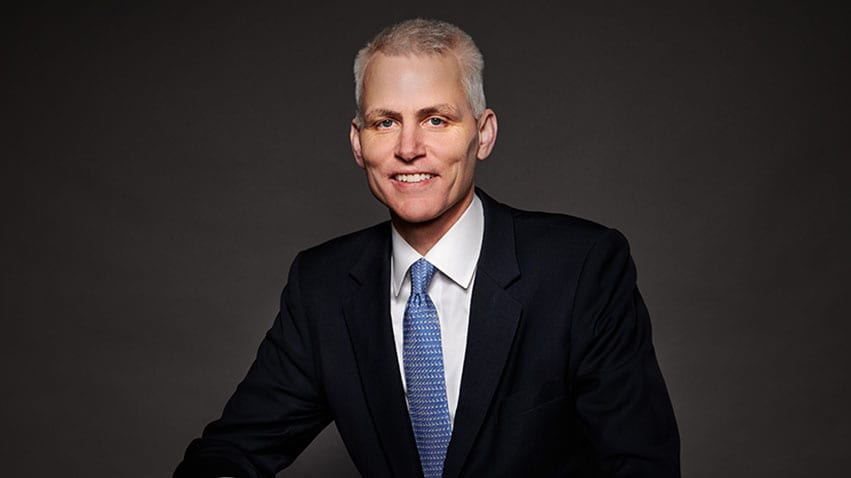
Michael O’Grady
 NORTHERN TRUST
About Michael O’Grady
Michael G. O’Grady is Chairman (since 2019) and Chief Executive Officer (since 2018) of Northern Trust Corporation (NTRS) and chairs the Board’s Executive Committee; he previously served as President (since 2017), President of Corporate & Institutional Services (2014–2016), and CFO (2011–2014) after a decade at Bank of America Merrill Lynch as Managing Director (2000–2011) . He is 59 and has been a director since 2017; he also serves on Abbott Laboratories’ board (since 2023) . Under his leadership in 2024: total revenue reached a record $8.3B (up 22%, with a noted Visa exchange gain), trust/investment/servicing fees rose 8% to $4.7B, pre‑tax margin improved to 32.1% (from 21.6%), ROE was 17.4% (above a 10–15% target), and diluted EPS was $9.77 (from $5.08) . Pay-versus-performance disclosures show 2024 compensation actually paid to the CEO and company TSR progression alongside Adjusted ROE (13.7%) and net income ($2,031M) with a $100 initial investment valued at $113.12 vs KBW Banks at $132.60 .
Past Roles
| Organization | Role | Years | Strategic impact |
|---|---|---|---|
| Northern Trust Corporation | Chairman of the Board | 2019–Present | Unified board leadership; leads strategy execution as combined Chair/CEO |
| Northern Trust Corporation | Chief Executive Officer | 2018–Present | Drove “One Northern Trust” strategy; improved ROE and margins in 2024 |
| Northern Trust Corporation | President | 2017–Present | Enterprise leadership across businesses |
| Northern Trust Corporation | President, Corporate & Institutional Services | 2014–2016 | Led institutional franchise |
| Northern Trust Corporation | Chief Financial Officer | 2011–2014 | Financial leadership, capital, and reporting |
| Bank of America Merrill Lynch | Managing Director, Investment Banking | 2000–2011 | Capital markets and advisory experience |
External Roles
| Organization | Role | Years | Notes |
|---|---|---|---|
| Abbott Laboratories | Director | 2023–Present | Current public company directorship |
Fixed Compensation
| Metric (USD) | 2022 | 2023 | 2024 |
|---|---|---|---|
| Base salary | $987,500 | $1,000,000 | $1,000,000 |
Performance Compensation
- CEO 2024 incentive structure: 80% corporate performance and 20% individual performance; corporate achieved 88% of target; individual 95%; combined outcome 89% of target . At the CEO’s request, the Committee applied negative discretion, setting incentive at $8.2M (vs $9.345M calculated), holding total direct compensation at $9.2M (same as 2023) .
| Component | Weighting / Structure | Target/Actual | Payout/Outcome | Vesting |
|---|---|---|---|---|
| Corporate performance | 80% | 88% achievement | 70% weighted payout | N/A (drives award sizing) |
| Individual performance | 20% | 95% achievement | 19% weighted payout | N/A (drives award sizing) |
| Short‑term cash incentive | ≤25% of incentive | 2024 actual: $2,050,000 | Included in $8.2M total incentive | Cash paid; annual |
| Performance Stock Units (PSUs) | 65% of LTI | 2024 grant value: $3,997,500 | Earned on 3‑yr absolute/relative ROE | 3‑year performance period |
| Restricted Stock Units (RSUs) | 35% of LTI | 2024 grant value: $2,152,500 | Time-based | Vest 25% per year over 4 years |
PSU design and payout calibration:
- Metric: 50% three‑year average absolute ROE; 50% three‑year average ROE vs peer group (large U.S. financials) with a 0–150% payout scale; absolute ROE target 11–12% for 2025 grants .
- Realization: PSUs granted in 2022 paid at 129.8% of target based on adjusted three‑year average ROE of 13.6% and relative ROE at the 83.7th percentile; O’Grady received 63,107 shares on Feb 18, 2025 .
Multi‑year CEO compensation (Summary Compensation Table):
| Component (USD) | 2022 | 2023 | 2024 |
|---|---|---|---|
| Stock awards (grant-date fair value) | $8,500,158 | $8,500,150 | $7,700,038 |
| Non‑equity incentive (cash) | $1,000,000 | $500,000 | $2,050,000 |
| Change in pension value | $289,639 | $138,719 | $137,067 |
| All other compensation | $39,342 | $35,891 | $42,681 |
| Total | $10,816,639 | $10,174,760 | $10,929,786 |
Say‑on‑Pay support (context): 95% approval in 2024 for 2023 NEO compensation .
Equity Ownership & Alignment
| Item | Detail |
|---|---|
| Total beneficial ownership | 439,051 shares (340,174 shares + 98,877 options) (<1% of class) as of 12/31/24 |
| Options outstanding (exercisable) | 23,739 @ $70.21 exp 2/17/25; 34,489 @ $58.25 exp 2/16/26; 40,649 @ $88.06 exp 2/21/27 |
| Unvested RSUs (and value) | 73,590 units; $7,542,975 at $102.50 (12/31/24) |
| PSU unearned (max and value) | Max 255,096 units; $26,147,340 at $102.50 (12/31/24) |
| 2022 PSU distribution | 63,107 shares delivered 2/18/25 |
| Scheduled RSU vesting | 27,846 (3/1/2025); 21,966 (3/1/2026); 15,686 (3/1/2027); 8,092 (3/1/2028) |
| Stock ownership guideline | CEO = 8x base salary; all NEOs met/exceeded guidelines as of 12/31/24 |
| Hedging/pledging policy | Prohibits short selling, margining, pledging, and hedging of NTRS shares |
Implications for supply/pressure:
- Near‑term equity deliveries include annual RSU tranches each March and periodic PSU settlements (e.g., 2/18/25), which can create potential selling windows; actual sales are subject to policy and individual decisions (no hedging/pledging allowed) .
Employment Terms
| Topic | Terms |
|---|---|
| Severance plan (non‑CIC) | U.S. plan for involuntary terminations: lump sum based on tenure; COBRA subsidy; full vesting under retirement plans; special pro‑rata NPIP payment for H2 notices (policy caps apply under 409A) |
| Change‑in‑control (CIC) plan | Double‑trigger: benefits upon qualifying termination within 2 years post‑CIC. CEO multiple: 3x (salary + 3‑yr average cash incentive) plus pro‑rata bonus and 36 months of welfare benefits; cutback (no excise tax gross‑ups) |
| CEO CIC payout illustration | If terminated in connection with CIC on 12/31/24: $34,970,944 total (Cash severance $7,000,000; Pro‑rata bonus $1,333,333; Welfare $65,346; RSUs $8,167,273; PSUs $18,404,992; based on $102.50 share price) |
| Death/Disability/Retirement | RSUs and PSUs fully vest or continue to vest per award terms; total equity value illustration $26,572,265 as of 12/31/24 |
| Clawback | Rule 10D‑1 recoupment policy covering incentive‑based compensation for accounting restatements; broader forfeiture/recoupment for misconduct and “significant risk outcomes” |
Board Governance
- Role and independence: O’Grady is combined Chair/CEO and not independent under NASDAQ; the Board uses a robust Lead Director model (Jay L. Henderson) with authority over agendas, executive sessions, and stockholder engagement .
- Committees: All standing committees are composed solely of independent directors except the Executive Committee (which O’Grady chairs) .
- Attendance and oversight: In 2024, the Board met 17 times; all incumbents attended ≥75% of Board/committee meetings; independent directors met in 14 executive sessions .
- Securities policy: Prohibits short selling, margining, pledging, and hedging of company stock .
Board service history and committee roles for O’Grady:
- Director since 2017; Chairman since 2019; Executive Committee Chair; no other committee memberships (executive-only) .
- Dual‑role implications: Combined Chair/CEO structure mitigated via a strong Lead Director and fully independent committees (except Executive) to enhance oversight and independence .
Compensation Committee Analysis and Peer Benchmarking
- Governance practices include high at‑risk pay mix, 65% PSUs in LTI, clawbacks, ownership guidelines, and no option repricing or excise tax gross‑ups .
- Independent consultant: Meridian Compensation Partners advises the Committee; no conflicts identified .
- Compensation peer group includes BNY Mellon, State Street, PNC, U.S. Bancorp, Schwab, BlackRock, Truist, Fifth Third, Franklin Resources, KeyCorp, M&T, T. Rowe Price .
Performance & Track Record
| Measure | 2023 | 2024 |
|---|---|---|
| Total revenue | $6.8B | $8.3B (record; includes Visa exchange gain) |
| Trust/investment/servicing fees | $4.4B | $4.7B |
| Pre‑tax margin | 21.6% | 32.1% |
| ROE (GAAP) | 10.0% | 17.4% |
| Diluted EPS | $5.08 | $9.77 |
| Pay‑vs‑Performance: Adjusted ROE | 12.1% | 13.7% |
| TSR ($100 initial investment) | $90.05 (Corp) vs $96.65 (KBW) | $113.12 (Corp) vs $132.60 (KBW) |
Strategic execution in 2024 under “One Northern Trust”:
- Optimized growth across Wealth Management, Asset Servicing, and Asset Management; productivity initiatives and AI/automation; strengthened resiliency and risk management; CET1 12.4% at year-end 2024 .
Director Compensation (context for dual role)
- Non‑employee director compensation is disclosed separately; O’Grady, as an employee director/CEO, is compensated under the executive program (see Performance Compensation above) .
Compensation Structure Diagnostics (signals)
- Mix shifts and at‑risk profile: CEO incentive ≥75% equity; LTI = 65% PSUs (3‑year ROE absolute/relative), 35% RSUs (4‑year vest) — aligns pay with sustained returns and peer‑relative performance .
- Target‑based CEO framework: 2024 set at $10.5M with 150% cap; negative discretion applied to maintain employee alignment — a governance positive .
- Clawbacks and risk: Comprehensive clawback and risk‑sensitive design (deferred equity, multi‑year metrics, capped payouts) reduce risk‑taking incentives .
- Say‑on‑Pay: 95% approval indicates strong shareholder support .
Risk Indicators & Red Flags
- Pledging/hedging prohibited (reduces alignment risk) .
- No excise tax gross‑ups; CIC cutback/best‑net approach (shareholder‑friendly) .
- Combined Chair/CEO mitigated by strong Lead Director and independent committees (oversight remains a focal point) .
Employment Economics – Change‑in‑Control
| Scenario (12/31/24) | Amount (USD) |
|---|---|
| CIC + qualifying termination total | $34,970,944 (cash severance $7,000,000; pro‑rata bonus $1,333,333; welfare $65,346; RSUs $8,167,273; PSUs $18,404,992) |
| Death/Disability/Retirement total (equity effects) | $26,572,265 |
Investment Implications
- Alignment and performance sensitivity: High equity mix and ROE‑based PSUs tie realizable pay to sustained profitability and peer‑relative results; 2022 PSUs paid 129.8% on strong 3‑yr ROE, signaling upside leverage when returns outperform .
- Retention and overhang: Meaningful unvested PSUs/RSUs (and options through 2027) create retention hooks but also future share supply on vesting/settlement dates (e.g., RSU tranche 3/1 annually; PSU settlement like 2/18/25); monitor Form 4 filings around these windows for selling pressure .
- Governance quality: No hedging/pledging, robust clawbacks, strong Say‑on‑Pay support, and independent committee oversight mitigate governance risk despite combined Chair/CEO structure .
- Change‑in‑control math: Double‑trigger CIC terms with 3x cash multiple and accelerated equity could be sizable ($35M illustration), implying potential cost in strategic transactions but standard relative to peers; absence of tax gross‑ups limits shareholder friction .
Net: Compensation design is performance‑weighted with clear ROE linkages, ownership requirements, and risk controls. For trading, watch scheduled RSU vest dates and PSU settlement events; for governance, the Lead Director model and strong shareholder support offset combined Chair/CEO concerns .