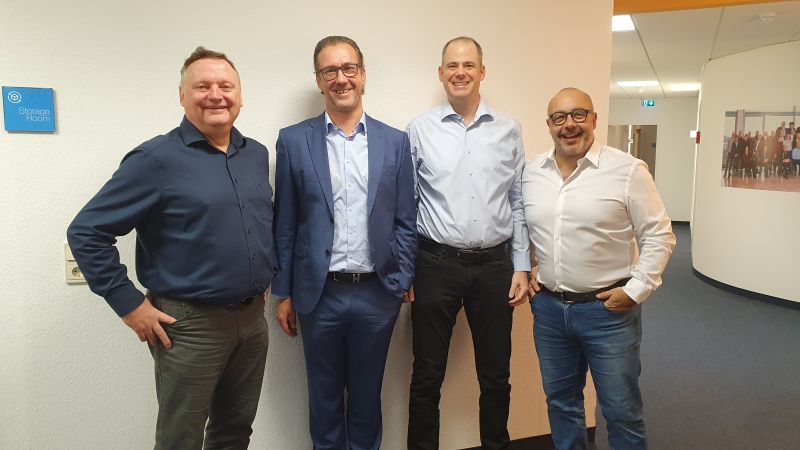
Daniel A. Baker
About Daniel A. Baker
Daniel A. Baker is President and CEO of NVE Corporation and has served on NVE’s board since 2001, with 24 years of board tenure and age 67 as of June 13, 2025 . He holds a Ph.D. and MBA from the University of Minnesota and a B.S. in Biomedical Engineering from Case Western Reserve University, with more than 35 years of public tech company executive experience prior to NVE . For fiscal 2025, NVE reported income from operations of $16.0 million, net income of $15.1 million (EPS $3.12), gross margin of 84%, operating income margin of 62%, and a 3‑year total shareholder return of 39% (17% price appreciation, 22% dividends), reflecting an industry downturn but improved sequential revenue into year‑end . The board has an independent Chairman separate from the CEO, and all directors other than Baker are independent, with independent director executive sessions at every regular meeting to mitigate dual‑role risks .
Past Roles
| Organization | Role | Years | Strategic Impact |
|---|---|---|---|
| Printware, Inc. | President & CEO; Director | 1993–2001 (CEO); 1993–2000 (Director) | Led a publicly traded manufacturer of high-speed imaging systems, bringing public company leadership and B2B product development and sales experience . |
| Minntech (Cantel Medical/STERIS) | Director of Electronic Development | Not disclosed | Added medical technology and engineering experience relevant to NVE’s sensor markets . |
| Percom Data Corporation | Director of Engineering | Not disclosed | Expanded electronics/engineering leadership background prior to NVE . |
External Roles
| Organization | Role | Years | Notes |
|---|---|---|---|
| Printware, Inc. | Director | 1993–2000 | Public company board service prior to NVE; biography confirms experience on other public boards . |
Fixed Compensation
| Metric | FY 2023 | FY 2024 | FY 2025 |
|---|---|---|---|
| Salary ($) | 400,000 | 419,600 | 435,545 |
| Bonus ($) | – | – | – |
| All Other Compensation ($) | 13,290 | 14,743 | 13,267 |
| Total ($) | 1,055,480 | 577,985 | 586,515 |
Notes: “All other compensation” includes company 401(k)/HSA contributions and life/LTD premiums under the same terms as employees . FY25 total increased ~1% year over year driven by salary and option value increase, partially offset by lower performance‑based compensation amid lower operating income .
Performance Compensation
Annual Incentive Plan Structure and Outcomes
| Item | Details |
|---|---|
| Performance metric | Income from operations (excludes interest income and taxes; rewards revenue growth and cost control) . |
| Formula (CEO) | 0.5% of adjusted income from operations in FY2025 plus 5% of the increase in income from operations vs. FY2024 (threshold: positive operating income) . |
| Plan governance | Fiscal‑year plans approved by Compensation Committee at start of year; no fixed allocation policy between salary vs performance pay; no peer benchmarking targets . |
| Payouts ($) | FY 2023 | FY 2024 | FY 2025 | Vesting cadence |
|---|---|---|---|---|
| Non‑equity incentive plan compensation | 616,108 | 93,467 | 80,658 | Annual performance period; cash payout for fiscal year achievements . |
Option Awards (CEO)
| Grant date | Shares | Exercise price ($/sh) | Grant-date fair value ($) | Vest date | Status at vesting | Vesting schedule |
|---|---|---|---|---|---|---|
| Apr 29, 2024 | 2,500 | 81.96 | 57,045 | Apr 29, 2025 | Underwater both immediately post‑earnings release and at vest date | Options vest after one year; CEO currently sole employee option recipient . |
Option values are determined via Black‑Scholes‑Merton per 10‑K Note 5; CEO option values in the Summary Compensation Table are excluded in “Compensation Actually Paid” and replaced with period‑end/vesting fair values under SEC rules .
Equity Ownership & Alignment
| Ownership metric | Quantification |
|---|---|
| Shares beneficially owned | 73,686 shares (includes 12,500 currently exercisable options) . |
| % of shares outstanding | 1.5% of common stock . |
| Vested equity awards | 12,500 shares of vested equity‑based awards as of June 13, 2025 (options only) . |
| Shares outstanding (reference) | 4,837,166 as of June 13, 2025 . |
| Hedging/pledging policy | Prohibits pledging/margining, short sales, and any hedging/derivative transactions by directors/NEOs . |
| Ownership guideline | No formal requirement; CEO voluntarily holds stock with market value ~9× FY2025 salary, reflecting alignment exposure to share price . |
Equity plan overhang remains modest: 31,000 options outstanding at a $73.56 weighted‑average exercise price and 119,740 shares available for future issuance under the shareholder‑approved plan; cash buyouts of underwater options are not permitted .
Employment Terms
- Employment agreement sets initial salary and includes non‑competition, confidentiality, and assignment of inventions; terminable by either party on 30 days’ written notice, with termination for cause, death, or incapacity stipulated .
- No severance or change‑in‑control payments (other than unused accrued Paid Time Off); NEOs are at‑will employees without golden parachutes .
- Clawback policy adopted per NASDAQ standards and SOX 304 to recoup improper performance‑based compensation following restatements; filed as an exhibit to the FY2025 10‑K .
- Option timing aligned to governance: fiscal year‑end CEO grants now occur two business days after public release of fiscal results, outside the SEC‑defined “MNPI window,” and the Compensation Committee states it does not time awards around MNPI nor consider MNPI in award terms .
Board Governance
- Board service history: Baker is a director since 2001 and CEO since 2001; board tenure 24 years; age 67 .
- Committee roles: All three standing committees (Audit; Compensation; Nominating/Corporate Governance) are composed solely of independent directors; Baker is not listed as a committee member .
- Leadership structure: Independent Chairman (Terrence W. Glarner) separate from CEO since 2001; enhances accountability and independence .
- Independence: All directors except Baker are independent under SEC Rule 10A‑3 and NASDAQ Rule 5605(a)(2) .
- Meeting attendance: Board met five times in FY2025; each director attended ≥75% of board and committee meetings; independent directors meet without management at every regular meeting .
- Director compensation (context): Non‑employee directors receive $2,500/quarter cash, with modest chair stipends, plus an immediately vested 1,000‑share option upon reelection each year; no director perquisites .
- Say‑on‑pay: 97% shareholder approval at 2024 Annual Meeting, evidencing support for the NEO compensation programs .
Performance & Track Record
| Metric | FY 2023 | FY 2024 | FY 2025 |
|---|---|---|---|
| Net income ($) | 22,694,458 | 17,124,699 | 15,064,516 |
| Income from operations ($) | 25,644,182 | 18,518,865 | 15,994,149 |
| TSR value of $100 initial investment | $159.70 | $180.25 | $139.05 |
Narrative highlights: Management emphasized resilience amid an industry downturn, with strong margins (gross margin 84%, operating margin 62%) and 44% sequential revenue growth in the March 2025 quarter as conditions improved . CEO “Compensation Actually Paid” declined 13% in FY2025 consistent with lower operating income and a smaller fair value increase in option awards, evidencing pay‑for‑performance alignment .
Compensation Committee Analysis
- Committee independence: All members independent; charter prohibits compensatory fees to members; oversees human capital and the 2000 Stock Option Plan .
- Consultants/benchmarks: Committee did not retain compensation consultants; it does not use peer‑based benchmarking or set pay relative to peers, relying on surveys/government data; no pre‑established pay mix policy .
- Policy safeguards: Prohibitions on hedging/pledging; clawback policy; option timing practices outside MNPI windows; low burn rate and overhang .
Related Party Transactions and Other Risk Indicators
- Related party transactions: None in the past two fiscal years; there have never been any related‑party transactions involving the CEO .
- Section 16(a) compliance: Based on FY2024 review, all insider ownership reports were filed timely .
- Golden parachutes/severance: None; at‑will employment .
- Cybersecurity disclosure: No cybersecurity incidents reported over the last three years; Audit Committee oversees cybersecurity .
Equity Compensation Mix Trend (CEO)
| Component ($) | FY 2023 | FY 2024 | FY 2025 |
|---|---|---|---|
| Option awards (grant-date fair value) | 26,082 | 50,175 | 57,045 |
| Non‑equity incentive (cash) | 616,108 | 93,467 | 80,658 |
Observation: Mix has shifted modestly with rising option grant values and declining annual cash incentives as operating income declined, while base salary increased 4% in FY2025; options vested after one year and FY2024 grant was underwater at vesting, curbing near‑term exercise/selling pressure .
Equity Ownership & Alignment (Detail)
| Category | Figure |
|---|---|
| CEO stock exposure vs salary | CEO held company stock with market value ≈9× FY2025 salary, indicating strong alignment (no mandatory guideline) . |
| Exercisable options | 12,500 options included in beneficial ownership; all equity awards are options (no RSUs/PSUs) . |
| Pledging/hedging | Strict prohibitions for directors/NEOs . |
Employment Terms (Detail)
| Provision | Terms |
|---|---|
| Term/renewal | At‑will; 30 days’ written notice by either party . |
| Non‑compete/confidentiality/IP | Included in CEO agreement; similar provisions for other executives . |
| Severance/CoC | None; no change‑in‑control benefits; unused PTO only . |
| Clawback | SOX 304/NASDAQ‑compliant recovery policy; filed with FY2025 10‑K . |
Investment Implications
- Pay‑for‑performance linkage is tight: CEO annual cash incentive directly tied to operating income (and its YoY increase), and CEO “Compensation Actually Paid” fell alongside lower operating results, reinforcing alignment to profitability rather than financial engineering .
- Low severance and no CoC protections reduce takeover/franchise risk of executive entrenchment; shareholder‑friendly stance with annual say‑on‑pay support (97% in 2024) .
- Underwater option awards at vesting and prohibitions on pledging/hedging temper near‑term insider selling pressure and reduce misalignment risk, while CEO’s voluntary ownership (~9× salary) increases exposure to share price performance .
- Governance structure—with an independent Chair, independent committees, and executive sessions—mitigates dual‑role (CEO+Director) concerns; Baker is not independent, but this is counterbalanced by board practices and committee independence .
- Operating leverage and margins were strong despite revenue pressure; as industry conditions improve, the incentive formula provides upside participation for the CEO only as operating income recovers, aligning management’s financial motivation with shareholders’ profitability and TSR outcomes .