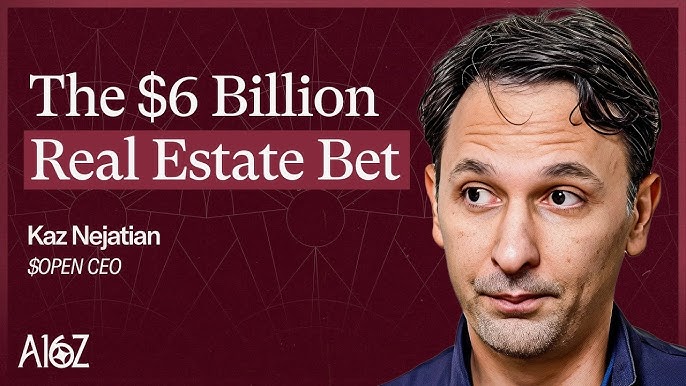
Kaz Nejatian
 Opendoor Technologies
About Kaz Nejatian
Kaz Nejatian was appointed Chief Executive Officer of Opendoor Technologies Inc. and a Class II director effective no later than October 7, 2025; he receives an annual base salary of $1 and is not eligible for an annual bonus, signaling pay-for-performance alignment . Prior roles include Chief Operating Officer and VP of Product at Shopify, product leadership at Meta, and founder/CEO of Kash (acquired in 2017). He holds a business degree from Queen’s University and a law degree from the University of Toronto . Age is not disclosed in filings. As his tenure began in late 2025, TSR, revenue, and EBITDA performance under his leadership are not yet disclosed .
Past Roles
| Organization | Role | Years | Strategic Impact |
|---|---|---|---|
| Shopify | COO; VP of Product | 2019–2025 (COO since 2022) | Scaled product and operations at a major commerce platform; drove operating leverage and execution speed |
| Meta (Facebook) | Product roles | Pre-2019 | Product leadership experience at scale |
| Kash (payments) | Founder & CEO | Pre-2017 | Early mobile payments for SMBs; acquired by a leading U.S. fintech in 2017 |
External Roles
| Organization | Role | Years | Notes |
|---|---|---|---|
| Not disclosed | — | — | No other current public company directorships disclosed in OPEN filings |
Fixed Compensation
| Component | Amount | Notes |
|---|---|---|
| Base Salary | $1 per year | Under Offer Letter |
| Annual Bonus | Not eligible | Explicitly excluded |
| Director Fees | Not disclosed | CEO also serves as director; no director compensation for executive directors typically disclosed in these filings |
Performance Compensation
| Award | Size | Performance Metric(s) | Time-Based Vesting | Key Terms |
|---|---|---|---|---|
| Performance-Based Inducement Award #1 | 40,886,344 PSUs | Average closing stock price ≥ $6.24 over 60 trading days preceding the applicable vest date (or any of next 4 vest dates) | 20% on 1st anniversary; remaining vest quarterly over 5 years | Up to 1/10 acceleration upon Qualifying Termination; double trigger acceleration if change-in-control price ≥ $25/share |
| Performance-Based Inducement Award #2 (7 tranches) | 40,886,344 PSUs | Stock price hurdles by tranche (60-day average): $9, $13, $17, $21, $25, $29, $33; performance window begins after 1st anniversary | Tranche 1 time-vests at 1st anniversary; tranches 2–7 vest quarterly across years 2–5 | Earned but unvested tranches vest upon death/disability; partial treatment upon Qualifying Termination; double-trigger acceleration for change-in-control thresholds starting at $25/share |
| Make-Whole Cash | $15,000,000 | — | Vests 9 months after start date | Accelerates upon Qualifying Termination |
| Make-Whole RSU | Grant-date value $15,000,000 | — | Vests 9 months after start date | Accelerates upon Qualifying Termination |
Definitions: “Qualifying Termination” includes involuntary termination without cause, resignation for good reason, or death/disability as described in the Offer Letter .
Equity Ownership & Alignment
- Total potential performance-based inducement equity equals 81,772,688 PSUs (two awards of 40,886,344 each), with significant stock-price hurdles, directly aligning wealth with long-term shareholder returns .
- Make-whole RSU vests once after 9 months; timing could create tax-driven selling pressure around vest date, though no Form 4 activity is analyzed here .
- Stock ownership guidelines: CEO must hold the lesser of six times annual base salary or 450,000 shares; executives/directors have five years to reach compliance; whether Kaz’s holdings meet guidelines is not yet disclosed .
- Hedging and pledging: Hedging, short sales, and derivative transactions are prohibited; pledging or margin accounts are prohibited without prior consent from the Chief Legal Officer .
Employment Terms
| Term | Detail |
|---|---|
| Position; Reporting | CEO of Opendoor Technologies Inc. and Opendoor Labs Inc.; appointed as a director effective by Oct 7, 2025 |
| Cash Comp | Base salary $1; not eligible for annual bonus |
| Inducement Equity | Two PSU awards totaling 81,772,688 shares with stock-price hurdles and time-based schedules over 5 years |
| Make-Whole Awards | $15M cash and $15M RSU; both vest 9 months post-start and accelerate upon Qualifying Termination |
| Change-of-Control | Double-trigger vesting provisions for PSU awards, with threshold prices starting at $25/share |
| Restrictive Agreements | Standard Confidential Information and Invention Assignment Agreement and Indemnification Agreement executed |
| Severance | Company maintains an Executive Severance Plan with double-trigger benefits for executives; specific participation/terms for Kaz beyond Offer Letter not disclosed |
Board Governance
- Board service: Appointed as Class II director; signatures on S-8 and 10-Q confirm role as CEO and director by Nov 6, 2025 .
- Leadership structure: Keith Rabois appointed non-executive Chairman; Eric Feder is Lead Independent Director, maintaining separation between CEO and Chair roles .
- Committees: Following Glenn Solomon’s resignation (Compensation Chair), Eric Feder was appointed Chair of the Compensation Committee; prior Audit & Risk Chair was Pueo Keffer, who stepped down from the Board concurrently with Solomon; updated Audit & Risk chair composition post-9/11 not disclosed .
- Independence: Opendoor emphasizes independent committees and governance practices; prior proxy reported seven of eight directors as independent and regular executive sessions of non-employee directors .
Performance & Track Record
- Operating approach: Reimagined investor communications (Financial Open House livestream on Robinhood, X, YouTube) to increase transparency and retail investor engagement under Kaz’s CEO leadership .
- Certifications: Kaz signed Sarbanes-Oxley CEO certifications for Q3 2025 10-Q .
Compensation Committee Analysis (context)
- Program evolution: Stockholder support for NEO pay increased to ~91% in 2024 (from 75% in 2023) after adding performance-based elements (ANI-based bonus; PRSUs) for other executives; CEO’s 2025 structure is purely stock-price contingent .
- Independent consultant: Compensia advises the Compensation Committee; peer groups refined between 2024 and 2025 .
Risk Indicators & Red Flags
- High stock-price hurdles ($9–$33) create execution risk; failure to meet gates may result in minimal vesting and retention pressure over time .
- Reverse split context (special proxy): While unrelated to Kaz’s hire, the company sought flexibility to regain Nasdaq bid-price compliance; potential dilution and capital market access considerations remain strategic risks .
- Insider policy strength: Robust hedging/pledging prohibitions and clawback policy reduce misalignment risk .
Performance Compensation – Detailed Vesting Conditions
| Metric | Weighting | Target/Hurdle | Actual/Payout | Vesting |
|---|---|---|---|---|
| Stock Price Gate (First Award) | 100% | ≥ $6.24 60-day avg before vest date (or next 4 dates) | N/A (new grant) | 20% at 1-year; remainder quarterly over 5 years, subject to gate |
| Stock Price Hurdles (Second Award tranches) | 100% | $9, $13, $17, $21, $25, $29, $33 (60-day avg, post-1st anniversary) | N/A (new grant) | Tranche-specific time vest across years 1–5, plus hurdle attainment |
| Make-Whole Cash/RSU | 100% | N/A | N/A | Single cliff at 9 months; acceleration on Qualifying Termination |
Equity Ownership & Alignment – Selected Policies
| Policy | Requirement | Status |
|---|---|---|
| Stock Ownership Guidelines (CEO) | Hold vested shares equal to six times base salary or 450,000 shares, whichever is less; 5-year attainment window | Compliance status for Kaz not disclosed (tenure began late 2025) |
| Hedging & Pledging | Hedging and short sales prohibited; pledging/margin accounts prohibited without consent | Applies company-wide, including CEO |
| Clawback | Recovery of erroneously awarded incentive compensation per Rule 10D-1 | Applies to executive officers |
Investment Implications
- Alignment: $1 salary, no bonus, and large PSU grants entirely contingent on multi-year time and stock-price hurdles materially align CEO outcomes with shareholder value creation .
- Retention vs. Overhang: The 9-month cliff on $15M cash and RSU creates near-term vesting; larger PSU hurdles spread over five years suggest durable retention if hurdles are credible; however, aggressive price gates ($25+ for CIC acceleration) raise execution risk in a cyclical, capital-intensive business .
- Governance: Separation of CEO and Chair roles (Rabois as Chairman) and a Lead Independent Director mitigate dual-role concerns; Compensation Committee independence and use of an external consultant support shareholder-friendly oversight .
- Trading signals: Expect potential tax-related selling pressure around the 9-month make-whole vest date; PSU vesting is conditional, reducing near-term dilution unless price hurdles are met . Retail-focused investor engagement may improve liquidity and sentiment, but fundamental execution toward price hurdles remains the primary driver .
Citations:
Offer Letter and CEO/director appointment details **[1801169_0001140361-25-034609_ef20055426_8k.htm:3]** **[1801169_0001140361-25-034609_ef20055426_8k.htm:4]**; Biography **[1801169_0001140361-25-034609_ef20055426_ex99-1.htm:1]**; Press release and board updates **[1801169_0001140361-25-034609_ef20055426_ex99-1.htm:0]**; S-8 and 10-Q signatures **[1801169_0001140361-25-040825_ef20058344_s-8.htm:7]** **[1801169_0001801169-25-000092_open-20250930.htm:85]**; Investor communications change **[1801169_3a047ebba8b3479bb663447d430ed4c9_0]**; Governance, committees, policies, ownership guidelines, clawback **[1801169_0001140361-25-015722_ny20044754x1_def14a.htm:7]** **[1801169_0001140361-25-015722_ny20044754x1_def14a.htm:23]** **[1801169_0001140361-25-015722_ny20044754x1_def14a.htm:24]** **[1801169_0001140361-25-015722_ny20044754x1_def14a.htm:27]** **[1801169_0001140361-25-015722_ny20044754x1_def14a.htm:28]** **[1801169_0001140361-25-015722_ny20044754x1_def14a.htm:29]**; Severance Plan **[1801169_0001140361-25-015722_ny20044754x1_def14a.htm:56]**.