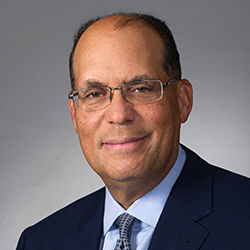
Thomas J. Baltimore, Jr.
About Thomas J. Baltimore, Jr.
Thomas J. Baltimore, Jr. is Chairman, President and Chief Executive Officer of Park Hotels & Resorts Inc. (PK), serving as a director since 2016 and as Chairman and CEO since December 2016; he is 61 years old and holds a B.S. from the University of Virginia’s McIntire School of Commerce and an MBA from UVA’s Darden School of Business . He currently serves on the boards of American Express Company and Comcast Corporation, and previously served on the boards of Prudential Financial, AutoNation, Duke Realty, RLJ Lodging Trust, and Integra LifeSciences; he is a past Chair (2018) of Nareit’s Executive Board . Park’s annual incentive plan for 2024 tied management to measurable operating and financial goals (RevPAR, hotel-adjusted EBITDA margin, Adjusted EBITDA, and Net Debt/EBITDA) with aggregate corporate achievement of 141.4% and CEO payout at 147% of target; long-term incentives are predominantly PSUs based on relative TSR, with 2023 PSUs tracking at maximum and 2024 above target .
Past Roles
| Organization | Role | Years | Strategic impact |
|---|---|---|---|
| RLJ Lodging Trust (NYSE: RLJ) | President & CEO; Trustee | 2011–2016 | Led public lodging REIT; board service through formation to 2016 . |
| RLJ Development | Co‑founder; President | 2000–2011 | Raised and invested >$2.2B in equity across lodging investments . |
| Hilton Hotels Corporation | VP, Gaming Acquisitions | 1997–1998 | Corporate development in gaming segment . |
| Hilton Hotels Corporation | VP, Development & Finance | 1999–2000 | Development and finance leadership . |
| Marriott Corp. and Host Marriott Services | Various roles incl. VP, Business Development | N/A | Brand-owner operating roles; business development . |
External Roles
| Organization | Role | Years | Notes |
|---|---|---|---|
| American Express Company (NYSE: AXP) | Director | Current | Current public company board . |
| Comcast Corporation (Nasdaq: CMCSA) | Director | Current | Current public company board . |
| Prudential Financial (NYSE: PRU) | Director | Until Mar 2023 | Former public company board . |
| AutoNation (NYSE: AN) | Director | Until Jan 2021 | Former public company board . |
| Duke Realty (NYSE: DRE) | Director | Until Apr 2017 | Former public company board . |
| RLJ Lodging Trust (NYSE: RLJ) | Trustee | Until May 2016 | Former public REIT trustee . |
| Integra LifeSciences (Nasdaq: IART) | Director | Until Aug 2012 | Former public company board . |
| Nareit Executive Board | Chair | 2018 | Industry leadership . |
Fixed Compensation
| Metric | FY 2022 | FY 2023 | FY 2024 |
|---|---|---|---|
| Base Salary ($) | 1,000,000 | 1,000,000 | 1,100,000 (first increase since joining) |
| Target Annual Bonus (% of Salary) | 175% (effective since 2020) | 175% | 175% (range 87.5%–350%) |
Notes:
- 2024 total cash annual incentive earned: $2,835,621 (147% of target) .
- 2024 equity grant grant‑date fair value: $6,462,611 (RSAs + PSUs) .
- In Feb 2025 the Compensation Committee set the CEO’s 2025 LTIP target at $6,500,000 (aggregate target value) .
Performance Compensation
Annual STIP Design and Results (FY 2024)
- Weighting: CEO 90% corporate objectives / 10% individual performance .
- Corporate objectives split into Phase I (H1) and Phase II (H2), each 50% of corporate score, with metrics and thresholds below. Phase II was recalibrated to exclude Hilton Hawaiian Village in Q4 2024 due to strike disruption .
Phase I Corporate Objectives (50% weight of corporate score)
| Metric (allocation) | Threshold | Target | High | Actual |
|---|---|---|---|---|
| Consolidated Portfolio RevPAR (20%) | $178.75 | $185.62 | $192.25 | $185.28 |
| Consolidated Hotel Adj. EBITDA Margin (30%) | 26.1% | 27.4% | 28.6% | 28.6% |
| Adjusted EBITDA (30%) | $308.1M | $338.1M | $368.1M | $355.4M |
| Net Debt / TTM Adjusted EBITDA (20%) | 5.77x | 5.38x | 5.00x | 5.25x |
- Phase I Achievement: 154.0% .
Phase II Corporate Objectives (50% weight of corporate score; HHV excluded in Q4)
| Metric (allocation) | Threshold | Target | High | Actual |
|---|---|---|---|---|
| Comparable Portfolio RevPAR (20%) | $174.07 | $181.07 | $188.07 | $183.38 |
| Comparable Hotel Adj. EBITDA Margin (30%) | 25.2% | 26.2% | 27.2% | 26.1% |
| Adjusted EBITDA (30%) | $240.3M | $270.3M | $300.3M | $279.6M |
| Net Debt / TTM Adjusted EBITDA (20%) | 6.26x | 5.91x | 5.56x | 5.67x |
- Phase II Achievement: 128.9%; Weighted corporate score (Phase I & II): 141.4% .
- CEO Individual objectives examples: portfolio reshaping; dividend increase; ROI projects; operator engagement; investor relations; ERM/cyber oversight .
- CEO Actual STIP payout: $2,835,621 (147% of target) .
Long-Term Incentives (structure and recent grants)
- Mix and metrics: 65% PSUs (relative TSR vs FTSE Nareit Lodging Resorts Index >$1B market cap), 35% RSAs; CEO pay is ~88.1% variable/“at risk” at target .
- PSU design: 3‑year performance period; vesting 0%–200% of target shares based on relative TSR; dividends assumed reinvested; Monte Carlo valuation used (e.g., 2025 10‑Q assumptions) .
- Negative TSR modifier: PSU payouts for certain officers limited if TSR is negative (maintained practice) .
2024 CEO Grant Detail (Grant date 2/22/2024)
| Instrument | Shares/Units | Grant-date fair value ($) | Vesting |
|---|---|---|---|
| RSAs | 134,698 | 2,187,496 | Ratable over 3 years . |
| PSUs (Target) | 250,153 | 4,275,115 | Cliff at end of 3-year period; relative TSR (0%–200%) . |
Tracking/Outcomes
- 2022–2024 PSUs (granted 2/2022) were earned (performance achieved) .
- 2023 and 2024 annual PSU tranches are currently projecting maximum and above‑target achievement, respectively (as of proxy) .
Equity Ownership & Alignment
| Item | Detail |
|---|---|
| Beneficial ownership | 1,580,318 PK shares; less than 1% of outstanding (201,864,175 shares o/s as of Mar 3, 2025) . |
| CEO stock ownership guideline | 6x base salary . |
| Actual ownership vs guideline | $24,257,881 toward requirement; 24.3x salary (uses 2024 avg price $15.35) . |
| Hedging/pledging | Prohibited for directors and executive officers . |
| Ownership policy compliance | Executives satisfied, exceeded, or on track; CEO exceeds . |
| Outstanding unvested RSAs (12/31/24) | 134,698 (2024 grant); 96,802 (2023 grant); 33,073 (2022 grant) . |
| PSUs outstanding (12/31/24) | 500,306 max units (2024 award); 539,320 max units (2023 award); 3‑yr TSR metric . |
| Director compensation overlay | CEO receives no additional pay for director service . |
Vesting schedules and potential selling pressure:
- RSAs vest ratably on the first three anniversaries of grant (e.g., 2/22/25; 2/22/26; 2/22/27), creating predictable vesting events and potential trading windows under 10b5‑1 plans .
- PSUs vest at the end of 3‑year periods (2023 grant vests after 2023–2025; 2024 grant after 2024–2026), subject to relative TSR; payout can range 0%–200%, implying lumpy vesting when performance periods end .
Employment Terms
| Term | Key provisions |
|---|---|
| Employment agreement | Initial 4‑year term from Apr 26, 2016; auto‑renews annually unless 90‑day notice; extended through May 16, 2025 as of the 2025 proxy . |
| Base salary floor | No less than $1,000,000 under agreement (actual 2024 salary set to $1,100,000) . |
| Target annual bonus range | Initially ≥150% target; increased in 2020 to 175% target (87.5% threshold, 350% max) . |
| LTIP floor | Annual LTIP target value ≥$3,500,000 per agreement; 2024 LTIP set at $6,250,000; 2025 LTIP set at $6,500,000 . |
| Severance (non‑CIC) | Cash severance = 2.99x (salary + target bonus), plus accelerated vesting of unvested time‑based equity/options and pro‑rated target PSUs; benefits continuation . |
| CIC terms | “Double‑trigger” (qualifying termination within 12 months post‑CIC): same 2.99x cash; PSUs at target not pro‑rated; equity acceleration; benefits continuation . |
| Estimated payouts (12/31/24) | Termination w/o cause: Total $15,979,365 (Cash $8,521,500; Equity $7,428,453; Benefits $29,412). Within 12 months post‑CIC: $19,587,223 (Cash $8,521,500; Equity $11,036,311; Benefits $29,412). Death/Disability: $9,178,453 (Includes bonus $1,750,000) . |
| Clawback | Updated Oct 2023 to comply with SEC/NYSE; mandatory recoupment of incentive comp upon restatements . |
| Hedging/pledging | Prohibited for directors and executive officers . |
Board Governance (Service, Committees, Dual‑role Implications)
- Board service history: Director since 2016; Chairman since December 2016; not independent (only non‑independent director) .
- Committees: All three standing committees (Audit; Compensation & Human Capital; Nominating, Governance & Corporate Responsibility) are 100% independent; as CEO/Chair, Mr. Baltimore is invited to attend committee meetings but has no vote .
- Dual‑role mitigants: Strong Lead Independent Director (Stephen I. Sadove) with expansive duties; 100% independent committees; majority‑independent board (8 of 9 nominees independent) .
- Board activity and attendance: Board held 8 meetings in 2024; each director attended at least 75% of Board and committee meetings; all nine directors attended the 2024 annual meeting in person .
Performance & Track Record (selected)
- 2024 execution highlights: Disposed three non‑core assets; invested nearly $230M in capex; returned over $400M to stockholders ($116M buybacks + $287M dividends) .
- 2025 YTD liquidity and balance sheet: Amended and upsized revolver to $1.0B and added an $800M delayed‑draw term loan; liquidity to $2.1B as of Q3 2025 .
- Management commentary focuses on active asset management, cost controls, and portfolio reshaping; technology and labor agreements cited as levers; timeline to address maturities not dependent on asset sales .
Say‑on‑Pay & Shareholder Feedback
- Say‑on‑Pay approvals: ~93% (2023) and ~94% (2024) of votes cast supported executive compensation .
- Program changes tied to feedback: Increased PSU weighting (CEO 65%, other NEOs 60%) and TSR negative‑modifier maintained; enhanced target rigor and disclosure; updated clawback policy .
Director Compensation (context for dual role)
- Independent director program: Annual cash retainer $80,000 plus committee/lead fees; annual RSAs vest at next annual meeting; stock ownership guideline 5x cash retainer; CEO receives no additional director compensation .
Compensation Structure Analysis
- Mix and risk: Approximately 88.1% of CEO target pay is variable/at‑risk; LTI tilted toward PSUs (65%) on relative TSR, aligning pay to shareholder outcomes .
- Metric rigor/transparency: Multi‑metric STIP with leverage, EBITDA, margin, and RevPAR; 2024 two‑phase design due to uncertainty, with disclosed thresholds/targets/high and actuals; recalibration to remove HHV Q4 strike impact explicitly disclosed .
- Retention economics: Double‑trigger CIC with 2.99x cash and full target PSU (no proration) upon qualifying termination increase retention and potential transaction costs .
- Clawback and alignment safeguards: Updated clawback; prohibitions on hedging and pledging; robust ownership guideline (CEO 6x salary; actual 24.3x) .
Risk Indicators & Red Flags
- Equity/transaction protections: 2.99x CIC multiple and full target PSU vesting upon double‑trigger may be viewed as shareholder‑unfriendly by some investors in change‑of‑control scenarios .
- Compensation judgment: STIP Phase II recalibration to exclude HHV Q4, while disclosed, may draw investor scrutiny; however, overall corporate achievement still below Phase I (128.9%) and aggregate corporate score 141.4% .
- Governance mitigants: Strong lead independent structure; independent committees; updated clawback; no hedging/pledging reduce governance risk .
Investment Implications
- Alignment: High insider ownership relative to salary (24.3x) and significant PSU weighting with relative TSR drive alignment; hedging/pledging prohibitions limit downside misalignment risk .
- Retention vs. deal optics: 2.99x severance and full‑target PSU in CIC terminations support retention but could elevate transaction costs; double‑trigger design tempers single‑trigger concerns .
- Performance sensitivity: STIP links to RevPAR, margins, Adjusted EBITDA, and leverage—favorable for cyclical discipline; 2024 outcomes (corporate score 141.4%, CEO payout 147%) indicate above‑plan execution despite labor/renovation disruptions .
- Near‑term flows: RSA tranches vest annually and PSUs at cycle ends (2026–2027), creating periodic settlement windows; however, no pledging reduces forced‑sale risk; sales subject to trading windows/10b5‑1 planning .
- Governance balance: Combined Chair/CEO role is counterbalanced by an empowered Lead Independent Director and fully independent committees, which may mitigate typical dual‑role concerns in investor assessments .
Board/Committee snapshot and CEO governance context:
- Director since 2016; Chairman/CEO since Dec 2016; only non‑independent director **[1617406_0001617406-25-000013_pk-20250312.htm:18]** **[1617406_0001617406-25-000013_pk-20250312.htm:36]**.
- Committees 100% independent; CEO attends but has no committee vote **[1617406_0001617406-25-000013_pk-20250312.htm:37]** **[1617406_0001617406-25-000013_pk-20250312.htm:45]**.
- Lead Independent Director in place with robust authorities **[1617406_0001617406-25-000013_pk-20250312.htm:35]**.
Key compensation signals to monitor:
- PSU performance tracking (2023 at max, 2024 above target) **[1617406_0001617406-25-000013_pk-20250312.htm:91]**.
- 2025 LTIP target increased to $6.5M; continued 65% PSU weighting **[1617406_0001617406-25-000013_pk-20250312.htm:91]** **[1617406_0001617406-25-000013_pk-20250312.htm:16]**.
- STIP metric calibration and leverage targets as balance‑sheet signal **[1617406_0001617406-25-000013_pk-20250312.htm:81]** **[1617406_0001617406-25-000013_pk-20250312.htm:82]**.