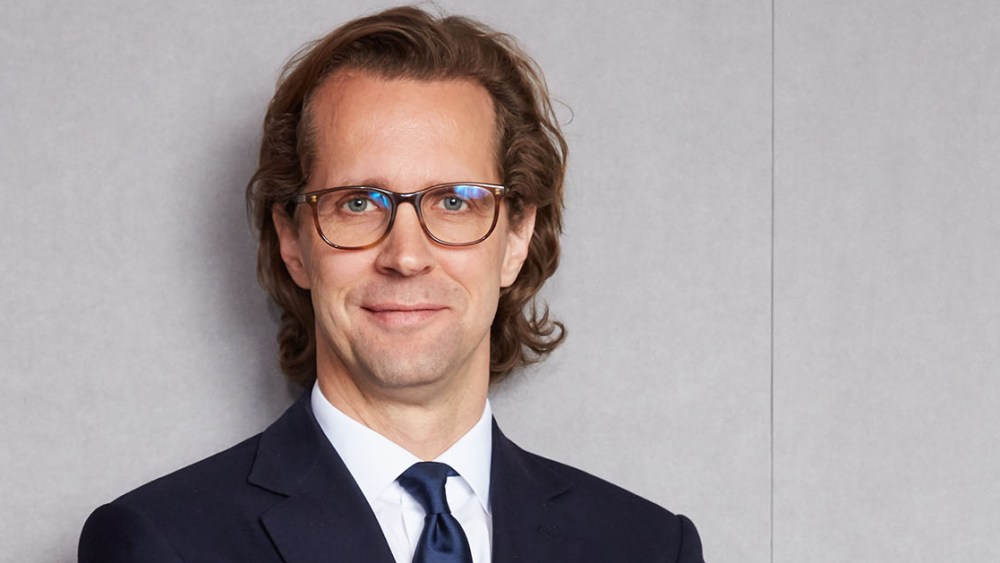
Stefan Larsson
 PVH CORP. /DE/
About Stefan Larsson
Stefan Larsson (age 50) is PVH’s Chief Executive Officer and a director since 2021, having previously served as President (2019–2021) . Under his leadership, PVH executed the PVH+ Plan with 2024 revenue of $8.7B, EBIT of $772M ($865M non-GAAP), EPS of $10.56 ($11.74 non-GAAP), and ~$500M of share repurchases (4.7M shares) . CEO pay is heavily performance-weighted; 2024 “compensation actually paid” to the CEO (SEC methodology) was $1.0M, reflecting mark-to-market equity impacts . He is an employee director (not independent), with an independent, non-executive Chair structure separating roles .
Past Roles
| Organization | Role | Years | Strategic impact |
|---|---|---|---|
| PVH Corp. | Chief Executive Officer; previously President | CEO since 2021; President 2019–2021 | Leads PVH+ Plan; brand-building, cost efficiency, data- and demand-driven supply chain |
| Ralph Lauren Corp. | President & CEO | 2015–2017 | Refocused the company, improved performance, set path for future growth |
| Old Navy (Gap Inc.) | Global President | 2012–2015 | 12 consecutive quarters of profitable growth; elevated brand with millennials |
| H&M | Multiple leadership roles | Nearly 15 years (years not disclosed) | Helped drive revenue from ~$3B to ~$17B; expansion from 12 to 44 countries |
External Roles
| Organization | Role | Years | Notes |
|---|---|---|---|
| Ralph Lauren Corporation | Director | 2015–2017 | Public company directorship |
| The RealReal, Inc. | Director | 2019–2020 | Public company directorship |
Fixed Compensation
| Component | 2022 | 2023 | 2024 | Notes |
|---|---|---|---|---|
| Base Salary ($) | 1,300,000 | 1,291,667 | 1,421,154 | Annualized rate raised from $1.3M to $1.45M (+11.5%) for 2024 to reflect performance and peer alignment |
| Perquisites & Other ($) | 221,394 | 161,714 | 207,846 | Includes car/driver commuting benefit; company DC plan contributions |
| Pension value change ($) | 417,826 | 274,671 | 244,990 | CEO participates in qualified and supplemental pension plans; PV as of 2/2/25: $96,182 and $1,252,931 |
Performance Compensation
Annual Bonus (Performance Incentive Bonus Plan)
- Metrics: Corporate EBIT (75% weight) and Revenue (25% weight); threshold-to-maximum ranges were 80%–115% for EBIT and 93%–105% for Revenue .
- CEO Target: 200% of base salary; 100% corporate weighting .
- 2024 Results: Corporate Revenue $8,696M vs $8,733M target (95.53% payout on that slice); Corporate EBIT $876M vs $883M target (97.30% payout on that slice); Weighted payout 96.86% of target .
| Metric (Corporate) | Weight | Threshold | Target | Maximum | Actual | Payout vs Target |
|---|---|---|---|---|---|---|
| Revenue ($M) | 25% | 8,125 | 8,733 | 9,175 | 8,696 | 95.53% |
| EBIT ($M) | 75% | 710 | 883 | 1,015 | 876 | 97.30% |
| Weighted payout | 100% | — | — | — | — | 96.86% |
| Payout Summary (CEO) | 2024 |
|---|---|
| Target Bonus ($) = 200% x $1,450,000 | 2,900,000 |
| Actual Bonus Paid ($) | 2,808,940 |
Long-Term Incentives (LTI) – 2024 Grants
- Mix: PSUs (50% value), RSUs, and Stock Options (options granted in 2024 to CEO, CFO, and former CEO PVH Europe) .
- RSUs/Options vest 25% annually over 4 years; options expire after 10 years .
- PSUs: 50% three-year average ROIC and 50% three-year relative TSR vs a custom apparel/retail peer basket; threshold/target/max = ROIC 30%/34%/38%, TSR 30th/55th/80th percentile; linear interpolation; CEO must hold after-tax PSU shares for 1 year post-vesting .
| 4/10/2024 CEO Grants | Quantity | Terms | Grant-date/Plan Detail |
|---|---|---|---|
| Stock Options (#) | 36,500 | 25%/yr vest; strike $109.75; expires 4/10/2034 | Grant-date fair value $2,225,040 |
| RSUs (#) | 30,344 | 25%/yr vest | Grant-date fair value $3,330,254 |
| PSUs (target #) | 50,572 | 3-year: 50% ROIC, 50% relative TSR | Grant-date fair value $6,039,814 |
| PSU performance grid | — | ROIC: 30%/34%/38% | TSR: 30th/55th/80th percentile |
Realized/Realizable Indicators
- 2024 Total Stock Awards grant-date values: $9.37M (RSUs $3.33M; PSUs $6.04M) .
- 2024 Options grant-date value: $2.225M .
- PSU cycle (granted 5/2022) paid above target based on relative TSR (62nd percentile) with below-threshold EBIT; CEO received 30,336 shares .
Equity Ownership & Alignment
- Beneficial ownership: 340,650 shares (<1% of class) as of record date; right to acquire 231,700 shares via options within 60 days included in totals .
- Outstanding/unvested equity (as of FY-end): CEO holds multiple tranches of unvested RSUs and PSUs; options span 2019–2024 grants with strikes across $47.96–$109.75 .
| Category | Detail |
|---|---|
| Beneficially owned shares | 340,650; less than 1% of outstanding |
| Options exercisable (within 60 days) | 231,700 shares (CEO) |
| Unvested RSUs (counts/market value at 1/31/25) | 2021: 5,753 ($515,469); 2022: 16,782 ($1,503,667); 2023: 29,805 ($2,670,528); 2024: 30,344 ($2,718,822) |
| Unearned PSUs (counts/market value at 1/31/25) | 2022 grant: 58,835 ($5,271,616); 2023: 115,216 ($10,323,354); 2024: 63,215 ($5,664,064) |
| Ownership guidelines | CEO must hold shares = 6x base salary; must hold after-tax PSU shares for 1 year post-vest |
| Hedging/pledging | Prohibited for officers and directors |
Vesting and insider selling pressure: With four RSU tranches vesting 25% annually (2021–2024 awards) and large unearned PSU cycles outstanding, routine vesting creates periodic sell-to-cover potential; no pledging/hedging allowed, and no evidence of related-party transactions in 2024 .
Employment Terms
- Employment agreement: Evergreen; includes confidentiality, non-solicit, non-compete covenants; salary reviewed annually (only upward adjustments) .
- Severance (ordinary and CIC): 2x base salary + 2x target bonus; healthcare continuation for 2 years; cutback to avoid excise tax if beneficial (no gross-up) .
- Equity on CIC: Double-trigger vesting (if awards assumed), i.e., vest on original schedule or upon qualifying termination within 2 years post-CIC .
- Clawback: Restatement or material breach of a material company policy can trigger recoupment .
| Potential Payments (as of 2/2/25) | Voluntary | Death | Disability | Termination without Cause / for Good Reason | CIC + Qualifying Termination |
|---|---|---|---|---|---|
| Severance ($) | 0 | 0 | 0 | 8,700,000 | 8,700,000 |
| In-the-money unexercisable options ($) | 0 | 644,687 | 644,687 | 0 | 644,687 |
| Unvested RSUs ($) | 0 | 7,408,486 | 7,408,486 | 0 | 7,408,486 |
| Unvested PSUs ($) | 0 | 8,260,390 | 8,186,918 | 6,953,755 | 8,260,390 |
| Welfare benefits ($) | 0 | 0 | 0 | 47,830 | 47,830 |
| Total ($) | 0 | 16,313,563 | 16,240,091 | 15,701,585 | 25,061,393 |
Definitions: “Cause” includes gross negligence/willful misconduct causing harm, willful failure to perform, certain felonies, willful disclosure of confidential information, legal disqualification, or material policy breach. “Good reason” includes material diminution of role, salary reduction (absent broad-based reductions), material diminution of total compensation/benefits, relocation beyond 35 miles (CEO), failure to nominate CEO to Board, or failure of successor to assume agreement; additional CIC-specific protection if CEO not CEO and director of top-tier successor for one year post-CIC (excluding certain conditions) .
Board Governance
- Board service: Director since 2021; 100% Board meeting attendance in 2024; not independent (employee director) .
- Committees: None (all key committees are fully independent) .
- Leadership structure: Independent, non-executive Chair (Michael M. Calbert) since June 2022; Board does not anticipate recombining Chair/CEO roles; regular executive sessions of independent directors .
- Meetings: 5 Board meetings in 2024; committees met 6–10 times .
- Employee directors receive no additional director compensation .
Dual-role implications: CEO also serves as a director, but an independent Chair structure, fully independent committees, and frequent executive sessions provide independent oversight and mitigate independence concerns .
Compensation Structure Analysis
- Strong pay-for-performance design: Annual bonus uses EBIT and revenue; PSUs use ROIC and relative TSR with three-year horizon; mix tilted to variable, long-term equity; awards are capped; clawback applies .
- 2024 cash vs equity: CEO base increased to align with peers; majority of target compensation remained equity-based (RSU/PSU/options), with PSU 50% of LTI value .
- No poor practices: No option repricing, no severance tax gross-ups, no hedging/pledging, no dividends on unvested RSUs or dividend equivalents on unearned PSUs .
- Shareholder support: Say-on-pay received >98% approval at 2024 meeting; last five years never below 92% .
Related Party Transactions
- None reportable in 2024 under SEC rules .
Compensation Peer Group (benchmarking context)
- Peer set includes apparel/retail comparables (e.g., Ross, Estée Lauder, Gap, VF, Ralph Lauren, Tapestry, Levi’s, Victoria’s Secret, Hanesbrands, Capri); PVH’s 2024 revenue $8.653B positions it mid-pack; Committee does not target a fixed percentile but uses peers to ensure competitiveness .
Say-on-Pay & Shareholder Feedback
- 2024 Say-on-pay approval >98%; five-year support never below 92%. Regular investor engagement on compensation; Committee retained FW Cook as independent advisor in Dec 2024 to refresh perspectives .
Investment Implications
- Alignment: High proportion of at-risk, multi-year equity (notably PSUs with ROIC/relative TSR) aligns CEO pay with long-term value creation; robust ownership guideline (6x salary) and post-vest holding heighten alignment and limit early monetization .
- Retention vs overhang: Large unvested RSU/PSU overhang is retention-positive but implies predictable periodic vesting-related sell-to-cover flow; prohibitions on pledging/hedging reduce risk of forced selling; no related-party transactions observed .
- Downside protection: Double-trigger CIC equity vesting and 2x salary+bonus severance are standard; clawback and no gross-ups are governance positives; independent Chair and fully independent committees mitigate CEO/director dual-role concerns .
- Execution risk: 2024 bonus paid at ~97% of target (near-plan performance) while top-line declined 6% amid strategic portfolio actions; continued delivery on PVH+ Plan levers (ROIC, TSR relative to peers) remains key to PSU realizations and stock performance sensitivity .