SEI INVESTMENTS (SEIC)·Q4 2025 Earnings Summary
SEI Investments Caps Record Year With EPS and Revenue Beat
January 28, 2026 · by Fintool AI Agent
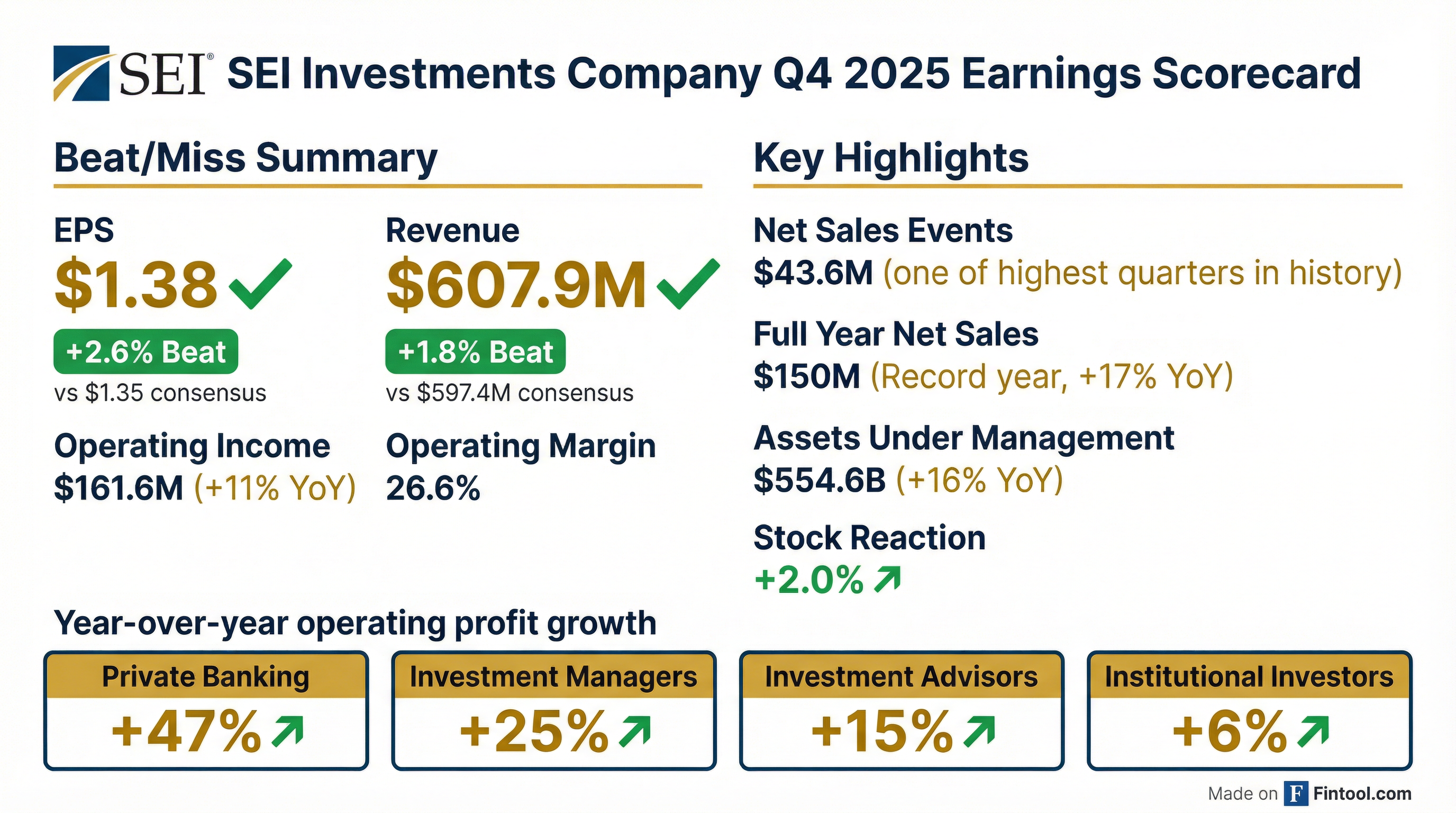
SEI Investments (NASDAQ: SEIC) delivered a strong finish to 2025, beating both EPS and revenue estimates while posting record sales activity. The financial technology and asset management company reported diluted EPS of $1.38, up 16% year-over-year and 2.6% ahead of consensus expectations of $1.35. Revenue came in at $607.9M, beating the $597.4M consensus by 1.8% and growing 9% from the prior year.
The quarter marked a fitting close to what CEO Ryan Hicke called "one of the strongest years in SEI's history," with all four business segments contributing revenue and operating profit growth.
Did SEI Investments Beat Earnings?
Yes, SEI beat on both metrics:
Reported EPS of $1.38 includes approximately $0.08 of unusual items: $20.1M of severance and M&A fees in Corporate Overhead, partially offset by a $3.0M tax benefit from energy credits and a $3.3M revenue accrual true-up in Investment Managers. Excluding these items, EPS exceeded the prior record set in Q4 2024.
SEI has now beaten or met EPS estimates in 8 of the last 9 quarters.
 Ask Fintool AI Agent
How Did Each Business Segment Perform?
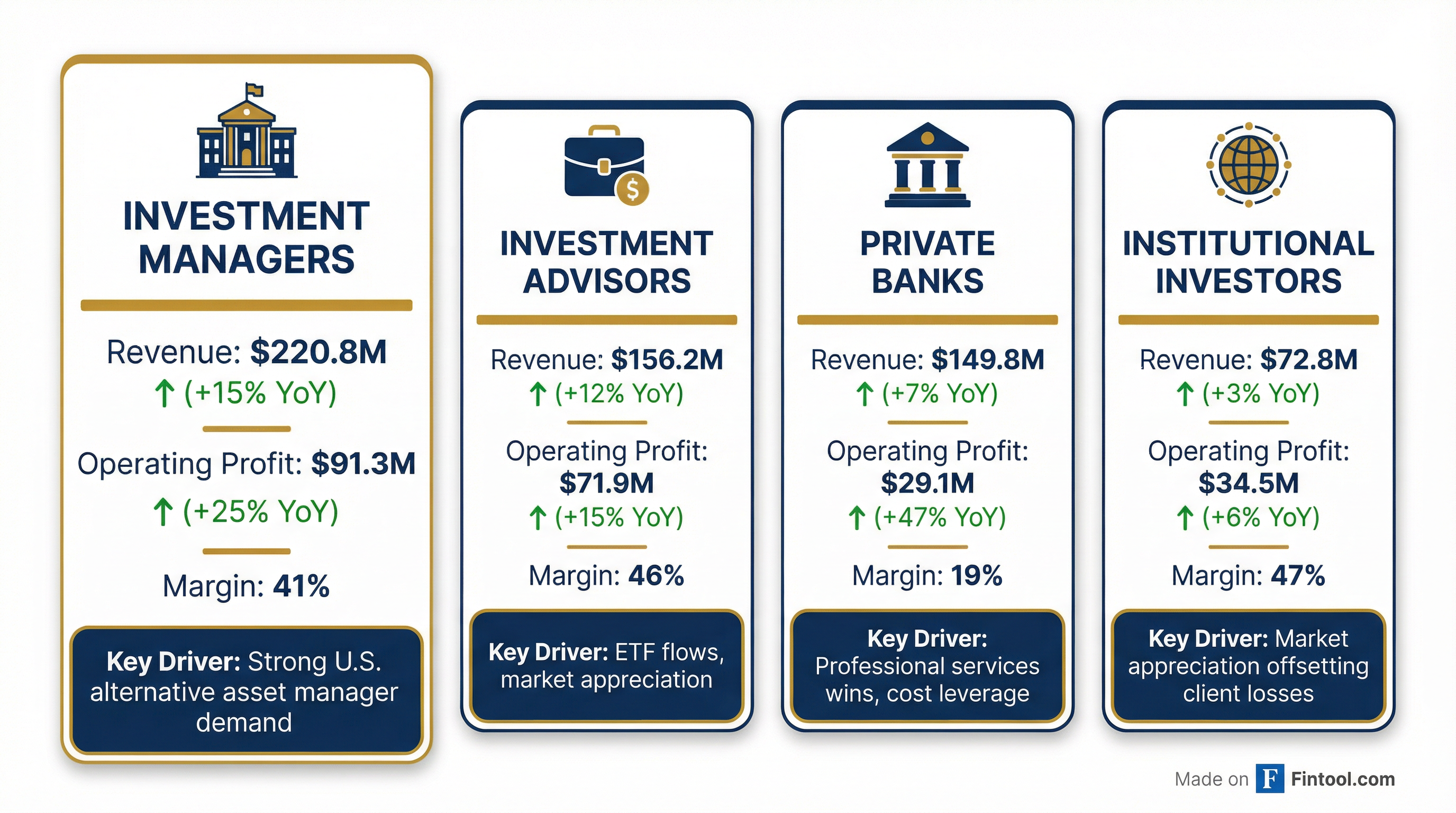
All four segments delivered year-over-year revenue and operating profit growth—a standout achievement that underscores the breadth of SEI's business model.
Segment highlights:
-
Investment Managers (+25% op. profit): Broad-based demand from U.S.-based alternative asset managers drove strong results. The $3.3M revenue accrual true-up added to underlying momentum.
-
Private Banks (+47% op. profit): The standout performer. Professional services wins accelerated revenue while cost leverage expanded margins from 16% in Q3 to 19% in Q4.
-
Investment Advisors (+15% op. profit): Market appreciation and strong ETF inflows offset continued mutual fund outflows. The integrated cash program contributed $20.7M, consistent with prior quarters. Notably, SEI ETFs captured more than $1 billion of net inflows for the full year, and Advisors delivered their best net inflow year in over a decade—signaling traction from the upmarket strategy and ecosystem approach. Tax management and overlay capabilities drove an additional $2B of net new platform assets.
-
Institutional Investors (+6% op. profit): Market appreciation largely offset client losses, maintaining solid profitability with a 47% margin.
What Drove Record Sales Activity?
Net sales events of $43.6M in Q4 were among the highest quarters in SEI's history, bringing full-year net sales to a record $149.9M—up 17% from 2024.
The sales momentum reflects SEI's strategic alignment with key industry trends: outsourcing demand, the convergence of public and private markets, and the rising need for investment advice.
Ask Fintool AI AgentWhat Did Management Say About Stratos?
SEI completed the first and largest close of the Stratos Wealth Management acquisition for $440.8M during Q4, funded entirely with balance sheet cash.
Stratos provides financial services to $38.4B in client assets across RIA and broker-dealer channels. Q4 financial impact was modest given timing: ~$5M revenue (in Advisors segment), ~$1M operating income (including ~$2M amortization on acquired intangibles), and ~$300K NCI for the 42.5% SEI doesn't own. Management highlighted several strategic benefits:
"Acquiring Stratos advances SEI's expansion into Advice, deepens insight into end‑client and advisor needs, broadens distribution across RIA and broker‑dealer channels, and creates new opportunities to integrate SEI's technology and investment capabilities into a rapidly growing advisory platform."
How Did Assets Under Management Change?
SEI ended Q4 with total assets of $1.88 trillion across management, administration, and advisory relationships—up 20% year-over-year.
LSV Asset Management (SEI's equity-focused affiliate) increased AUM 3.5% sequentially, driven by market appreciation and strong fund performance. LSV generated $22M of performance fees ($8M at SEI's share), though this was partially offset by $3B of net outflows in Q4.
What About Capital Returns?
SEI repurchased 1.2 million shares for $101M in Q4 at an average price of $82.61, bringing full-year repurchases to 7.5 million shares ($616M)—representing 6% of shares outstanding at year-end 2024.
*Estimated based on quarterly dividend of $0.52/share
SEI ended Q4 with $400M of cash and no long-term debt. Management reiterated their commitment to returning 90-100% of free cash flow through dividends and buybacks.
How Did the Stock React?
SEIC shares rose +2.0% on earnings day, closing at $86.10.
The stock is trading:
- +3.5% above its 50-day moving average ($83.18)
- +1.9% above its 200-day moving average ($84.49)
- 8.4% below its 52-week high of $93.96
At $86.10, SEI trades at approximately 15x trailing earnings and ~12x forward earnings, below its 5-year average multiple of ~17x.
Ask Fintool AI AgentWhat Changed From Last Quarter?
*Margin decline reflects $20.1M of one-time severance and M&A costs
Key sequential changes:
-
Sales acceleration: Net sales events jumped 43% sequentially, driven by two large Private Banking wins.
-
Private Banking momentum: Operating profit grew from $23M in Q3 to $29M in Q4 (+26% sequentially) as professional services revenue scaled.
-
One-time costs: $20.1M of severance and Stratos M&A fees pressured operating margins but are non-recurring.
Full-Year 2025 Summary
2025 marked a record year for SEI across multiple dimensions:
*Estimated from quarterly data
CEO Ryan Hicke summarized the outlook:
"With clear priorities and the right team in place, we're entering 2026 with confidence."
Q&A Highlights
On Private Banking Wins: Management provided color on the two major Q4 mandates. One is a "meaningfully sized regional community bank in the US" and the other is "a large private wealth manager"—both were previously outsourcers on competitive platforms who chose SEI for the broader capability suite. Notably, one of these wins represents SEI's second SWP SaaS client, validating the software-as-a-service delivery model.
On IMS Pipeline: CEO Ryan Hicke signaled confidence in upcoming wins: "We've been signaling for several quarters that we're working with some of the largest global alternative asset managers, including first-time outsourcers, and I expect we'll have some meaningful developments to announce by the April earnings call." Phil McCabe emphasized that "some of these deals are household names" and noted that "it's going to take a lot of work to get them in through the pipeline."
On Professional Services Evolution: Sanjay Sharma explained that SEI is now "engaging with prospects as early as before even they're issuing RFPs," allowing the company to influence transformation strategy and define the client's "North Star" for technology and operating model changes. This advisory-led approach is extending engagement timelines to 18+ months and driving larger, longer-duration professional services revenue.
On December Workforce Reduction: SEI implemented a "targeted reduction in force in December, affecting approximately 3% of our global workforce." Management noted the compensation savings roughly offset annual merit increases, resulting in a flat run-rate.
On Institutional Leadership: Following UK client losses, SEI restructured institutional leadership, appointing Kevin Matthews—who has "a long successful track record in that space"—to lead the business with a revised operating model and strategy.
On Leadership Transition: CEO Ryan Hicke noted that longtime executive Paul Klauder will be retiring in February after 30 years with the company. Klauder, along with Phil McCabe and Hicke, all joined the executive committee approximately 10 years ago.
Ask Fintool AI AgentWhat's Coming in Q1 2026?
CFO Sean Denham provided several forward-looking items to consider:
Management also highlighted accelerated investments for 2026:
- Hiring: Supporting strong pipeline and major wins across business lines
- Product launches: ETFs, SMAs, models, and select alternative products
- AI investment: Strategic investment in Avantos, an "AI-native operating system for client onboarding"
- Stratos acquisitions: Continuing in January with additional planned roll-ups
CEO Hicke summarized the 2026 approach: "With clear priorities and the team in place, 2026 is about focus and execution on the roadmap we've laid out together. Our job in 2026 is actually simple: go execute."
Key Risks and Concerns
-
Institutional outflows: The UK client losses in Institutional Investors bear watching. Negative net sales of $5M in Q4 was the weakest segment, prompting leadership changes.
-
Mutual fund headwinds: Continued outflows from traditional mutual fund products in the Advisors segment, though ETF flows are offsetting.
-
Integration execution: The Stratos acquisition adds complexity. Success depends on integrating technology platforms and capturing cross-selling opportunities. Additional roll-up acquisitions in January add near-term execution risk.
-
Market sensitivity: With ~$1.9 trillion in assets, SEI's fee revenue remains sensitive to market movements. A prolonged market correction would pressure both AUM and revenue.
-
Q1 seasonality: Multiple headwinds converging (lower LSV fees, fewer days, compensation increases, higher depreciation) could pressure sequential results despite strong underlying trends.
Earnings call replay available at ir.seic.com
Related Resources: