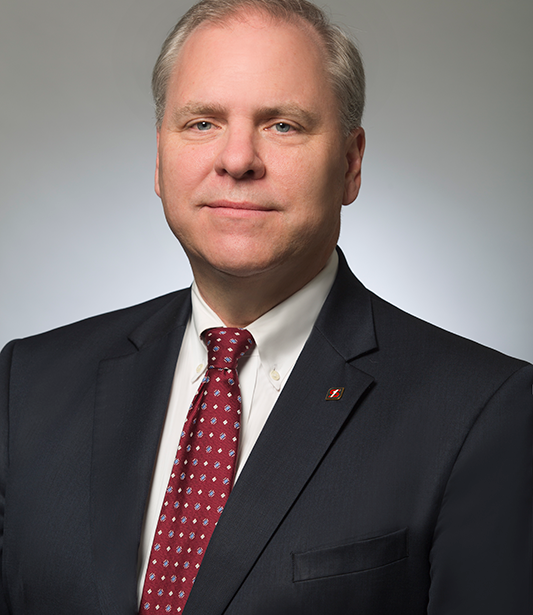
George Makris Jr
 SIMMONS FIRST NATIONAL
About George Makris Jr
George A. Makris Jr, 68, is Chairman and Chief Executive Officer of Simmons First National Corporation (SFNC) and Simmons Bank. He re-assumed the CEO role on January 1, 2025 after serving as Executive Chairman during 2023–2024; he previously was Chairman and CEO from January 2, 2013 through 2022 and has been an SFNC director since 1997. He holds a B.A. in Business Administration from Rhodes College and an MBA from the University of Arkansas . Recent corporate performance indicators tied to incentive pay include 2024 adjusted pre-provision net revenue less net charge-offs (PPNR) of $215.2 million vs. a $214.0 million target and an adjusted efficiency ratio (ER) of 64.59% vs. a 65% target, indicating modest outperformance on these metrics .
Past Roles
| Organization | Role | Years | Strategic Impact |
|---|---|---|---|
| Simmons First National Corporation / Simmons Bank | Chairman & CEO (2013–2022), Executive Chairman (2023–2024), Chairman & CEO (2025–present) | 2013–present | Led SFNC through multiple cycles; Board reinstated combined Chair/CEO in 2025 given operating environment, with independent Lead Director oversight . |
| M. K. Distributors, Inc. | President; employed since 1980, President since 1985; prior to joining SFNC | Through 2012 (prior to SFNC employment in 2013) | Private company leadership; long-term operating experience cited by SFNC as executive qualification . |
| Worthen National Bank — Pine Bluff (and successors) | Director (1985–1996); Chairman (1994–1996) | 1985–1996 | Prior bank governance exposure in key local market . |
External Roles
| Organization | Role | Years | Strategic Impact |
|---|---|---|---|
| Federal Advisory Council to the Federal Reserve Board (Eighth District) | Council representative | 2023 | Direct policy and macro insights relevant to banking sector . |
| Jefferson Regional Medical Center | Board of Trustees | Ongoing | Community and regional healthcare network ties . |
| University of Arkansas at Little Rock | Board of Visitors | Ongoing | Academic/community engagement . |
| Prior civic/board leadership (Economic Development Corp. of Jefferson County, Arts & Science Center for SE Arkansas, various) | Chair/Director roles | Various years | Regional development, governance experience . |
Fixed Compensation
| Year | Base Salary ($) | Cash Bonus ($) | Notes |
|---|---|---|---|
| 2024 | 961,157 | 0 | Served as Executive Chairman in 2024; did not participate in cash CIP . |
| 2023 | 1,000,000 | 13,591 | Includes dividend-equivalent cash on vested PSUs . |
| 2022 | 887,618 | 40,211 | Included CIP payout of $810,661 in 2022 non-equity incentive line (shown in summary table narrative) . |
Additional pay elements (2024): Stock awards grant-date fair value $2,300,352; no options granted; no non-equity incentive (CIP) payment; change in pension value $108,111; all other compensation $87,312 .
Performance Compensation
Annual and Long-Term Incentive Design
- 2024 program design for Executive Chairman (Makris Jr): equity-only; target equity incentive 225% of salary, split 50% RSUs / 50% PSUs (valued at target) .
- PSU metrics and weights (2024 grants; 2024–2026 performance period): 50% tangible book value per share growth ranking vs. peer group; 50% TSR ranking vs. KBW Regional Banking Index; threshold/target/maximum at 25th/50th/75th percentile; cap at 200% of target .
2024 Grants (for the 2024–2026 “2026 Performance Period”)
| Grant Type | Grant Date | Shares/Target | Vesting / Performance | Notes |
|---|---|---|---|---|
| PSUs | 02-29-2024 | 59,905 target; 119,810 max | Payout in early 2027 based on certified 2024–2026 TBV growth and TSR rankings | 50% weight TBV growth vs. 2024 comp peer group; 50% TSR vs. KBW Regional Banking Index . |
| RSUs | 02-29-2024 | 59,905 | Time-vest in three equal installments on 3/1/2025, 3/1/2026, 3/1/2027 | Time-based; dividend equivalents paid in cash at vest . |
Legacy PSU Outcomes
| PSU Cohort | Performance Period | Metrics (weights) | Result | Payout |
|---|---|---|---|---|
| 2022 PSU grant | 2022–2024 | Core ROAA rank (30%), Core ROTCE rank (35%), TSR rank (35%); thresholds at 25th/50th/75th percentiles | Achieved approx 12th percentile (ROAA), 16th percentile (ROTCE), 10th percentile (TSR) | Aggregate payout 0% of target . |
Equity Ownership & Alignment
- Beneficial ownership: 781,802 SFNC shares (less than 1%), including 34,331 direct; 581,167 joint with spouse; 9,270 in his IRA; 10,990 in spouse’s IRA; 12,000 in trust; 1,016 in 401(k); 1,158 in ESPP; and 131,870 through exercisable stock options (within 60 days) as of February 7, 2025 .
- Anti-pledging/anti-hedging: Policy prohibits directors and senior officers from hedging or pledging Company securities, absent prior NCGC approval; exceptions require prior approval .
- Stock ownership guidelines: CEO (and Executive Chairman) minimum ownership of 5x base salary; other EVPs 3x; 5-year compliance window; includes vested options, unvested RSUs, and PSUs at 100% target for guideline measurement .
- Clawback: Incentive compensation subject to a clawback policy in the event of an accounting restatement; applied to cash and equity plans .
Upcoming Vesting and Potential Supply Overhang
| Instrument | Quantity | Vesting / Expiry Schedule | Terms |
|---|---|---|---|
| RSUs (single vest) | 9,076 | 02-24-2025 | Time-based. |
| RSUs (2-tranche) | 29,202 | 01-19-2025 and 01-19-2026 (14,601 each) | Time-based. |
| RSUs (3-tranche) | 59,905 | 03-01-2025; 03-01-2026; 03-01-2027 (~equal) | Time-based; associated with 2024 grant . |
| PSUs (2015 Plan) | Up to 87,606 (max) | 2023–2025 performance; payout timing per plan | Performance-based. |
| PSUs (2023 Plan) | Up to 119,810 (max) | 2024–2026 performance; payable after certification in early 2027 | Performance-based . |
| Stock options (exercisable) | 104,580 @ $22.75 | Expire 08-09-2025 | Legacy options. |
| Stock options (exercisable) | 27,290 @ $23.51 | Expire 01-19-2026 | Legacy options. |
Insider selling pressure: The combination of annual RSU vesting (2025–2027) and option expirations in 2025–2026 can create periodic supply events. In 2024, Makris Jr exercised 46,860 options, realizing $104,359 value; he also had 50,126 shares vest from stock awards .
Employment Terms
| Provision | Detail |
|---|---|
| Change-in-control (CIC) cash | Estimated $4,215,992 upon CIC with qualifying termination; cash equal to 2–3x salary+bonus depending on executive agreements; CIC payouts are “double-trigger” (CIC + qualifying termination) . |
| Equity acceleration on CIC | Unvested options vest immediately; restrictions on restricted stock lapse; RSUs vest if terminated within one year post-CIC; PSUs vest typically at target if CIC occurs after first nine months of performance period; CIP becomes payable at target (pro-rated) . |
| Retirement/deferred comp | Present value of supplemental retirement benefits (Makris Jr): $2,862,376 at 12/31/2024; vests upon meeting plan retirement criteria or upon CIC . |
| Clawback | Company-wide policy applies to incentive-based compensation upon an accounting restatement . |
| Hedging/pledging | Prohibited for directors/senior officers absent pre-approval . |
| Tax gross-up | Company policy disallows new CIC tax gross-up features; the only tax gross-up disclosed applies to another executive (Fehlman), not Makris Jr . |
Board Governance
- Board service history: Director since 1997; currently Chairman & CEO (combined roles in 2025); not independent under Nasdaq standards .
- Committee roles: Not a member of the Audit, Compensation, or Nominating & Corporate Governance Committees; independent directors comprise these committees .
- Dual-role implications: Board opted for combined Chair/CEO in 2025 with a longstanding independent Lead Director (Steven Cossé) who chairs executive sessions and the Executive Committee, providing counterbalance and independent oversight .
- Attendance: Board met 8 times in 2024; all incumbent directors attended ≥75% of board and committee meetings; all directors attended the 2024 annual meeting .
- Say-on-pay: Approximately 93% approval for 2023 NEO compensation at the 2024 annual meeting .
Compensation Structure Analysis
- Mix shift and at-risk alignment: In 2024, Makris Jr (as Executive Chairman) received equity-only incentive compensation, targeted at 225% of salary with a 50/50 RSU/PSU mix, emphasizing multi-year performance alignment over annual cash bonuses .
- Performance rigor: The 2022 PSU cohort paid 0% (below-threshold percentile ranks on Core ROAA, Core ROTCE, and TSR), signaling pay-for-performance sensitivity and relative underperformance over that window .
- Metric evolution: 2024 PSU design pivots to TBV growth rank (vs. compensation peer set) and TSR rank (vs. KBW Regional Banking Index), balancing balance-sheet value creation and market-relative returns .
- Peer group benchmarking: 2024 comp program benchmarked to 20 regional banks (~$13.1–$61.8B assets, median ~$30.5B) across AR/CO/FL/GA/IN/MO/MS/OK/TN/TX/VA; peers include OZK, HOMB, SSB, PB, ONB, PNFP, UMBF, etc. .
Company Performance Context (select metrics influencing incentives)
| Metric (FY 2024) | Target/Definition | Actual/Outcome |
|---|---|---|
| Adjusted PPNR less net charge-offs | Target $214,000,000; threshold $192,000,000; maximum $235,000,000 | $215,204,867 certified; slightly above target and within landing zone . |
| Adjusted Efficiency Ratio (ER) | Target 65%; threshold 69%; maximum 61% | 64.59% certified; modest beat vs. target . |
Related Party and Governance Risk Checks
- Related party: Immediate family member (George A. Makris III) serves as EVP, General Counsel & Secretary; compensation reviewed and approved by the Compensation Committee; disclosed under related-party policy controls .
- Policies: Anti-hedging/anti-pledging, clawback policy, stock ownership guidelines, and independent committee structures in place; robust Lead Director role mitigates combined Chair/CEO risk .
Performance & Track Record
- Leadership continuity: Long-tenured SFNC leader with prior executive stint (2013–2022), Executive Chairman (2023–2024), and return to Chair/CEO (2025) .
- 2024 operating execution: Company exceeded target on PPNR and ER inputs used for annual incentives (applies to participating NEOs; Executive Chairman was equity-only in 2024) .
- Relative shareholder value creation (legacy awards): 2022 PSU cohort paid 0% based on below-threshold rankings on Core ROAA, Core ROTCE, and TSR for 2022–2024 .
- External recognition/roles: 2023 appointment to the Federal Advisory Council (Eighth District) highlights regulatory and macro engagement .
Director Compensation (context for dual role)
- Stock ownership guidelines for directors: 3x annual equity retainer; 5-year compliance window, with restrictions on selling equity compensation until compliant .
- Anti-hedging/pledging and clawback apply to directors and executives; independent Lead Director chairs executive sessions .
Equity Award Detail (for clarity on vesting cadence and potential trading signals)
| Category | 2024 Activity / Status | Quantitative Detail |
|---|---|---|
| Stock vested (2024) | Value realized on vesting | 50,126 shares; $962,101 value realized . |
| Options exercised (2024) | Value realized on exercise | 46,860 options; $104,359 value realized . |
| Outstanding options | Near-term expirations | 104,580 @ $22.75 expiring 08-09-2025; 27,290 @ $23.51 expiring 01-19-2026 . |
Employment & Contracts – Economics Under CIC (illustrative values as of 12/31/2024)
| Component | Amount (Makris Jr) |
|---|---|
| Cash compensation programs (double-trigger severance) | $4,215,992 . |
| Accelerated vesting of incentives (CIC) | $5,494,762 . |
| Retirement plans (present value) | $2,862,376 . |
| Other benefits / tax gross-up | No tax gross-up disclosed for Makris Jr; company policy disallows new gross-ups . |
Investment Implications
- Alignment and retention: Heavy equity weighting (225% of salary in 2024, split RSUs/PSUs) and 5x salary ownership guideline for the CEO align Makris Jr’s incentives with multi-year TBV growth and TSR outcomes; clawback and anti-pledging policies further support governance quality .
- Performance sensitivity: 0% payout on the 2022 PSU cohort underscores relative underperformance in ROAA/ROTCE/TSR during 2022–2024, a signal that long-term awards are meaningfully at risk if execution falters vs. peers .
- Near-term flow dynamics: Scheduled RSU vesting across 2025–2027 and option expirations in 2025–2026 create identifiable windows for potential insider selling to cover taxes or exercises; 2024 exercises and vesting provide precedent .
- Governance offsets to combined role: Independent Lead Director with executive-session authority, independent key committees, and strong governance policies mitigate combined Chair/CEO concerns; say-on-pay support (~93% in 2024) indicates shareholder acceptance of pay design .
- Related-party transparency: Son’s executive role is disclosed and overseen under related-party policies; no pledging permitted without pre-approval, reducing alignment risks .