Skyward Specialty Insurance Group (SKWD)·Q4 2025 Earnings Summary
Skyward Specialty Delivers Record Quarter But Stock Drops 6% on Earnings Call
February 24, 2026 · by Fintool AI Agent
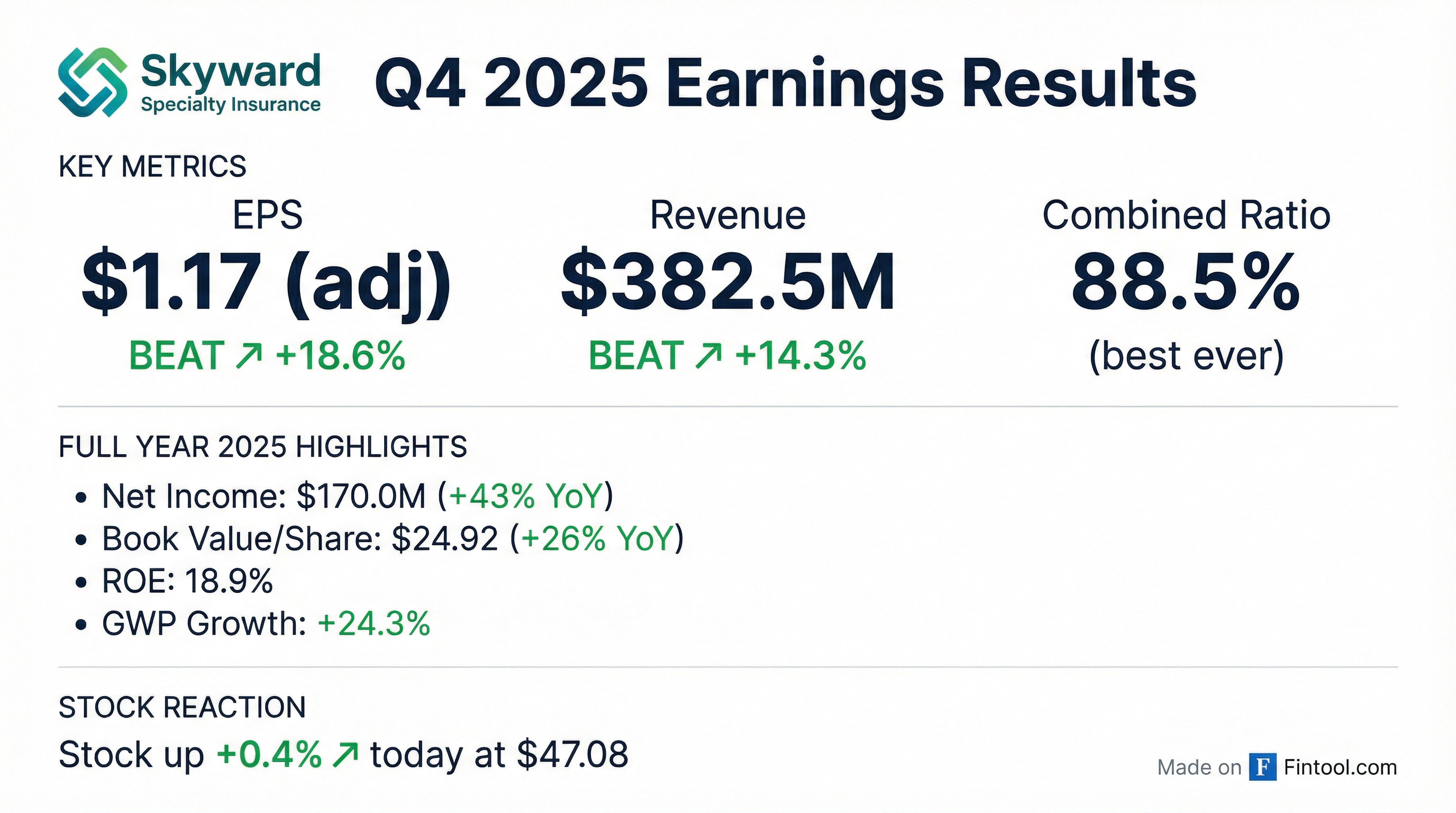
Skyward Specialty Insurance Group (SKWD) reported fourth quarter 2025 results that exceeded expectations, delivering adjusted operating EPS of $1.17 versus consensus of $1.02, a beat of approximately 15%. Revenue of $385.6M topped estimates by 1.2%. The quarter capped what CEO Andrew Robinson called an "incredible year" with the fourth consecutive quarter of record results for adjusted operating income and underwriting income.
Despite the strong results, the stock sold off -6.1% on the day of the earnings call, falling from $47.25 at the open to $44.30 at close. This reaction may reflect investor concerns about moderating growth, competitive market conditions, and increased leverage from the Apollo acquisition.
Did Skyward Specialty Beat Earnings?
Yes — double beat, but stock sold off 6% on the earnings call.
This marks the 8th consecutive quarter Skyward has beaten EPS estimates since going public in January 2023.
Three-Year Progress as Public Company:
- Adjusted operating income: 4x greater than Q4 2022
- Diluted EPS: 3x greater ($1.17 vs $0.36)
- Fully diluted book value/share: 2x greater at Apollo close
 Ask Fintool AI Agent
How Did the Stock React?
Down -6.1% — a sharp reversal from the pre-call aftermarket gain.
The stock opened higher following the prior day's earnings release but sold off throughout the earnings call. Potential concerns driving the decline:
- GWP growth deceleration: 13% in Q4 vs 26% in Q3 — management attributed this to competitive markets and intentional discipline
- Leverage increase: Debt-to-capital rising to 28-29% post-Apollo from under 11%
- Property competition: CEO noted pricing pressure has extended "to all levels" with no signs of improvement
- Loss ratio tick-up: Underlying loss ratio increased sequentially due to business mix shift toward higher loss ratio lines (A&H, Ag)
What Did Management Say About the Uber AV Partnership?
The most significant announcement was Apollo's partnership with Uber for autonomous vehicle insurance.
Key Details:
- Product: AVIP (Autonomous Vehicle Insurance Policy) — a comprehensive liability product combining general liability, product liability, and other coverages
- Structure: Embedded directly in the Uber autonomous vehicle platform — "not sold, but consumed"
- Scope: Launching in 15 cities, covering manufacturers, ADS providers, fleet managers, and other participants
- Differentiation: Apollo has proprietary data and "the largest dataset available" on AV risk on the insurer side
Important Clarification: This is NOT commercial auto insurance.
"For the avoidance of doubt, this is not a commercial auto policy. Any AV on the road has to carry commercial auto to meet their legal requirements. This is not that. This is a coverage for anybody who participates on the platform, embedded into the Uber platform." — CEO Andrew Robinson
Bull Case on AVs: Management emphasized the safety advantage of autonomous vehicles over human drivers, citing "dramatically" lower frequency and severity. CEO Robinson noted:
"No company in the world is better positioned than Uber to demonstrate the safety and the difference between autonomy and human drivers... When you think about a legal and tort backdrop, I don't know who you'd like to be if you had to choose, but I couldn't imagine being better positioned as being a partner to them."
Ask Fintool AI AgentWhat Are the Apollo Transaction Details?
The Apollo acquisition closed January 1, 2026. Key financial impacts:
Apollo's Financial Profile (similar to Skyward Specialty):
- Growth: ~20%
- Combined ratio: ~89%
- Expense ratio: 4-5 points higher than Skyward
- Loss ratio: 4-5 points lower accordingly
Syndicate 1971 Structure (ibott, digital economy focused):
- Skyward capital participation: 25%
- Third-party capital: 75% (from notable reinsurers)
- Fee-based component from managing third-party capital
- Quota share reinsurance support behind the syndicate
What Drove the Combined Ratio Improvement?
The 88.5% combined ratio represents a company record and the fourth consecutive quarter of all-time bests.
Reserve Profile — Strongest in Company History:
- 74% of reserves in IBNR — highest level ever
- 65% paid-to-incurred — consistent with 2024
- CFO Mark Haushill: "I feel as good about our reserves as I ever have since we have been public"
Reserve Development Details:
- Net favorable development: $7.5M (2.1 points on loss ratio) primarily from surety and property
- Adverse development: ~$25M in commercial auto (accident years 2022 and 2024)
- Adverse development offset by shorter tail line releases
- All adverse development in areas that have been exited over past 3 years
How Did Each Business Segment Perform?
Growth Leaders in Q4:
- Surety: +20%+ — driven by federal funds release in Q4, well-diversified across trades, avoided $1B+ loss from solar company failure
- A&H: +20%+ — 1/1 renewals "off the chart," massively ahead of plan
- Specialty Programs: +20%+ — strong continued momentum
A&H Competitive Position:
"Our loss ratio is 15 points better than the market and a full 30 points better than the big names that performed really poorly over the course of the last couple of years, purely on the loss ratio side. The numbers don't lie." — CEO Andrew Robinson
Intentional Pullback Areas:
- Construction & Energy: Shrinking due to commercial auto reduction — 62% exposure reduction over 12 quarters
- E&S/Professional Lines: Less new business due to competitive pricing, though defended existing book effectively
Portfolio Construction Achievements:
- 58% of business in short tail lines
- 48% in lines less exposed to P&C cycles — up from prior years
- Largest division only 16% of premium — well diversified
What's the Outlook for Property and Casualty Markets?
Property Market — Competitive Pressure Extending:
- Pricing pressure started on very large accounts in Q2 2025
- Now extended "to all levels" including <$50K premiums
- About to lap the start of softening — watching to see if market stabilizes
- No signs of improvement yet
Casualty Market — Capital Redeployment Coming:
"I'm sure companies are going to redeploy capital elsewhere in the market. Some of that's going to find its way into the liability side, and it's going to become more competitive." — CEO Robinson
Management's View on Casualty Growth:
"You should always take pause at companies that don't have a track record in casualty that grow a lot... The people who are chomping up big chunks of this market and growing at quite considerable levels are not doing it and beating the better players out there because they're better underwriters. They're doing it to get share, and they're doing it oftentimes with price and terms."
What Changed From Last Quarter?
Why Loss Ratio Ticked Up: Management emphasized this is a mix shift, not deteriorating underwriting. A&H and Ag are higher loss ratio / lower expense ratio businesses that are "earning in faster than the low loss ratio businesses like credit and surety." Combined ratio guidance unchanged.
Q&A Highlights
On Captives Slowdown: Group captives have been structural share gainers even during soft markets, but the current pricing backdrop may reduce the "impetus" for companies to move from guaranteed cost to captive structures. Most do it for strategic/long-term reasons.
On Wholesale Facilities (Ryan-style diversified facilities):
"We will never do that while I'm the CEO of the company... Our strategy is about rule your niche. It is about distinct focus. It is about expertise and capabilities."
On California Wildfire Recoveries: Very little loss from wildfires. Recoveries looking good. Not even material enough to see through the P&L.
On M&A Pipeline:
- Strategically led, patient approach
- Targeting people and teams they know are great performers
- Not an active acquirer — financial responsibility to shareholders
- Apollo was a "unique transaction" that matched next phase of company
On Net Retention Trends:
- Full year 2025: ~65% gross-to-net (up from 62-63% in 2024, 60% in 2023)
- Consistent upward trajectory of "eating more of our own cooking"
- On excess reinsurance: increased cede but also kept 10% more of writings
Ask Fintool AI AgentKey Takeaways
-
Record Results, Soft Stock Reaction: 8th consecutive EPS beat with record combined ratio, but stock dropped 6% on concerns about growth deceleration and market competition
-
Uber AV Partnership is Significant: Apollo's embedded insurance product in Uber's autonomous platform positions Skyward at the forefront of a potentially massive emerging market
-
Reserve Strength Emphasized: 74% IBNR (highest ever), conservative reserving despite commercial auto adverse development in exited areas
-
Intentional Growth Discipline: Management willing to shrink divisions (C&E, E&S) rather than chase unprofitable growth — 62% commercial auto reduction over 3 years
-
Diversification Working: 48% of business in non-cycle exposed lines, largest division only 16% of premium
-
A&H Outperformance: 15 points better loss ratio than market, 1/1 renewals significantly beat expectations
-
Apollo Integration Smooth: Similar financial profile (89% combined ratio, 20% growth), balance sheet "every bit as conservative" as Skyward
Earnings call: February 24, 2026. Full transcript