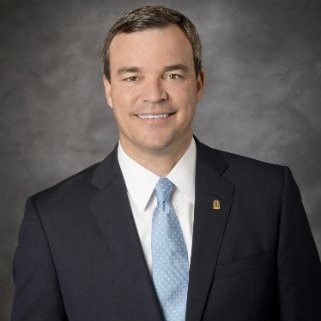
John Corbett
 SouthState Bank
About John Corbett
John C. Corbett (age 56) is Chief Executive Officer of SouthState Corporation and President/CEO of SouthState Bank; he has served on the SouthState Board since 2020 following the CenterState merger, where he previously served as CEO and a long‑tenured leader since 1999 . Under his leadership, 2024 results included net income of $535M ($6.97/diluted share), adjusted net income of $553M ($7.21/diluted share), ROATCE of 15.0% (15.5% adjusted), NIM of 3.43%, 4.7% annualized loan growth, and 2.7% annualized deposit growth . SouthState’s stock rose 18% in 2024 and outperformed the KBW Regional Bank Index by 8% (1-year), 25% (2-year), and 29% (3-year) lookbacks, reflecting value creation through disciplined growth and the January 2025 acquisition of Independent Bank Group that brought the balance sheet to ~$65B assets .
Past Roles
| Organization | Role | Years | Strategic Impact |
|---|---|---|---|
| CenterState Bank Corporation | President & CEO; EVP (prior); CEO/Director of CenterState Bank, N.A.; Chief Credit Officer | EVP 2007–2015; CEO 2015–2020; Bank CEO/Director 2003–2020; CCO 2000–2003 | Built/led the platform ultimately merged into SouthState; deep credit/risk and operating expertise |
| First Union National Bank (FL) | VP, Commercial Banking | 1990–1999 | Large-bank credit and commercial banking foundation |
External Roles
| Organization | Role | Years | Notes |
|---|---|---|---|
| CenterState Bank Corporation | Director | 2011–2020 | Pre-merger public company board experience |
| Other listed public boards | — | — | None disclosed |
Board Service and Governance
| Board | Role | Since | Committees | Independence | Chair/CEO Structure | Attendance / Sessions |
|---|---|---|---|---|---|---|
| SouthState Corporation | Director (CEO) | 2020 | None (all committees independent) | Not independent (management) | Independent Chair separated from CEO | Board attendance 95% in 2024; 7 executive sessions of independent directors |
- Director fees: as an employee-director, Corbett does not receive director retainers/fees or equity for board service .
Fixed Compensation
| Metric | 2022 | 2023 | 2024 | Notes |
|---|---|---|---|---|
| Base Salary ($) | 975,000 | 1,043,250 | 1,074,547 | 2025 base salaries increased 5% post-Independent merger (applies to NEOs) |
Performance Compensation
- 2024 pay mix at target: ~82% variable and ~63% performance-based for CEO, aligning pay with performance .
2024 Annual Incentive Plan (AIP) – Metrics and Payout
| Metric (Weight) | Threshold | Target | Max | 2024 Actual | Payout vs Target |
|---|---|---|---|---|---|
| Adjusted PPNR less Net Charge-offs (80%) | $586M [0%] | $651M [100%] | $716M [150%] | $722M | 150% |
| NPAs / (Loans + OREO) absolute/peer (20%) | 25th pct [0%] | 50th pct [100%] | 75th pct [150%] | 0.63% (≤0.75% = max) | 150% |
| CEO AIP | Target (% Salary) | Target ($) | Max (% Salary) | 2024 Earned ($) |
|---|---|---|---|---|
| Corbett | 125% | 1,343,184 | 187.5% | 2,014,777 |
- AIP design update in 2024 excluded net charge-offs from PPNR to focus on core earnings outside CECL volatility .
2024 Long-Term Incentive (LTI)
- Mix: 60% PSUs (performance-based) and 40% RSUs (time-based), vesting ratably over 3 years on January 1 each year following grant; PSUs vest 0–150% on 3-year compound TBV/share growth and 3-year relative ROATCE vs peers (equal weights) .
| CEO 2024 LTI | Grant Date | RSUs (#) | PSUs Target (#) | RSU FV ($) | PSU FV ($) | Total Target LTI ($) |
|---|---|---|---|---|---|---|
| Corbett | 1/23/2024 | 15,034 | 22,551 | 1,231,134 | 1,846,701 | 3,008,732 |
- 2024 CEO LTI opportunity set at 280% of base salary; target AIP increased to 125% (from 115%) to align with peers; design for other NEOs also modestly increased .
- 2022 PSU cycle (performance period 1/1/2022–12/31/2024) paid at 131.2%: TBV growth 16.6% (max) and relative ROATCE 64th percentile . CEO realized 36,092 shares, $3,590,432 value at $99.48/share on 12/31/2024 .
2024 Total Direct Compensation (selected items)
| Component | 2024 ($) |
|---|---|
| Salary | 1,074,547 |
| Stock Awards (FASB ASC 718) | 3,077,836 |
| Non-Equity Incentive (AIP) | 2,014,777 |
| All Other Compensation | 53,908 |
| Total | 6,221,068 |
Equity Ownership & Alignment
| Ownership and Alignment Element | Detail |
|---|---|
| Common stock beneficially owned | 135,796 shares (incl. 1,347 in IRA; remainder individually) |
| RSUs vestable within 60 days | 36,092 (counted in beneficial ownership via right to acquire) |
| Outstanding unvested PSUs/RSUs (not beneficially owned) | 89,258 at target (PSUs/RSUs) |
| Outstanding equity detail (as of 12/31/2024) | RSUs outstanding: 18,142; 2,294; 9,616; 15,034; PSUs (unearned): 36,092; 21,636; 22,551 |
| Ownership as % of shares outstanding | <1% (“*” in table) |
| Executive stock ownership guideline | CEO must hold ≥6x base salary; all NEOs exceeded requirements as of YE 2024 |
| Hedging/pledging policy | Hedging and pledging prohibited for directors/officers/employees |
| 10b5‑1 and insider trading policy | Policy governs trading and Rule 10b5‑1 plans; filed as Exhibit 19.1 to 2024 10‑K |
| Director ownership guideline (for reference) | Directors ≥5x cash retainer within 5 years |
Vesting schedules and potential selling pressure: RSUs vest ratably on January 1 in each of the three years after grant; PSUs cliff-vest after the 3-year performance period, creating periodic taxable events and potential sell-to-cover activity, subject to the company’s insider trading window policy and 10b5‑1 plans .
Employment Terms
Corbett’s “grandfathered” employment agreement (originally 2010, auto-renewing) provides legacy single‑trigger CIC severance and excise tax gross‑up; these provisions have been discontinued for new arrangements but remain for him and one other executive .
- Termination without cause / for good reason (no CIC): Lump‑sum 1x highest W‑2 compensation over prior 3 years, subject to release .
- Change in Control (single trigger under grandfathered agreement): Lump‑sum 3x highest W‑2 compensation over prior 3 years, plus excise tax gross‑up; unvested equity accelerates (with specific plan mechanics) .
- Death/Disability: Continuation/benefits as specified; COBRA for family for 12 months after death; disability benefits per plan .
- Restrictive covenants: Non-compete and non-solicit for one year post-termination (except following a CIC) .
Potential payments table (as of 12/31/2024; assumes termination/change on that date):
| Scenario | Cash Severance ($) | Equity – PSUs ($) | Equity – RSUs ($) | COBRA ($) | BOLI / Term Life ($) | Tax Gross‑Up ($) | Total ($) |
|---|---|---|---|---|---|---|---|
| Qualifying termination (no CIC) | 5,872,934 | 4,533,537 | 2,766,349 | 109,945 | — | — | 13,282,765 |
| Disability | — | 4,533,537 | 2,766,349 | — | — | — | 7,299,886 |
| Death | — | 4,533,537 | 2,766,349 | 24,988 | 239,782 (BOLI) + 212,141 (Term) | — | 7,776,796 |
| Change in Control (incl. qualifying termination; CIC cash/gross‑up single‑trigger for Corbett) | 17,618,803 | 4,533,537 | 2,766,349 | 109,945 | — | 8,856,899 | 33,885,533 |
Clawbacks: SEC/NYSE-compliant recoupment policy (effective Oct 2, 2023) covering incentive-based compensation upon certain restatements; complements a broader clawback policy in place since 2021 .
Related party note: Corbett is the brother‑in‑law of Stephen D. Young (Chief Strategy Officer); the company discloses related-person review and Regulation O compliance .
Performance & Track Record
| Metric | 2024 Result |
|---|---|
| Net Income | $535M; adjusted $553M |
| ROATCE | 15.0%; adjusted 15.5% |
| PPNR | $740M; PPNR/share $9.64 |
| NIM | 3.43% |
| Loans/Deposits Growth | 4.7% / 2.7% annualized |
| TSR/Stock | +18% in 2024; outperformed KBW Regional Bank Index on 1-, 2-, 3-year lookbacks |
Major initiatives: Closed Independent Bank Group acquisition (effective Jan 1, 2025), expanding to ~343 branches across 8 states and ~$65B in assets . Culture and engagement remain strengths (83% engagement vs 75% industry benchmark) .
Compensation Structure Analysis
- Increased at-risk mix and performance leverage: CEO target AIP increased to 125% and LTI maintained at 280% with 60% performance equity, reinforcing pay-for-performance .
- Rigorous metrics tied to shareholder value: AIP based 80% on Adjusted PPNR less NCOs and 20% on NPAs/Loans+OREO; LTI based on 3-year TBV/share growth and relative ROATCE vs peers .
- Shareholder alignment safeguards: Strong ownership guidelines (CEO 6x salary), hedging/pledging bans, 10b5‑1 governance, and clawback policies .
- Shareholder support: 86.4% Say‑on‑Pay approval at 2024 annual meeting, with continued investor engagement .
Equity Ownership & Alignment (Detail)
| Item | Amount / Policy |
|---|---|
| Beneficial ownership | 135,796 common shares; <1% of class |
| Vested but unsettled within 60 days | 36,092 RSUs |
| Unvested awards (illustrative) | RSUs totaling 18,142; 2,294; 9,616; 15,034; PSUs at target 36,092; 21,636; 22,551 |
| Ownership guideline status | CEO exceeds 6x salary requirement |
| Hedging/pledging | Prohibited |
Employment Terms (Key Legal/Retention Levers)
- Agreement form: Auto-renewing “grandfathered” CEO agreement (legacy single‑trigger CIC and excise tax gross‑up) .
- Non-compete / non-solicit: One year (except following CIC) .
- Severance multiples: 1x highest W‑2 (no CIC); 3x highest W‑2 + excise gross‑up (CIC single-trigger) .
- Equity treatment: CIC and qualifying termination provisions accelerate per plan; see quantified table above .
Investment Implications
- Alignment positives: High variable/performance-based mix, stringent ownership guidelines, clawbacks, and hedging/pledging bans support alignment and reduce governance risk; strong 2024 operational performance and AIP/LTI designs directly tied to core profitability and capital-accretive metrics .
- Watch items: Legacy single‑trigger CIC cash (3x W‑2) plus excise tax gross‑up and full acceleration create a sizable parachute ($33.9M modeled at 12/31/2024), representing a potential overhang in strategic scenarios; related‑party connection (CSO is brother‑in‑law) is disclosed and governed but merits ongoing monitoring .
- Trading/flow signals: Known RSU/PSU vesting events (Jan 1 schedules and end-of-cycle PSU cliffs) create periodic liquidity and potential sell‑to‑cover activity, though insider trading windows and 10b5‑1 plans plus pledging bans mitigate adverse optics/forced selling risk .
- Governance structure: Separate Independent Chair, independent committees, and robust risk governance provide counterbalance to CEO/director dual role; strong Say‑on‑Pay support (86.4%) suggests investor acceptance of the current design despite legacy CIC terms .