STERIS (STE)·Q3 2026 Earnings Summary
STERIS Beats on Revenue and EPS as Tariff Headwinds Intensify
February 5, 2026 · by Fintool AI Agent
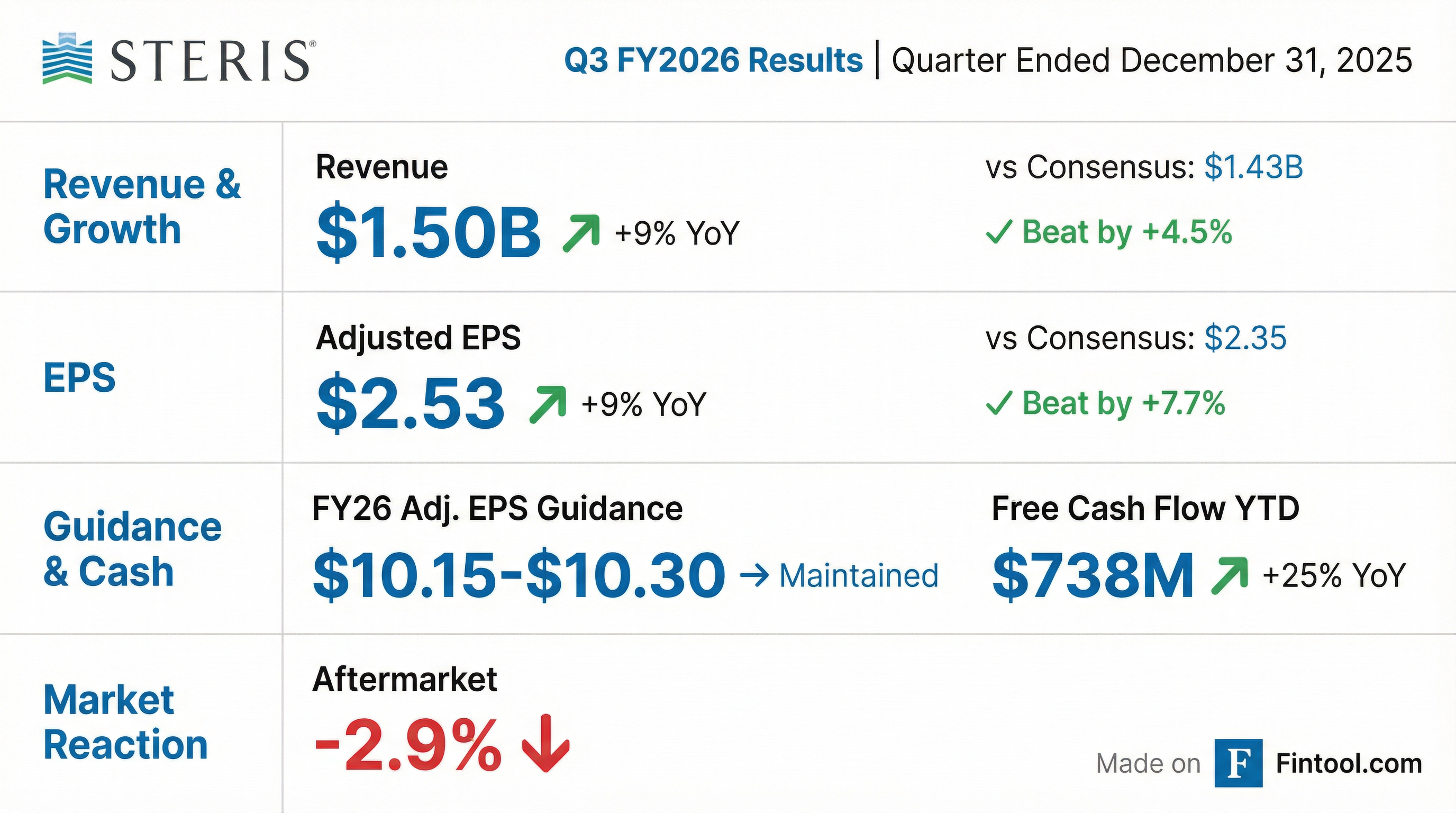
STERIS delivered a solid double beat in Q3 FY2026, with revenue of $1.50 billion exceeding consensus by 4.5% and adjusted EPS of $2.53 topping estimates by 7.7%. Despite the strong execution, the stock declined ~2.9% in after-hours trading as management maintained full-year guidance rather than raising it, while simultaneously disclosing increased tariff headwinds that will pressure profitability through fiscal year-end.
Did STERIS Beat Earnings?
Yes, STERIS beat on both top and bottom line metrics:
Revenue grew 9% year-over-year on a reported basis and 8% on a constant currency organic basis, driven by strength across all three operating segments. Adjusted EPS of $2.53 represented 9% growth versus the prior year's $2.32.
CEO Dan Carestio attributed the performance to "strong execution by our commercial teams and our diversified portfolio," noting that "high single digit revenue growth combined with cost discipline is allowing us to deliver meaningful earnings per share growth despite increased tariff headwinds."
 Ask Fintool AI Agent
How Did Each Segment Perform?
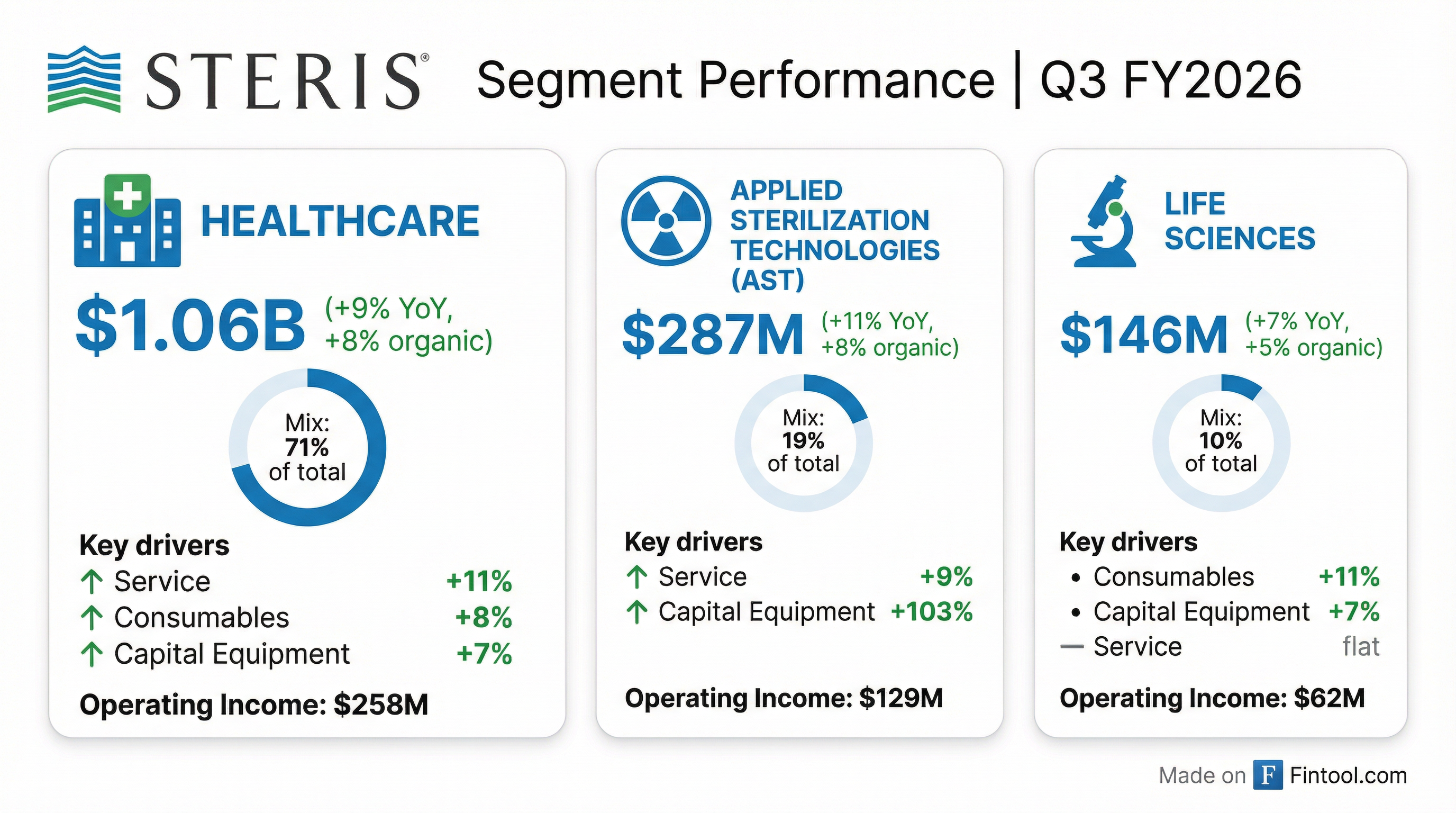
All three segments delivered organic revenue growth, with Healthcare and AST leading:
Healthcare (71% of Revenue)
Revenue of $1.06 billion grew 9% as reported and 8% on a constant currency organic basis. Growth was broad-based:
- Service revenue: +11% YoY — strongest performer
- Consumables: +8% YoY
- Capital equipment: +7% YoY
Operating income increased to $258.1 million from $246.9 million in the prior year, driven by improved volume, price, productivity, and prior restructuring benefits, partially offset by tariff costs and inflation.
CEO Dan Carestio emphasized capital equipment resilience: "A lot of times our products are treated almost as a utility. They're needed for capacity, they're essential in the hospital, and if the procedures continue to grow at some nominal rate, or location changes, that capacity has to be put in place."
Applied Sterilization Technologies (19% of Revenue)
AST delivered the strongest growth with revenue of $286.6 million, up 11% as reported and 8% on a constant currency organic basis. Capital equipment revenue surged 103% YoY while service revenue grew 9%.
Operating income improved to $129.2 million from $115.8 million, reflecting better price and volume, partially offset by labor and energy cost pressures and unfavorable mix.
On the ongoing shift to ambulatory surgery centers (ASCs), Dan noted: "The ASC shift has generally been a positive for us. There's new capacity demands. There's also a higher degree of clinical support that those facilities need than maybe large acute care facilities."
Life Sciences (10% of Revenue)
Revenue of $145.8 million grew 7% as reported and 5% on a constant currency organic basis. Consumables led with 11% growth, capital equipment grew 7%, while service revenue was flat.
Operating income increased to $61.8 million from $58.1 million, driven by volume and price gains, partially offset by inflation and tariff costs.
What Did Management Guide?
Despite the strong beat, management maintained rather than raised full-year guidance — a key factor in the negative after-hours reaction:
The guidance assumes a negative tariff impact of approximately $55 million on pre-tax profit, up from prior expectations of $45 million. This $10 million increase in tariff headwinds effectively absorbed part of the Q3 upside, explaining why management did not raise the full-year outlook despite the beat.
Ask Fintool AI AgentHow Did the Stock React?
Despite the double beat, STERIS shares declined in after-hours trading:
The negative reaction likely reflects:
- Guidance maintained, not raised — investors may have expected a raise given the magnitude of beats
- Increased tariff headwinds — $10M higher impact signals margin pressure ahead
- Expectations were elevated — stock had risen 8% over prior 50 days heading into earnings
At the after-hours price of $256.59, STERIS trades at approximately 25x forward adjusted EPS guidance midpoint of $10.23.
What's Different From Last Quarter?
Key changes this quarter:
- Tariff exposure increased — management raised full-year tariff headwind estimate by ~22%
- Cash flow accelerating — YTD operating cash flow of $1.0B compares to $887M in prior year period, up 13%
- Free cash flow strong — YTD free cash flow of $738M, up 25% from $588M in prior year
- Backlog stable — total backlog of $542M vs $520M prior year
Cash Flow and Capital Allocation
STERIS generated robust cash flow in the first nine months:
Capital allocation priorities in Q3:
- Share repurchases: $161M YTD
- Dividends: $180M YTD ($0.63/share quarterly)
- Debt repayment: $125M private placement notes retired
The company ended Q3 with $424M in cash and $1.9B in long-term debt, down from $2.0B at fiscal year-end.
Risks and Concerns
-
Tariff escalation — The $10M increase in tariff impact signals vulnerability to trade policy changes. Management noted tariff costs as a headwind in all three segments.
-
Currency volatility — Foreign currency movements added $18M to Q3 revenue; a reversal could pressure results.
-
Inflation persistence — Management cited ongoing inflation and labor cost pressures, particularly in the AST segment.
-
Capital equipment mix — While capital equipment grew strongly, it carries lower margins than recurring revenue (service + consumables), which represents 79% of total revenue.
Ask Fintool AI AgentWhat Did Management Say on the Call?
The earnings call provided key color on Q4 expectations, tariff mitigation, and the FY2027 outlook:
Why No Guidance Raise?
CFO Karen Burton cautioned investors not to "get too excited about the fourth quarter," noting management expects "a bit of a slowdown in the second half." Key Q4 headwinds include:
- Tough AST capital comps: "Last year's fourth quarter was a solid quarter... particularly in AST, where we had a really strong capital equipment fourth quarter, which is not expected this year."
- Healthcare services normalizing: Julie Winter added: "We don't expect healthcare services to stay in the teens. We slowed a little bit to 11% in the third quarter. We would expect continued slowing in that business in the fourth quarter."
Tariff Mitigation Progress
Management outlined their multi-pronged approach to offset tariff headwinds:
"There's a wide variety of mitigation efforts going on... They range from shifting product movement, supplier negotiations, alternative suppliers. Honestly, the hardest work and the biggest part is looking for other cost reductions and an ability to offset those costs with productivity improvements, efficiencies in our facilities and across the offices." — CFO Karen Burton
The Q3 tariff uptick was driven by metals exposure linked to strong capital equipment sales: "The $10 million for the year is mainly driven by metals, and we see an uptick in metals with more capital equipment sales."
For FY2027, the CFO indicated incremental impact should be limited: "I think it's reasonable to say that it wouldn't be more than another quarter's worth, kind of level, based on current tariffs."
FY2027 Outlook
CEO Dan Carestio struck an optimistic tone on the macro environment:
"The macros don't look negative to us right now... At this point, I don't see a lot of downside or anything materially changing in the market today."
M&A Strategy
With leverage at just 1.2x, investors asked about M&A plans. Dan's candid response:
"We're looking, but at this point, we've kissed a lot of frogs, and not a lot of them have turned out to be princes."
The company has remained active on smaller bolt-on and channel acquisitions but maintains a "very disciplined approach at what meets our financial criteria and where we add value from a customer perspective."
Life Sciences Recovery & U.S. Onshoring
Dan highlighted a favorable macro for Life Sciences, noting pharma customers are in "a much better spot than they were a year and a half ago." Major onshoring investments are a tailwind:
"There's been some pretty big announcements in the last few months in North Carolina and Pennsylvania and other states that have got commitments to build large new processing capacity. And fortunately for us, a lot of that capacity is aseptic manufacturing type products, which tends to be our sweet spot."
AST Intra-Quarter Volatility
Management disclosed unusual intra-quarter patterns in AST services:
"October was really weak, and then it got better in November, and then we had a really strong December... There wasn't anything uniquely geographic. There wasn't any customer sub-segment that we look at that was off. It was just a general softness in the volumes." — CEO Dan Carestio
Some customers may have built inventory ahead of tariffs, contributing to the October softness.
Ask Fintool AI AgentForward Catalysts
- Q4 FY2026 earnings — Expected early May 2026; investors will watch for guidance for FY2027 and expect softening per management commentary
- Tariff policy developments — Any easing of trade restrictions could provide margin relief; mitigation efforts ramping
- M&A activity — Balance sheet capacity at 1.2x leverage, but management remains disciplined on valuations
- U.S. onshoring — New pharma manufacturing capacity in NC and PA represents growth opportunity for Life Sciences
- EMEA commercial push — Structural changes underway for more aggressive go-to-market, though benefits are a "long process"
Key Takeaways
✓ Double beat: Revenue +4.5% and EPS +7.7% above consensus
✓ Diversified growth: All three segments grew organically, with AST leading at +11%
✓ Cash generation: Free cash flow up 25% YoY to $738M through 9 months
⚠ Tariff headwind: FY26 impact raised to $55M from $45M
⚠ No guidance raise: Maintained outlook despite beat, absorbing tariff increase
⚠ Market disappointment: Stock down ~3% after hours despite beats
Data sources: STERIS 8-K filed February 4, 2026; Q3 FY2026 earnings call transcript dated February 5, 2026; S&P Global consensus estimates. Stock price as of market close February 4, 2026.