TAL Education (TAL)·Q3 2026 Earnings Summary
TAL Education Delivers 266% Profit Surge as Margins Hit Multi-Year Highs
January 29, 2026 · by Fintool AI Agent
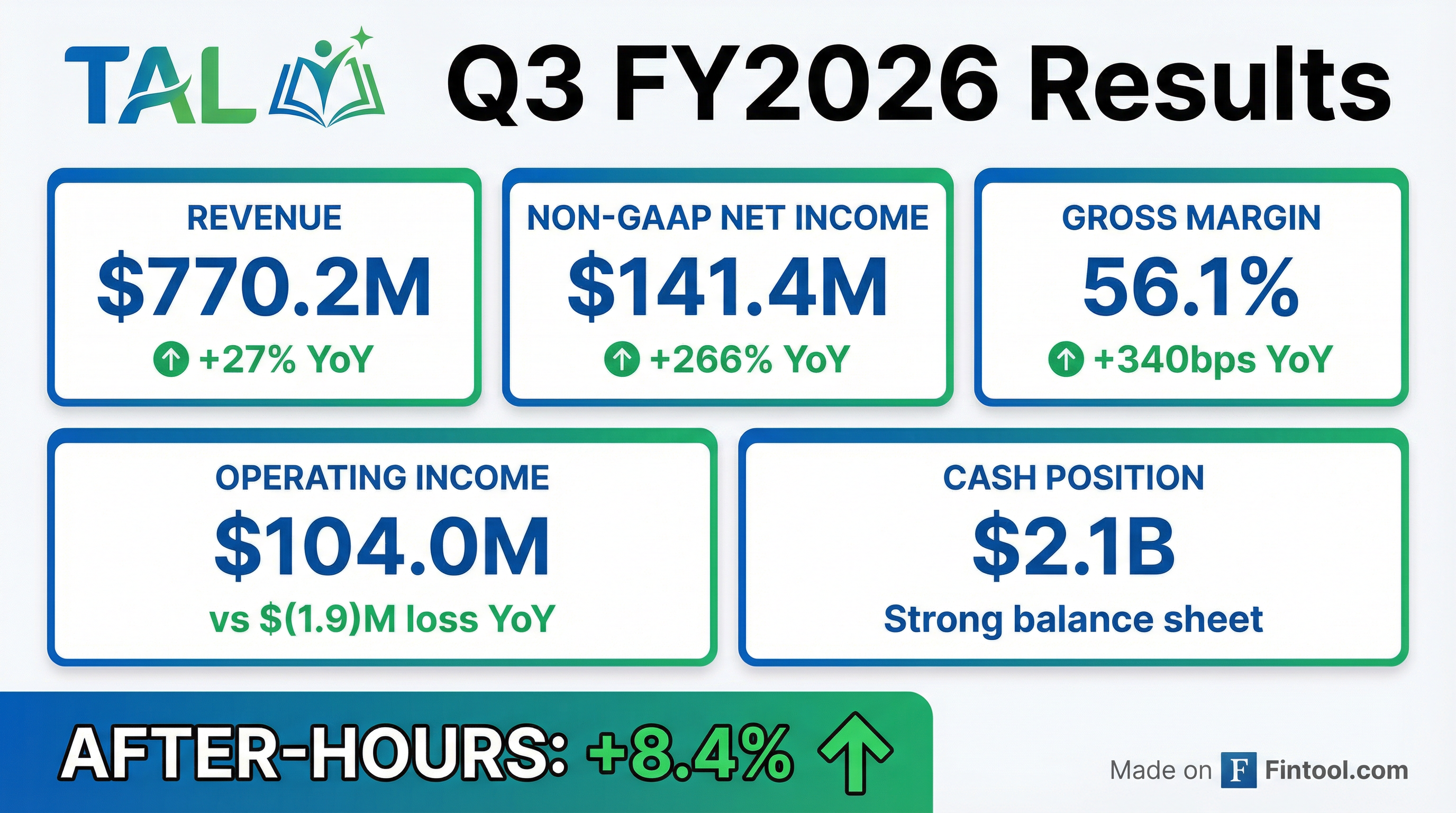
TAL Education Group reported fiscal Q3 2026 results that exceeded expectations with a dramatic profitability turnaround. Revenue grew 27% year-over-year to $770.2 million while non-GAAP net income surged 266% to $141.4 million, driven by significant operating leverage and disciplined cost management. The stock responded favorably, jumping approximately 8.4% in after-hours trading.
What Were the Key Numbers?
This marks the highest November quarter operating margin since 2018, according to an analyst on the call.
 Ask Fintool AI Agent
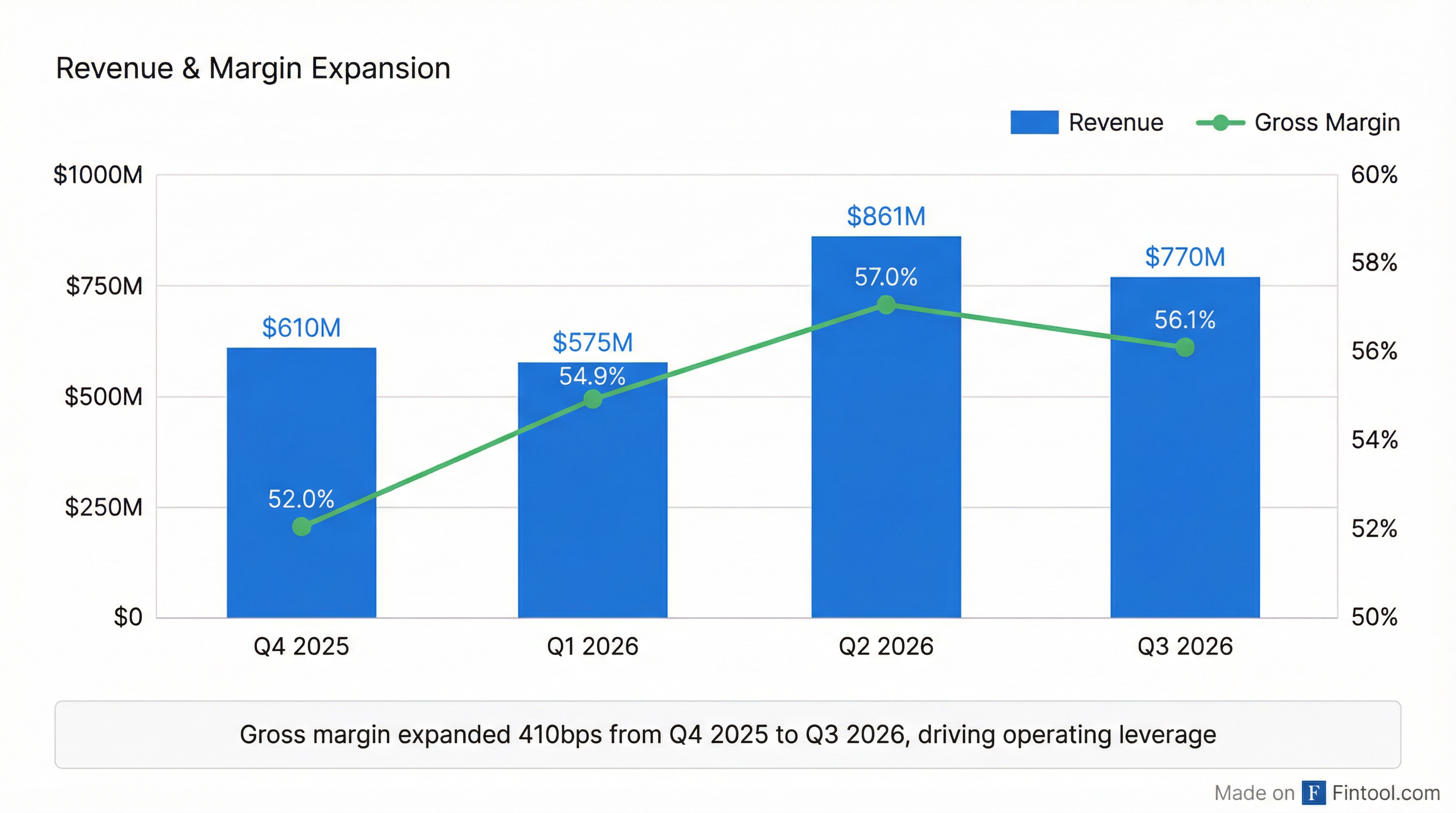
What Drove the Margin Expansion?
The dramatic margin improvement stemmed from two key factors:
1. Operating Leverage on Revenue Growth Selling and marketing expenses decreased 2.8% YoY to $220.1 million despite 27% revenue growth, with non-GAAP S&M as a percentage of revenue declining from 36.7% to 28.3%. Management noted that online marketing and branding expenses for the learning device business were lower than the same period last year.
2. Cost Discipline Across Business Lines G&A expenses grew only 7.1% YoY while revenue grew 27%, driving G&A as a percentage of revenue down from 16.6% to 14.4%.
How Did Each Business Perform?
Peiyou Small Class (Offline Enrichment)
The flagship offline tutoring business delivered stable year-over-year revenue growth driven by increased enrollments, with ASP remaining relatively stable. Key operational highlights:
- Learning Center network expansion remained "disciplined" with evaluation based on organizational readiness, operational efficiency, and regional market demand
- Strong operating metrics including retention rates affirm user trust
- Growth expected to moderate in FY2026 due to higher comparison base
Online Enrichment Programs
Online offerings also maintained year-over-year growth, enhanced by technology-driven innovation including immersive classroom solutions. The company introduced gamified learning mechanisms where students role-play as protagonists from classic literature.
Learning Devices
The learning device segment showed continued momentum but with decelerating growth:
Management acknowledged the growth deceleration was driven by: (1) transition from rapid expansion to sustained growth, and (2) timing differences in product launches between fiscal years.
"We continue to prioritize long-term competitiveness over short-term profitability for this emerging business. The break-even timeline remains uncertain." — Jackson Ding, Deputy CFO
What's the AI Strategy?
TAL is positioning its learning devices as "AI companions" rather than simple problem-solving tools. Key initiatives:
AI Thinkie 1-on-1: Interactive step-by-step tutoring companion that has facilitated over hundreds of thousands of hours of guided learning.
Xiao Si AI Assistant: Activated over 1 billion times by students as of December 2025.
AI Buddy: Showcased at CES 2026, winning the TWICE Picks Award. Designed for children aged 6-12 with voice, touch, and motion-based interactions.
"Rather than simply providing answers, our AI solutions aim to emulate human teaching methodologies—breaking down complex problems, offering tailored explanations, and guiding students through learning progression pathways." — Alex Peng, President & CFO
Ask Fintool AI AgentWhat About the Balance Sheet?
TAL maintains a strong financial position:
The company continued its share repurchase program, buying back 844,856 shares for approximately $27.7 million between October 30, 2025 and January 28, 2026, under a $600 million authorization from July 2025.
What Did Management Guide?
Management provided qualitative rather than specific financial guidance:
Near-term Outlook:
- Year-over-year growth rate expected to moderate in H2 FY2026 due to higher comparison base
- H2 growth rate expected to be lower than H1
- Learning device revenue expected to see continued fluctuation
Profitability:
- Improving overall profitability remains a key priority
- Expect near-term variability from market conditions, investment cycles, and seasonal fluctuations
- Management cautioned against using Q3 margin performance as benchmark for future periods
"We remain focused on building the long-term capabilities needed to seize the opportunities in the market... We may face occasional variability and limited visibility in our financial performance." — Alex Peng
How Did the Stock React?
TAL shares closed regular trading at $10.76, up 1.0% on the day. Following the earnings release, shares jumped approximately 8.4% in after-hours trading to $11.66.
What Should Investors Watch?
Positives:
- Dramatic margin expansion demonstrates operating leverage potential
- Strong cash generation ($527M operating cash flow)
- Peiyou offline business showing sustainable enrollment growth
- AI investments positioning company for future differentiation
- Robust balance sheet with $2.1B+ cash
Concerns:
- Learning device growth decelerating, profitability timeline uncertain
- Management warning of limited near-term visibility
- Higher comparison base will pressure growth rates in coming quarters
- Competitive dynamics in learning devices remain intense
Ask Fintool AI AgentEarnings Call Q&A Highlights
On Learning Center Expansion (Felix Liu, UBS): Growth was primarily driven by increased enrollments while ASP remained stable. Management emphasized a disciplined approach evaluating "organizational readiness, operational efficiency, and regional market demand" at a micro level of "districts and neighborhoods."
On Revenue Growth Moderation (Charlotte Wei, HSBC): Management explained the deceleration was primarily driven by learning devices transitioning from rapid expansion to sustained growth, plus product launch timing differences creating different comparable bases.
On Competitive Landscape (Liping Zhao, CICC): Management noted the learning device market is "dynamic" with AI fundamentally transforming educational technology. TAL's approach combines "vertical domain large models with general AI capabilities." Market share during 2011 promotion was "aligned with expectations."
On Margin Sustainability (Timothy Zhao, Goldman Sachs): The margin improvement reflected lower online marketing/branding expenses for learning devices plus disciplined cost management. Management cautioned against extrapolating Q3 margins as marketing expenses naturally fluctuate.
Analysis based on TAL Education Q3 FY2026 earnings call held January 29, 2026.