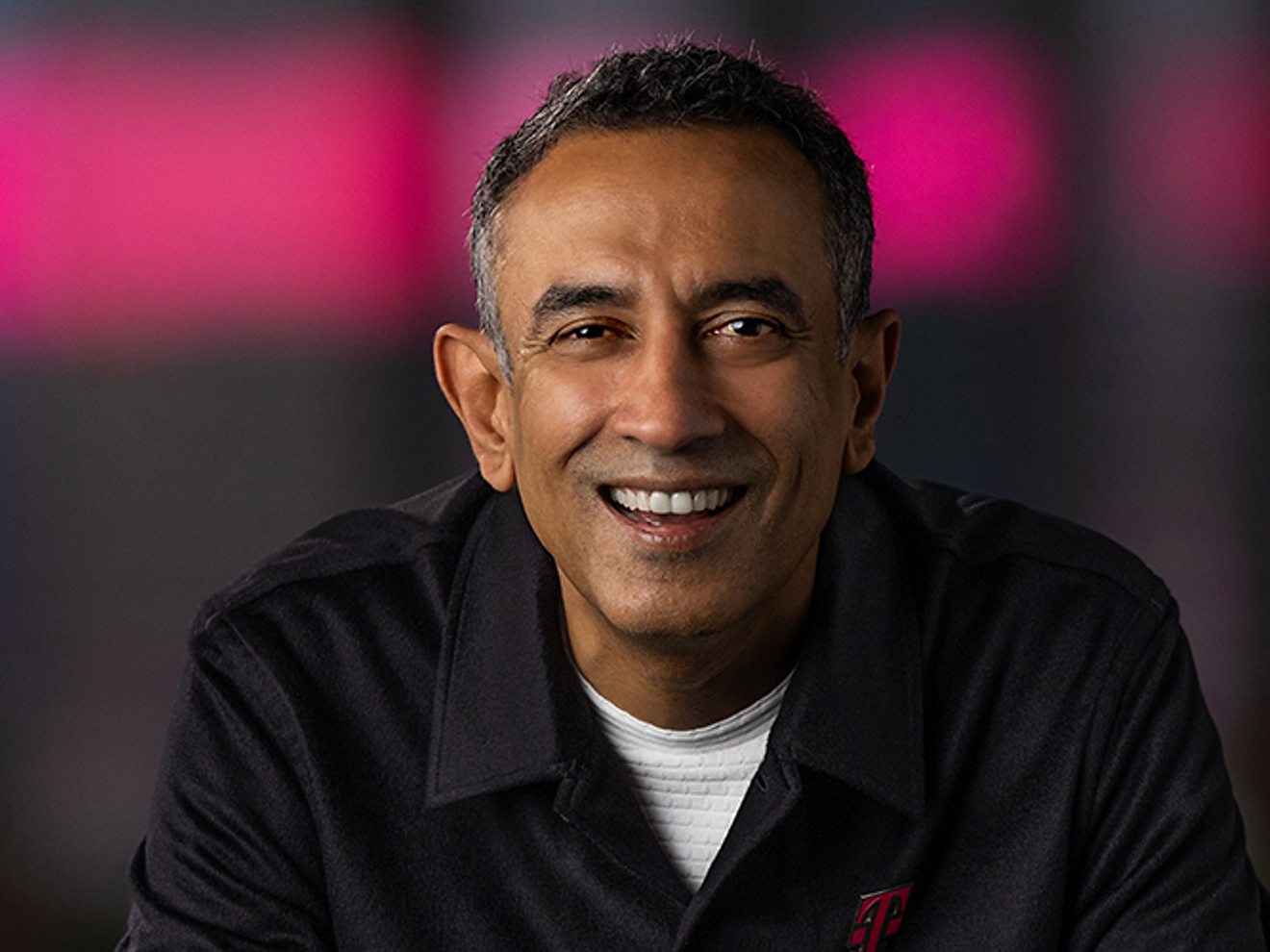
Srini Gopalan
 T-Mobile US
About Srini Gopalan
Srini Gopalan is Chief Operating Officer of T-Mobile US (since March 2025) and will become President and Chief Executive Officer effective November 1, 2025; he previously served on T-Mobile’s Board from August 2022 to February 2025 and led Telekom Deutschland GmbH as Managing Director from October 2020 to February 2025 . He is 55 and holds a Bachelor’s in Business Administration from St. Stephen’s College and an MBA from the Indian Institute of Management Ahmedabad . The company frames his appointment around “record growth and unprecedented financial performance,” and his track record includes doubling growth at Telekom Deutschland, scaling fiber to millions of homes, and achieving record mobile market share .
Past Roles
| Organization | Role | Years | Strategic Impact |
|---|---|---|---|
| T-Mobile US | Chief Operating Officer | Mar 2025 – Oct 2025 | Helped lead record growth initiatives and set stage for adjacent market expansion |
| T-Mobile US | Director (Board member) | Aug 2022 – Feb 2025 | Served on Compensation and Transaction Committees; contributed to governance and pay oversight |
| Telekom Deutschland GmbH | Managing Director | Oct 2020 – Feb 2025 | Doubled growth rate, scaled fiber to millions, record mobile market share |
| Deutsche Telekom AG | Board of Management, Europe | Jan 2017 – Oct 2020 | Drove convergence of fixed/mobile and initiated 5G rollout across Europe |
| Vodafone UK | Director, Consumer Business Unit | ~2010s (3 years) | Led consumer business; part of management team in T-Mobile UK/Orange JV “Everything Everywhere” |
| T-Mobile UK | Chief Marketing Officer | ~2009–2010s | Management role leading brand and marketing prior to EE JV |
| Capital One (UK) | Managing Director, UK | Until 2009 | Led UK business; data/digital strategies driving consumer solutions |
| Bharti Airtel (India) | Head of Consumer Business | Pre-2017 | Positioned Airtel in price-sensitive market through innovative offerings |
External Roles
| Organization | Role | Years | Notes |
|---|---|---|---|
| Hellenic Telecommunications Organization (OTE) | Director | 2017 – Nov 2021 | Public company board experience |
| Various prior employers | Executive roles | Pre-2017 | Bharti Airtel, Capital One, Vodafone; global telecom and digital expertise |
Fixed Compensation
| Component | Terms | Amount / Rule |
|---|---|---|
| Base Salary (CEO) | Effective Nov 1, 2025 | $1,400,000 |
| Short-Term Incentive (STI) – 2025 | Prorated dual targets | $2,000,000 (pre-Effective Date, prorated) + $3,500,000 (post-Effective Date, prorated) |
| Short-Term Incentive – 2026+ | Target percent of base | 250% of base salary; max payout 200% of target |
| Perquisites | Annual tax prep/financial planning | Up to $50,000 per year |
| Relocation | To Bellevue area | Continued assistance; pro-rata repayment if terminated for cause or resignation without good reason by Mar 1, 2026 |
| Travel | First-class airfare for family | Through Mar 1, 2027; capped at 32 total round trips; tax gross-up applied |
Performance Compensation
| Metric | Weighting | Target/Payout Structure | Vesting |
|---|---|---|---|
| PRSUs – Relative TSR | 65% of PRSU grant | Measured vs T-Mobile peer group | 3-year performance period |
| PRSUs – Free Cash Flow | 35% of PRSU grant | Company FCF over 3 years | 3-year performance period |
| RSUs (time-based) | N/A | Annual LTI mix includes RSUs | Typically vest in three annual installments (program design) |
| STI – CEO 2026+ | 250% of base target; cap | Max 200% of target | Annual cash plan |
CEO LTI Awards Summary
| Award | Grant Value | Structure | Key Terms |
|---|---|---|---|
| Annual LTI Target (starting 2026) | Not less than $19,500,000 | Mix of RSUs/PRSUs per program | Adjusted annually to specified peer CEO percentiles (see below) |
| True-Up LTI Awards (one-time) | $2,904,110 | 50% RSUs; 50% PRSUs | Mirrors vesting/performance terms of Mar 1, 2025 annual awards |
| Transformation Award (one-time PRSUs) | $10,000,000 | Performance-based RSUs | Same schedule/terms as Apr 1, 2025 senior leadership PRSUs |
CEO Compensation Percentile Ramp (Peer CEOs)
| Calendar Year | Base Salary Percentile | Annual LTI Target Value Percentile |
|---|---|---|
| 2026 | 40th percentile | 40th percentile |
| 2027 | 45th percentile | 45th percentile |
| 2028 | 45th percentile | 45th percentile |
| 2029 | 50th percentile | 50th percentile |
| 2030 | 50th percentile | 50th percentile |
Equity Ownership & Alignment
| Policy / Item | Details |
|---|---|
| Executive Stock Ownership Guidelines | CEO must hold 5x base salary; execs reporting to CEO must hold 3x base; 5-year compliance window; retain 50% of net shares until threshold met |
| Anti-Hedging/Short Sale/Pledging | Prohibited for directors and executive officers |
| Beneficial Ownership (as of Mar 31, 2025) | TMUS discloses directors/NEOs; Gopalan not listed individually in that table; DT has voting control over ~58.9% including SoftBank proxy shares |
| Match Payments | Cash payments in 2026/2027/2028 linked to DT share average price and DT shares released to Gopalan; paid if employed through payment date or per post-termination terms |
Employment Terms
| Term | Details |
|---|---|
| CEO Employment Agreement | Effective Nov 1, 2025; initial term through Nov 1, 2030; extendable by mutual written agreement (no auto-renew) |
| Severance – Without Cause / Good Reason | 2x base salary + 2x target STI (lump sum); prior-year STI; pro-rata STI based on actual results; equity treatments; 18 months health/dental; continued mobile discounts; continued Match Payments per schedule |
| Equity Treatment on Termination (pre-Effective Date awards) | Full vesting of time-based RSUs; performance-based awards vest partly pro-rata on actual through termination and partly at greater of target or actual for remainder; details per award agreements |
| Equity Treatment on Termination (post-Effective Date awards) | Continued vesting of time-based awards on scheduled dates; performance awards continue to vest/pay based on actual performance (as if employment continued) |
| Death/Disability | Prior-year STI; pro-rata STI (greater of target or actual); continued vesting rules as above; mobile discounts if disability |
| Retirement (end of term) | If retiring Nov 1, 2030 with 12 months’ notice, receives substantially same compensation/benefits as a without cause/good reason termination |
| Clawback | Subject to Amended and Restated Executive Incentive Compensation Recoupment Policy per SEC/NASDAQ standards |
| 280G “Best Pay” | “Best pay cap” applies for excise tax efficiency under IRC 4999 |
| Restrictive Covenants | NEOs subject to confidentiality, non-compete and non-solicit; typical non-compete period is one year (sometimes 18 months) after termination |
Board Governance
- Board service history: T-Mobile Director Aug 2022 – Feb 2025; served on Compensation and Transaction Committees in 2024 .
- CEO + Director dual role: Will be CEO and a Board member effective Nov 1, 2025; T-Mobile separates Chairman and CEO roles and maintains a Lead Independent Director, mitigating concentration concerns .
- Committee governance: Compensation Committee uses independent consultant Mercer; no single-trigger vesting; clawback policy in place .
- Stockholder influence: Deutsche Telekom designates 10 directors and has voting control over ~58.9% of common stock (including SoftBank proxy shares), shaping governance context and potentially executive oversight .
Director Compensation
| Element | Amount |
|---|---|
| Annual cash retainer (non-employee directors) | $143,000 |
| Annual RSU grant (non-employee directors) | $255,000 (time-based, 1-year vest) |
| Additional cash retainers | Lead Independent Director $55,000; Audit Chair $60,000; Compensation Chair $25,000; Nominating Chair $20,000; Audit Committee Member $15,000; National Security Director $75,000 |
| Meeting fees | Board $3,000; Committee $2,000 |
| Ownership guideline (directors) | 5x annual cash retainer; 5-year compliance window; retain 50% of net shares until met |
Note: “Non-employee directors” exclude employees/officers of Deutsche Telekom; Gopalan served as a DT-affiliated director and thus would not be eligible for the non-employee director compensation program during that period .
Compensation Structure Analysis
- High variable pay mix: Program emphasizes pay-for-performance; PRSUs tied to multi-year TSR and FCF outcomes; no single-trigger vesting on change-in-control .
- Peer-informed calibration: CEO base and LTI target ramp to 50th percentile by 2029–2030, signaling competitiveness without immediate top-decile inflation risk .
- One-time performance awards: $10M Transformation PRSU and $2.9M True-Up LTI align initial CEO incentives to transformation and continuity goals .
- Clawback and “best pay cap”: Robust recovery and tax-efficient parachute design reduce shareholder-unfriendly optics (no excise tax gross-ups) .
Equity Ownership & Insider Selling Pressure
- Vesting cadence: RSUs vest annually over three years; PRSUs cliff-vest at end of 3-year performance periods – likely creates periodic tax-related selling windows but mitigates near-term pressure due to performance gating on 65% TSR/35% FCF components .
- Anti-pledging/hedging: Policies reduce alignment risk; executives must meet ownership guidelines within five years and retain 50% of net shares until met .
- Beneficial ownership context: DT voting control and SoftBank proxy arrangements frame board oversight and strategic decision-making .
Employment & Contracts – Retention Risk
- Five-year CEO term to Nov 2030 with retirement election and favorable equity continuation reduces near-term turnover risk; severance multiple at 2x base + target STI is competitive but not excessive .
- Match Payments linked to DT equity vesting dates (May 2026/May 2027/May 2028) further anchor retention through 2028 .
Say-on-Pay & Shareholder Feedback
- Prior advisory vote: 2023 say-on-pay approval ~96.7%; next advisory vote planned for 2026 per Board cycle, indicating strong historical shareholder support for compensation architecture .
Investment Implications
- Alignment: Multi-year PRSUs (65% TSR/35% FCF) and large annual LTI target ($19.5M+) tightly link CEO pay to value creation; clawback and anti-pledging policies reinforce alignment .
- Retention and runway: Five-year CEO term, DT-linked Match Payments, and retirement-equivalent treatment at term end lower key-man risk; periodic vesting schedules suggest orderly, predictable equity settlements rather than ad hoc selling .
- Governance context: DT’s 58.9% voting control and designation rights shape board composition and strategic continuity; separation of Chair/CEO and presence of Lead Independent Director mitigate dual-role concerns as Gopalan joins the Board as CEO .
- Risk checks: No single-trigger vesting; clawback policy; 280G “best pay cap” replace gross-ups; restrictive covenants and non-compete periods standardize departures—overall fewer shareholder-unfriendly features versus peers .
- Trading signals: Watch PRSU performance windows and milestone updates tied to TSR and FCF; the $10M Transformation Award implies execution milestones—updates on transformation KPIs could catalyze sentiment and revisions to estimate trajectories .