UA (UA)·Q3 2026 Earnings Summary
Under Armour Beats Q3 as Reset Enters Final Stage, Stock Jumps 8%
February 6, 2026 · by Fintool AI Agent
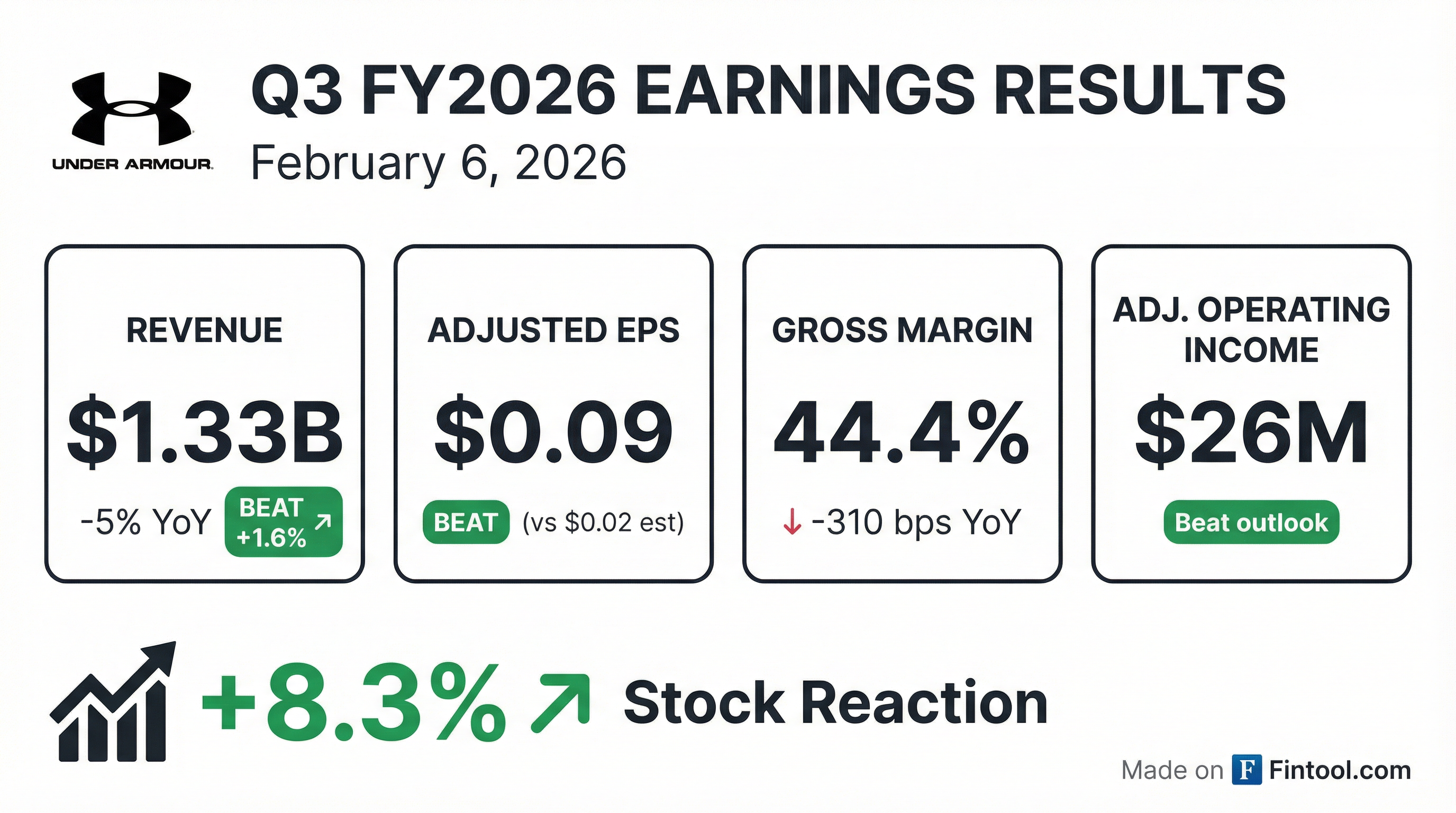
Under Armour (UAA) delivered a better-than-expected Q3 FY2026, with revenue of $1.33 billion topping consensus by 1.6% and adjusted EPS of $0.09 crushing estimates of $0.02. The stock surged 8.3% on the results as CEO Kevin Plank declared that "the most disruptive phase of our reset is now behind us."
The beat came with caveats: $0.06 of the EPS outperformance stemmed from a one-time tax benefit related to an IRS-approved method change. Strip that out, and underlying EPS was closer to $0.03—still ahead of expectations, but a more modest beat. The company also modestly raised full-year adjusted operating income guidance to ~$110 million, the high end of its prior $95-110 million range.
Did Under Armour Beat Earnings?
Revenue and EPS estimates from S&P Global consensus.
Revenue declined 5% year-over-year, but came in "slightly better than the outlook" shared in November. The outperformance was partly due to ~1 percentage point of timing shift as some wholesale deliveries pulled forward from Q4 into Q3.
Gross margin declined 310 basis points to 44.4%, driven by 200 bps of tariff headwinds, 140 bps of pricing pressure from a promotional North America environment, and unfavorable channel/regional mix.
 Ask Fintool AI Agent
What Did Management Guide?
Under Armour raised its outlook toward the high end of prior ranges:
Management emphasized that Q4 should show "a meaningful improvement in fourth quarter revenue trends as we continue executing our strategies and move toward the stabilization we expect in fiscal 2027."
How Did the Stock React?
UAA shares jumped 8.3% on the day, trading at $6.80 after opening at $6.42. The stock is now up 30% from its 52-week low of $4.13, though still 10% below its 52-week high of $7.60.
The market reaction suggests investors are buying into the "inflection" narrative—that Under Armour has moved past the painful restructuring phase and is now positioned for stabilization and eventual recovery.
What Changed From Last Quarter?
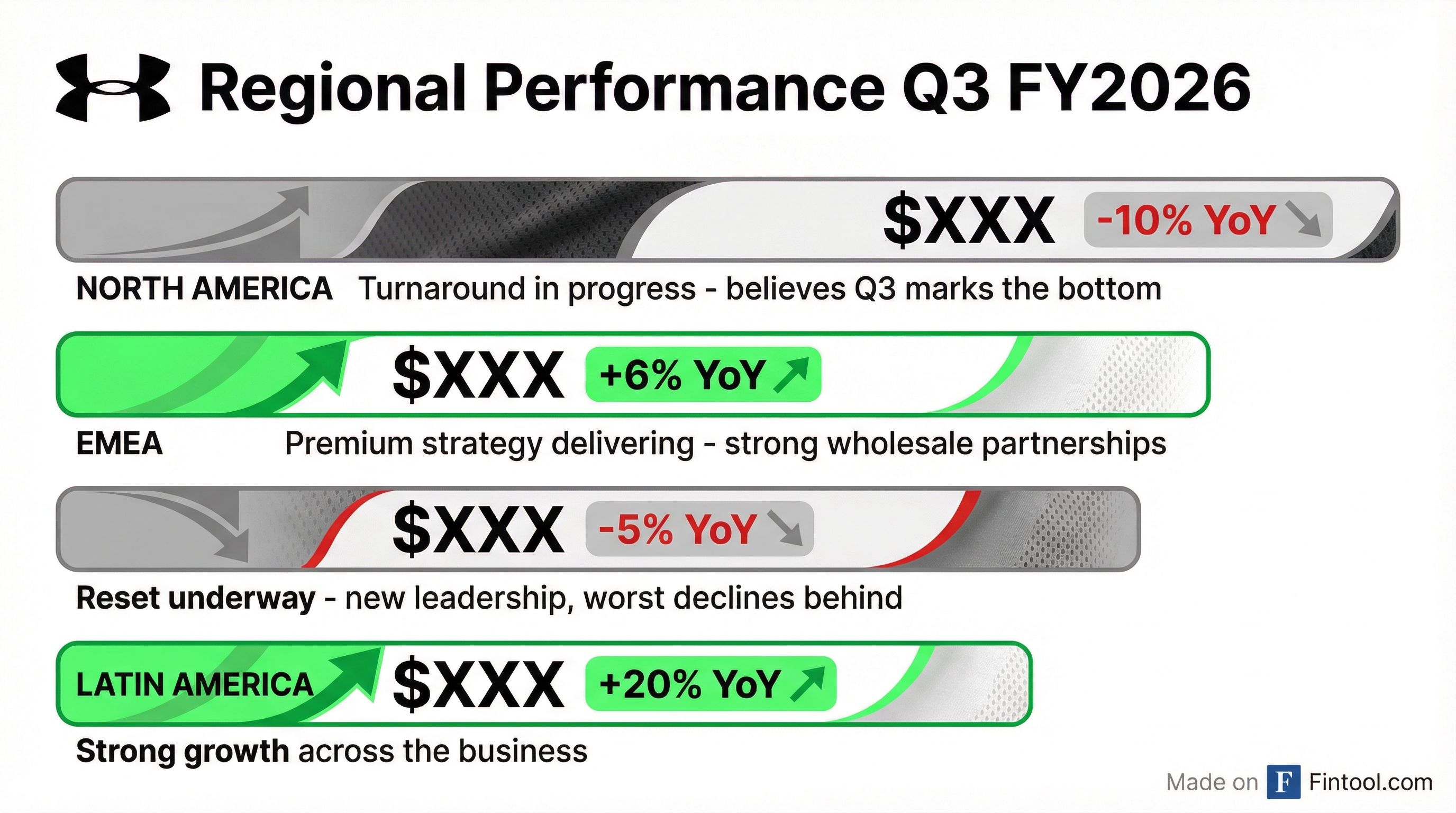
1. North America "Bottoming" — CEO Kevin Plank stated definitively: "We believe the December quarter marks the bottom of the reset" for North America. The region declined 10% YoY, but wholesale order books are "shaping up" better, and Plank said the company is "no longer looking at significant declines" going forward.
2. Leadership Realignment — Key executive changes announced:
- Kara Trent → Chief Merchandising Officer (end-to-end product responsibility)
- Adam Peake → President of the Americas
- Eric Liedtke → Chief Marketing Officer & EVP of Strategy
- Yasin Saidi → Transitioned to external senior advisor role
3. CFO Transition — Dave Bergman, CFO for 9 years and a 21-year company veteran, is departing. Reza (surname not specified) will take over. Plank called Bergman "a true professional" in an emotional farewell.
4. Footwear Reality Check — Kevin Plank was "very direct" about footwear: YTD sales are down ~14%, reflecting "structural issues we are actively unwinding." The company is exiting low-productivity styles, reducing redundant SKUs, and concentrating investment behind fewer franchises. Stabilization expected in FY2027.
Key Management Quotes
On the turnaround stage:
"If there's one thing to take away from today's call, we believe that the most disruptive phase of our reset is now behind us. We're past the period of structural change and operating noise, and the organization is now focused squarely on execution and stabilization." — Kevin Plank, CEO
On brand confidence:
"After 20 years public and celebrating 30 years this year as a business, I've just seen a lot. So we feel very good about what the North America position looks like... there's just a different level of confidence, swagger, whatever you wanna call it." — Kevin Plank, CEO
On footwear challenges:
"For multiple seasons, we tried to grow by expanding the assortment—more styles, more price points, more incremental updates—without consistent demand or the scale to support it. That diluted volume, pressured margins, and increased inventory risk." — Kevin Plank, CEO
Ask Fintool AI AgentSegment & Channel Performance
By Region (Q3 FY2026 YoY):
- North America: -10% — Wholesale decline, DTC slightly better
- EMEA: +6% — Continued strength, "clearest expression of premium strategy"
- APAC: -5% — Sequential improvement, new leadership in place
- Latin America: +20% — Strong growth across business
By Channel:
- Wholesale: -6% — Lower full-price and off-price, offset by distributor growth
- DTC: -4% — E-commerce down 7%, owned stores down 2%
- Licensing: +14% — International licensees driving growth
By Product:
- Apparel: -3% — Softness in train/golf/run, sportswear flat
- Footwear: -12% — Declines across most categories
- Accessories: -3% — Golf/outdoor weakness, sportswear growth
Balance Sheet & Capital
Under Armour ended Q3 with a solid liquidity position:
The company repaid ~$200 million of revolver borrowings during the quarter. The $600M in restricted investments is earmarked for senior notes maturing in June 2026 and should not be viewed as operating liquidity.
Q&A Highlights
On wholesale order books (Simeon Siegel, Guggenheim): Plank confirmed: "For the first time in quite some time, we're no longer looking at significant declines... we're at a place that we like the way the order book is shaping up right now."
On EMEA sustainability (Jay Sole, UBS): EMEA has been delivering ~9% growth. The region is "more promotional, particularly in the UK," but partnerships with JD Sports and Sports Direct remain strong.
On SKU rationalization (Peter McGoldrick, Stifel): The company previously eliminated 25% of SKUs and sees "additional opportunity to be even more efficient"—not just with SKUs but with raw materials. Manufacturing was using 300+ fabrics when only 30 fabrics drive 80% of volume.
On FY2027 outlook: CFO Dave Bergman declined to provide details: "Getting into details on fiscal 2027 is not something we're really, at this point, going to do. We're gonna do that more when we get to the early May call."
What to Watch Going Forward
-
FY2027 stabilization — Management has set expectations that North America and footwear will stabilize. Q4 results and initial FY2027 guidance (May call) will be the test.
-
Tariff impact — FY2027 will have a full year of tariff costs vs. partial year in FY2026. The company is working on pricing and cost offsets.
-
New CFO integration — Reza's transition as CFO will be closely watched for continuity.
-
Footwear recovery — At $1B+ in annual revenue but -14% YTD, footwear remains the biggest turnaround challenge. New launches like HB Low ($100) and Sola ($120) are early indicators.
-
Wholesale partner confidence — Dick's Sporting Goods and other key partners are engaging more positively. Fall order books will validate the narrative.
Ask Fintool AI AgentHistorical Revenue & Margin Trends
Values retrieved from S&P Global.
Note: Q3 FY2026 EBIT margin was impacted by $99M litigation reserve expense and $75M restructuring charges. Adjusted operating income was $26M (positive).
Related: Under Armour Company Overview | Q3 2026 Earnings Transcript | Q2 2026 Earnings