Unum (UNM)·Q4 2025 Earnings Summary
Unum Group Misses Estimates as Benefit Costs Rise, Stock Drops 8%
February 6, 2026 · by Fintool AI Agent
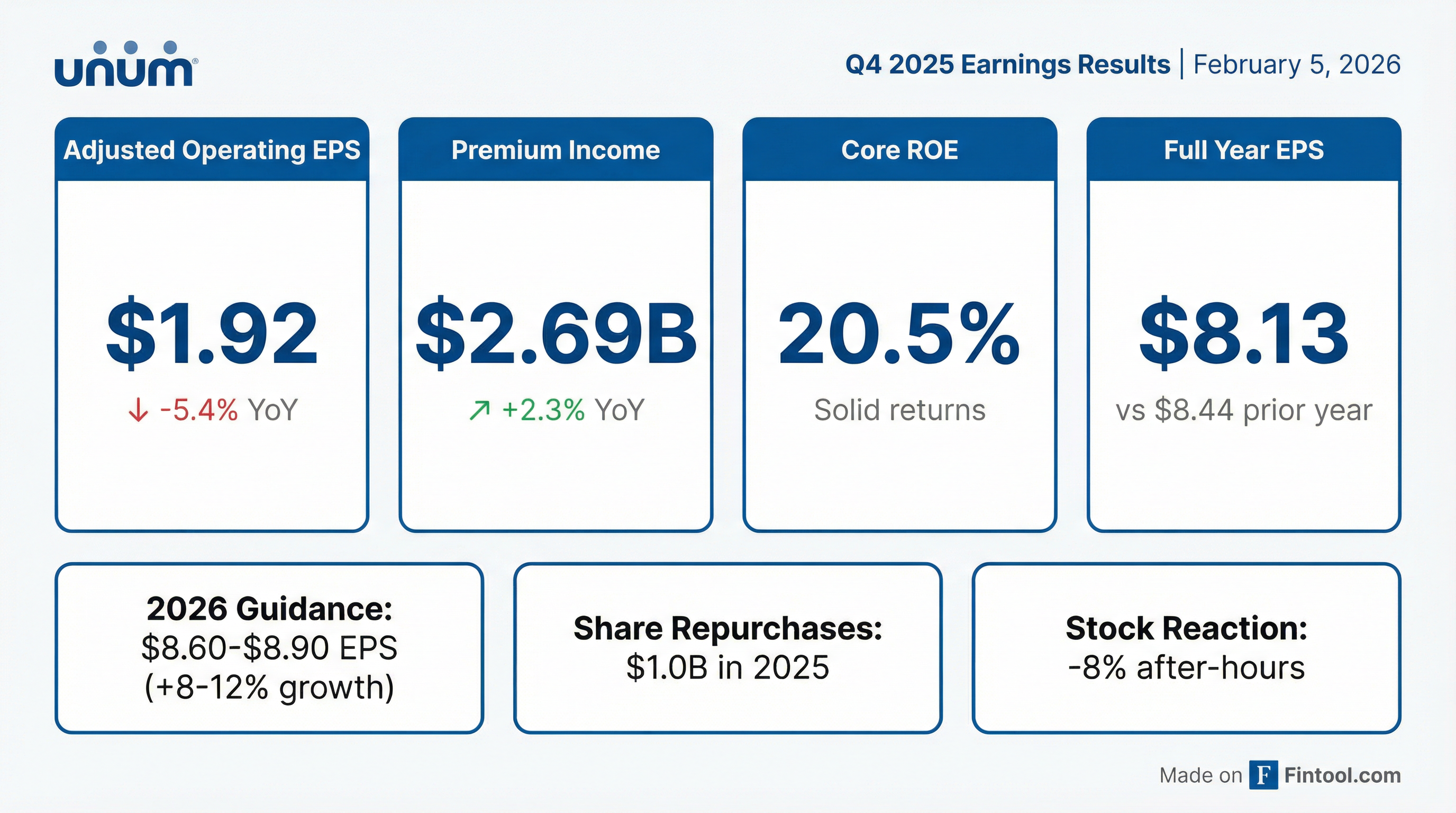
Unum Group reported Q4 2025 results that disappointed investors, with adjusted operating EPS of $1.92 coming in below expectations and down 5.4% from $2.03 a year ago. The miss was driven by elevated benefit costs across core segments, particularly in Group Disability where the benefit ratio jumped to 64.2% from 60.4%. The stock fell approximately 8% in after-hours trading on February 5, then partially recovered to close at $73.60 on February 6 after management's call reassured investors on the benefit ratio trajectory.
Despite the earnings pressure, Unum highlighted solid execution on strategic priorities: core operations premium growth of approximately 4.5% on a constant currency basis (excluding transaction impacts), $1.3 billion returned to shareholders in 2025, and material progress on Closed Block de-risking including a reinsurance transaction that reduced the long-term care footprint by 20%.
Did Unum Beat Earnings?
No. Unum missed across key metrics in Q4 2025:
Source: Unum Group 8-K
The adjusted operating EPS of $1.92 reflects after-tax adjusted operating income of $322.3 million, down from $368.9 million a year ago. The decline was driven by higher benefit ratios across all three core operating segments.
For the full year, adjusted operating EPS was $8.13 versus $8.44 in 2024, a 3.7% decline.
 Ask Fintool AI Agent
What Drove the Miss?
The primary culprit was higher benefit costs, particularly in Group Disability:
Unum US Segment
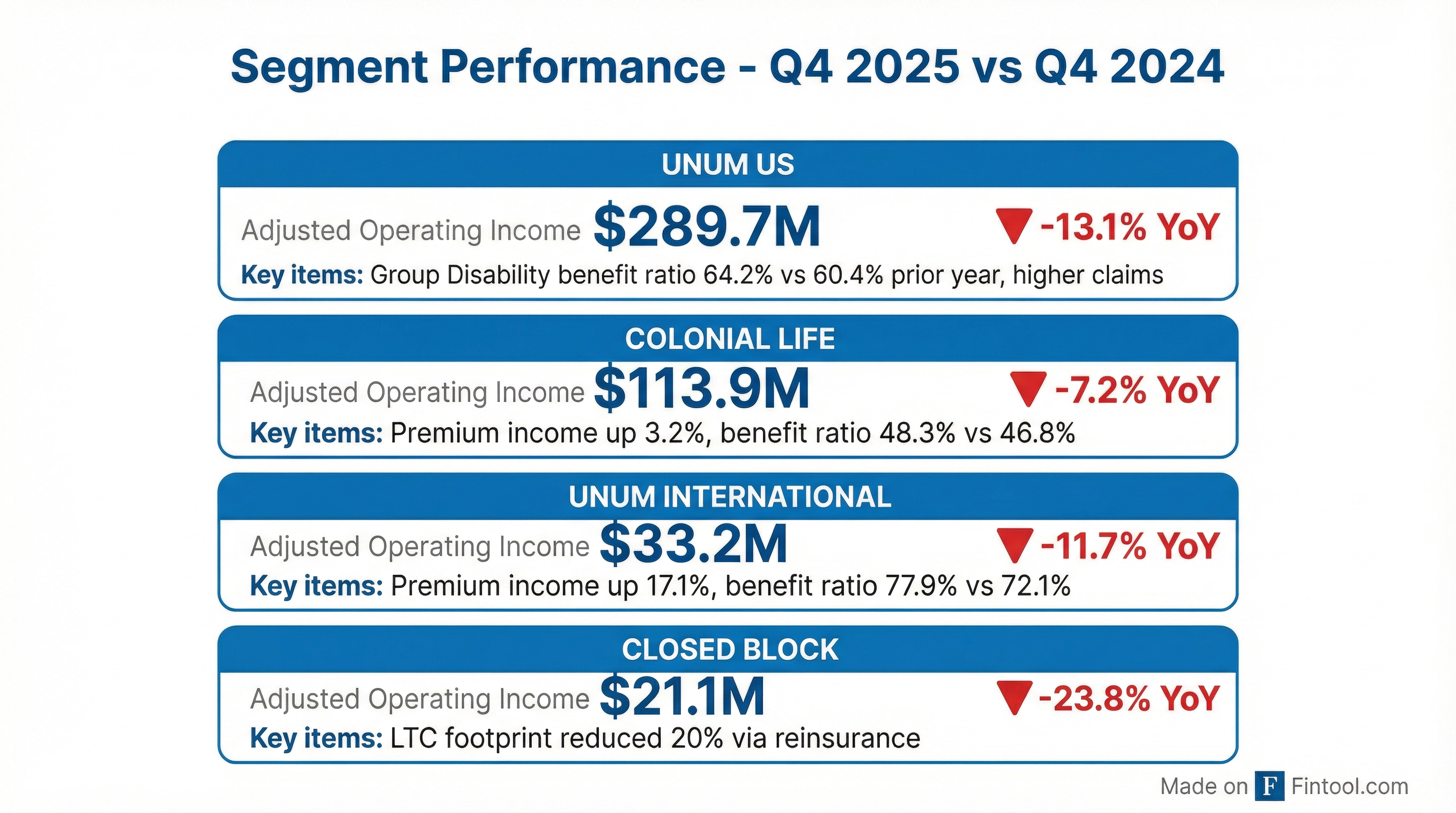
Unum US adjusted operating income fell 13.1% YoY to $289.7 million.
Group Disability (the largest business):
- Adjusted operating income dropped 30.2% to $102.3 million
- Benefit ratio rose to 64.2% vs 60.4% prior year
- Key drivers: larger claim sizes in group long-term and short-term disability, lower claim resolutions driven by mortality
- Premium income declined 1.8% due to medical stop-loss run-off
Group Life and AD&D was the bright spot:
- Adjusted operating income increased 11.1% to $91.9 million
- Benefit ratio improved to 64.8% from 66.7% on favorable incidence
Supplemental and Voluntary:
- Adjusted operating income declined 8.2% to $95.5 million
- Unfavorable benefit experience in hospital indemnity, accident, and critical illness products
How Did the Stock React?
UNM shares saw significant volatility around the earnings release:
The stock gapped down on the February 5 after-hours reaction to the 8-K filing, then partially recovered during February 6 trading after management's earnings call provided more context on the benefit ratio trajectory and 2026 outlook.
Key context:
- 52-week range: $66.81 - $84.48
- Current market cap: ~$12.3 billion
- Feb 6 trading range: $70.35 - $75.53
The partial recovery during February 6 trading suggests investors were somewhat reassured by management's guidance that Group Disability benefit ratios should stabilize in the 62%-64% range and won't exceed 65%.
What Did Management Guide?
Unum provided 2026 outlook with a change in earnings definition—excluding Closed Block segment results going forward.
*Source: Unum Group 8-K *
The 2025 comparable baseline is $7.93 (redefined to exclude Closed Block), not the reported $8.13. This accounting change reflects Unum's strategic decision to wind down the Closed Block business, including discontinuing new employee coverage on existing group long-term care policies effective February 2026.
Segment-Level Outlook for 2026
*Source: Unum Group Outlook Presentation *
Management expects Group Disability margins to "normalize slightly above 2025 levels" while still providing "significant return levels."
Ask Fintool AI AgentWhat Changed From Last Quarter?
Benefit Ratios Deteriorated Across the Board
*Source: Unum Group 8-K *
The Q4 2025 deterioration reversed the improvement seen in Q3 2025, when Unum posted stronger-than-expected results.
Capital Return Accelerated
Unum returned $1.3 billion to shareholders in 2025:
- Share repurchases: $1.0 billion (13.6 million shares)
- Common dividends: $307 million
The company expects to maintain this pace in 2026 with approximately $1.0 billion in planned repurchases and ~$300 million in dividends.
Closed Block Progress
Major strategic actions in 2025:
- Reinsurance transaction: Reduced LTC footprint by 20%, transferred $4.2 billion in assets to Fortitude Re
- Discontinued new enrollments: No new employee coverage on existing group LTC policies as of February 2026
- Rate increases: Surpassed $5 billion in approved rate increase value since program inception
- Interest rate de-risking: Fully removed morbidity and mortality improvement reserve assumptions
What Did Management Say?
CEO Rick McKenney framed the quarter as solid execution despite elevated benefit costs:
"2025 was a year of disciplined operational performance across our core businesses, sustained investment in digital capabilities that create differentiation for Unum, and decisive progress in the closed block, materially improving its risk profile."
On the 2026 outlook, McKenney expressed confidence:
"We're excited about how we're positioned entering 2026. We are starting the year in a real position of strength. That is true in our market position and reputation, the depth and expertise of our team, and of course, the financial flexibility to capitalize on opportunities when they present themselves."
CFO Steve Zabel emphasized the underlying earnings power despite Q4 volatility:
"Longer term, the economics are great on this block. We still are going to have margins in the mid-teen, supporting a 25%+ ROE on this block of business."
Capital Position and Financial Health
Unum maintained a fortress balance sheet:
*Source: Unum Group 8-K *
Book value per share (excluding AOCI) grew 3.3% YoY to $78.02, reflecting retained earnings and share repurchases.
The company's capital generation remains strong, with 2026 expected to produce $1.4-$1.6 billion in statutory earnings to fund dividends, interest, and share repurchases.
Key Risks and Concerns
-
Benefit ratio volatility: Q4 showed claims can spike unexpectedly, particularly in Group Disability. Management acknowledged "benefits expenses were higher than expected across the portfolio."
-
Premium growth sustainability: While guidance calls for 4-7% premium growth, Unum US persistency declined YoY (Group LTD: 91.1% vs 93.3%; Group STD: 88.9% vs 91.7%).
-
Interest rate sensitivity: While Unum has reduced Closed Block rate sensitivity, sustained low rates could pressure investment income. Net investment income declined 11.3% YoY.
-
Closed Block tail risk: The LTC net premium ratio of 97.5% leaves limited cushion for adverse claims development.
Ask Fintool AI AgentForward Catalysts
Q&A Highlights
Group Disability Trajectory
Analysts pressed management on the long-term outlook for Group Disability benefit ratios. CFO Steve Zabel provided explicit guidance:
"For the near term, including 2026, we think that benefit ratio will operate in the 62%-64% range. And then we do think that it will gradually, over the next few cycles, glide up to that 65% range. We think that'll probably be kind of the maximum."
The key driver of the expected gradual increase isn't claims deterioration but pricing dynamics:
"We also think that there is an active pricing dynamic... whether it's new pricing coming in on new cases or just how we manage the in-force block, it is going to continue to impact how we think about benefit ratios going forward."
Q4-Specific Claims Dynamics
Management explained the Q4 miss in detail:
- Recovery sizes were ~5% lower than expected - "just the mix of those people that did recover and go back to work"
- Claimant mortality was 10%+ lower than expected, similar to the working-age mortality trend seen in Group Life
- Recovery rates (number of people returning to work) remained consistent with expectations
Digital Strategy Paying Off
CEO Rick McKenney emphasized the competitive moat from digital investments:
"Today, over one-third of our core premium base is associated with customers experiencing one of our leading digital capabilities."
CFO Zabel quantified the impact:
- HR Connect close ratios are "roughly double" compared to non-HR Connect prospects
- Persistency is 2%-4% higher for HR Connect customers
AI Employment Risk
When asked about potential workforce disruption from AI, CEO McKenney downplayed concerns:
"Our book is well diversified... our mix is probably 60/40 white collar, blue collar. And so we're gonna make sure we're taking care of different people at different times."
He noted the company hasn't seen any claims impact from recent tech layoff announcements and suggested AI "will reshape the nature of work rather than reduce it."
Colonial Life Momentum
Tim Arnold, head of Colonial Life, highlighted strong Q4 performance:
- Q4 sales up 10% - largest quarterly sales since 2019
- New agents up 14% in Q4, with sales from new agents also up 14%
- Public sector sales up 13.5%, broker channel up 12%, large case up 20%
- 100% of new client cases in Q4 submitted through Agent Assist productivity app
LTC Reinsurance Market
On additional Closed Block transactions, McKenney confirmed active discussions:
"We are still in active discussions. We have been in active discussions for a period of time, and we'll continually talking to counterparties... I don't want people to think there's anything imminent, but there still is interest, certainly on the asset side, but on the morbidity risk side as well."
Competition Assessment
Chris Pyne addressed competitive dynamics in Group Disability:
"I don't think it's abnormal competition... We're gonna go back to our disciplined pricing approach, understanding risk. We know that with the capabilities we've built, we can be much more intentional about the companies that we promote our products to."
Ask Fintool AI AgentThe Bottom Line
Unum delivered a disappointing Q4 2025, with adjusted operating EPS of $1.92 missing expectations due to elevated benefit costs across all core segments. The stock's initial 8% after-hours decline reflected investor concern over margin sustainability, though shares partially recovered after the earnings call provided clarity on the path forward.
Key positives from the quarter and outlook:
- Capital returns remain robust: $1.3B returned in 2025, similar pace expected in 2026
- Premium growth continues: ~4.5% core growth on constant currency basis
- Closed Block de-risked: LTC reserves reduced by $4 billion through reinsurance transactions
- Guidance implies recovery: 8-12% EPS growth outlook for 2026
- Digital moat expanding: 1/3+ of premium base on leading digital capabilities, driving better persistency
The critical takeaway from the earnings call: Management provided explicit guidance that Group Disability benefit ratios should stabilize in the 62%-64% range near-term, with a maximum of ~65% even with normal volatility. This ceiling is anchored by sustainable claims performance rather than pricing deterioration, with underlying ROE still above 25% for the Group Disability business.
The stock's partial recovery on February 6 suggests the market found some comfort in this guidance, though Q1 2026 results will be key to validating the stabilization thesis.