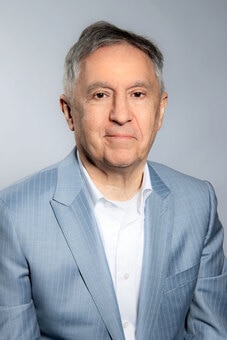
Patrizio Vinciarelli
 VICOR
VICORAbout Patrizio Vinciarelli
Founder of Vicor (1981) and its long-serving Chairman, President, and CEO; age 78; Ph.D. in Physics from the University of Rome; credited with more than 150 patents in power conversion technology . Vicor is a controlled company with Vinciarelli holding 79.6% of voting power via Common and Class B shares, allowing him to unilaterally elect directors and assure quorum; the Board has no Lead Independent Director and relies on controlled company exemptions under Nasdaq rules . Recent performance highlights: FY2024 revenue declined to $359.1M and diluted EPS to $0.14; cumulative TSR on a $100 investment since 2020 was 103 at YE2024, reflecting a difficult 2024 after strong 2021–2023 and Revenues/Net Income/EPS table below.
Five-year performance (financial scale USD)
| Metric | FY 2020 | FY 2021 | FY 2022 | FY 2023 | FY 2024 |
|---|---|---|---|---|---|
| Revenues | $296.6M * | $359.4M * | $399.1M * | $405.1M * | $359.1M * |
| EBITDA | $28.4M* | $67.3M* | $47.5M* | $68.6M* | $37.8M* |
| Net Income | $17.9M * | $56.6M * | $25.4M * | $53.6M * | $6.1M * |
| Diluted EPS | $0.41 * | $1.26 * | $0.57 * | $1.19 * | $0.14 * |
- Values retrieved from S&P Global
Past Roles
| Organization | Role | Years | Strategic impact |
|---|---|---|---|
| European Organization for Nuclear Research (CERN) | Fellow | 1973–1976 | Advanced physics research; technical foundation for later power-conversion innovations . |
| Institute for Advanced Study; Princeton University | Fellow; Instructor | 1977–1980 | Academic research/teaching; underpins Vicor’s deep technical IP base . |
External Roles
| Organization | Role | Years | Notes |
|---|---|---|---|
| None disclosed | — | — | The proxy lists other public boards for nominees; none are disclosed for Vinciarelli in the past five years . |
Board Governance
- Board service: Director since 1981; Chairman and CEO dual role; presides over meetings and sets agendas with Corporate Secretary .
- Controlled company: Holds 79.6% voting power; Vicor relies on Nasdaq controlled-company exemptions (not required to have majority independent Board or solely independent comp/nomination processes) .
- Committees: Audit and Compensation Committees are fully independent; members include Carlson, Eichten, Shen; Carlson is Audit Chair and “financial expert” .
- Meetings and attendance: Board met 3 times in 2024; Audit and Compensation each met 5 times; all Directors attended ≥75% of meetings; independent Directors hold executive sessions at each Board meeting .
- Dual-role implications: No Lead Independent Director; CEO chairs Board while recommending executive pay (approved by independent Compensation Committee), increasing governance concentration risk typical of founder-controlled structures .
Fixed Compensation
| Year | Base salary | Bonus paid | Perquisites and other | Total compensation |
|---|---|---|---|---|
| 2024 | $459,542 | $0 | $61,246 (includes $10,800 car allowance, supplemental benefits, 401(k) match) | $719,107 |
| 2023 | $442,464 | $0 | $59,798 | $821,250 |
| 2022 | $424,836 | $0 | $60,123 | $657,101 |
Notes:
- Vicor generally does not pay discretionary cash bonuses to non-sales executives; no NEO discretionary bonuses in 2024 .
- Employees are at-will; no employment contracts .
Performance Compensation
Vicor emphasizes stock options; RSUs/PSUs are not disclosed. The Compensation Committee approves grants; CEO may receive merit-based option awards; director stock options are formulaic ($200,000 / closing price at the Annual Meeting) but excluded for holders >10% (Vinciarelli) .
2024 CEO equity grants
| Grant date | Securities underlying options | Exercise price | Grant-date fair value | Vesting schedule |
|---|---|---|---|---|
| 5/3/2024 | 12,165 | $33.96 | $198,319 | 20% annually on 5/3 from 2025–2029 (2,433 shares each year) . |
Outstanding CEO options (12/31/2024)
| Exercisable | Unexercisable | Exercise price | Expiration |
|---|---|---|---|
| 2,744 | 4,113 | $60.61 | 4/25/2029 |
| 3,455 | 13,818 | $41.61 | 5/2/2030 |
| — | 12,165 | $33.96 | 5/3/2031 |
Option exercises (selling pressure indicator)
| 2024 shares exercised | Value realized upon exercise |
|---|---|
| 429,371 | $12,069,619 (difference between strike and FMV at exercise) . |
Performance metrics linkage
Vicor identifies diluted EPS as the most important performance measure in its pay-versus-performance disclosure, alongside revenue growth, gross margin %, and operating profit %, but compensation is not mechanically tied to these metrics; payouts are discretionary rather than formula-based with metric weightings .
Equity Ownership & Alignment
| Ownership metric | Detail |
|---|---|
| Total beneficial ownership | 21,058,494 shares (Common + Class B + options within 60 days) . |
| Common stock owned | 10,021,388 shares . |
| Class B owned | 11,023,648 shares (10 votes/share; convertible 1:1 into Common) . |
| Options exercisable within 60 days | 13,458 shares . |
| Voting power | 79.6% of total voting power as of 3/31/2025 . |
| Ownership % of classes | 29.7% of Common; 93.9% of Class B . |
| Transfer/pledging | Class B transfer restricted; must convert to Common to sell; automatic conversion on impermissible transfer . |
| Hedging/pledging policies | Hedging is not specifically prohibited; no anti-pledging policy disclosed . |
| Ownership guidelines | Not disclosed. |
Employment Terms
| Term | Provision |
|---|---|
| Employment agreement | At-will; no fixed-term contract . |
| Severance | None upon termination (no salary/bonus multiples) . |
| Change-of-control | Single-trigger acceleration of unvested options under Vicor 2000 Plan and Assumed VI Chip Plan . |
| Potential payout (COC, as of 12/31/2024) | Intrinsic value of CEO’s unvested options: $267,408 (market $48.32 less strike, times in-the-money unvested options) . |
| Clawback | Compensation recovery policy adopted in 2023, compliant with SEC/Nasdaq rules . |
| Non-compete / non-solicit | Not disclosed. |
| Perquisites | Car allowance ($10,800), fuel reimbursement, supplemental insurance, 401(k) matching for eligible personnel (CEO does not participate in 401(k)) . |
Additional Governance and Related Party Considerations
- Compensation Committee: Independent (Carlson, Eichten, Shen), meets regularly; CEO recommends exec pay for others; Committee approved all option grants .
- Say-on-Pay: Triennial frequency adopted; 2023 vote approved NEO compensation; next vote in 2026 .
- Related party transactions: Director Andrew D’Amico serves as IP counsel under an informal agreement (2024 payments/reimbursements $587,638; incentive fees tied to license royalties; option awards reported); IceMOS license agreement (Chairman/CEO of IceMOS is Director Anderson) with future royalties expected to exceed $120,000; Audit Committee reviews related-party transactions .
Investment Implications
- Alignment and control: Founder-CEO with 79.6% voting power creates strong strategic continuity but concentrates governance; pay is modest cash-heavy with equity via options; lack of formal performance-linked payouts reduces pay-for-performance transparency .
- Selling pressure and dilution: 2024 exercises of 429,371 shares and ongoing option grants introduce potential selling pressure and dilution; monitor Form 4 filings (e.g., 5/6/2024 grant activity; 5/5/2025 filing) and vesting calendars to anticipate windows of insider activity .
- Change-of-control economics: No severance; single-trigger option acceleration modest in value as of YE2024 ($267k), limiting golden-parachute risk and suggesting deal economics wouldn’t be materially impaired by executive payouts .
- Performance sensitivity: FY2024 step-down in revenue and EPS, with TSR retracing to 103, points to execution risk in scaling; compensation “CAP” has been volatile historically (large positive in 2020–2021; negative 2022) reflecting equity valuation swings—investors should focus on operational metrics (EPS, revenue growth, margins) that management cites in discretionary decisions .