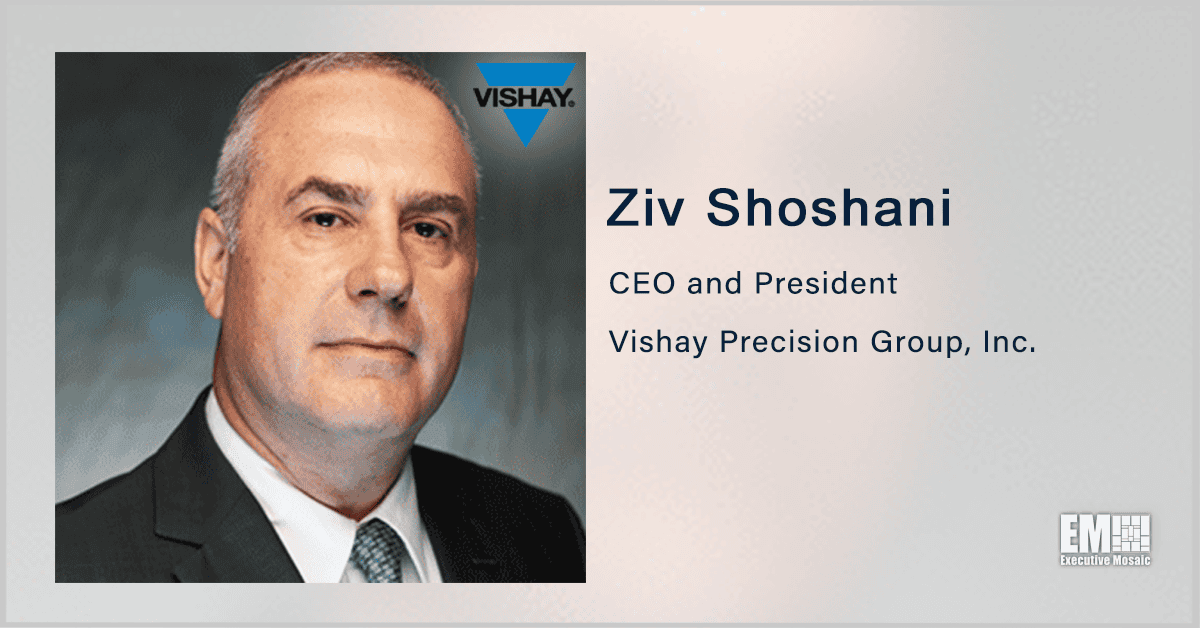
Ziv Shoshani
About Ziv Shoshani
Ziv Shoshani, 58, is President and Chief Executive Officer of Vishay Precision Group (VPG) and a director; he has served as CEO since VPG’s 2010 spin-off and as a director since 2009 . Prior to VPG’s spin, he held senior operating roles at Vishay Intertechnology (COO 2007–2009; Deputy COO 2006; EVP 2000–2009; employed since 1995) and will resign from the Vishay Intertechnology board effective May 20, 2025 . VPG’s 2024 total shareholder return (TSR) declined to 69.03 from 100.21 in 2023, and GAAP net income fell to $9.9M from $25.7M in 2023, consistent with weaker operating performance (adjusted EBITDA/operating targets missed, see below) . Governance mitigants include a non-executive chair (separated CEO/Chair roles) and fully independent key committees, though dual-class voting and family trust control concentrate voting power .
Performance context
| Metric | 2020 | 2021 | 2022 | 2023 | 2024 |
|---|---|---|---|---|---|
| TSR (Indexed to $100 at start) | 92.59 | 109.18 | 113.66 | 100.21 | 69.03 |
| GAAP Net Income ($) | 10,787,000 | 20,221,000 | 36,063,000 | 25,707,000 | 9,911,000 |
Revenue/EBITDA trend
| Metric (USD) | FY 2021 | FY 2022 | FY 2023 | FY 2024 |
|---|---|---|---|---|
| Revenues | $317.9M* | $362.6M* | $355.0M* | $306.5M* |
| EBITDA | $44.3M* | $59.97M* | $58.55M* | $33.36M* |
*Values retrieved from S&P Global.
Past Roles
| Organization | Role | Years | Strategic Impact |
|---|---|---|---|
| Vishay Intertechnology | Chief Operating Officer | 2007–2009 | Led global ops across businesses prior to VPG spin; operational expertise later applied at VPG . |
| Vishay Intertechnology | Deputy COO | 2006 | Transition role to COO; manufacturing and divisional oversight . |
| Vishay Intertechnology | EVP (Capacitors, Resistors; led Measurements Group and Foil) | 2000–2009 | Drove P&L accountability and portfolio leadership before VPG spin . |
| VPG | President & CEO | 2010–present | CEO since spin-off; accountable for capital allocation, M&A, and operating strategy . |
External Roles
| Organization | Role | Years | Strategic Impact |
|---|---|---|---|
| Vishay Intertechnology | Director (resigning effective May 20, 2025) | Through 2025 | Industry adjacency and information flow; resignation reduces potential interlocks . |
Fixed Compensation
| Year | Base Salary (USD) | Bonus Paid | Stock Awards (Grant-Date FV) | All Other Comp |
|---|---|---|---|---|
| 2022 | $720,053 | $645,443 | $1,113,891 | $241,666 |
| 2023 | $681,781 | $0 | $1,409,021 | $243,906 |
| 2024 | $678,555 | $0 | $1,220,376 | $231,294 |
- 2025 base salary increases effective March 1, 2025: 2,592,403 NIS ($743,235) for CEO (translated at 3.488 NIS/USD) .
- 2024 perquisites detail: Israeli employment benefits $197,260; personal use of company car $34,034 .
- CEO pay ratio (2024): 49:1 .
Performance Compensation
Annual cash bonus (2024 design and outcome)
| Metric | Weight | Target | Actual | Outcome |
|---|---|---|---|---|
| Adjusted EBITDA | 50% | $67.7M | $35.7M (52.7% of target) | Below 80% threshold → 0% payout |
| Adjusted Operating Margin | 50% | $49.9M | $18.5M (37.0% of target) | Below 80% threshold → 0% payout |
- Target bonus opportunity: 100% of salary; max 200% .
Long-term equity (RSUs and PBRSUs)
| Grant Year | Time-Vested RSUs (#) | PBRSUs (#) | Performance Metrics (PBRSUs) | Vest Date |
|---|---|---|---|---|
| 2024 | 18,182 | 18,182 total; two objectives at equal weight (per-objective max 9,091) | 3-yr cumulative Adjusted Net Earnings target $131.30M; 3-yr cumulative Adjusted Free Cash target $104.98M; vesting begins at 80% of target (50% of objective); +2.5% per 1% to 100% | Jan 1, 2027 (time); Jan 1, 2027 (PBRSUs subject to goal attainment) |
| 2023 | 16,158 | 16,159 (assumed at 100% target in table presentation) | Similar 3-yr framework | Jan 1, 2026 (time); Jan 1, 2026 (PBRSUs subject to goal attainment) |
| 2022 | 18,266 | 0 (2022 PBRSUs failed to vest) | 3-yr (2022–2024) Adjusted Net Earnings 66.2% and Adjusted Free Cash 69.9% of targets → no vesting | Jan 1, 2025 (time vested), PBRSUs forfeited |
- 2024 annual LTIP sizing: 175% of base salary granted as RSUs (50% time-based, 50% performance-based) .
- Equity plan features: PBRSUs vest at target immediately upon change in control; time-based RSUs vest immediately upon change in control or qualifying termination .
Equity Ownership & Alignment
Beneficial ownership and voting power
| Holding | Amount | Percent/Notes |
|---|---|---|
| Common Stock | 239,388 shares | 2.0% of common |
| Class B Common (family trust) | 615,487 shares (co-trustee with shared voting) | 60.2% of Class B |
| Aggregate Voting Power Controlled (solely or shared) | — | ~28.5% of total company voting power |
Outstanding equity and vesting calendar (as of 12/31/2024)
| Award Type | Unvested Units | Next Cliff Vest |
|---|---|---|
| Time-Vested RSUs | 52,606 (18,266 2022; 16,158 2023; 18,182 2024) | Jan 1, 2025 (2022 tranche), Jan 1, 2026 (2023), Jan 1, 2027 (2024) |
| PBRSUs (unearned, max at 100%) | Up to 34,341 (16,159 2023; 18,182 2024) | Jan 1, 2026 and Jan 1, 2027 (subject to performance) |
- Policy prohibitions: Hedging and pledging of company stock prohibited for directors, officers, employees, and covered family members .
- Executive stock ownership guidelines: CEO must hold ≥ 3x base salary; time-based RSUs count (vested/unvested), PBRSUs count only when vested; five-year phase-in to March 2026 and sales generally restricted until compliant .
Insider selling pressure and vesting profile
- The largest scheduled vest events ahead are Jan 1, 2026 (16,158 time RSUs + potential 16,159 PBRSUs) and Jan 1, 2027 (18,182 time RSUs + potential 18,182 PBRSUs), which could incrementally increase freely tradable shares if performance goals are met .
- Company policy bans pledging/hedging, reducing forced-sale risk from margin arrangements .
Employment Terms
Key agreement features
- Agreement framework: Initial 2011 employment agreement (as amended); auto-renews for 1-year terms unless terminated .
- Non-compete/non-solicit: 24 months post-termination for CEO .
- Clawback: Dodd-Frank compliant clawback adopted Nov 2023; three-year lookback for restatements .
Severance and change-in-control economics (CEO)
| Scenario (as of 12/31/2024) | Cash | Bonus | Equity | Benefits | Deferred Comp | Total |
|---|---|---|---|---|---|---|
| Termination Without Cause / Good Reason | 24 months base ($1,357,110) | Prior-year bonus if earned; pro rata current-year at target ($678,555) | Immediate vest of time RSUs; PBRSUs vest later if goals met (at target on CoC) — value $2,469,373 at $23.47/sh | Health coverage estimate $71,886; post-62 lifetime medical per contract | KEWAP balance $1,942,983 (lump-sum election) | $6,519,907 |
| Change in Control (remain employed) | — | — | Accelerated vesting of RSUs and PBRSUs at target ($2,469,373) | — | — | $2,469,373 |
Deferred compensation
| Item | 2024 Activity |
|---|---|
| KEWAP (non-qualified plan) | 2024 aggregate earnings $255,314; year-end balance $1,942,983; lump-sum election upon termination . |
Board Governance
- Roles: Non-executive Chair (Saul Reibstein); CEO serves as director (not Chair), supporting separation of powers .
- Committees (independent-only): Audit (Chair: Reibstein; Audit Committee Financial Expert), Compensation (Chair: Janet Clarke), Nominating & Corporate Governance (Chair: Timothy Talbert) .
- Independence: Board determined independence for named non-management directors; CEO is management (non-independent) .
- Attendance: Board met six times in 2024; each director attended at least 75% of Board/committee meetings during service period .
- Director compensation: CEO receives no additional director compensation .
Dual-role implications
- CEO + Director with concentrated voting influence via family trust (approx. 28.5% voting power controlled solely or shared) can raise entrenchment concerns; mitigants include non-executive Chair, independent committees, hedging/pledging prohibitions, and clawback policy .
Compensation Committee Analysis
- Consultant: Meridian Compensation Partners (independent; no conflicts) .
- Peer group for 2024 decisions included Badger Meter, CSW Industrials, CTS, Daktronics, ESCO Technologies, FARO, Mercury Systems, Onto Innovation, Hurco, Luna Innovations, Amtech, nLight .
- Benchmarking approach: No fixed percentile target; peer data used as a reference; overall design caps annual bonuses (CEO 200% of salary max) and emphasizes multi-year equity to balance risk-taking .
- Say-on-pay: Over 99% approval in 2024; program largely reaffirmed .
Related Party & Ownership Structure Notes
- Family trust and voting agreements: Family trust holds 615,487 Class B shares (10 votes/share), with Shoshani as co-trustee; combined arrangements drive ~28.5% aggregate voting power for Shoshani (solely or shared) .
- Related party oversight: Formal policy; Nominating & Governance Committee administers, requiring pre-approval of related party transactions including employment relationships .
Investment Implications
- Pay-for-performance alignment: 2024 annual bonus paid 0% and 2022-cycle PBRSUs did not vest, demonstrating downside alignment when performance (adjusted EBITDA/operating income and multi-year cash/earnings) misses targets .
- Retention and supply overhang: Significant unvested RSUs and PBRSUs through 2027 support retention; if performance improves, 2026–2027 vest events could increase supply, though hedging/pledging bans reduce margin-sale risk .
- Governance risk balance: Non-executive Chair and independent committees are positives; however, dual-class structure and family trust control (~28.5% voting power for Shoshani solely/shared) can constrain shareholder influence and sustain management continuity irrespective of near-term results .
- Capital allocation signal: CEO’s background is deeply operational; 2024 weak TSR and net income reflect cycle and execution headwinds; watch 2024–2026 PBRSU metrics (cumulative Adjusted Net Earnings/Free Cash) as medium-term scorecard for value creation and future vesting/payouts .
Appendices
Director service and committees (selected 2024 data)
| Director | Audit | Nominating & Gov | Compensation |
|---|---|---|---|
| Ziv Shoshani (CEO) | — | — | — |
| Saul Reibstein | Chair | Member | — |
| Janet Clarke | Member | — | Chair |
| Timothy Talbert | Member | Chair | Member |
Say-on-Pay & Frequency
- 2024 say-on-pay approval >99% . Annual frequency maintained .