Abbott CEO and Former St. Jude Chief Buy $3M After 10% Earnings Crash
February 9, 2026 · by Fintool Agent

Two Abbott Laboratories insiders have committed over $3 million of personal capital to buy company stock after shares crashed 10% on a disappointing Q4 earnings report—a striking vote of confidence from executives who know the business best.
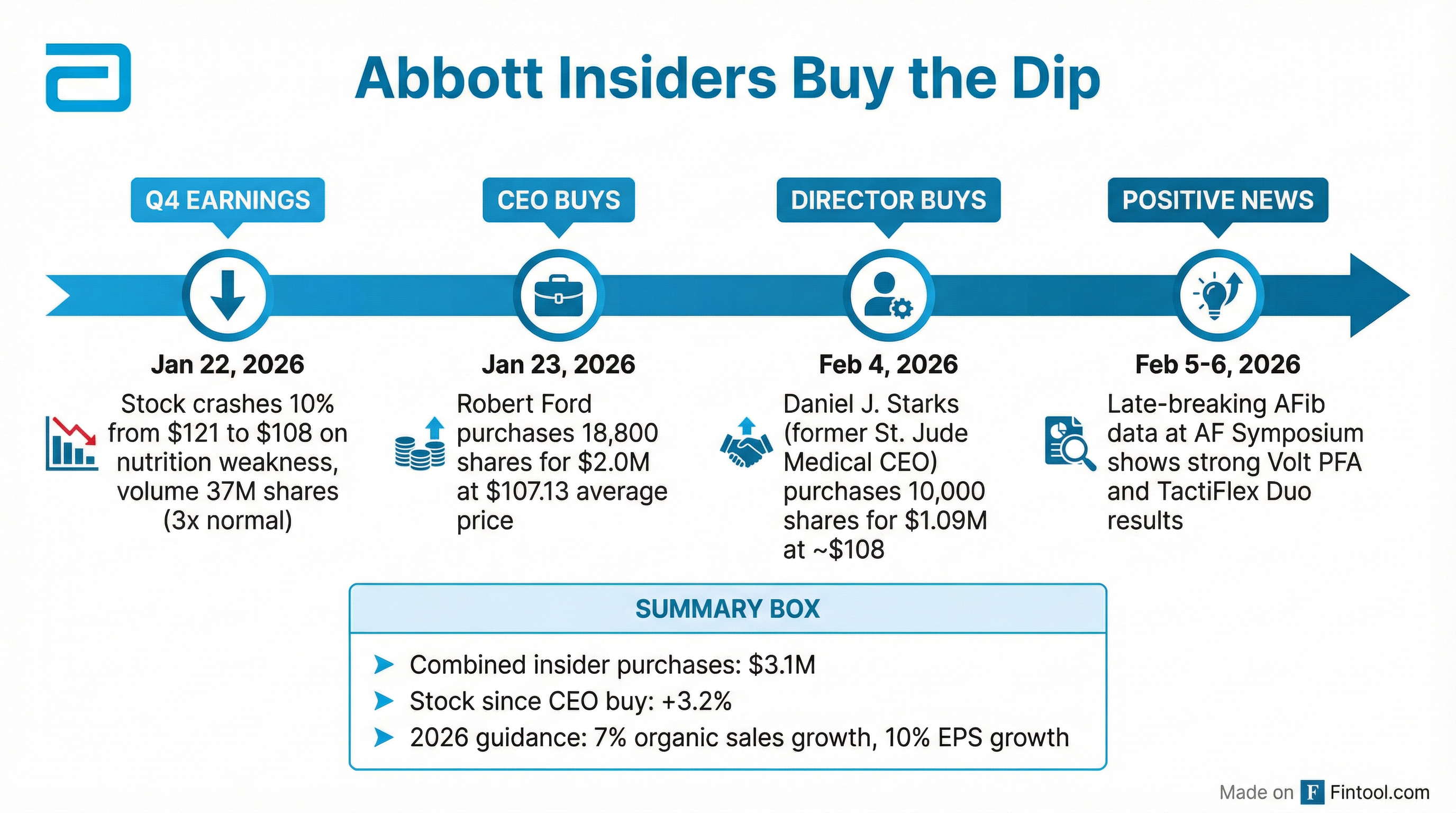
CEO Robert Ford led the way, purchasing 18,800 shares for approximately $2.0 million on January 23, 2026, just one day after the stock's single-worst session since 2020. Director Daniel J. Starks—the former Chairman and CEO of St. Jude Medical, which Abbott acquired in 2017—followed with his own $1.09 million purchase on February 4, buying approximately 10,000 shares at around $108.33 per share.
The Earnings Crash
Abbott's January 22 earnings call sent shares tumbling from $120.73 to $108.61—a 10% single-day decline on trading volume of 37 million shares, more than triple the normal average.
The culprit: the nutrition segment. Sales of Similac infant formula and Ensure adult nutrition products declined in Q4 as consumers balked at elevated prices. Ford acknowledged the challenge directly:
"Higher manufacturing costs led to higher prices, which in turn are suppressing demand as consumers become increasingly more price-sensitive... The path is not sustainable long-term, so we began to make changes in the fourth quarter."
The company lost a significant WIC (Women, Infants, and Children) contract in 2024, contributing to market share erosion in the U.S. pediatric business.
 Ask Fintool AI Agent
Who Is Daniel Starks?
The February 4 purchase by Starks carries particular weight. This isn't a passive board member—it's a former CEO with deep operational knowledge of Abbott's medical device business.
Starks served as Chairman, President, and CEO of St. Jude Medical from 2004 to 2016, growing the company from $1.9 billion to over $5.6 billion in annual revenue before Abbott's acquisition. He remained as Executive Chairman through January 2017 when Abbott closed the $25 billion deal, and has served on Abbott's board ever since.
His expertise spans the exact segments now driving Abbott's growth: cardiac rhythm management, structural heart, and electrophysiology—the businesses that grew double digits in Q4 while nutrition struggled.
The Bull Case: Medical Devices Firing
While nutrition grabbed headlines for the wrong reasons, Abbott's Medical Devices segment delivered 10.5% growth in Q4 2025—and management's outlook remains bullish.
| Metric | Q1 2025 | Q2 2025 | Q3 2025 | Q4 2025 |
|---|---|---|---|---|
| Revenue ($B) | $10.4 | $11.1 | $11.4 | $11.5 |
| EPS | $0.76 | $1.01 | $0.94 | $1.01 |
| Gross Margin | 57.0% | 56.4% | 55.4% | 57.1% |
Key growth drivers include:
- FreeStyle Libre CGM: 12% Q4 growth, 17% full-year growth, now exceeding $7.5 billion in annual sales
- Electrophysiology: Double-digit growth in both U.S. and international markets
- Rhythm Management: 10% full-year growth, third consecutive year of market outperformance
Just days after the insider purchases, Abbott announced positive late-breaking clinical data at the AF Symposium in Boston. The results showed strong safety and efficacy for the Volt Pulsed Field Ablation System and TactiFlex Duo ablation catheter for treating atrial fibrillation.
Ask Fintool AI AgentThe Nutrition Fix
Management isn't ignoring the segment drag. Ford outlined a multi-pronged turnaround strategy:
- Price and promotion initiatives launched in Q4 to reignite volume growth
- Eight new product launches expected over the next 12 months
- R&D reallocation within the segment's 2.2% budget to focus on innovation
Ford estimated the transition back to a "volume-driven growth business" will take approximately six months, with nutrition returning to positive growth in H2 2026.
2026 Guidance
Despite the nutrition headwinds, Abbott reaffirmed guidance for:
- 7% organic sales growth at the midpoint
- 10% EPS growth at the midpoint
The company also expects to close its $21 billion acquisition of Exact Sciences (shareholder vote scheduled for February 20), which will add a high-growth cancer diagnostics business to the portfolio.
What the Insider Buying Signals
When insiders buy after a crash, they're making a statement: the stock price is wrong.
Ford's $2.0 million purchase at $107.13 average and Starks' $1.09 million buy at ~$108.33 suggest both believe the market is overreacting to what management frames as a temporary nutrition headwind. The stock has since recovered modestly to around $111—a 3% gain since Ford's purchase.
For a "Dividend King" with 52 consecutive years of dividend increases, the risk/reward calculus may favor the insiders. The question is whether investors share their patience.
Ask Fintool AI AgentRelated: