Greg Abel's First Move: Berkshire Signals Exit From $7.5 Billion Kraft Heinz Stake
January 24, 2026 · by Fintool Agent


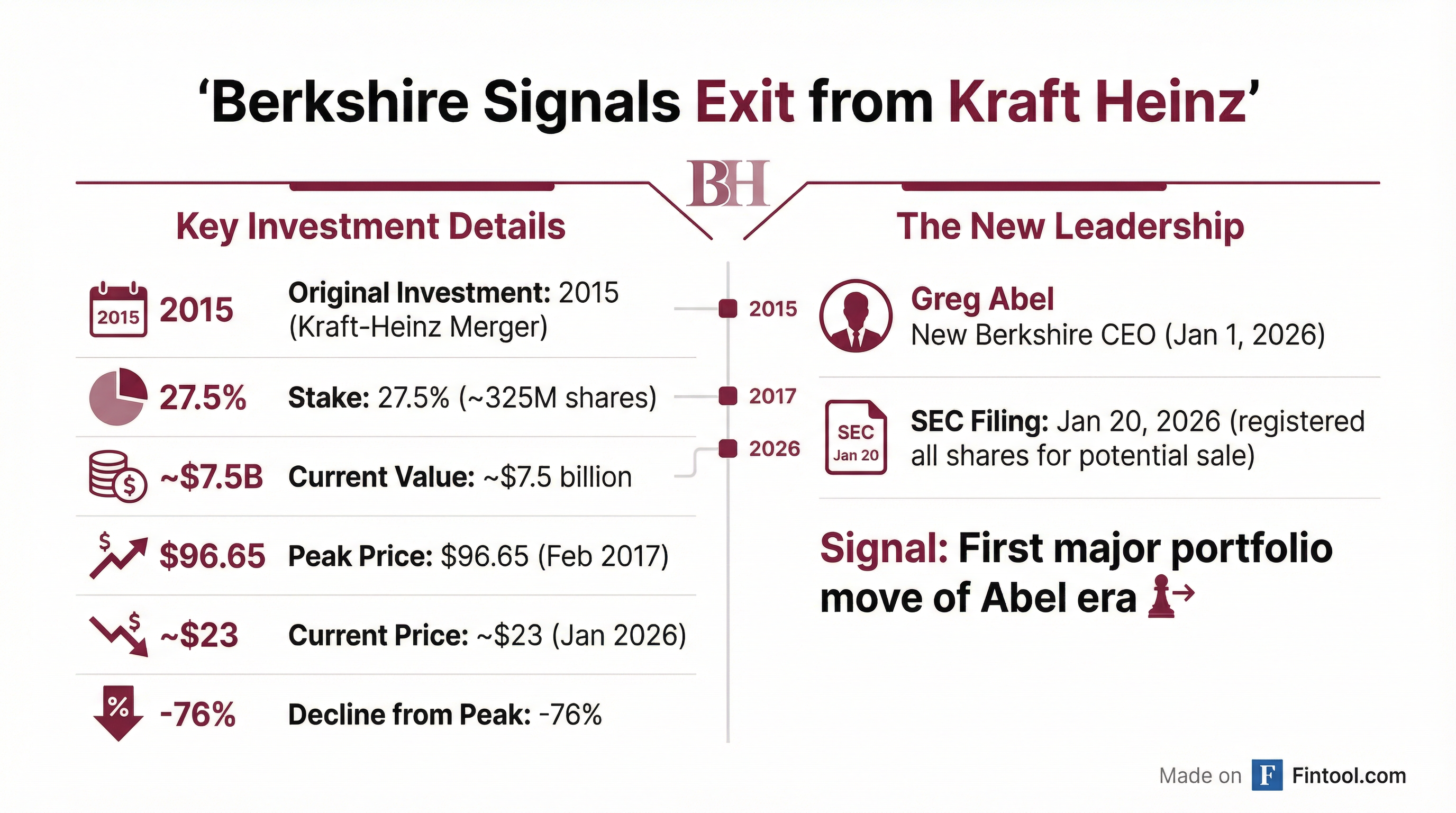
Just three weeks into his tenure as Berkshire Hathaway CEO, Greg Abel is preparing to close the book on one of Warren Buffett's most public investment mistakes. An SEC filing this week revealed that Berkshire has registered its entire 27.5% stake in Kraft Heinz—approximately 325 million shares worth $7.5 billion—for potential resale.
The move signals a decisive shift in Berkshire's portfolio management under new leadership. While the filing doesn't commit to an immediate sale, Morningstar analyst Greggory Warren called it "reflective of Abel's desire to clean up and pare down the investment portfolio early in his tenure."
Kraft Heinz shares fell as much as 7.5% on the news before recovering, closing the week at $23.20—down 76% from their February 2017 peak of $96.65.
 Ask Fintool AI Agent
A Decade of Disappointment
The Kraft Heinz saga began in 2015 when Buffett partnered with Brazilian private equity firm 3G Capital to merge Kraft Foods with H.J. Heinz in a $46 billion megadeal. The combination promised to create a packaged food powerhouse through aggressive cost-cutting and brand leverage.
Instead, the company struggled with underinvestment, shifting consumer tastes toward fresh and healthier foods, and intense competition from store-branded alternatives. The stock has been in a secular decline for nearly a decade:
Key milestones in the unraveling:
| Date | Event | Stock Impact |
|---|---|---|
| July 2015 | Kraft-Heinz merger closes | $72.96 |
| Feb 2017 | Stock peaks | $96.65 (all-time high) |
| Feb 2019 | $15B goodwill write-down, SEC investigation disclosed | -27% single day |
| 2023 | 3G Capital fully exits position | — |
| May 2025 | Berkshire exits KHC board | — |
| Aug 2025 | Berkshire takes $3.8B impairment on stake | — |
| Sep 2025 | KHC announces spin-off | — |
| Jan 2026 | Berkshire files to sell all shares | -7.5% intraday |
Buffett himself acknowledged the error. "It certainly didn't turn out to be a brilliant idea to put them together," he told CNBC in September 2025, "but I don't think taking them apart will fix it."
The Spin-Off Berkshire Opposed
Adding to Berkshire's frustration, Kraft Heinz announced in September 2025 that it would split into two independent public companies—a move both Buffett and Abel opposed.
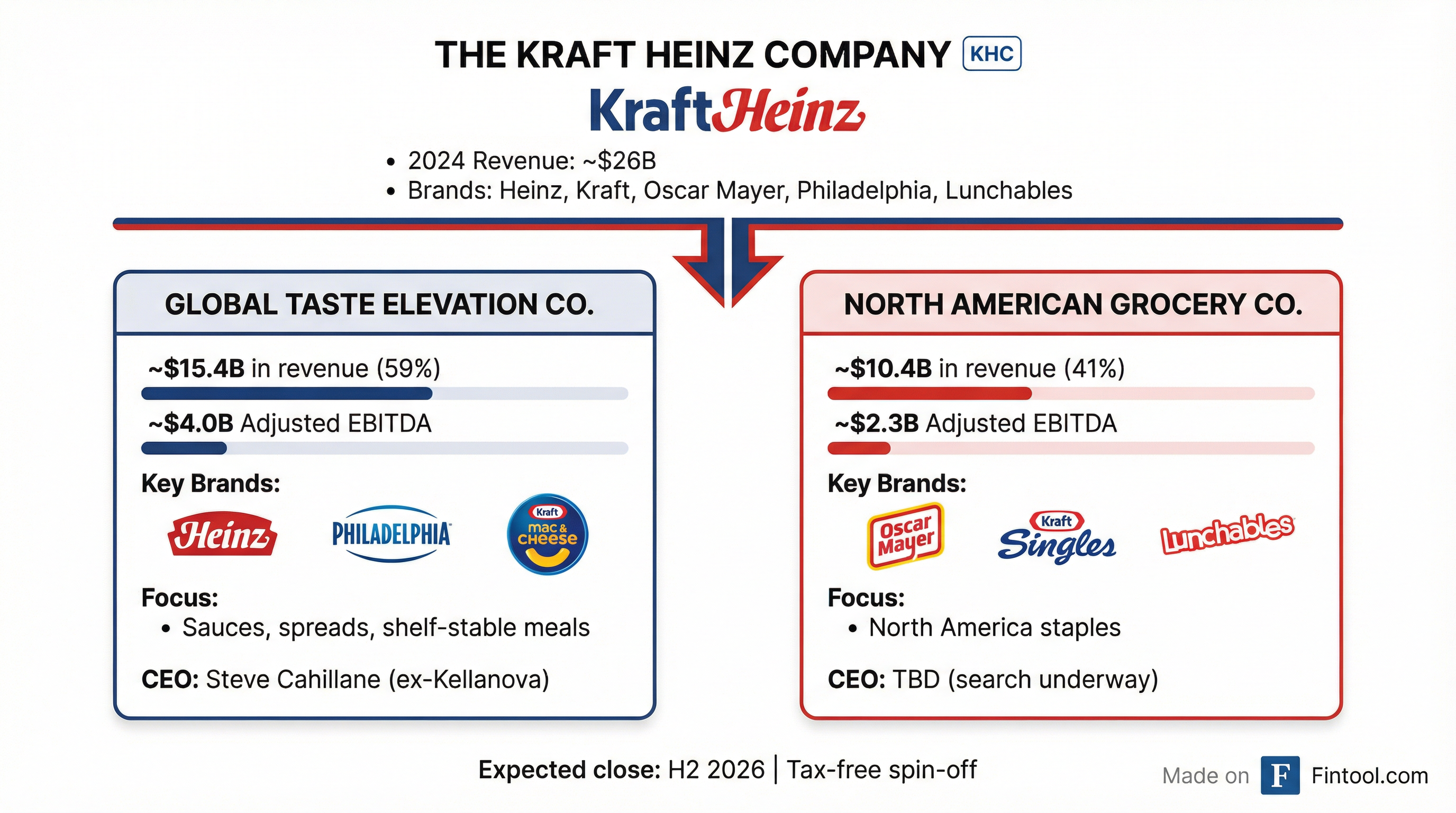
The separation, expected to close in the second half of 2026, will create:
Global Taste Elevation Co. (~$15.4B revenue)
- Billion-dollar brands: Heinz, Philadelphia, Kraft Mac & Cheese
- Focus: Sauces, spreads, shelf-stable meals
- ~20% of sales from Emerging Markets
- CEO: Steve Cahillane (former Kellanova chief)
North American Grocery Co. (~$10.4B revenue)
- Billion-dollar brands: Oscar Mayer, Kraft Singles, Lunchables
- Focus: North American staples
- 75% of brands are #1 or #2 in their categories
- CEO: Search underway
Kraft Heinz management expects up to $300 million in dis-synergies from the split, though they believe increased focus will drive better performance.
Ask Fintool AI AgentFinancial Trajectory: Stagnation Sets In
Kraft Heinz's financials tell the story of a company struggling to grow. Revenue has been essentially flat for five years while margins have compressed:
| Metric | FY 2020 | FY 2021 | FY 2022 | FY 2023 | FY 2024 |
|---|---|---|---|---|---|
| Revenue ($B) | $26.2 | $26.0 | $26.5 | $26.6 | $25.8 |
| Net Income ($B) | $0.4 | $1.0 | $2.4 | $2.9 | $2.7 |
| EBITDA Margin | 26.1% | 24.5% | 22.7% | 23.3% | 25.0% |
| Total Debt ($B) | $29.2 | $22.6 | $20.9 | $20.6 | $20.5 |
Analyst estimates show continued decline, with revenue expected to fall to ~$25.0 billion in FY 2025 and FY 2026, while EPS is projected to drop from $3.06 in FY 2024 to approximately $2.50.*
The company has used strong cash generation (operating cash flow of $4.2B in FY 2024 ) primarily to pay down debt—total debt declined from $29B in 2020 to $20.5B in 2024—rather than invest in growth.
In its most recent outlook, management cut FY 2025 guidance, now expecting organic net sales to decline 3.0-3.5% year-over-year and adjusted operating income to fall 10-12%.
What Happens Next
The SEC registration filing clears the administrative pathway for Berkshire to sell, but doesn't mandate a timeline. Stifel analysts noted that "transaction notifications are not required outside of quarterly 13F filings," meaning the next public disclosure will likely come in mid-May when Berkshire reports its Q1 2026 holdings.
For Abel, the potential Kraft Heinz exit accomplishes several objectives:
- Clean slate: Signals willingness to move on from underperforming legacy positions
- Cash deployment: A $7.5B sale would add to Berkshire's already massive $350B+ cash pile
- Philosophical clarity: Demonstrates that even iconic brands aren't immune to disposal when fundamentals deteriorate
The move may also reflect Abel's different investment philosophy. While Buffett famously wrote that he and Charlie Munger were "very reluctant to sell sub-par businesses as long as we expect them to generate at least some cash," Abel appears more willing to cut losses and redeploy capital.
For Kraft Heinz shareholders, the loss of Berkshire's support—and the implicit endorsement that came with it—removes one of the few remaining anchors of investor confidence. With the spin-off looming and its largest shareholder heading for the exit, the company faces an uncertain future as it attempts to reinvent itself.
Ask Fintool AI Agent*Values retrieved from S&P Global