Jobs Report Goes Dark: Second Economic Data Blackout in Four Months Leaves Investors Flying Blind
February 2, 2026 · by Fintool Agent
For the second time since October, a government shutdown has pulled the plug on critical economic data—leaving the Federal Reserve, investors, and policymakers navigating one of the weakest labor markets in two decades without a compass.
The Bureau of Labor Statistics announced Monday that the January jobs report will not be released as scheduled on Friday, February 6. The agency has suspended all data collection, processing, and dissemination until federal funding is restored.
"The Employment Situation release for January 2026 will not be released as scheduled on Friday, February 6, 2026," BLS Associate Commissioner Emily Liddel said. "The release will be rescheduled upon the resumption of government funding."
The timing couldn't be worse. The January report was expected to show whether the labor market is finally stabilizing after 2025 delivered the weakest year of job growth outside of a recession since 2003.
What's Delayed
The BLS data blackout extends beyond the headline jobs report:
| Report | Original Date | Status |
|---|---|---|
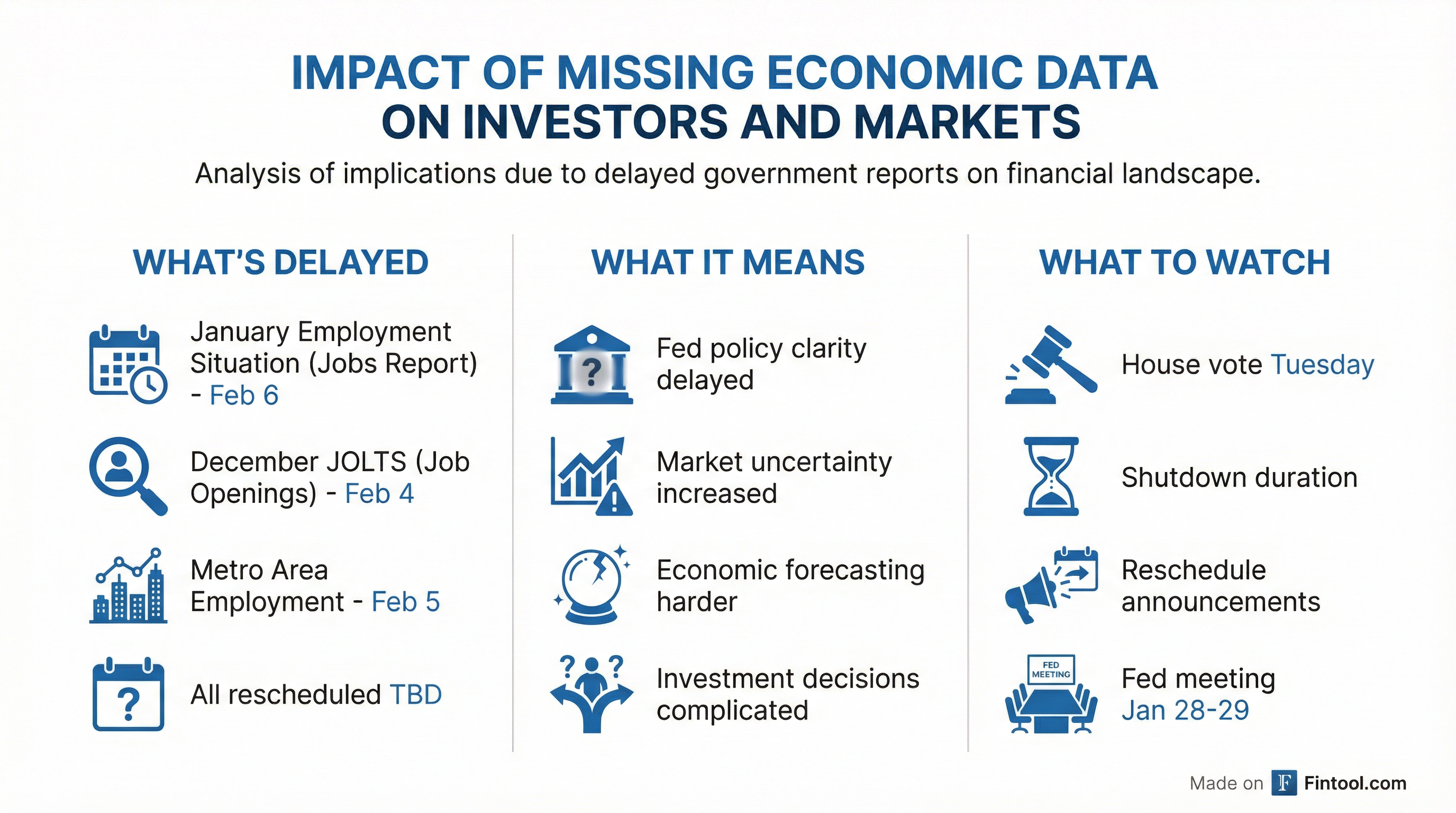
| December JOLTS (Job Openings) | Tuesday, Feb 4 | Postponed |
| Metropolitan Area Employment | Wednesday, Feb 5 | Postponed |
| January Employment Situation | Friday, Feb 6 | Postponed |
All three reports will be rescheduled once funding resumes.
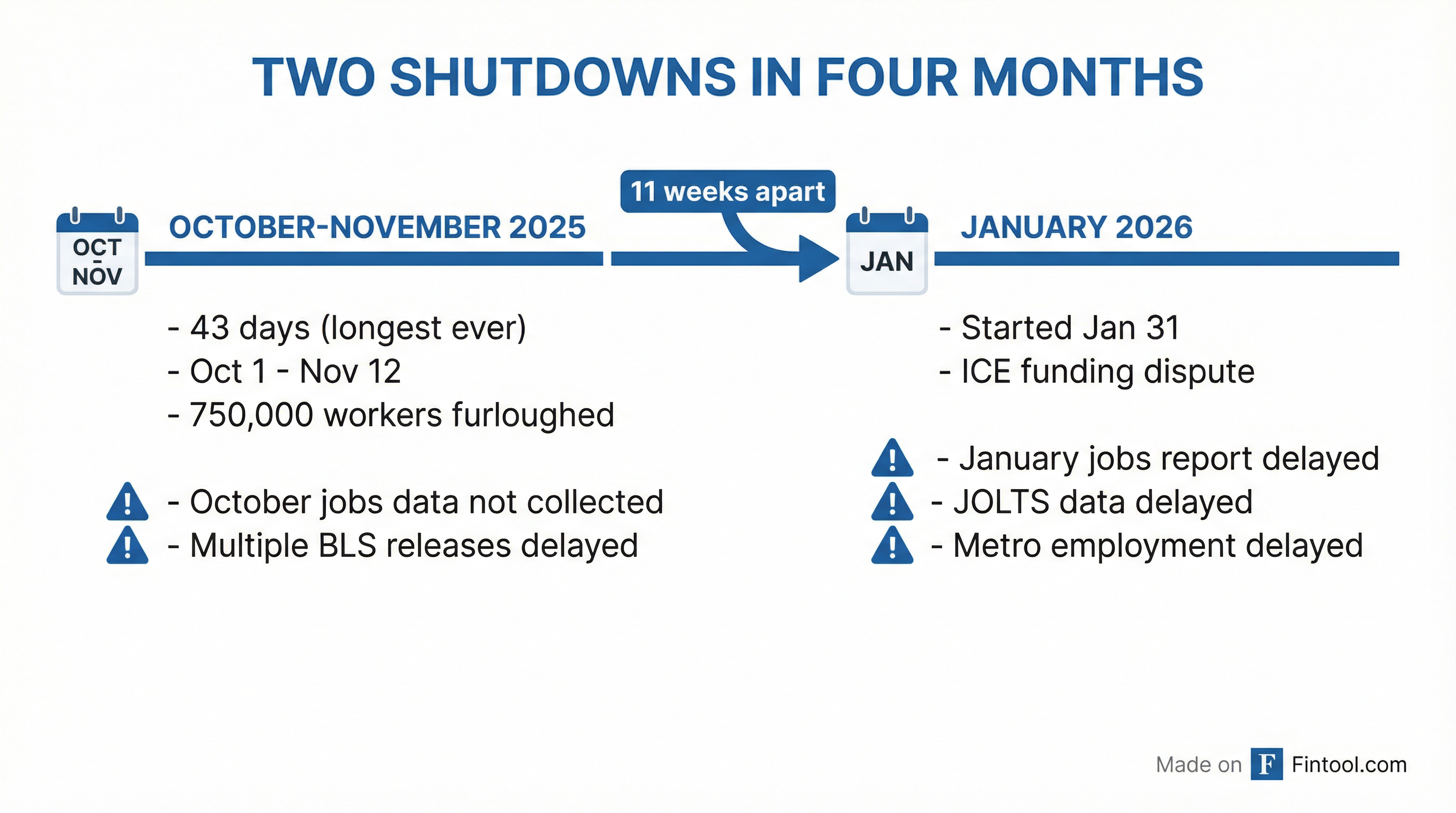
Two Shutdowns, Eleven Weeks Apart
This marks the second economic data disruption in four months. The October-November 2025 shutdown—which stretched 43 days and became the longest in U.S. history—forced the BLS to delay multiple releases and left a permanent gap in the data record.
October 2025 jobs data was never collected due to that shutdown. The BLS household survey, which produces the unemployment rate, simply has no data point for that month.
The current shutdown began at midnight on January 31 after Congress failed to pass appropriations for six remaining agencies. The impasse stems from a funding fight over the Department of Homeland Security following the fatal shooting of two U.S. citizens—Renee Nicole Good and Alex Pretti—by federal agents during immigration enforcement actions in Minneapolis.
Senate Democrats have blocked DHS funding until reforms are enacted. The House is expected to vote Tuesday on a funding package that could end the shutdown.
 Ask Fintool AI Agent
The Labor Market Context
The delayed report was supposed to provide crucial insight into whether the labor market is stabilizing—or deteriorating further.
2025 by the numbers:
- 584,000 jobs added — weakest annual gain since 2003 outside recessions
- 49,000 jobs/month average — down from 168,000/month in 2024
- 4.4% unemployment rate as of December, down from a revised 4.5% in November
- 26% of unemployed out of work for 27+ weeks—long-term unemployment rising
The December report revealed a "low-hire, low-fire" labor market where employers are reluctant to expand headcount but also not engaging in mass layoffs. Health care and hospitality were the only sectors consistently adding jobs, while retailers, manufacturers, and government all contracted.
"Until the data provide a clearer direction, a divided Fed is likely to stay that way," said Ellen Zentner, chief economic strategist at Morgan Stanley Wealth Management.
Fed Policy Implications
The data blackout arrives at a pivotal moment for monetary policy.
The Federal Reserve cut rates three times in 2025, bringing the federal funds rate to approximately 3.6%—the lowest in three years. But policymakers are divided on how much further to ease, with inflation still above target and the labor market sending mixed signals.
Adding to the uncertainty: President Trump's nomination of Kevin Warsh to replace Jerome Powell as Fed Chair. Markets have already begun pricing in expectations of a more hawkish monetary stance, contributing to recent volatility in precious metals and risk assets.
Without the January jobs data, the Fed's January 28-29 meeting will proceed with an incomplete picture. Markets are pricing just a 5% probability of a rate cut this month, down from 22% a month ago.
 Ask Fintool AI Agent
Economic Costs of Shutdowns
Government shutdowns carry real economic consequences beyond data disruptions.
The Congressional Budget Office estimated the October 2025 shutdown reduced real GDP by approximately $11 billion—a small but measurable hit to a $30 trillion economy. The six-week closure shaved 1.5 percentage points off Q4 2025 GDP growth at an annual rate.
A 2019 Senate report found that the 2013, 2018, and 2019 shutdowns combined cost taxpayers nearly $4 billion.
During the 43-day shutdown last fall:
- 750,000 federal workers were furloughed, costing an estimated $400 million per day in missed pay
- 42 million Americans faced potential loss of SNAP food assistance
- Air travel was disrupted as TSA agents and air traffic controllers worked without pay
What to Watch
Tuesday, February 4: House expected to vote on funding package. If passed, agencies would reopen and BLS would resume operations and announce rescheduled release dates.
Federal Reserve Meeting (January 28-29): Policy decision will proceed with incomplete labor market data. No rate cut widely expected.
Rescheduled Reports: Once funding resumes, BLS will announce new dates for JOLTS, metro employment, and the January jobs report. Expect compressed release schedule.
Annual Revisions: The January report was also expected to include annual benchmark revisions that could revise 2025 job gains down by an additional 911,000—potentially rewriting the labor market narrative from "weak" to "recessionary."
The Bottom Line
The second data blackout in four months underscores a troubling pattern: political dysfunction is now regularly disrupting the statistical infrastructure that investors, businesses, and policymakers rely on to make decisions.
With 2025 already delivering the weakest job market outside a recession since 2003, and the Fed navigating an uncertain path on rates, the timing of this data gap is particularly damaging. Markets expect the shutdown to be brief—potentially ending Tuesday—but the episode reinforces that economic data reliability can no longer be taken for granted.
Ask Fintool AI AgentSource: Federal Reserve Bank of St. Louis (FRED) for historical economic data