BNB Plus Pitches Binance Proxy Play at RedChip Conference, Targets 9-12% Yield on Digital Asset Treasury
February 4, 2026 · by Fintool Agent


BNB Plus Corp.-3.14% (Nasdaq: BNBX) made its investment case at the RedChip Fintech & DATS Virtual Investor Conference today, outlining a differentiated digital asset treasury strategy that management claims offers U.S. investors the closest proxy to owning equity in Binance, the world's largest cryptocurrency exchange.
Speaking at the virtual event, Chief Investment Officer Patrick Horsman and Chairman Joshua Kruger presented a four-pronged yield generation framework targeting 9-12% annualized returns on the company's BNB token holdings—returns they argue are impossible to replicate with passive Bitcoin treasury strategies.
The stock trades at $1.27 with a market cap of roughly $1.6 million, down sharply from its 52-week high of $142.50.
The Binance Equity Proxy Thesis
Horsman framed BNB Plus as a way to access the private Binance ecosystem through public markets. "Binance is not public. It's very closely held. Changpeng Zhao, the founder, is really the sole owner at this point. He's the 24th richest person in the world. He has no need for liquidity," Horsman told the RedChip audience. "We believe that through BNB, this is kind of the tokenization of Binance equity."
The bull case rests on Binance's market dominance:
| Metric | Binance | Coinbase |
|---|---|---|
| Share of Global Liquid Trading | 40% | 6% |
| Active Users | 300M+ | — |
| 2025 Trading Volume | $34T | — |
Source: Company presentation at RedChip Conference
Unlike other tokens, BNB has deflationary tokenomics. Binance conducts quarterly token burns—permanently deleting tokens from the supply—using exchange earnings. Over the past 12 months, burns have exceeded $1 billion per quarter. "By being a BNB holder, over time, you now have a larger claim on the total network and the BNB supply because the supply keeps shrinking," Horsman explained.
 Ask Fintool AI Agent
Four Yield Strategies, One Non-Directional Goal
The core investment thesis hinges on BNB's status as a "productive asset"—meaning the treasury can generate returns beyond simple price appreciation.
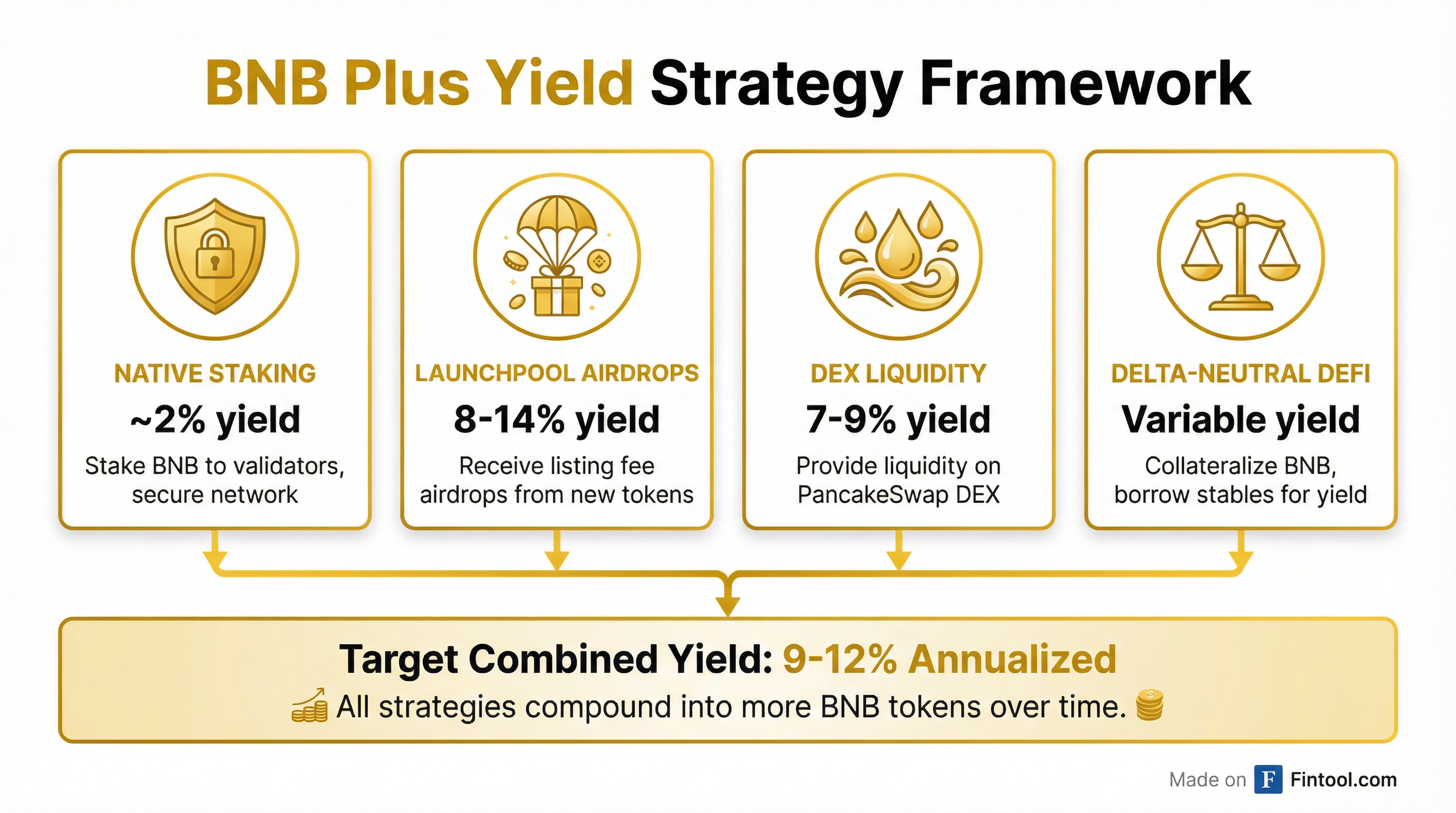
Strategy Breakdown
1. Native Staking (~2% yield)
Staking BNB to validators to help secure the network. Kruger described this as the "base layer of yield" that can be stacked with other strategies.
2. Binance Launchpool (8-14% yield)
The highest-yielding component. When Binance lists new tokens, it distributes listing fees as airdrops to BNB holders rather than retaining them. In 2025, Binance airdropped $782 million in tokens through this mechanism. "It's very lucrative and risk-free for LPs and holders because you're not putting anything at risk outside of just the beta of BNB," Kruger noted.
3. DEX Liquidity Provision (7-9% yield)
Providing liquidity on PancakeSwap between BNB and staked BNB variants. The company earns trading fees without taking additional directional exposure.
4. Delta-Neutral DeFi (Variable yield)
Collateralizing BNB to borrow stablecoins, then deploying into low-risk yield opportunities. "It's somewhat opportunistic," Kruger explained, used "only when you really do have an opportunity to make outsized return."
Critically, all strategies are designed to be non-directional—adding yield without adding risk beyond BNB's underlying price volatility. "You're already taking risk by being long BNB. But these yield strategies are non-directional, so they're additive from a yield standpoint, but not additive from a risk standpoint," Horsman said.
Offshore Structure Required for Binance Access
Executing the yield strategy required significant structural engineering. Binance doesn't accept direct U.S. investment, forcing BNB Plus to establish a British Virgin Islands subsidiary with an offshore trading team.
"Binance doesn't allow U.S. investment professionals to trade on Binance. They have to be fully offshore. So over the last quarter, we've implemented that entire structure. We're in a good position now to execute on the strategy," Horsman said.
The company raised approximately $27 million through a private placement in October 2025, with initial BNB holdings valued at over $17 million at closing.
Ask Fintool AI AgentLegacy DNA Business: From Drain to Break-Even
One notable development: the company's legacy Applied DNA Sciences business—which focused on nucleic acid production for biopharmaceuticals and diagnostics—has been rightsized and is now approaching profitability.
"We've made a major headcount reduction, and we've taken it to where it's had its first couple profitable months since October of this year in the company's history," Horsman said. "We've gotten some of the largest orders in the company's history, and we've done that with a massively reduced cost structure."
The LineaRx subsidiary recently announced its largest order ever—$1.2 million for LineaDNA—representing an accelerated two-year order cycle from a global diagnostics manufacturer.
Management is exploring strategic alternatives for the DNA business, including potential spin-off or additional capital raises, but emphasized it's "no longer a drain on the operations of the broader company."
Downside Protection in Down Markets
When asked about protecting shareholder value during crypto volatility like the current market conditions, Horsman pointed to the yield-generating nature of the strategy:
"Where all the Bitcoin guys are just kind of licking their wounds and really don't have any tools in their tool chest to implement, we're still running the yield strategies, we're still compounding your BNB, and we're not selling BNB when it dips. We're not levered."
Kruger added that falling BNB prices actually increase the compounding effect: "As the BNB price decreases, presumably, you're buying actually more BNB tokens, which adds to the asymmetry on the upside, when the market kind of returns."
What to Watch
Near-term: The company reports earnings on February 17, 2026, which should provide the first detailed look at treasury performance and yield generation since the strategy was fully implemented in Q4 2025.
Strategic catalyst: Management repeatedly referenced Binance's potential re-entry into the U.S. market following regulatory headwinds during the Biden administration. "We think that'll be a big boon for the business as well," Horsman said.
Risk factors: The investment thesis is heavily concentrated—100% long BNB with no diversification across other tokens. Execution risk on the offshore DeFi strategies and dependence on Binance Launchpool activity (which varies with new token listings) are key concerns.
Ask Fintool AI Agent