Brightline Skips Second Bond Payment as S&P Projects Default by 2027
January 16, 2026 · by Fintool Agent

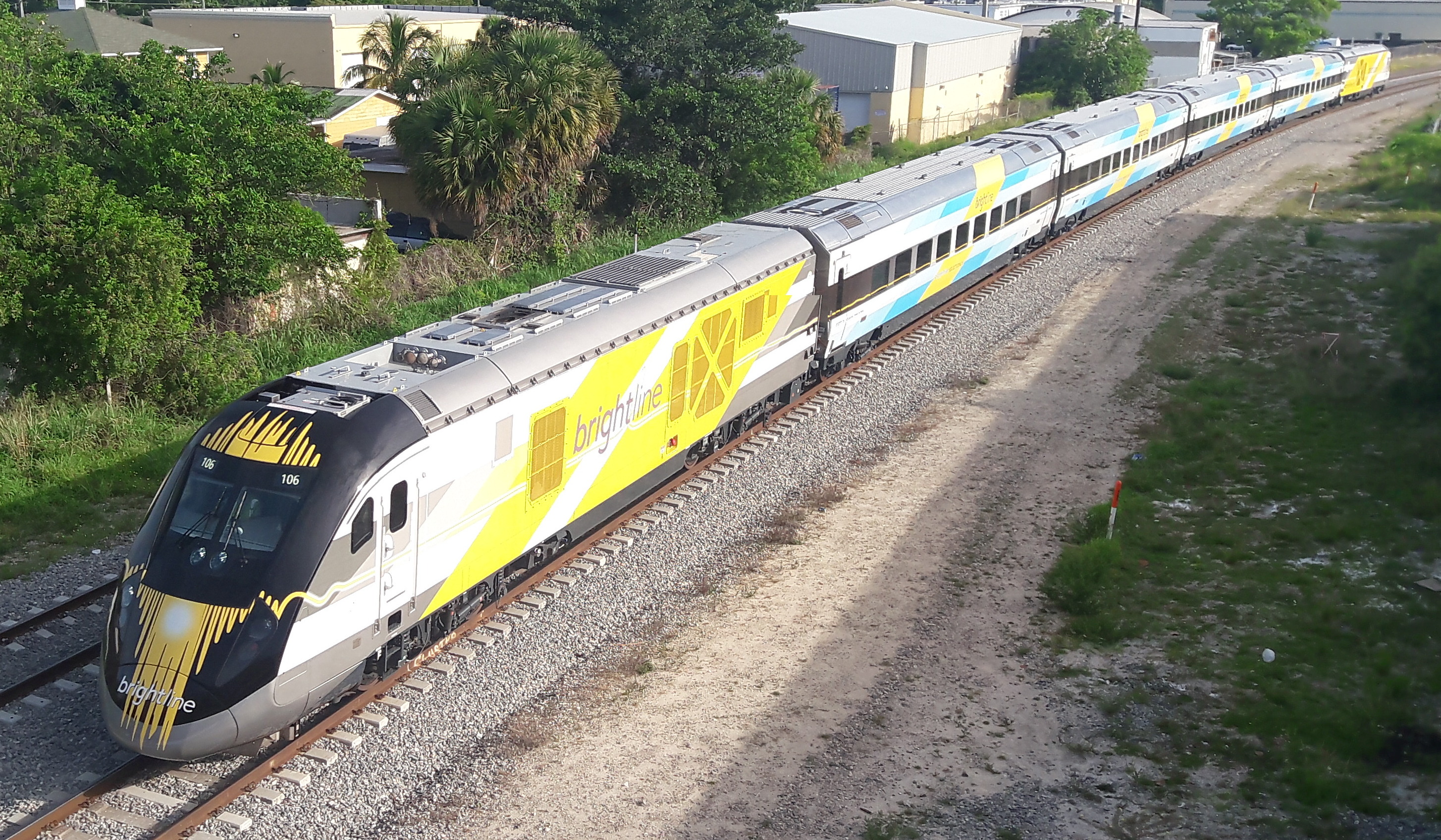
America's only private intercity passenger railroad missed its second bond payment in six months this week, as Brightline Florida deferred the January 15 interest payment on $1.2 billion of subordinate municipal debt—a move that underscores the fragile economics of private passenger rail in the United States.
The deferred payment, disclosed in a regulatory filing Thursday, required bondholders to waive a cash payment requirement. In return, Brightline agreed to raise the collateral price for a potential Tampa extension from $650 million to $850 million, effectively putting a floor under bonds currently trading at approximately 33 cents on the dollar.
S&P Global Ratings downgraded $2.2 billion of Brightline's municipal bonds five notches last month—from BB- to CCC—and warned of "a higher probability of default by January 2027" as ridership and revenue fell far short of projections.
The crisis tests whether private passenger rail can survive in a country where highways and airports receive substantial public subsidies, while Brightline must service $5.5 billion in debt from ticket revenue alone.
 Ask Fintool AI Agent
The Debt Stack
Brightline's complex $5.5 billion capital structure spans multiple tranches with different seniority and payment priority—a setup that has led to diverging fortunes for creditors.
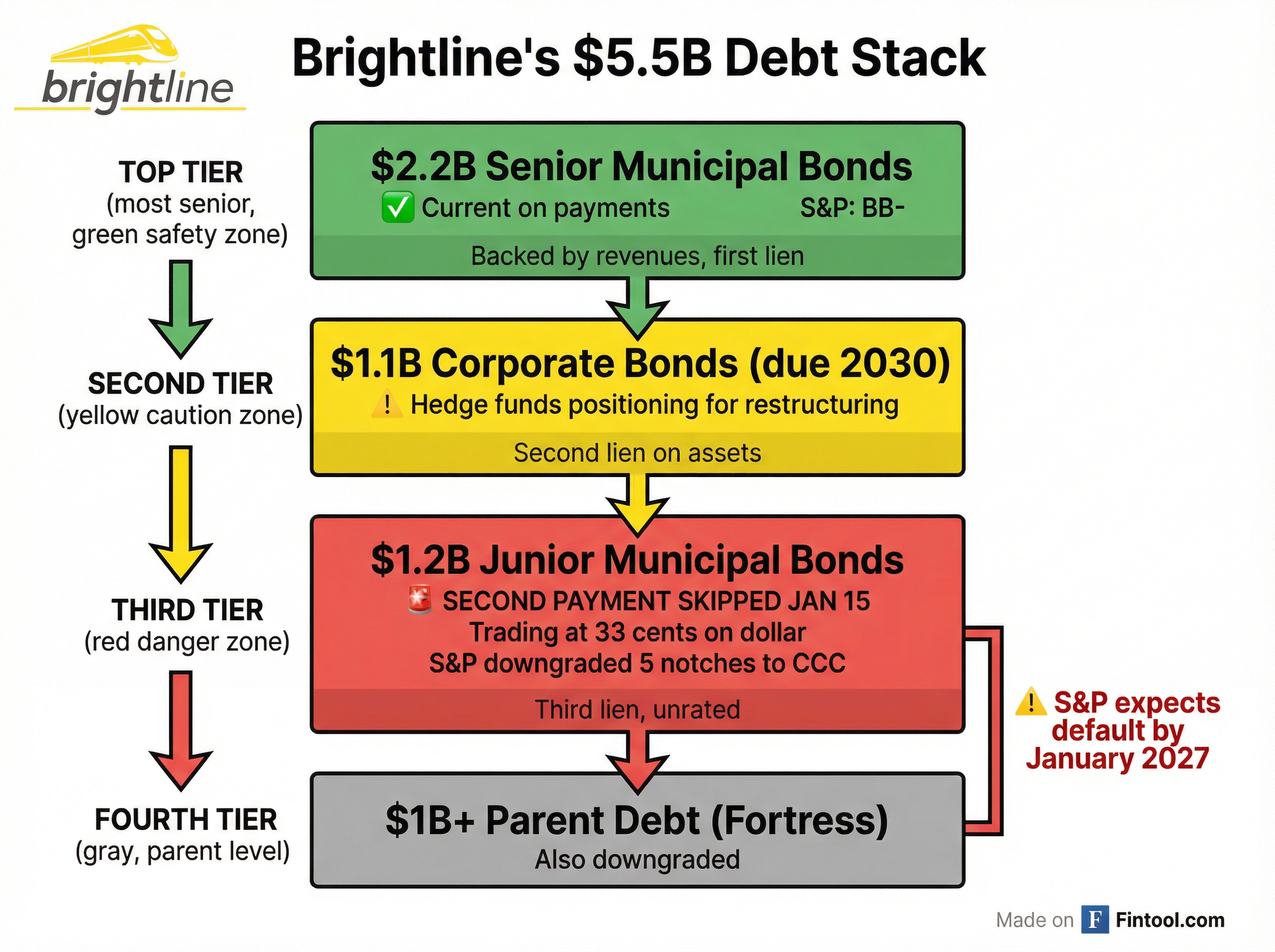
The senior-most $2.2 billion in tax-exempt municipal bonds remains current, though Brightline tapped debt service reserves to make the January 1 payment on its series 2024 debt, according to a separate regulatory filing.
The $1.1 billion in corporate bonds due 2030—held largely by hedge funds—has become the focal point of restructuring discussions. These bondholders control a majority of the debt and are exploring measures that would subordinate other holders of the same corporate debt to elevate their own claims.
The $1.2 billion in junior municipal bonds has borne the brunt of the crisis. After skipping the first interest payment in July, Brightline has now deferred a second consecutive payment. These bonds trade at roughly a third of face value.
| Debt Tranche | Amount | Status | S&P Rating |
|---|---|---|---|
| Senior Municipal Bonds | $2.2B | Current (using reserves) | BB- |
| Corporate Bonds (2030) | $1.1B | Current | B- |
| Junior Municipal Bonds | $1.2B | Deferred 2x | CCC |
| Parent Debt (Fortress) | $1B | Downgraded | — |
The Math Doesn't Work
The fundamental problem is simple: Brightline's trains are popular but not profitable.
The 235-mile Miami-to-Orlando corridor generated 3.1 million passengers in 2025—up meaningfully from prior years—but that's 54% below projections from its 2024 bond offering. Revenue ran 67% below forecasts.
"Brightline spent $341 million running and maintaining its trains and stations in 2024, bringing in about $188 million from ticket sales and other sources, for a deficit of more than $153 million," the Palm Beach Post reported. Interest payments added another $178 million.
To avoid default, S&P estimates Brightline needs to grow ticket revenue by approximately 51% in 2026—a target that would require either dramatic ridership gains or significant fare increases, or both.
The company has sought to optimize its network. In October, Brightline restructured schedules, adding capacity on high-demand routes while increasing short-distance frequency during commute times. November revenue jumped 18% year-over-year to $17.5 million on 280,136 riders.
But even with improved operations, the gap between revenue and debt service remains vast.
Ask Fintool AI AgentTimeline to Default
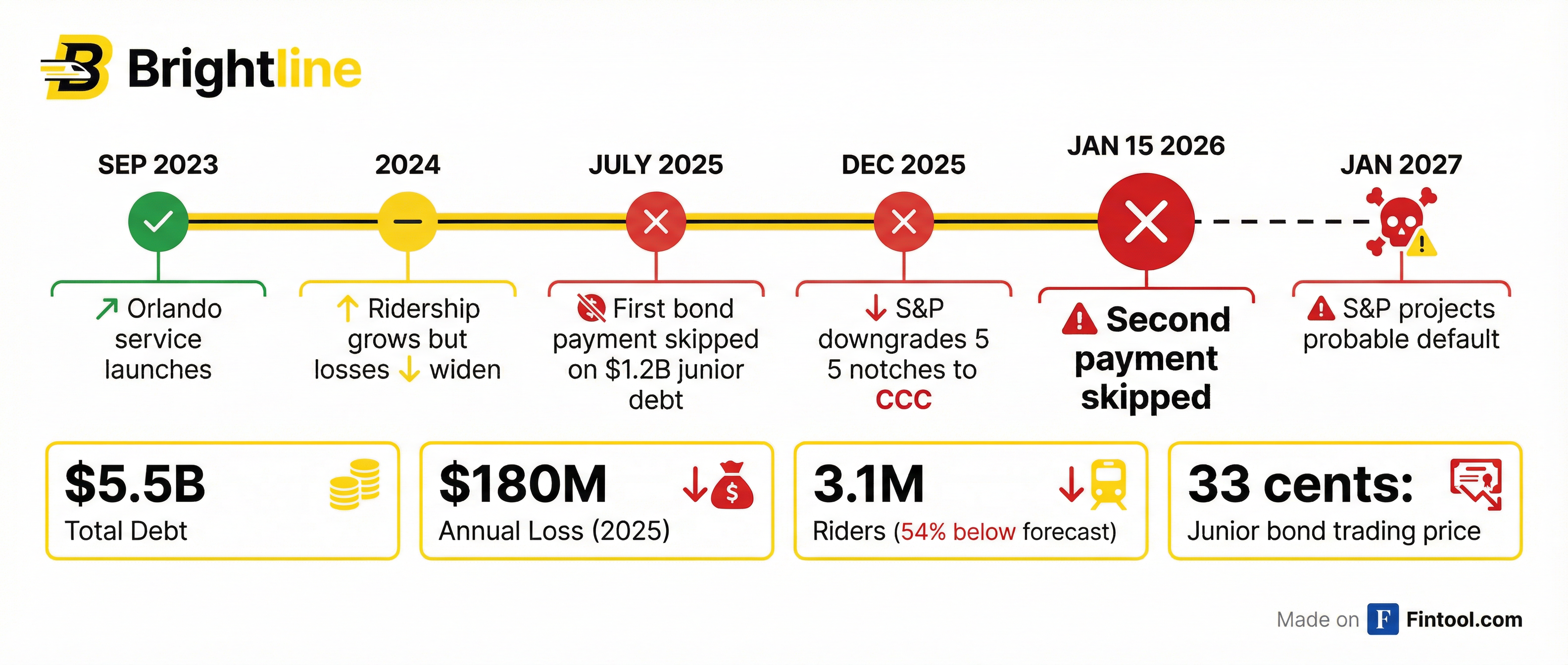
The clock is ticking. S&P's December downgrade noted that "liquidity available would be insufficient to meet debt service obligations" beyond early 2027 without additional capital.
Brightline is pursuing multiple lifelines:
Equity raise: The company disclosed it is "actively progressing the planned issuance of a substantial amount of equity, with a global process underway engaging with potential strategic partners." Proceeds would repay higher-coupon parent debt and increase cash reserves.
Additional debt: Investor disclosures mention discussions for "up to $100 million of additional debt" to meet upcoming obligations and cover "potential adverse outcomes of certain litigation"—a reference to ongoing lawsuits including a dispute with Florida East Coast Railway over trackage rights and maintenance fees.
Restructuring: Hedge fund creditors holding the corporate bonds are preparing restructuring plans that could give them priority over other creditors while providing new financing.
The outcome matters beyond bondholders. If Brightline cannot secure fresh capital or restructure on acceptable terms, the trains could stop running—a reputational blow to private passenger rail in America and a potential deterrent to future private infrastructure investments.
The Fortress Factor
Behind Brightline sits Fortress Investment Group, the $50+ billion alternative asset manager owned by SoftBank that has bankrolled the railroad since its inception.
Fortress's support has been crucial. The firm provided capital during construction, backed multiple debt offerings, and has continued to fund operations despite mounting losses. But Fortress's patience—and financial capacity—are not unlimited.
The December credit downgrade extended to Fortress-level debt, signaling rating agencies' concern about the parent's exposure. With Fortress also backing the separate $12 billion Brightline West project between Las Vegas and Southern California (which broke ground in 2024), the firm faces a choice about how much additional capital to commit to a struggling Florida operation.
"How the Fortress Investment Group chooses to use the deep pockets Brightline relied on to launch its Florida venture will likely play a role in the ability of this private rail operator to compete against publicly funded highways and air travel support systems," Railway Age noted.
Ask Fintool AI AgentThe Bigger Question
Brightline's struggles raise uncomfortable questions about whether private passenger rail can work in America without public support.
The company operates what is effectively the nation's only privately funded intercity passenger railroad. Unlike Amtrak, which receives billions in federal subsidies, Brightline must cover all capital and operating costs from fare revenue while servicing billions in debt.
The comparison is stark:
| Factor | Brightline | Amtrak Northeast Corridor |
|---|---|---|
| Ownership | Private (Fortress) | Federal government |
| Annual subsidy | $0 | $2B+ federal support |
| Ridership (annual) | 3M | 12M |
| Profitable | No | No (but subsidized) |
Proponents argue that Brightline's difficulties reflect execution challenges—overly optimistic ridership forecasts, expensive debt structures, litigation costs—rather than a fundamental flaw in the private model. With better planning and more realistic projections, private rail could work.
Critics counter that passenger rail is inherently a public good that cannot generate returns sufficient to service private capital. Roads, airports, and air traffic control all receive massive public investment; expecting private trains to compete on purely commercial terms may be unrealistic.
The verdict matters for Brightline West, which aims to connect Las Vegas to suburban Los Angeles by 2028. That project has secured $3 billion in federal loans—a hybrid public-private model that may prove more viable than Brightline Florida's fully private approach.
What to Watch
Equity raise progress: Brightline's ability to attract strategic investors will determine whether restructuring can be avoided. Any announcement of a major capital partner would signal confidence in the franchise's long-term value.
Bondholder negotiations: The hedge fund creditors preparing restructuring plans hold significant leverage. Watch for signs of consensus—or conflict—among different creditor groups.
Ridership trajectory: November's 18% year-over-year revenue growth offered a bright spot. If the network optimization and fare strategy gains traction, the company may have more runway than S&P projects.
Tampa expansion: Brightline has proposed extending service to Tampa, which could dramatically expand the addressable market. But raising capital for expansion while struggling to service existing debt would be challenging.
Brightline West implications: Any Florida restructuring could ripple to the Las Vegas project, where construction is underway and billions more in capital are needed.
For muni bond investors, Brightline is a reminder that tax-exempt infrastructure debt carries real credit risk—and that "essential service" projects can still fail when the math doesn't work.
Ask Fintool AI AgentRelated: Fortress Investment Group