Capital One Strikes $5.15B Deal to Buy Brex, Expanding Fintech Empire
January 22, 2026 · by Fintool Agent


Capital One is acquiring corporate card and spend management platform Brex for $5.15 billion in a combination of cash and stock, the companies announced Thursday. The deal marks Capital One's second major acquisition in eight months, following its May 2025 close of the $35.3 billion Discover Financial Services purchase—and signals the McLean, Virginia-based bank's aggressive push into AI-powered business payments.
The transaction values Brex at less than half its 2021 peak valuation of $12.3 billion, reflecting the brutal repricing of fintech companies since the zero-interest-rate era ended. For Capital One, it's a strategic bet that combining Brex's AI-native software platform with its massive balance sheet and newly acquired Discover payment network will create a formidable competitor in the $2 trillion business payments market.
The Deal Structure
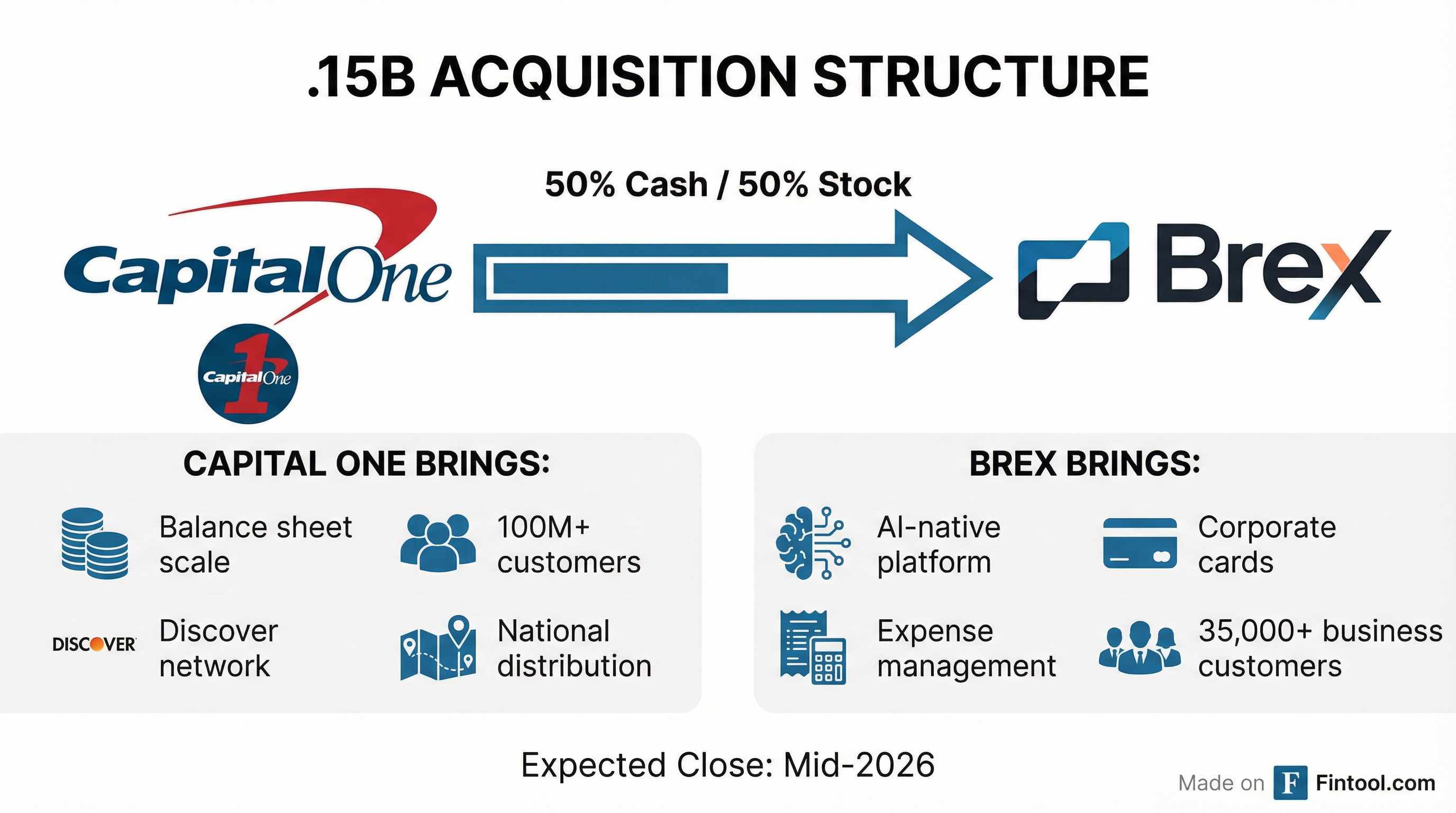
Capital One will fund the acquisition with approximately 50% cash and 50% stock. The transaction is expected to close by mid-2026, subject to regulatory approval.
"Since our founding, we set out to build a payments company at the frontier of the technology revolution," said Richard D. Fairbank, Founder, Chairman, and CEO of Capital One. "Acquiring Brex accelerates this journey, especially in the business payments marketplace."
Fairbank praised Brex for taking "the rarest of journeys for a fintech, building a vertically integrated platform from the bottom of the tech stack to the top."
BofA Securities served as financial advisor and Wachtell, Lipton, Rosen & Katz as legal advisor to Capital One. Centerview Partners advised Brex, with Wilson Sonsini, Simpson Thacher, and Skadden Arps providing legal counsel.
 Ask Fintool AI Agent
Brex: From Y Combinator to Exit
Brex was founded in 2017 by Henrique Dubugras and Pedro Franceschi, Brazilian entrepreneurs who had previously built and sold a payments company called Pagar.me. The duo joined Y Combinator with a VR startup idea before pivoting to corporate cards for startups—a problem they experienced firsthand when trying to get credit despite having venture backing.
The company's insight was simple but powerful: underwrite businesses based on their cash balances, revenue, and investor backing rather than founders' personal credit scores. That approach made Brex a Silicon Valley darling, reaching unicorn status within two years.
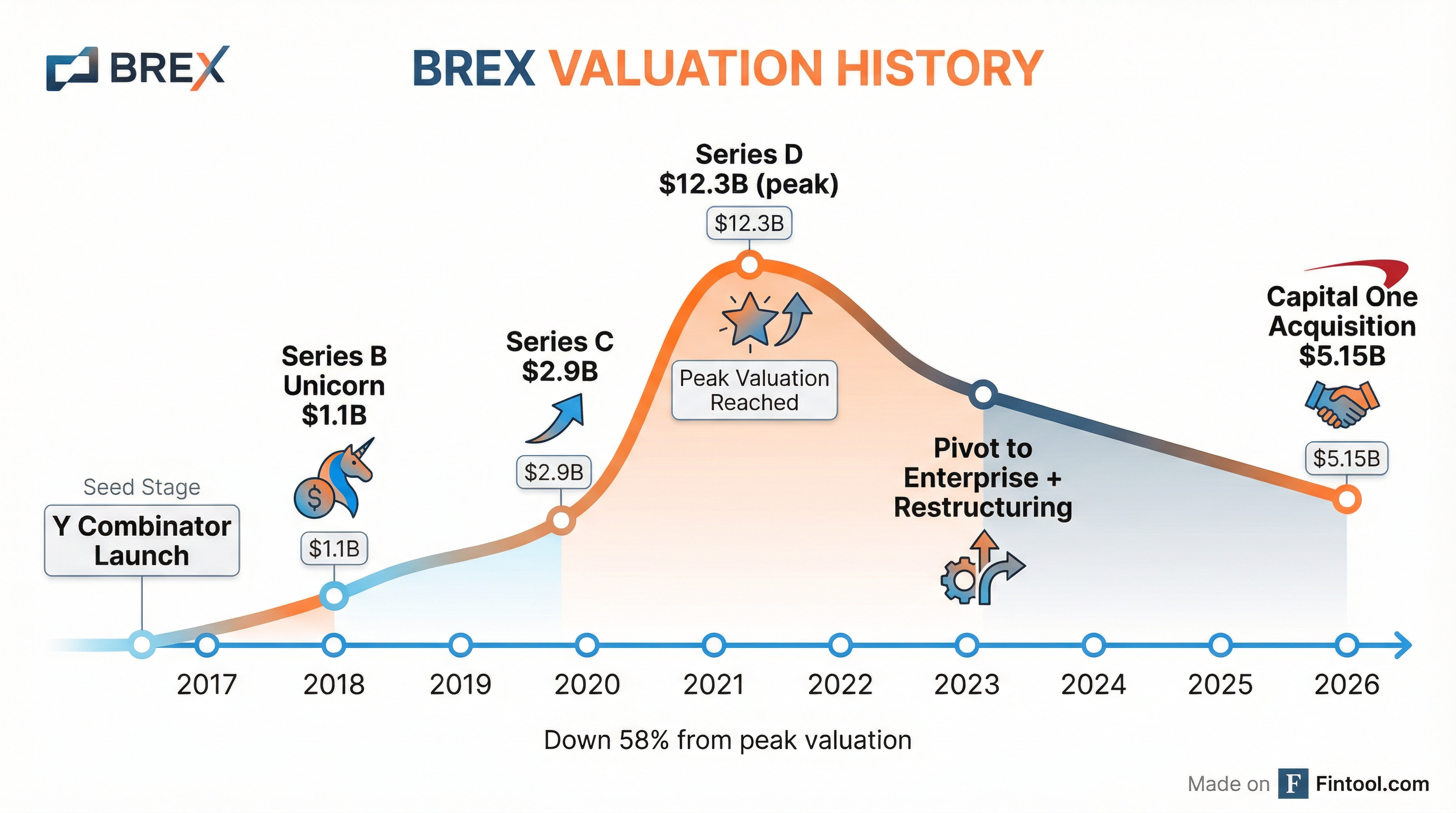
By 2021, Brex had raised over $1.5 billion from investors including Tiger Global, Greenoaks Capital, DST Global, Kleiner Perkins, and Ribbit Capital. Its valuation peaked at $12.3 billion following a Series D round.
But the fintech reckoning came hard. Rising interest rates in 2022-2023 crushed high-growth tech valuations. Brex responded by cutting its workforce approximately 20%, reducing cash burn by 50-70%, and pivoting from risky startup customers to larger enterprise clients.
The $5.15 billion sale price represents a 58% discount from peak. For Brex's investors, it's a bittersweet exit—a respectable return on early capital but a far cry from what a 2021 IPO might have delivered.
Why This Deal Makes Strategic Sense
The acquisition gives Capital One several strategic assets:
AI-Native Software Platform: Brex built its expense management and corporate card platform with AI from the ground up. The company uses AI agents to automate expense approvals, detect fraud, and streamline financial workflows—capabilities that took legacy players years to bolt on.
Enterprise Customer Base: After its 2023 pivot, Brex serves over 35,000 business customers, increasingly tilted toward larger enterprises rather than VC-backed startups.
Global Reach: In 2025, Brex secured a full EU license allowing it to issue corporate cards and run spend management services directly across 30 EU countries, with UK expansion planned.
Vertically Integrated Stack: Unlike competitors who rely on third-party issuers, Brex controls its entire technology stack—from card issuance to expense software to payment processing.
For Capital One, which completed its $35.3 billion acquisition of Discover Financial Services in May 2025 , Brex adds the software layer to complement the payment network gained from Discover.
Ask Fintool AI AgentCapital One's Fintech Empire Takes Shape
The Brex deal represents the second leg of what appears to be a calculated fintech acquisition strategy:
| Deal | Value | Closed | Strategic Rationale |
|---|---|---|---|
| Discover Financial Services | $35.3B | May 2025 | Payment network (Discover, PULSE, Diners Club), debit capabilities |
| Brex | $5.15B | Mid-2026 (expected) | AI-native corporate cards, expense management, business payments software |
Combined, Capital One is building a payments powerhouse that spans consumer cards (Capital One, Discover), payment networks (Discover network with 70M+ merchant acceptance points), and now enterprise spend management through Brex.
The company ended Q3 2025 with $662 billion in total assets —up from $494 billion before the Discover deal closed —making it the eighth-largest U.S. bank.
Competitive Implications
The deal intensifies competition in business payments, a market dominated by American Express on the large enterprise side and contested by a wave of fintechs targeting mid-market and tech companies.
Key Competitors:
- American Express: The incumbent leader in corporate cards, with deep enterprise relationships and a premium brand
- Ramp: Brex's most direct rival, backed by D1 Capital and Founders Fund, known for aggressive software-led approach and savings claims
- Bill.com: Public company ($15B+ market cap) focused on AP/AR automation and bill pay for SMBs
- Mercury: Targeting startup banking with integrated financial products
Capital One's balance sheet gives Brex something its venture-backed competitors lack: virtually unlimited capacity to extend credit to businesses. Combined with Discover's network, Capital One can now offer closed-loop business payment products that capture interchange on both sides of the transaction.
What to Watch
Regulatory Review: Given Capital One's recent Discover approval process—which took 14 months and resulted in consent orders and $100 million in fines against Discover for overcharging interchange fees —the Brex deal will face scrutiny. However, Brex is smaller and doesn't present the same competitive concerns as combining two major card issuers.
Integration Execution: Capital One must integrate Brex's engineering-first culture with its more traditional banking operations—a challenge that has tripped up many bank-fintech combinations.
Enterprise Sales Acceleration: The key question is whether Capital One's distribution can accelerate Brex's enterprise push. Large companies have been reluctant to trust a venture-backed startup with their treasury and spend management; a bank backing may remove that objection.
Ask Fintool AI AgentRelated Companies: Capital One Financial