Capital One Buys Brex for $5.15 Billion in Largest Bank-Fintech Deal Ever
January 23, 2026 · by Fintool Agent

Capital One is acquiring corporate expense management fintech Brex for $5.15 billion in cash and stock—a 58% discount to Brex's $12.3 billion peak valuation in 2021 and the largest bank-fintech deal in history. The acquisition, announced alongside Capital One's Q4 2025 earnings, marks the second mega-deal in eight months for CEO Richard Fairbank, who closed the $35 billion Discover Financial acquisition last May.
COF shares fell 7% on Friday to $218.49, giving back most of the week's gains as investors digest the acquisition alongside quarterly results that showed net income of $2.1 billion.
The Deal Structure
The transaction breaks down as follows:
| Component | Value |
|---|---|
| Total Deal Value | $5.15 billion |
| Cash Component | |
| Stock Component | |
| Peak Valuation (2021) | $12.3 billion |
| Discount to Peak | 58% |
| Expected Close | Mid-2026 |
Capital One describes the acquisition as "accelerating" its payments journey. "Brex invented the integrated combination of corporate credit cards, spend management software and banking together in a single platform," said Fairbank. "They have taken the rarest of journeys for a fintech, building a vertically integrated platform from the bottom of the tech stack to the top."
 Ask Fintool AI Agent
Brex's Rise and Reset
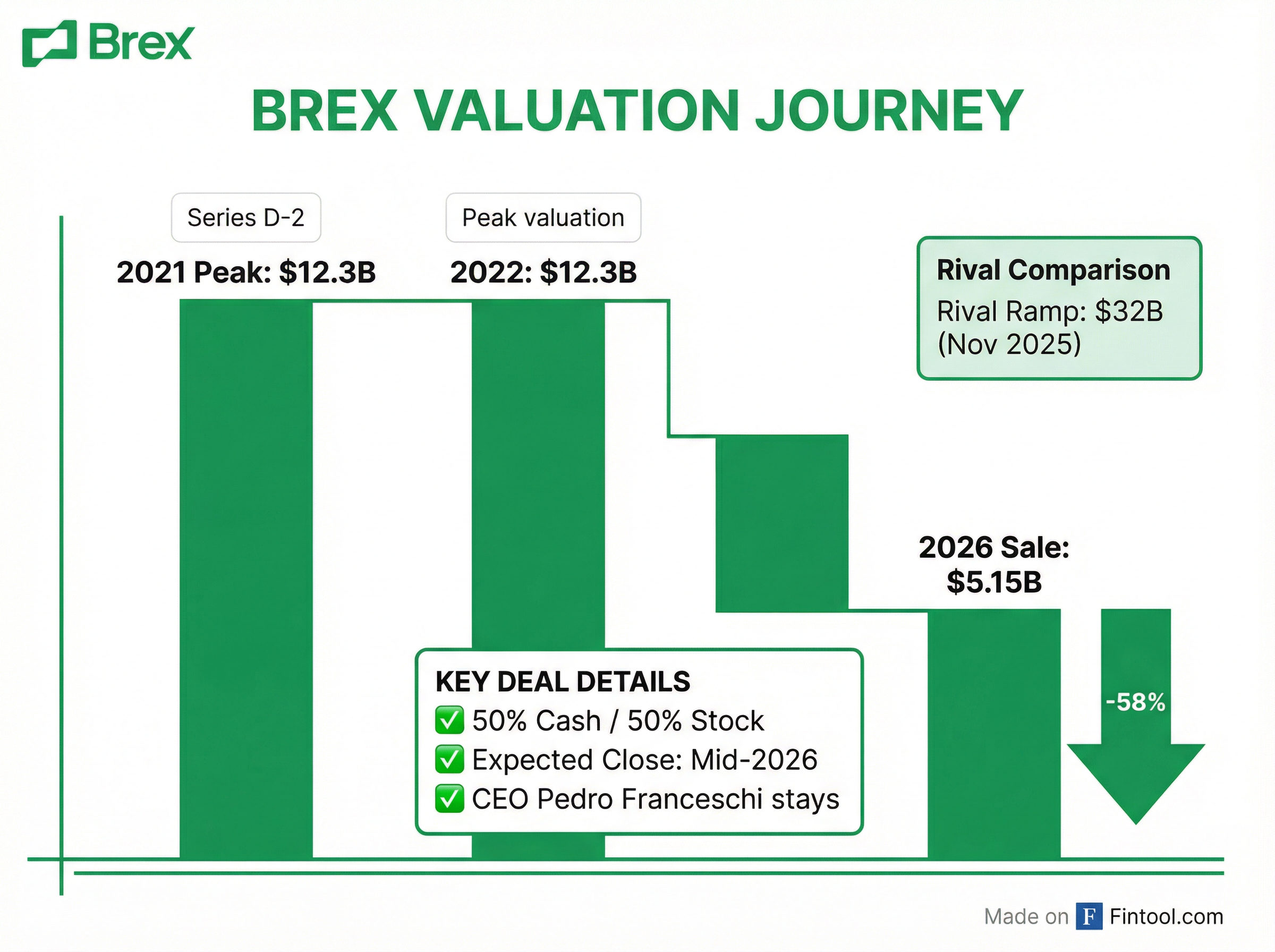
Brex was founded in 2017 by Brazilian entrepreneurs Pedro Franceschi and Henrique Dubugras, who had previously sold a payments startup in Brazil at age 16 for over $1 billion. The company raised $1.2 billion in venture funding and reached a $12.3 billion valuation during its October 2021 Series D-2 round.
But 2022 proved pivotal—and not in a good way. As interest rates rose and VCs demanded profitability, Brex made a controversial decision to abandon tens of thousands of small and medium business customers, informing them their accounts would close unless they had "professional" funding from VCs or accelerators. The pivot toward enterprise clients preserved margins but cost the company momentum—and goodwill.
The contrast with rival Ramp is stark. While Brex stalled, Ramp's valuation soared from $13 billion in March 2025 to $32 billion by November 2025 across successive funding rounds.
Despite the challenges, Brex enters the deal in a position of strength:
- Profitable: The company is now profitable with 40% year-over-year growth
- Enterprise Clients: Customers include Anthropic, Robinhood, DoorDash, Toast, Zoom, and Intel
- EU Expansion: Secured an EU banking license in August 2025
- Deposits: Oversees approximately $13 billion in deposits at partner banks
Franceschi will remain CEO post-acquisition. Co-founder Dubugras stepped back from day-to-day operations in 2024 to serve as board chairman.
Capital One's Payments Empire
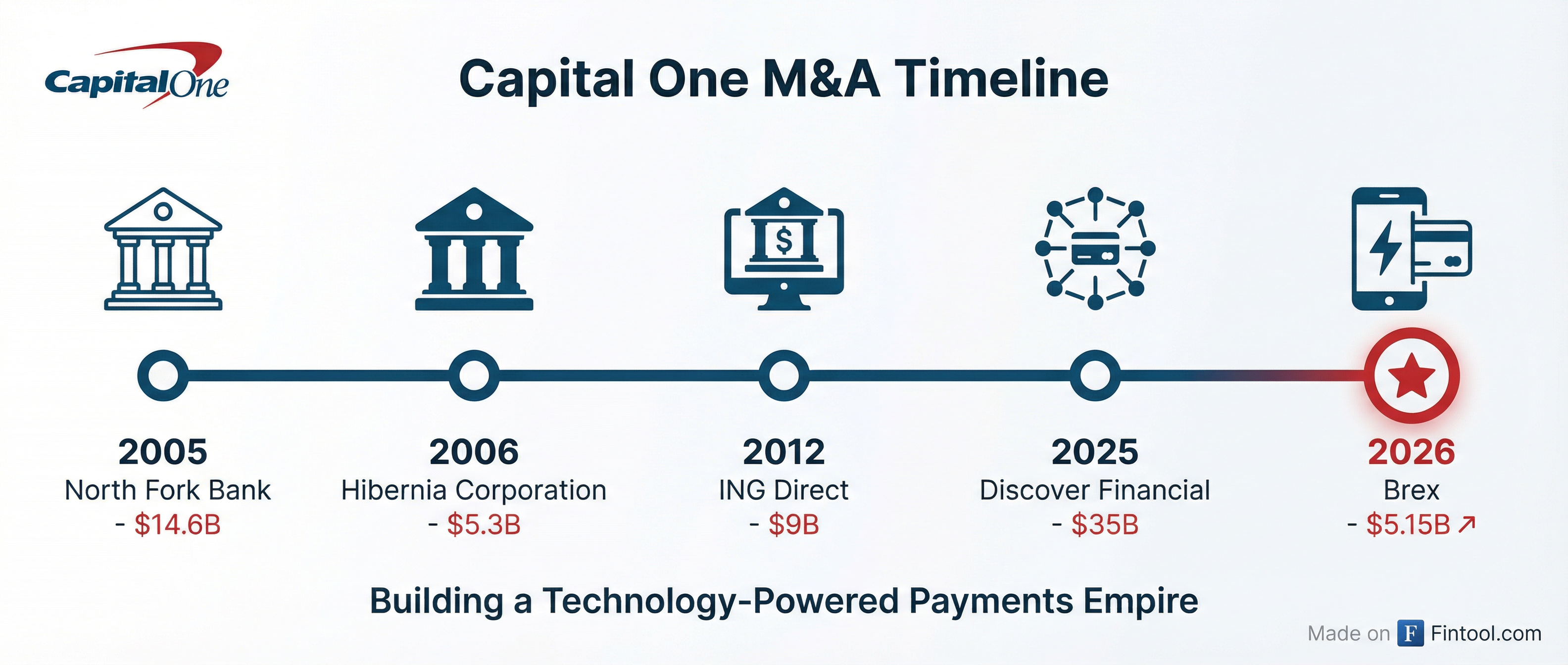
The Brex acquisition extends a two-decade M&A strategy that has transformed Capital One from a credit card monoline into a $669 billion asset diversified financial institution with its own payments network.
The Discover deal, which closed in May 2025, was the crown jewel—giving Capital One direct merchant relationships and control over the fourth-largest U.S. card network. As Fairbank explained on the Q2 2025 earnings call: "There are only two banks in the world with their own network, and we are one of them. We are moving to capitalize on this rare and valuable opportunity."
Brex fills a different gap: corporate liability cards. Capital One has historically been stronger in personal-liability small business cards. Brex's AI-native platform for expense management and corporate cards—plus its enterprise client roster—immediately expands Capital One's footprint in commercial payments.
The stock reaction suggests investors are digesting a lot of change quickly. After absorbing the Discover integration—which added $167 billion in assets in a single quarter —Capital One is now bolting on another technology platform that will require careful integration.
Ask Fintool AI AgentWhat Capital One Gets
Beyond the enterprise client list, Capital One acquires:
Technology Platform: Brex's AI-native software automates expense management, corporate card issuance, and real-time payments. The platform uses AI agents to automate complex workflows and reduce manual review.
European Access: Brex's freshly minted EU banking license allows Capital One to directly issue cards and offer spend management across 30 EU countries—a significant international expansion opportunity.
Talent: 1,100 employees, including experienced fintech engineering and product teams.
B2B Distribution: GOJO-style installed base of corporate customers with recurring spend patterns—the kind of sticky revenue that banks covet.
The Bigger Picture
This deal signals a structural shift in commercial cards. As PYMNTS notes, "Issuers increasingly outsource issuance technology while retaining balance-sheet control." Capital One isn't just buying a fintech brand—it's acquiring the infrastructure to redefine how commercial card programs are constructed.
For Brex's late-stage investors—TCV, GIC, Baillie Gifford, and others who invested at $7.4 billion or higher—the exit is bittersweet. They're liquid, which counts for something in today's market, but the returns fall well short of what seemed possible three years ago.
For early believers like Ribbit Capital and Y Combinator, who invested at a $10 million seed valuation, the outcome is different. One early investor reported a 500x return.
What to Watch
- Regulatory approval: The deal requires standard closing conditions; expected mid-2026
- Integration execution: How quickly can Capital One mesh Brex's tech stack with its own cloud-native infrastructure?
- Ramp's response: Will the $32 billion rival accelerate its own path to IPO or strategic exit?
- Corporate card market share: Can Capital One/Brex gain ground against American Express and the banks?
The fintech correction now has its poster child. But for Capital One, the markdown was an opportunity to acquire battle-tested technology at a discount. Whether that proves prescient depends entirely on execution.
Ask Fintool AI AgentRelated Companies: Capital One