Cintas Makes Third Run at UniFirst with $5.2 Billion Bid as Activist Pressure Mounts
December 22, 2025 · by Fintool Agent


Cintas Corporation is taking another swing at Unifirst Corporation, going public Monday with a $5.2 billion all-cash proposal to acquire its smaller rival for the third time in nearly three years. The bid arrives just days after activist investor Engine Capital lost a proxy fight at UniFirst's annual meeting—but won significant shareholder support in a rebuke of the board's refusal to sell.
The $275-per-share offer represents a 64% premium to UniFirst's 90-day average closing price, the highest premium relative to market price that Cintas has offered since it began pursuing the company in 2022.
"We remain unwavering in our conviction that combining Cintas and UniFirst would deliver considerable benefits for customers, employee-partners and shareholders," said Todd Schneider, Cintas President and CEO.
A Three-Year Pursuit
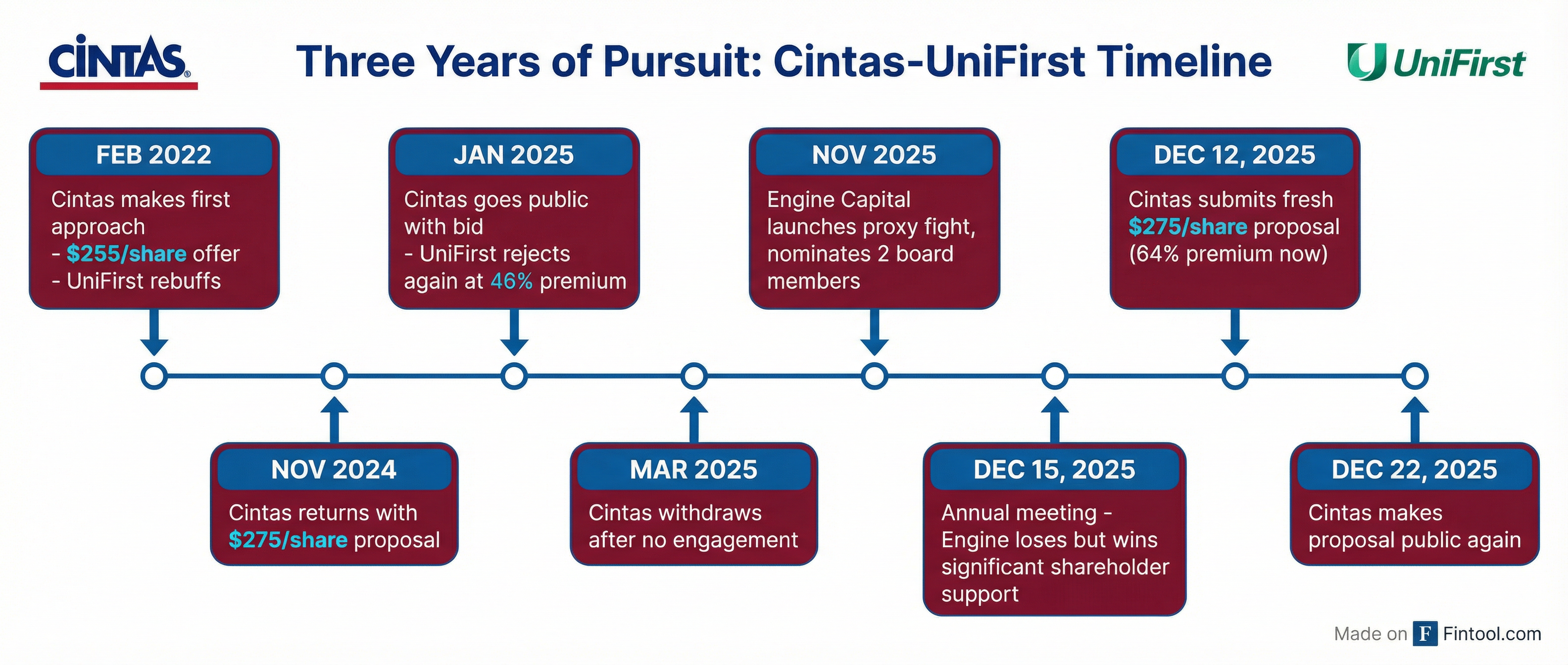
The proposal marks Cintas's third major approach since February 2022, when it first indicated interest in acquiring UniFirst at $255 per share. UniFirst rejected that approach without substantive engagement. Cintas returned in November 2024 with an improved $275 per share offer, which UniFirst's board rejected twice—in November and again in December—before Cintas went public with the bid in January 2025.
After failing to win engagement from UniFirst's board, Cintas terminated talks in March 2025. Now, less than a year later, the uniform services giant is back with the same price but dramatically different circumstances.
Activist Sets the Stage
The renewed bid follows a contentious proxy fight at UniFirst's December 15 annual meeting. Engine Capital, which holds more than 3% of UniFirst shares, nominated two board members—including Michael Croatti, son of former CEO Ron Croatti—while pushing for the company to initiate a sale process.
Engine's candidates failed to secure seats due to UniFirst's dual-class share structure, which gives the Croatti family approximately 70% of voting power despite owning a much smaller economic stake. But the activist won significant support among institutional shareholders—what Engine called "an unequivocal rebuke of UniFirst's value-destructive stand-alone strategy."
"Recent market commentary confirms that many UniFirst shareholders, including several of the Company's largest institutional investors, recognize the value that a combination would deliver and share our belief that we are stronger together than we are apart," Schneider said in the December proposal.
The $1.3 Billion Cost of Saying No
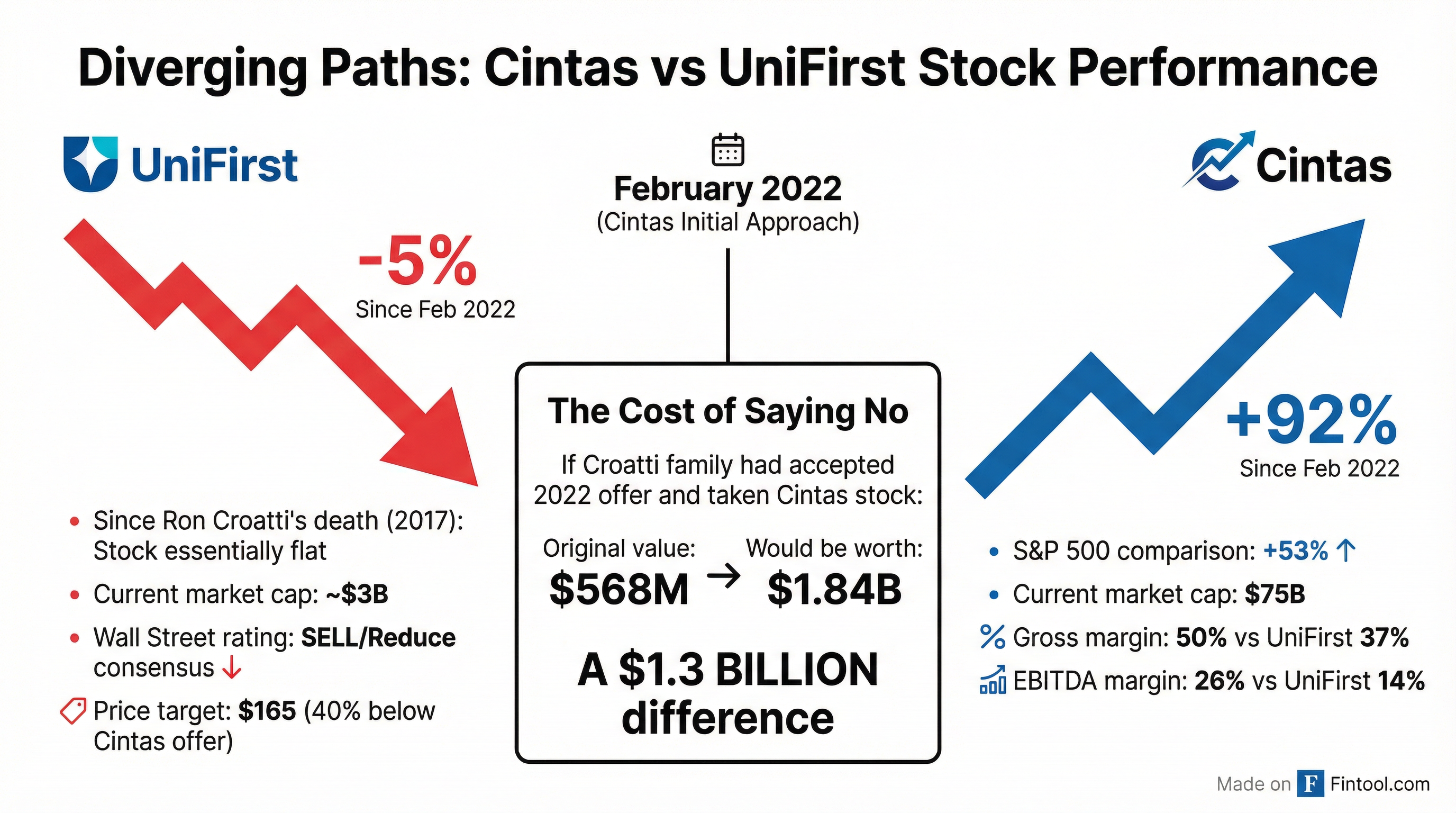
Engine Capital's proxy materials laid bare the financial consequences of UniFirst's refusal to engage with Cintas. In a pointed analysis, the activist calculated that if the Croatti family had accepted the 2022 offer at $255 per share and taken Cintas stock as consideration, their stake would be worth approximately $1.84 billion today—versus roughly $568 million at current UniFirst prices.
The divergence in performance between the two companies has been stark. Since Cintas's initial approach in February 2022, UniFirst shares have declined approximately 5%, while Cintas has gained 92% and the S&P 500 has risen 53%. Since the death of Ron Croatti in 2017, UniFirst's stock has been essentially flat while Cintas shares have risen nearly fivefold.
Scale Advantage Widening
The financial gap between the two companies underscores Cintas's competitive advantage. In fiscal 2025, Cintas generated revenues of $8.0 billion with an EBITDA margin of 26.3% and gross margins exceeding 50%. UniFirst, meanwhile, reported revenues of $2.4 billion with EBITDA margins of just 13.6% and gross margins of 36.6%.
| Metric | Cintas (FY 2025) | UniFirst (FY 2025) |
|---|---|---|
| Revenue | $8.0B | $2.4B |
| Net Income | $1.8B | $148M |
| EBITDA Margin | 26.3% | 13.6% |
| Gross Margin | 50.0% | 36.6% |
| Market Cap | $75B | $3B |
Values from S&P Global.
Engine Capital argued that UniFirst's competitive position is deteriorating rapidly. "Cintas is on a mission to win over UniFirst's large national accounts—and it will succeed," a former senior UniFirst employee told the activist. "Cintas offers a broader range of products and can offer more competitive pricing than UniFirst, and there is very little Steve can do to change that dynamic at this point."
The activist noted that Cintas has increasingly pursued "customer buyouts"—making upfront payments to win larger accounts away from competitors like UniFirst. With Cintas now nearly five times UniFirst's size, the scale advantages in route density, pricing power, and technology investment continue to compound.
Deal Terms and Protections
Cintas is offering significant protections to address regulatory concerns. The proposal includes a $350 million reverse termination fee—more than 6.5% of deal value—payable to UniFirst if the transaction is blocked on antitrust grounds.
The company has engaged Davis Polk & Wardwell as legal counsel and Compass Lexecon as economics consultants, expressing confidence in its ability to obtain regulatory approval. The proposed timeline contemplates a 10-month closing period with two four-month extensions available if regulatory approvals require additional time.
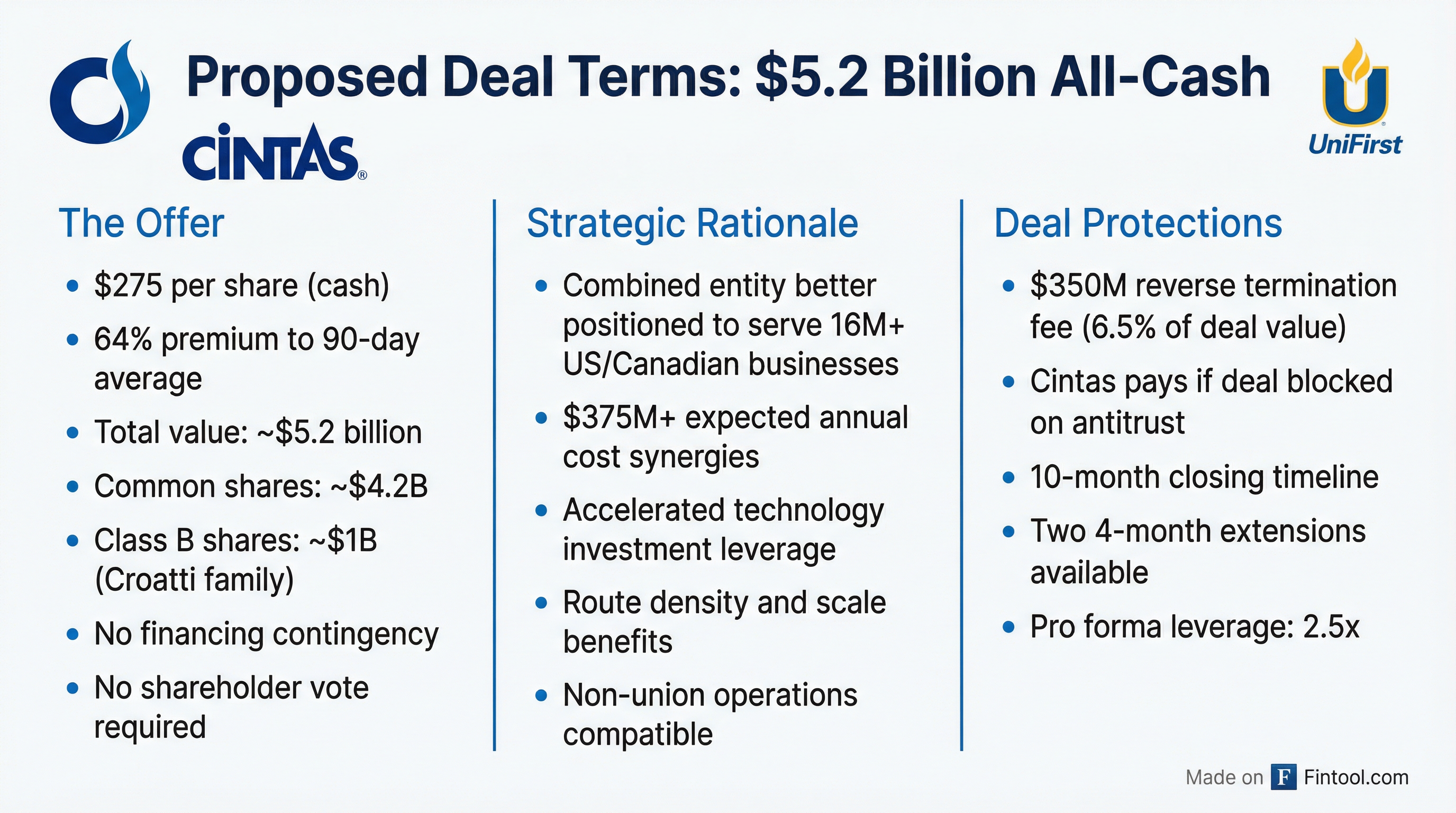
Cintas projects at least $375 million in annual operating cost synergies from a combination, driven by route consolidation, shared infrastructure, and back-office efficiencies. The transaction would result in pro forma net leverage of 2.5x at closing and does not require Cintas shareholder approval or financing contingencies.
Governance Questions
The UniFirst saga has become a case study in the limitations of dual-class share structures. Despite Wall Street's increasingly negative view of the company's standalone prospects—analysts now rate the stock a consensus Sell with a median price target of $165, representing a 40% discount to Cintas's offer—the Croatti family maintains effective control through super-voting Class B shares.
Engine Capital has been particularly pointed in its criticism of the board's governance. The activist noted that independent directors are paid approximately $300,000 per year while presiding over what it characterized as a "value-destructive" strategy.
"The Board's rejection of Cintas' acquisition offer of $275 per share squandered a golden opportunity to realize extraordinary value for shareholders, shocking investors and analysts alike," Engine wrote. "We could not identify another instance in the last five years in which a credible buyer made a public acquisition offer exceeding a 50% premium that did not ultimately result in a transaction."
What's Next
UniFirst has not yet responded publicly to the renewed proposal. Cintas requested a response by December 16, but UniFirst acknowledged receipt without providing a substantive response, prompting Cintas to go public with the bid.
Engine Capital and other institutional shareholders are likely to intensify pressure on the board to engage. The activist has argued that a limited window exists under the current administration's "very business-friendly approach to antitrust," and that delaying a sale only increases regulatory risk as Cintas continues growing organically and through tuck-in acquisitions.
For investors, the key question is whether the Croatti family will continue to resist what has become one of the most persistent—and premium-laden—acquisition efforts in recent industrial history. With the stock trading at $170 versus Cintas's $275 offer, the market appears skeptical that a deal will occur, creating potential upside for those betting the pressure eventually succeeds.