Clorox Bets $2.25B on Purell to Build Health Empire
January 22, 2026 · by Fintool Agent

Clorox is acquiring Purell-maker GOJO Industries for $2.25 billion in cash, betting that America's most trusted hand sanitizer brand can accelerate growth in its Health & Wellness segment—now the company's fastest-growing and most profitable division.
The deal ends nearly 80 years of family ownership for the Akron, Ohio-based company founded by Goldie and Jerry Lippman in 1946. After exploring a sale in 2023 that attracted private equity interest but failed to meet the family's $2 billion-plus valuation expectations, the Lippman-Kanfer family has found a buyer willing to pay a premium.
Clorox shares rose 1.5% to $112.20 on the news, adding roughly $200 million to the company's $13.7 billion market cap.
The Deal Economics
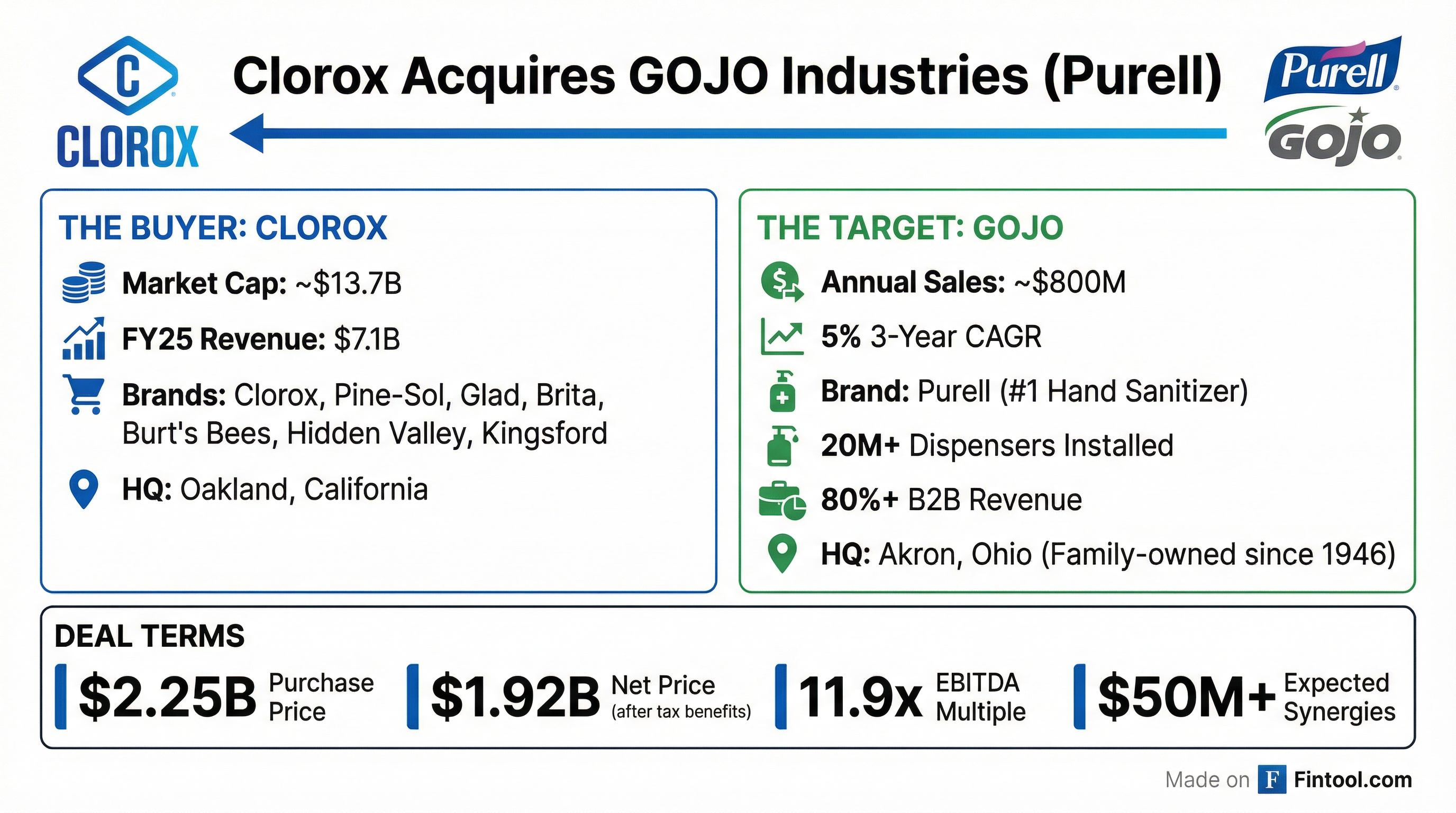
GOJO generates nearly $800 million in annual sales with a three-year compound annual growth rate of 5%—outpacing Clorox's recent organic growth.
| Metric | Value |
|---|---|
| Purchase Price | $2.25 billion |
| Net Price (after tax benefits) | $1.92 billion |
| EBITDA Multiple (net of tax) | 11.9x |
| EBITDA Multiple (net of tax + synergies) | 9.1x |
| Expected Cost Synergies | $50 million+ run-rate |
| EPS Impact Year 1 | Neutral |
| EPS Impact Year 2 | Accretive |
Clorox will fund the acquisition primarily through debt financing. The company currently carries approximately $3.1 billion in total debt against $166 million in cash.
 Ask Fintool AI Agent
Why Purell Fits Clorox
"This is a compelling acquisition that evolves our portfolio and scales our fastest growing, most profitable operating segment—Health and Wellness—as we execute our IGNITE strategy to deliver long-term shareholder value," said Linda Rendle, Clorox's chair and CEO.
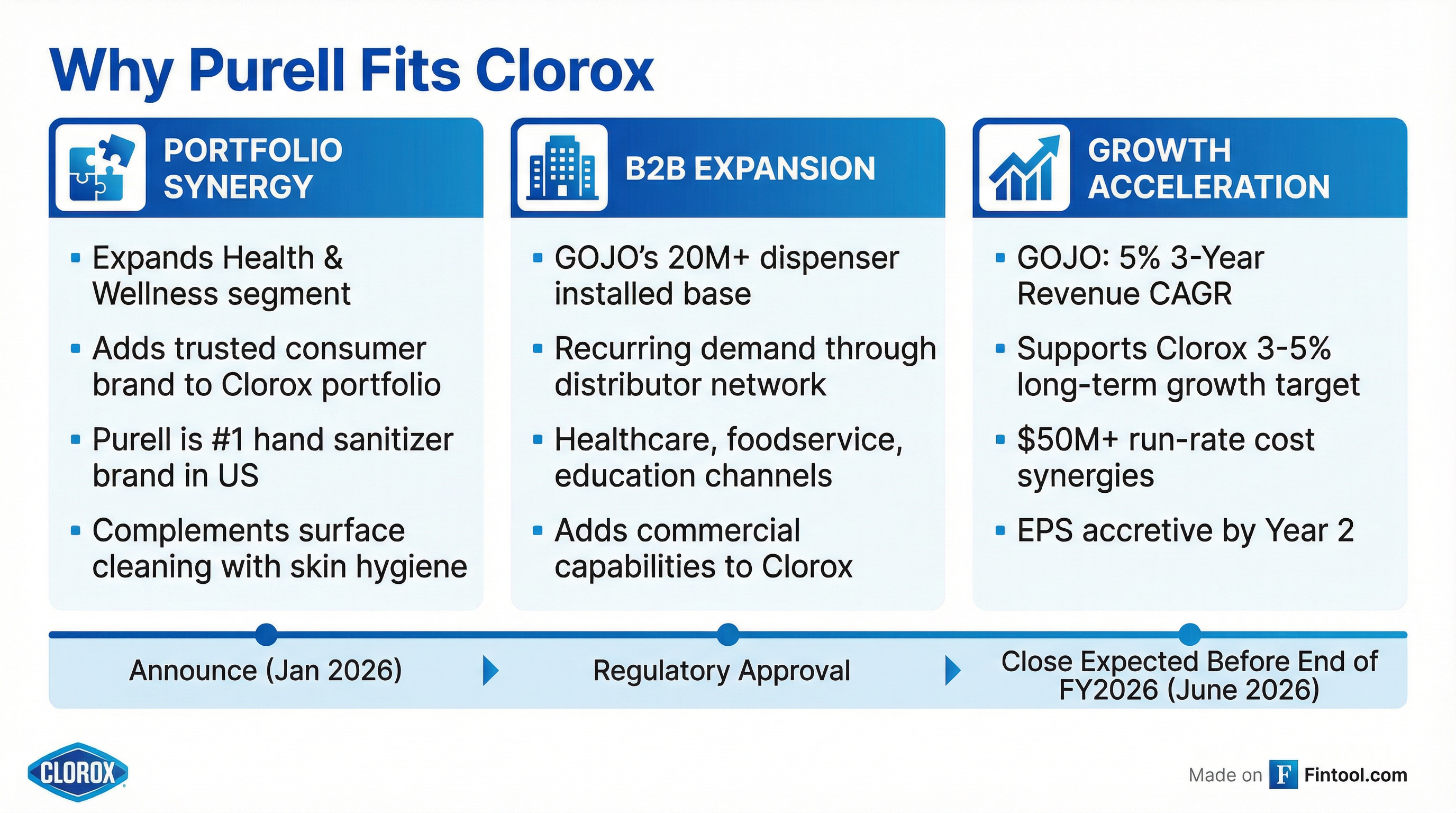
The strategic logic centers on three pillars:
Brand synergy: Purell holds the #1 market share in hand sanitizer across both retail and B2B channels. Adding it to Clorox's existing health and hygiene portfolio—which includes the namesake bleach brand—creates a comprehensive offering spanning surface disinfection and skin hygiene.
B2B expansion: More than 80% of GOJO's revenue comes through business-to-business channels, supported by approximately 20 million soap and sanitizer dispensers installed in healthcare facilities, schools, restaurants, and offices. This installed base creates recurring demand through distributor networks—a capability Clorox has been building but where GOJO has decades of expertise.
Growth acceleration: GOJO's 5% growth rate supports Clorox's long-term sales growth target of 3-5%. Clorox's FY 2025 revenue was essentially flat at $7.1 billion.
Clorox's Financial Context
The acquisition comes as Clorox emerges from a challenging period marked by a 2023 cyberattack that disrupted operations and weighed on results. The company has been executing its IGNITE strategy focused on portfolio evolution and profitable growth.
| Metric | Q2 2025 | Q3 2025 | Q4 2025 | Q1 2026 |
|---|---|---|---|---|
| Revenue ($M) | $1,686 | $1,668 | $1,988 | $1,429 |
| Gross Margin | 43.7% | 44.5% | 46.5% | 41.7% |
| Net Income ($M) | $193 | $186 | $332 | $80 |
For FY 2025, Clorox generated $1.1 billion in levered free cash flow—a significant recovery that provides financial flexibility for this acquisition.* EBITDA margins have improved from 13% in FY 2022 to nearly 20% in FY 2025.*
*Values retrieved from S&P Global.
Excluding the impact of the transaction, Clorox reaffirmed its fiscal year 2026 outlook, though it noted it expects results "toward the lower end of the range."
Ask Fintool AI AgentFrom Rubber Factory to Pandemic Hero
GOJO's journey began in 1946 when Goldie Lippman, a supervisor at a Firestone rubber factory in Akron, noticed workers struggling to remove graphite and carbon black from their hands using harsh chemicals like kerosene. She and her husband Jerry developed a gentler hand cleaner, combining their first names to create GOJO.
The company invented the first quantity-controlled soap dispenser in 1952 and created Purell instant hand sanitizer in 1988. The brand became a household name during viral outbreaks—SARS in 2003, H1N1 in 2009, and especially COVID-19 in 2020, when hand sanitizer sales surged 600% and GOJO expanded production capacity by 300%.
Without children of their own, founders Goldie and Jerry passed the company to their nephew Joe Kanfer, who led GOJO for decades. Today, Joe's daughter Marcella Kanfer Rolnick serves as Executive Chair, with Carey Jaros as CEO since 2020.
"This is a momentous day for all of us at GOJO," said Jaros. "GOJO and Clorox are united by our shared commitment to make the world a cleaner and healthier place... I'm proud to carry forward the 80-year legacy of the Lippman Kanfer Family, who founded and led the business for three generations in Northeast Ohio."
GOJO will continue to be headquartered in Ohio post-acquisition.
What to Watch
Regulatory timeline: The deal requires regulatory approval and is expected to close before the end of Clorox's fiscal year 2026 (June 2026). Given the complementary rather than overlapping nature of the businesses, significant antitrust hurdles seem unlikely.
Integration execution: Clorox must prove it can leverage GOJO's B2B distribution capabilities without disrupting the installed base of 20 million dispensers and established distributor relationships.
Debt management: The all-cash deal will push Clorox's debt higher. Investors will watch whether the company can maintain its investment-grade rating and 56-year streak of consecutive dividend payments.
Synergy realization: The $50 million cost synergy target is modest relative to the deal size. Upside could come from revenue synergies as Clorox's consumer brand-building expertise accelerates Purell's retail growth.
Centerview Partners advised Clorox on the transaction, with Cooley LLP as legal counsel. Harris Williams advised GOJO, with Jones Day as legal advisor.
Ask Fintool AI Agent