Coeur Mining CEO Signals New Gold Deal Closing 'In the Next Few Weeks' at BMO Conference
February 24, 2026 · by Fintool Agent


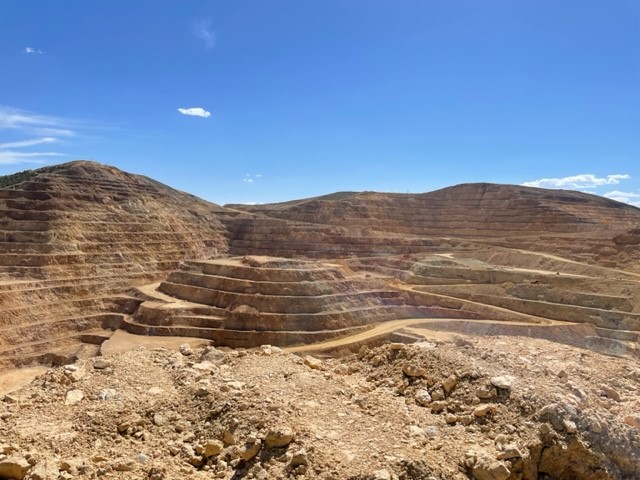
Coeur Mining CEO Mitchell Krebs told investors at the BMO Global Metals, Mining & Critical Minerals Conference that the transformative $7 billion New Gold acquisition is on track to close "in the next few weeks," setting up the creation of a dominant North American precious metals producer with an approximately $20 billion market capitalization.
The deal, which received final court approval from the Supreme Court of British Columbia in early February and strong shareholder support, will combine Coeur's five U.S. and Mexican operations with New Gold's two Canadian mines at New Afton and Rainy River—creating a seven-asset portfolio spanning the continent.
"This is really a transaction about making us better, not just bigger," Krebs emphasized, noting that post-merger, 82% of revenue will come from the U.S. and Canada, compared to roughly 55% on a standalone basis.
Shares of CDE closed at $24.43 on Monday, down 0.8% on the session but up 39% year-to-date. The stock has surged 374% over the past year and an extraordinary 843% over two years as surging gold and silver prices—now trading near $5,000 and $86 per ounce respectively—combined with successful M&A and operational improvements to transform the 98-year-old company.
 Ask Fintool AI Agent
From $250 Million to $15 Billion
The BMO presentation showcased a remarkable corporate turnaround story. A decade ago, Coeur's market cap was just $250 million, with a stretched balance sheet approaching 4.5x leverage and short mine lives across its portfolio.
"There was some lower price environments over the last 5, 6, 7 years. It made it hard to do, but we stayed committed" to heavy reinvestment in exploration and expansions, Krebs recounted.
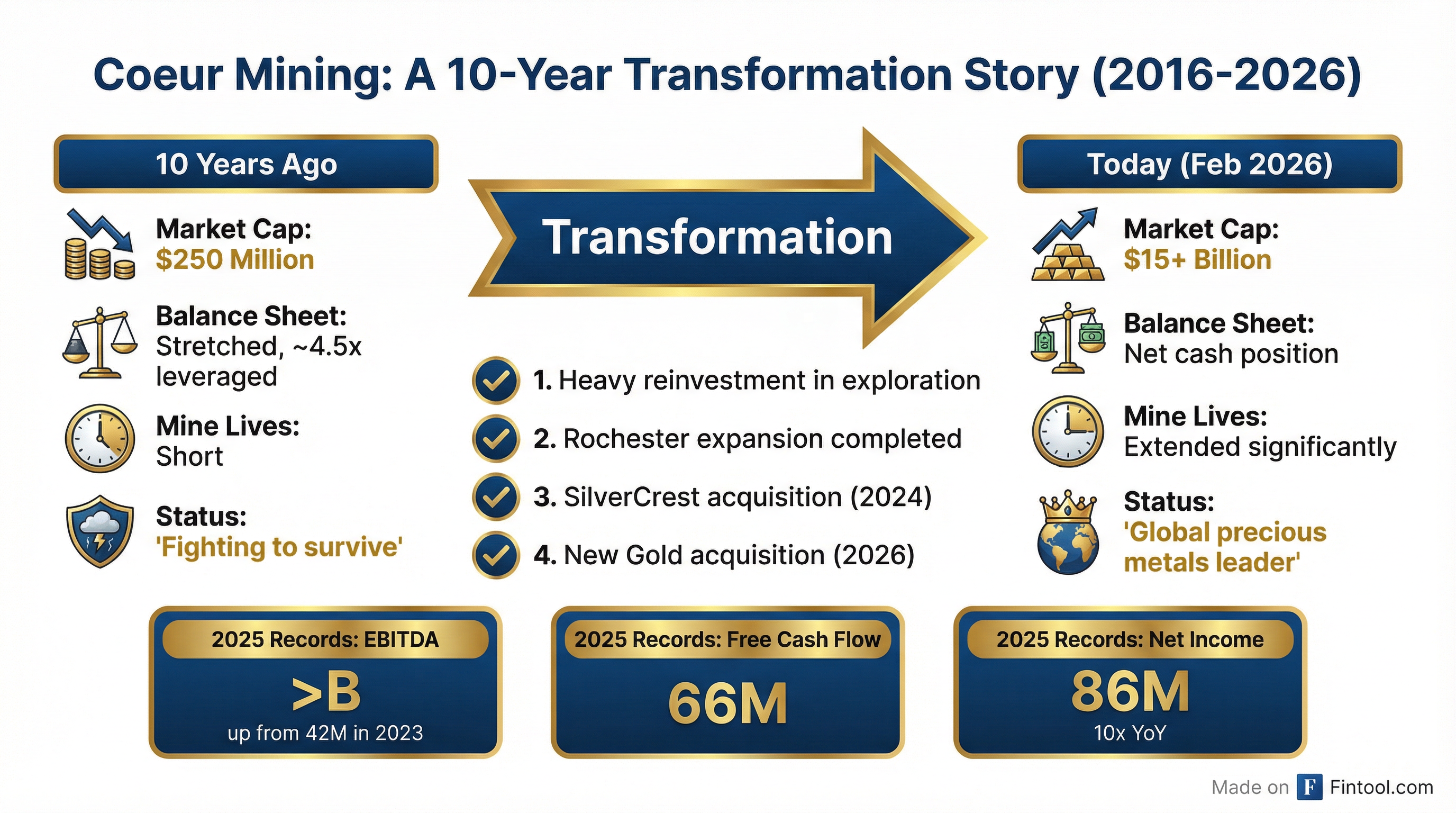
That strategy paid off dramatically in 2025, when the company posted all-time record results:
| Metric | FY 2025 | FY 2023 | Change |
|---|---|---|---|
| Net Income | $586 million | $59 million | +10x |
| EBITDA | >$1 billion | $142 million | +7x |
| Free Cash Flow | $666 million | -$300 million | N/M |
| Cash Position | 10-fold YoY increase | — | Net Cash |
"Literally, just in 2023, our EBITDA was $142 million. Last year, just over $1 billion. On the heels of the New Gold combination, that'll be over $3 billion on a combined basis," Krebs said.
Record Q4 Anchored by Rochester Turnaround
Fourth quarter 2025 results released last week underscored the momentum. Revenue hit $675 million with cash flow from operations of $375 million.
The long-awaited Rochester silver and gold mine expansion in Nevada—which had stretched the balance sheet during construction—finally delivered in Q4, generating $78 million in free cash flow at an average realized silver price of approximately $50 per ounce.
"Based on yesterday's meetings, we don't get any more Rochester questions," Krebs quipped, referring to years of investor skepticism about the project. Rochester is now guiding for approximately 7 million ounces of silver and 70,000 ounces of gold production in 2026, with a 16-year mine life ahead.
| CDE Quarterly Revenue | Q1 2024 | Q2 2024 | Q3 2024 | Q4 2024 | Q1 2025 | Q2 2025 | Q3 2025 | Q4 2025 |
|---|---|---|---|---|---|---|---|---|
| Revenue ($M) | $213 | $222 | $313 | $305 | $360 | $481 | $555 | $675 |
Ask Fintool AI AgentExploration: The ROIC Engine
A centerpiece of Krebs' presentation was Coeur's exploration-driven growth model, which he called "the poster child for ROIC." The company is increasing its standalone exploration budget by nearly 50% in 2026.
The results speak for themselves:
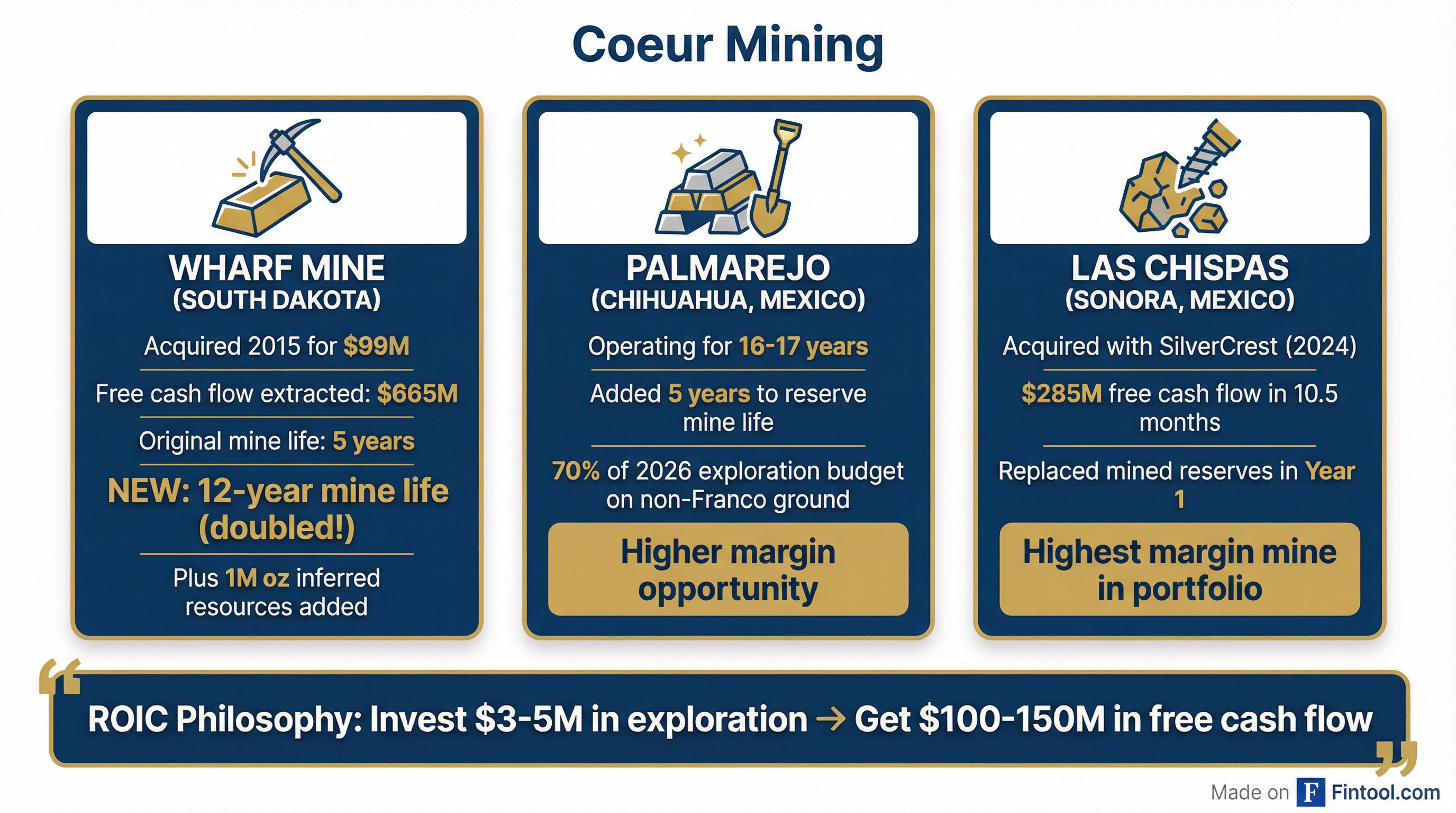
Wharf Mine (South Dakota): Acquired from Goldcorp in 2015 for $99 million, the mine has since generated $665 million in free cash flow. Despite having "had a five-year mine life for about 42 years now," year-end 2025 reserve updates doubled remaining mine life to 12 years, with over 1 million ounces of inferred resources added.
"If we can put in $3 or $5 and get back $100 or $150, we'll keep doing that all day long," Krebs said, explaining the economic logic.
Palmarejo (Chihuahua, Mexico): The 16-year-old operation added five years to its reserve mine life. Notably, 70% of 2026 exploration spending will target ground outside a Franco-Nevada gold stream's area of interest—where Coeur must sell half its gold production for $800/oz versus spot prices above $5,000.
Las Chispas (Sonora, Mexico): The high-grade silver-gold mine acquired with SilverCrest generated $285 million of free cash flow in just 10.5 months and successfully replaced mined reserves in year one—despite integration demands.
Return on invested capital reached 26% in 2025, with guidance pointing to the mid-40s in 2026. Executive compensation is directly tied to ROIC, reserve growth, and free cash flow per share.
New Gold: The Next Chapter
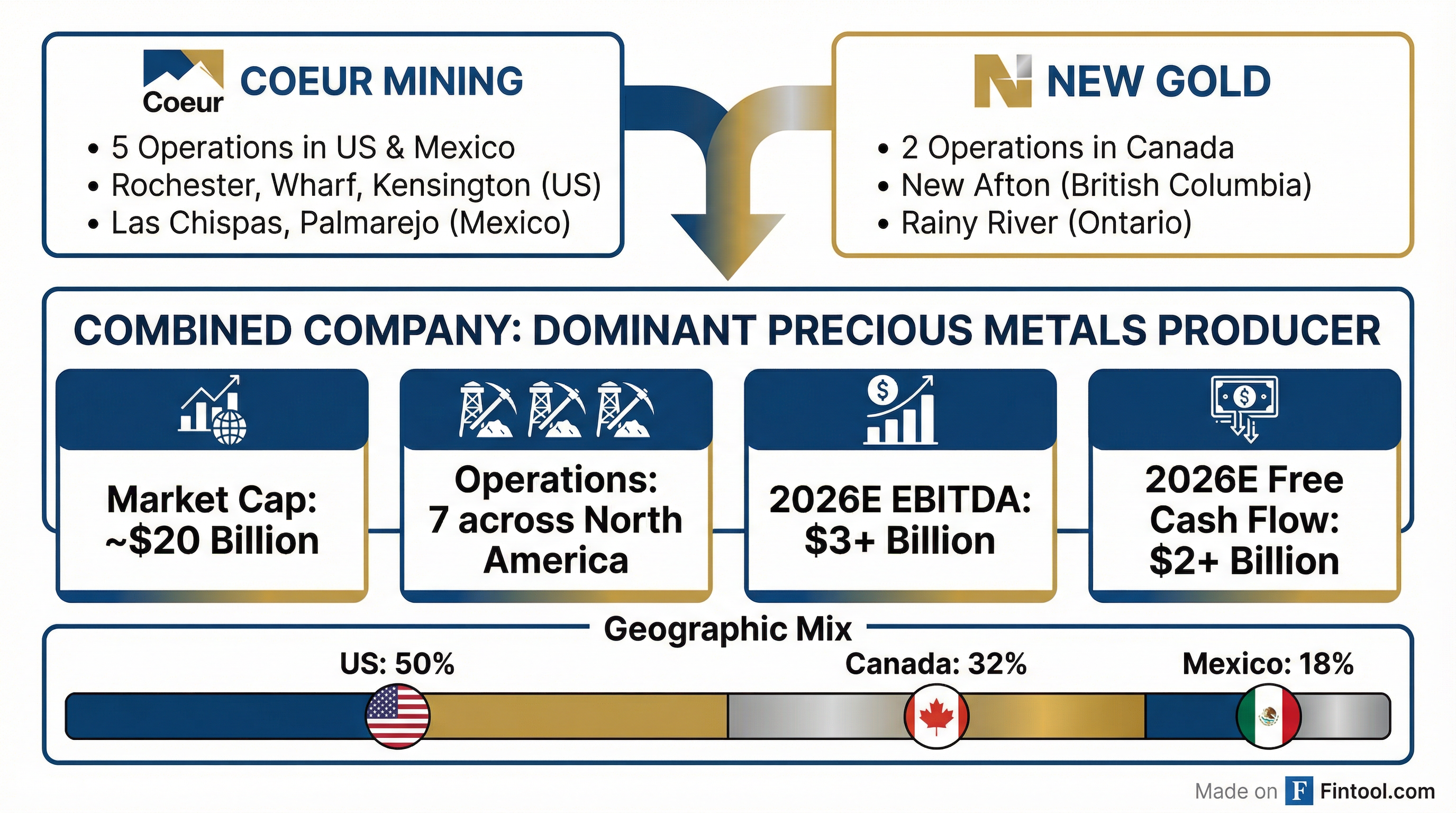
The New Gold acquisition adds two lower-cost Canadian operations that Krebs described as having "tremendous" potential:
New Afton (British Columbia): A block cave copper-gold mine that CEO Pat Godin—who attended the BMO presentation—has positioned for strong cash flow growth via the C-Zone ramp-up. An initial K-Zone resource will be disclosed at deal close, which Krebs said "will start to give people a better sense of what the longer-term potential at New Afton is."
Rainy River (Ontario): An open-pit-to-underground transitioning gold mine that was New Gold's largest cash flow generator in 2025, particularly in Q3 and Q4. With a 25,000 ton-per-day mill and a 50 square kilometer land position "that has really only begun to be touched from an exploration standpoint," Krebs sees major upside.
"I think in 5 years from now, when we look back on this transaction, we'll all say that, 'Wow, Rainy River was the big surprise in this combined company,'" Krebs predicted.
The transaction is expected to be roughly 40% accretive to free cash flow per share—"really hard to find when you're looking for external opportunities."
Return of Capital Coming
With free cash flow expected to exceed $2 billion in 2026 on a combined basis, Coeur plans to announce a "robust approach to returning capital" immediately after the New Gold closing.
Krebs balanced shareholder return expectations with capital preservation philosophy: "I don't think there's anything to apologize for having a big cash balance. This is a company historically that's always had to fight and claw and scratch its way through low-price environments."
The combined company will be eligible for S&P 500 inclusion as a U.S.-domiciled, NYSE-listed entity—a potential catalyst for passive fund flows.
Ask Fintool AI AgentWhat to Watch
Near-term catalysts:
- New Gold closing (expected within weeks)
- Combined company guidance release
- New Afton K-Zone initial resource disclosure
- Return of capital strategy announcement
- Reserve and resource updates for New Afton and Rainy River
Operational priorities for 2026:
- Rochester continued ramp-up to full capacity
- Palmarejo exploration on non-Franco ground
- Wharf reserve conversion from inferred resources
- New Afton C-Zone production ramp
- Rainy River underground transition
Risks:
- Gold and silver price volatility (currently at/near record highs)
- Integration execution with New Gold
- Labor cost inflation (3-5% across portfolio)
- Mexican peso appreciation impacting Sonora/Chihuahua costs
- Regulatory risks in Mexico (18% of combined revenue exposure)
The BMO conference presentation marks one of the final public appearances before the combined Coeur-New Gold entity emerges. For a 98-year-old company that nearly collapsed during prior precious metals downturns, the transformation into a potential S&P 500 constituent generating over $2 billion in annual free cash flow represents a remarkable reinvention—one that CEO Krebs attributed to "staying committed" through difficult years and "gaining the trust of employees, communities, investors" by consistently delivering on promises.
Related