December Jobs Report: 50,000 Jobs Added Caps Off Worst Hiring Year Since 2003
January 9, 2026 · by Fintool Agent


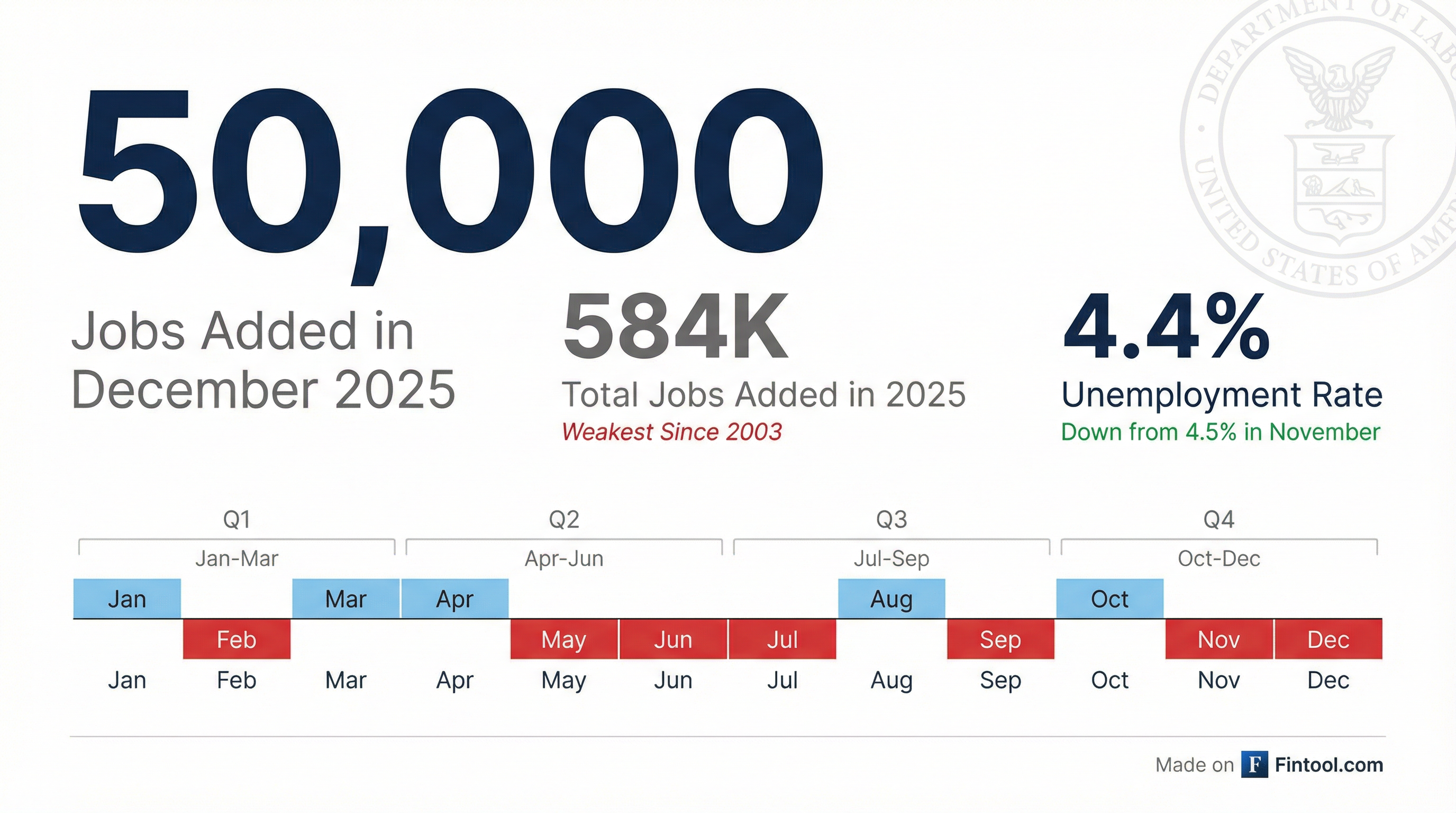
The U.S. economy added just 50,000 jobs in December, capping off the weakest year for hiring outside a recession since 2003. The unemployment rate declined to 4.4% from a revised 4.5% in November—welcome relief after hitting a four-year high—but the headline masks a labor market that has ground to a near-halt.
Total job gains for 2025 came in at approximately 584,000, a stark deceleration from 2.0 million added in 2024. More concerning: 84% of those gains occurred in the first four months of the year. Since May, only one sector—healthcare and social assistance—has added jobs in aggregate.
The Numbers
| Metric | December 2025 | Forecast | November 2025 |
|---|---|---|---|
| Nonfarm Payrolls | +50,000 | +60,000 to +73,000 | +56,000 (revised) |
| Unemployment Rate | 4.4% | 4.5% | 4.5% (revised from 4.6%) |
| Average Hourly Earnings (MoM) | +0.3% | +0.3% | +0.2% |
| Average Hourly Earnings (YoY) | +3.8% | +3.8% | +3.6% |
| Labor Force Participation | 62.4% | — | 62.5% |
Source: Bureau of Labor Statistics, January 9, 2026
The Bureau of Labor Statistics also revised prior months sharply lower. October's losses deepened to -173,000 from the initially reported -105,000, while November was trimmed to +56,000 from +64,000. The three-month moving average has now turned negative—a troubling signal for a labor market that isn't supposed to be in recession.
 Ask Fintool AI Agent
Market Reaction: Relief Rally
Stocks rose on the softer-than-expected report, with investors interpreting the data as supportive of the Federal Reserve's wait-and-see approach. The S&P 500 gained 0.5% in early trading, while the Dow added 0.4%. Treasury yields held steady, with the 10-year at 4.18%.
| Index | Price | Change |
|---|---|---|
| S&P 500 (SPY) | $692.96 | +0.50% |
| Dow Jones (DIA) | $494.60 | +0.42% |
| Nasdaq 100 (QQQ) | — | +0.38% |
Prices as of 11:30 AM ET, January 9, 2026
"It is now difficult to argue that the labour market is collapsing and in urgent need of monetary support," said Seema Shah, Chief Global Strategist at Principal Asset Management. "However, the picture remains far from clear: payroll growth undershot expectations, and downward revisions to prior months have pushed the three-month moving average into negative territory."
The Paradox: Strong Economy, Weak Hiring
The disconnect between economic growth and job creation has become the defining puzzle of 2025. GDP expanded at a robust 4.3% annualized pace in Q3, and the Atlanta Fed's GDPNow tracker estimates Q4 growth at 5.4%. Consumer spending during the holiday season hit a record $257.8 billion. Yet employers aren't hiring.
KPMG Chief Economist Diane Swonk framed it starkly: "Economic growth has decoupled from the labor market, which is sending mixed signals to the Fed."
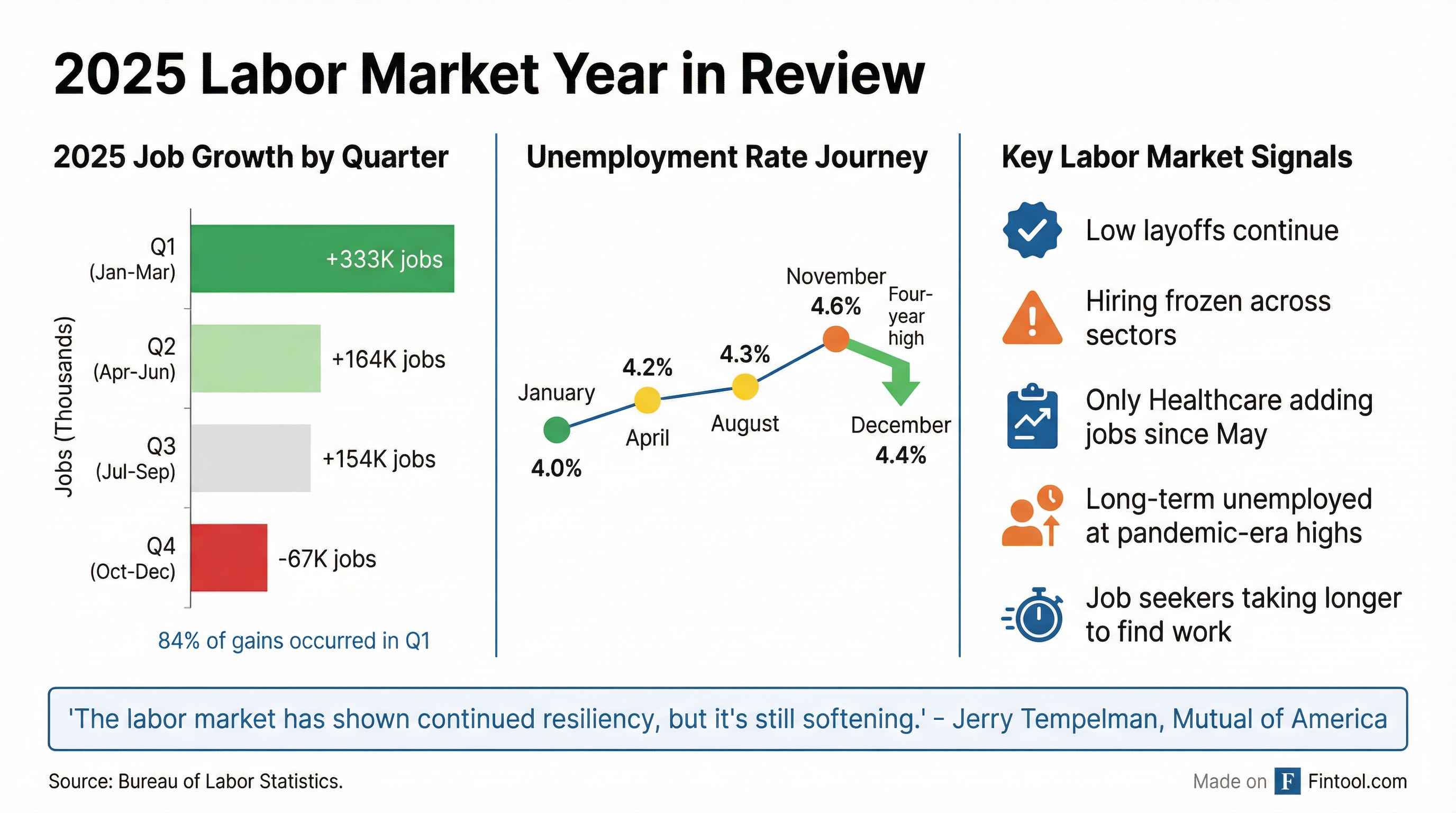
The data reveals a "no hire, no fire" equilibrium. Layoffs remain historically low—initial jobless claims fell to 208,000 for the week ending January 3, the lowest since April 2024. But hiring has frozen across most sectors. The JOLTS survey showed job openings fell to 7.15 million in November, the lowest since September 2024, while new hires dropped to 5.12 million.
Ask Fintool AI AgentWhat's Driving the Slowdown?
Several factors have converged to freeze hiring:
Trade Policy Uncertainty: Tariff volatility throughout 2025 left businesses reluctant to expand headcount until policy clarity emerged. The "tariff tantrum" in April coincided precisely with the inflection point in hiring momentum.
AI-Driven Automation: Multiple employers cited artificial intelligence adoption as reducing the need for new hires. Amazon explicitly linked its January layoffs of up to 2,500 workers to automation initiatives.
Birth-Death Model Distortions: The BLS has acknowledged significant overcounting in recent data. The agency estimated 911,000 fewer jobs were created in the year through March 2025 than initially reported. February's benchmark revision may reveal further adjustments.
Fed Implications: Pause, Then Assess
Markets now price in a near-certain pause at the Fed's January 28-29 meeting, with the next cut not expected until June. The central bank delivered three consecutive rate cuts in the final months of 2025, bringing the fed funds rate to the 3.50%-3.75% range, but policymakers have signaled caution going forward.
| Meeting | Fed Funds Target | Market-Implied Probability |
|---|---|---|
| Jan 28-29 | Hold at 3.50-3.75% | 95% |
| March | Hold | 70% |
| June | Cut 25bps | 55% |
Source: LSEG, Fed fund futures as of January 9, 2026
KPMG's Swonk warns the Fed faces a difficult choice: "If the weakness we are enduring is more structural than cyclical, then those cuts will fail to cure what ails the labor market and risk stoking a more persistent bout of inflation. The shifts we are seeing to both trade and immigration policies stoke stagflation—increases in both inflation and unemployment."
Ask Fintool AI AgentConsumer Sentiment: A Warning Sign
The New York Fed's Survey of Consumer Expectations released Thursday showed the perceived probability of finding a job hit a record low of 43.1% in December—the worst reading since the survey began in 2013. Meanwhile, the probability of losing a job rose to 15.2%, the highest since April 2025.
The University of Michigan's consumer sentiment index ticked up to 54.0 in January's preliminary reading from 52.9 in December, but remains 25% below year-ago levels. Inflation expectations remain elevated at 3.4% for the year ahead.
What to Watch
February Benchmark Revision: The BLS will publish revised payroll data next month that could show significantly weaker 2024-2025 job growth than currently reported. The agency is also implementing changes to its birth-death model starting with January's data.
Supreme Court Tariff Ruling: A decision expected imminently could reshape business confidence and hiring plans for 2026. Retail stocks slid Thursday as the court delayed its anticipated ruling.
Q4 Earnings Season: Banks kick off reporting next week. Management commentary on commercial lending, credit conditions, and hiring across their client bases will provide real-time insight into whether the labor market is stabilizing or deteriorating further.
Data sourced from Bureau of Labor Statistics, Federal Reserve Bank of St. Louis (FRED), and market data providers.