DraftKings Cuts Jobs as Prediction Markets Threaten Sports Betting Dominance
February 24, 2026 · by Fintool Agent


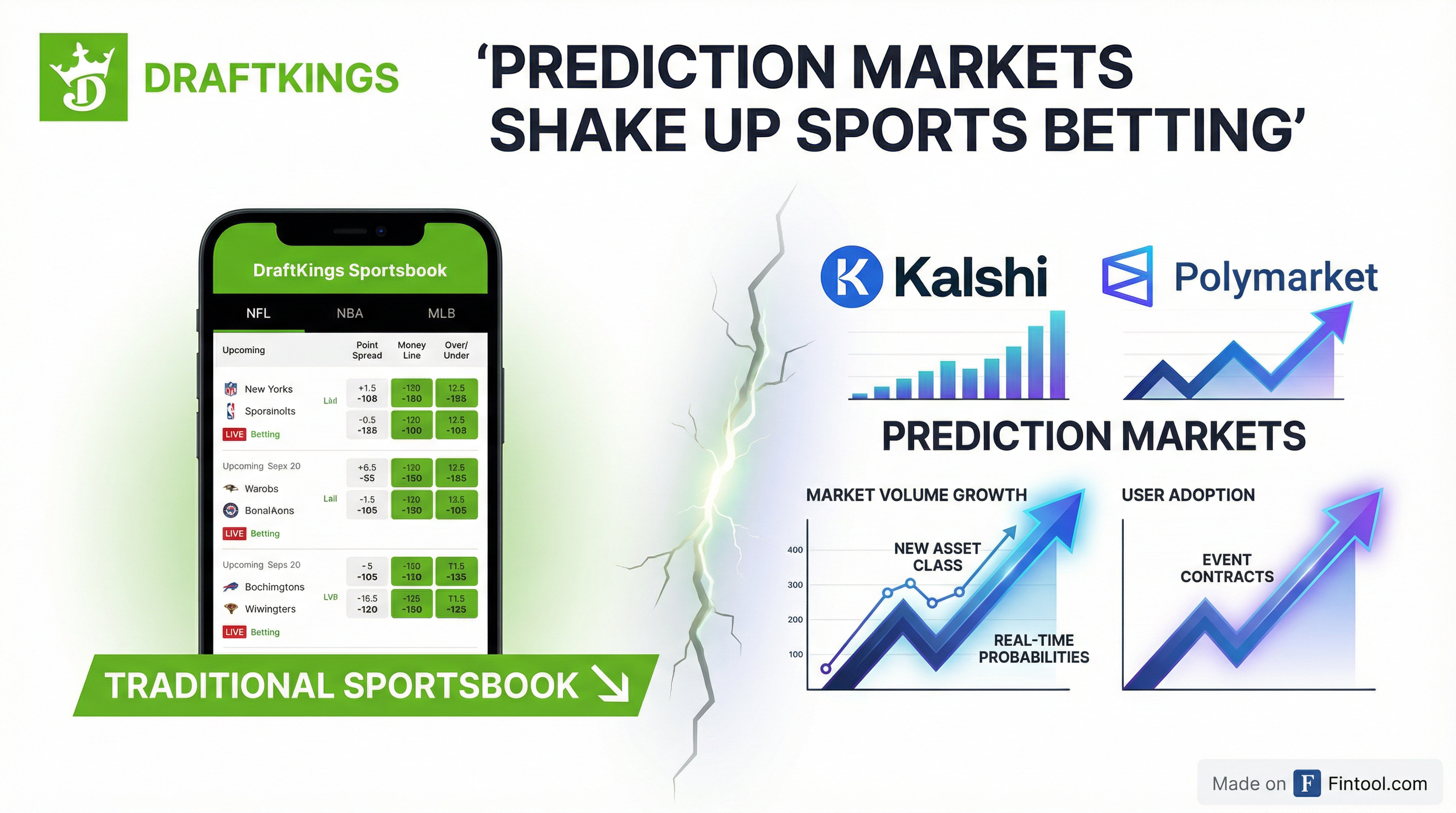
Draftkings is cutting staff just 10 days after disappointing Wall Street with conservative 2026 guidance, as the sports betting giant faces an existential competitive threat from federally-regulated prediction markets that have exploded in popularity.
The Boston-based company confirmed it is "reorganizing some teams to better align their people with the most important priorities and areas of investment" — corporate speak for layoffs that analysts estimate could affect up to 5% of the workforce and save approximately $30 million annually.
The timing is telling: DraftKings' stock has collapsed 37% year-to-date to around $22, trading near its 52-week low of $21, after the company's FY2026 guidance of $6.5 billion to $6.9 billion in revenue missed the $7.32 billion Wall Street had projected.
The Prediction Market Siege
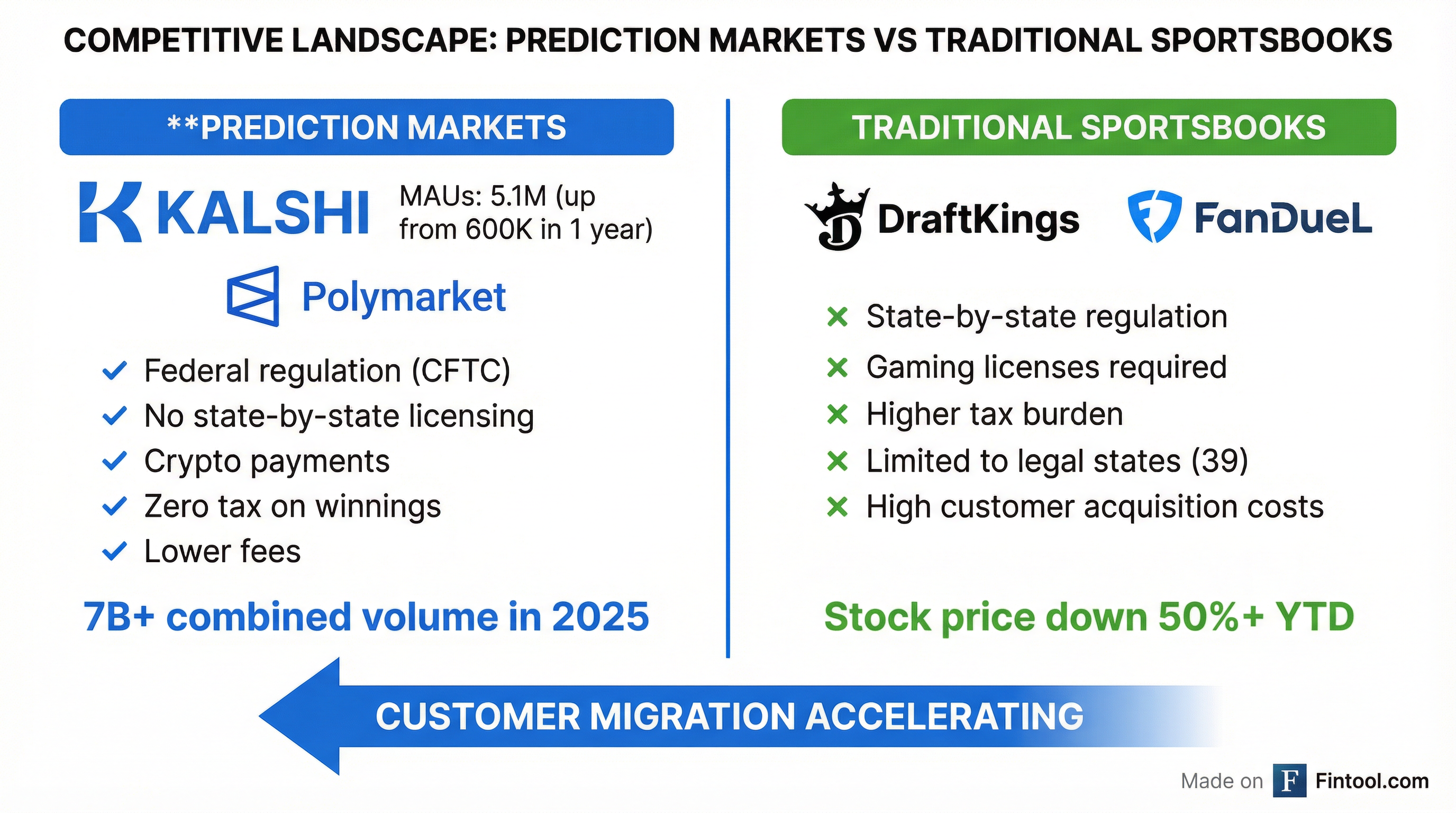
The culprit is clear: prediction markets like Kalshi and Polymarket have surged from niche curiosities to mainstream competitors, processing over $37 billion in combined volume in 2025. These platforms operate under federal CFTC regulation, bypassing the state-by-state licensing that constrains traditional sportsbooks to roughly half the U.S. population.
The numbers are staggering. Kalshi alone captured $720 million in NFL bets during a single playoff week — nearly equivalent to a quarter of DraftKings' total quarterly revenue. The platform's monthly active users have exploded from 600,000 to 5.1 million in just over a year.
"Prediction markets are operating as federally regulated exchanges that circumvent state gambling laws, drawing users away from established operators like DraftKings and Flutter Entertainment," according to industry analysis.
 Ask Fintool AI Agent
Q4 Beat, But Guidance Spooked the Street
The layoffs come despite what was otherwise a banner quarter. DraftKings delivered record Q4 2025 results:
| Metric | Q4 2025 | Q4 2024 | YoY Change |
|---|---|---|---|
| Revenue | $1.99B | $1.39B | +43% |
| Adjusted EBITDA | $343M | $86M | +299% |
| EBITDA Margin | 17% | 6% | +1,100 bps |
| Sportsbook Handle Growth | 13% | - | Accelerating |
For FY2025, DraftKings grew revenue 27% to over $6 billion, more than tripled adjusted EBITDA to over $600 million, and reported positive GAAP net income for the first time in company history.
But the FY2026 outlook spooked investors:
| Metric | FY2026 Guidance | Street Estimate | Miss |
|---|---|---|---|
| Revenue | $6.5B-$6.9B | $7.32B | -6% to -12% |
| Adjusted EBITDA | $700M-$900M | $998M | -10% to -30% |
Values retrieved from S&P Global
CFO Alan Ellingson noted the guidance "reflects expected investments in DraftKings Predictions, line-of-sight jurisdiction launches, and disciplined planning as business conditions evolve."
"If You Can't Beat Them, Join Them"
CEO Jason Robins isn't retreating — he's pivoting. In what may be the most significant strategic shift since DraftKings went public, the company is aggressively entering the prediction market space it once ignored.
"Predictions is the most exciting new growth opportunity we have seen since PASPA was struck down in 2018," Robins declared on the earnings call, referencing the Supreme Court decision that legalized sports betting nationwide.
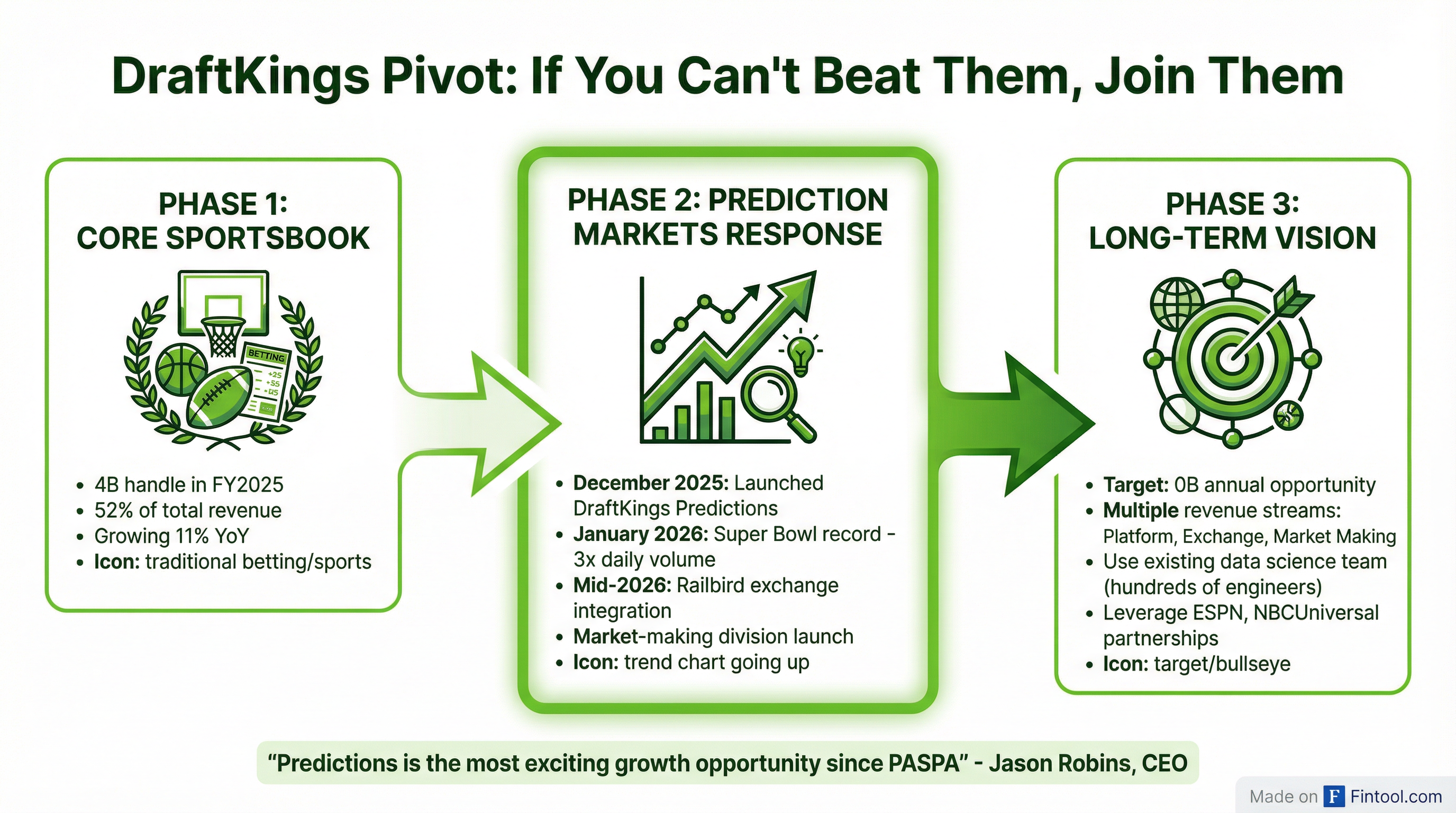
DraftKings launched its Predictions platform in December 2025, and early signals are promising. On Super Bowl Sunday, DraftKings Predictions had the second-most downloads in its category and delivered three times its prior record for daily trading volume.
The company's playbook includes:
- Mid-2026: Integrate Railbird exchange to "improve innovation velocity and strengthen customer economics"
- Market Making: Launch proprietary market-making division to provide liquidity
- Multi-Exchange: Connect to multiple exchanges to "stay nimble as trading options evolve"
- Leverage Existing Assets: Use ESPN and NBCUniversal marketing partnerships for efficient customer acquisition
Robins estimates prediction markets could represent "a $10 billion annual gross revenue opportunity in the years ahead" — and DraftKings intends to capture it across platforms, exchanges, and market making.
Ask Fintool AI AgentThe AI Angle
The layoffs also reflect DraftKings' embrace of artificial intelligence. The company has adopted AI functions across the organization — writing RFPs, helping engineers code, powering chatbots, and even drafting legal opinions.
Perhaps most significantly, 70% of promotional spending is now determined by AI algorithms, which should increase over time. "Overall, we could expect more cost structure rationalization in the coming quarters to years as the business continues to benefit from AI and maturing markets," noted Jefferies analyst Jordan Bender.
CEO Robins emphasized AI's role: "AI and machine learning amplify each one [of our advantages] by making our products better, our platform faster, consumer trust stronger, and marketing more efficient."
The Cannibalization Question
The elephant in the room: will prediction markets cannibalize DraftKings' core sportsbook business?
Robins addressed this directly: "To date, we are not seeing a discernible impact from predictions on our revenue." He noted that in Missouri, DraftKings' newest sportsbook state, adoption was higher than any other launch in company history. Q4 sportsbook handle accelerated to 13% year-over-year growth.
However, he acknowledged that in January, "internal and third-party data suggest predictions impacted our January handle only very slightly and primarily impacted low-margin customers."
For context, DraftKings' sportsbook processed $54 billion in handle during FY2025, with $2.5 trillion in total potential payouts (capital at risk) due to the multiplicative nature of parlays — a figure the company pointedly noted is "comparable to volume that predictions operators report."
What to Watch
Investor Day (March 2): DraftKings will unveil detailed strategy for predictions, including product and marketing plans.
Railbird Integration (Mid-2026): The exchange integration will determine how quickly DraftKings can compete on platform economics.
CFTC Regulation: The CFTC Chair recently directed staff to establish clear standards for event contracts. "We view this direction as constructive," Robins said.
State Tax Pushback: Robins is lobbying states against raising online sports betting taxes, arguing "states would be absolutely crazy right now to raise OSB taxes with everything going on with predictions."
Ask Fintool AI AgentRelated: Draftkings · Flutter Entertainment