Ed Garden Takes Aim at Fortune Brands Before New CEO Even Starts
February 22, 2026 · by Fintool Agent


Activist investor Ed Garden has built a stake in Fortune Brands Innovations and is privately nominating a slate of director candidates—with a singular mission: stop incoming CEO Amit Banati before he even takes the job.
The intervention, reported by the Wall Street Journal on Sunday, comes just ten days after Fortune Brands' stock crashed 18% following weak Q4 earnings and the surprise announcement that CEO Nicholas Fink would depart to "pursue a professional opportunity outside the company."
Garden, who co-founded Trian Fund Management with Nelson Peltz, views Banati's appointment as the board repeating the same mistake it made when it promoted Fink. He sees Banati—currently a Fortune Brands director and former CFO of Kenvue and Kellanova—as lacking the leadership and industry experience needed to turn around the struggling building products company.
The Timeline: From Earnings Miss to Activist Attack
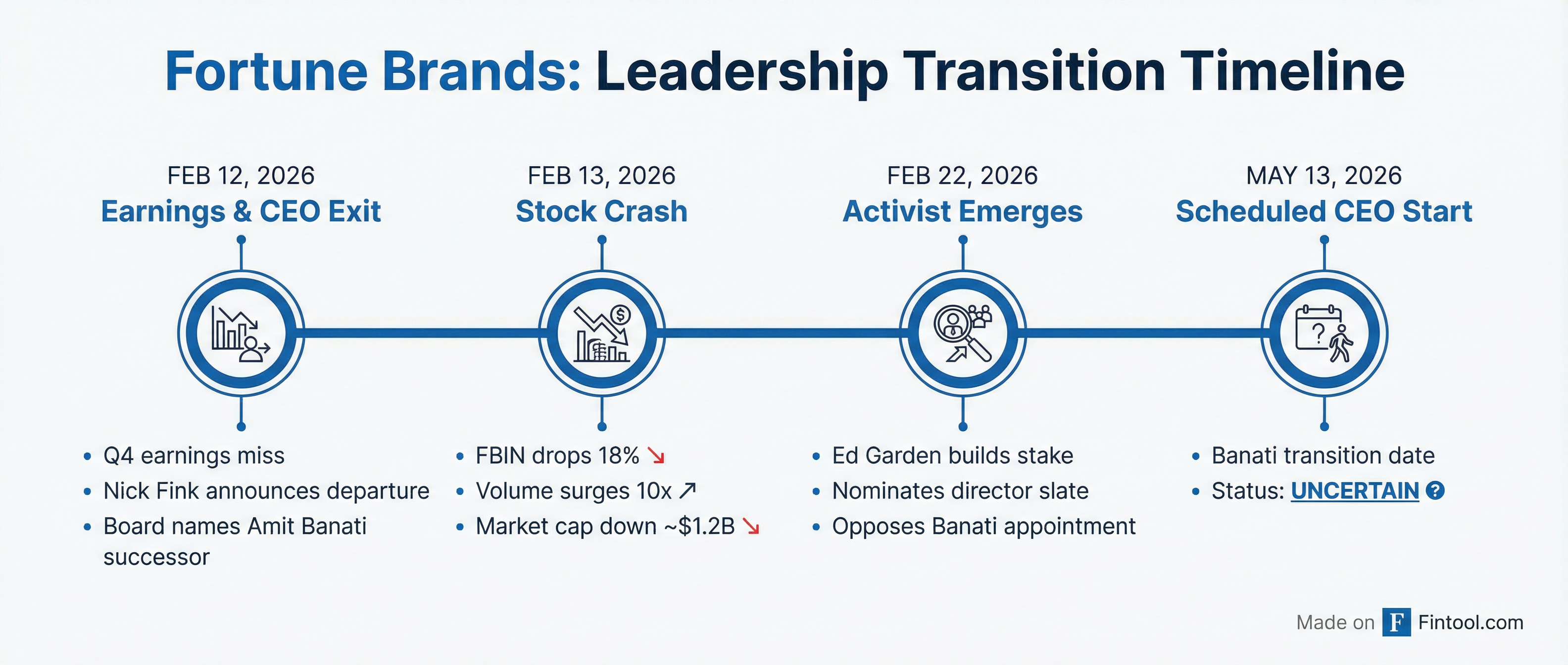
The sequence of events unfolded rapidly:
February 12, 2026: Fortune Brands reported Q4 2025 results that missed expectations. Revenue fell 2.4% year-over-year to $1.08 billion, while net income dropped 27% to $76 million. The same day, the board announced Fink's departure and named Banati as his successor, effective May 13.
February 13, 2026: Shares collapsed 18% on massive volume—18.4 million shares traded, roughly 10x the average daily volume. The $1.2 billion market cap wipeout in a single session signaled deep investor concern about both the financial performance and leadership vacuum.
February 22, 2026: Garden's involvement becomes public. He has privately nominated directors ahead of the company's annual meeting, positioning for a proxy fight if the board doesn't reverse course.
 Ask Fintool AI Agent
The Financial Picture: Profitability Under Pressure
Fortune Brands' Q4 earnings call painted a company in the midst of a "profitability reset." CEO Fink was blunt: "Let me be very clear, we are not satisfied with our profitability today."
| Metric | Q4 2024 | Q1 2025 | Q2 2025 | Q3 2025 | Q4 2025 |
|---|---|---|---|---|---|
| Revenue ($M) | $1,104 | $1,033 | $1,203 | $1,149 | $1,078 |
| Net Income ($M) | $105 | $51 | $100 | $71 | $76 |
| EBITDA Margin | 21.2% | 16.8% | 20.7% | 22.2% | 15.2% |
The company's full-year 2025 revenue declined 3.2% to $4.46 billion, with management citing "high single digit" volume deleverage in the industry. The 2026 guidance isn't reassuring: flat to 2% sales growth and EPS of $3.35–$3.65—below where analysts had expected.
In response, Fortune Brands initiated aggressive cost cuts:
- 10% reduction in headquarters workforce
- $60 million in continuous improvement savings captured in 2025
- Another $35 million in annualized savings targeted by year-end 2026
Who Is Ed Garden?
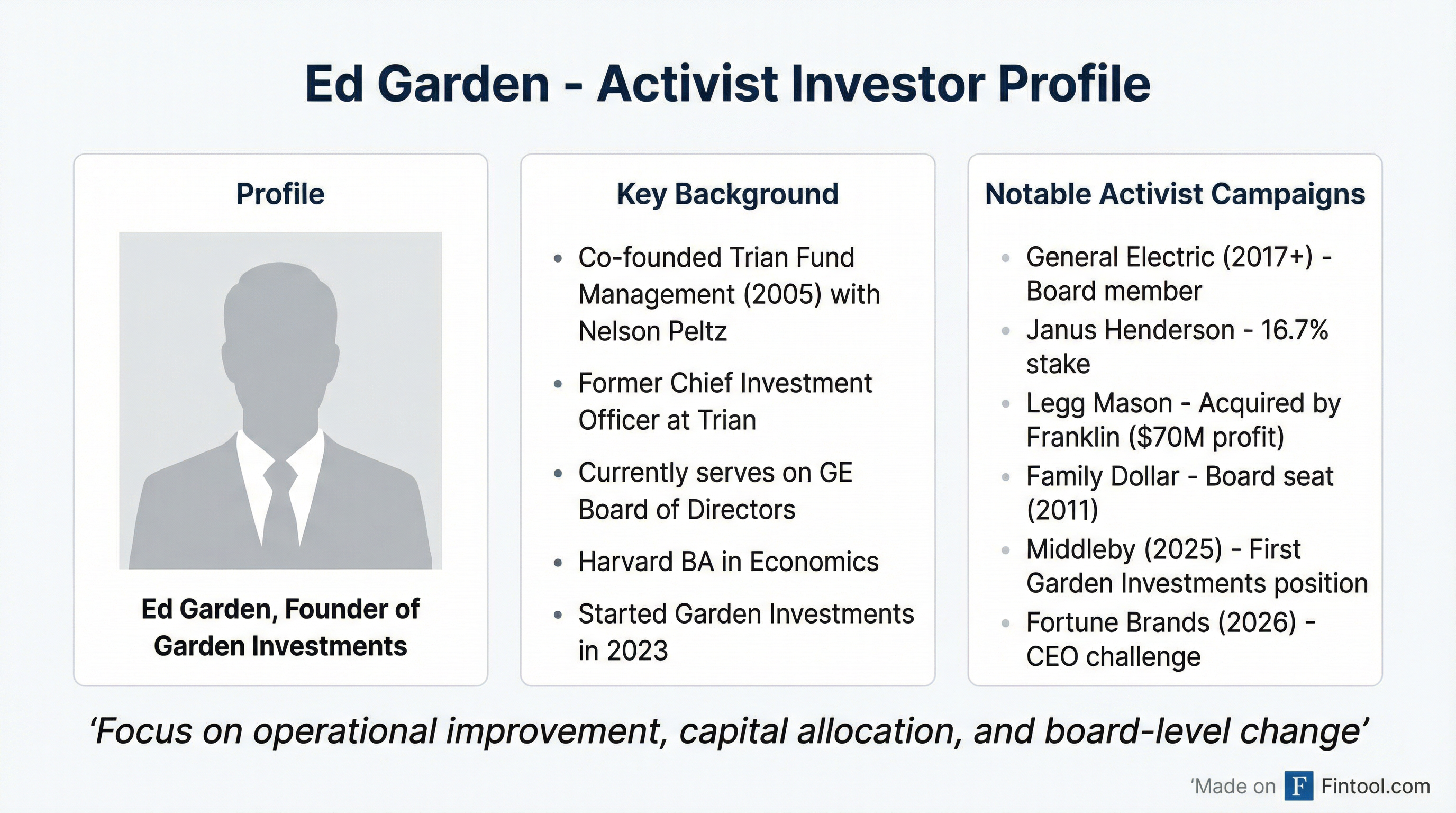
Ed Garden is one of the most accomplished activist investors of the past two decades. He co-founded Trian Fund Management in 2005 with Nelson Peltz (his father-in-law) and Peter May, serving as Chief Investment Officer until stepping down in 2023 to launch his own family office, Garden Investments.
His track record includes:
- General Electric: Board member since 2017, where he continues to serve on the Finance & Capital Allocation Committee
- Janus Henderson: Built a 16.7% stake, became the firm's largest shareholder, and placed Peltz on the board
- Legg Mason: Board seat alongside Peltz; Trian profited $70 million when Franklin Templeton acquired the company
- Family Dollar: Gained a board seat in 2011 after pushing for changes
- Middleby: Garden Investments' first activist position, taken in January 2025 with a nearly 5% stake in the kitchen equipment maker
Garden's playbook typically focuses on operational improvements, capital allocation discipline, and board-level change. At Fortune Brands, he believes the company "could grow much larger over the next decade"—but not under Banati's leadership.
Ask Fintool AI AgentThe Board's Defense
Fortune Brands' board framed the succession as the result of "a defined, deliberate, and well-structured succession process." Board Chair Susan Kilsby, who will serve as Executive Chair during the transition, emphasized continuity: "Amit has been on the board of Fortune Brands for nearly six years, most recently as chair of the Audit Committee. He has worked closely with the management team and knows the company and this market extremely well."
Incoming CEO Banati brings finance credentials from his tenure as CFO of Kenvue (the Johnson & Johnson consumer health spinoff) and Vice Chairman and CFO of Kellanova (the Kellogg's snack spinoff). But Garden's criticism—that Banati lacks operating experience in the building products industry—echoes concerns investors may have about whether a finance-focused executive can navigate the competitive dynamics of faucets, security hardware, and smart home products.
The Brands at Stake
Fortune Brands owns some of the most recognized names in home products:
Water Innovations:
- Moen – The #1 faucet brand in North America
- House of Rohl – Premium faucets and fixtures
Outdoors & Security:
- Master Lock – The iconic padlock brand
- Therma-Tru – Entry door systems
Connected Products: The company is pushing into smart home technology, with Moen's connected devices showing progress. Management highlighted "nice and improved market outperformance" in the Water segment, with share gains in brick-and-mortar retail and with builder customers.
What to Watch
The battle lines are drawn:
Garden's Path to Victory: Accumulate enough shares to force a proxy fight, convince fellow shareholders that Banati is the wrong choice, and either block his appointment or push for an alternative CEO with deeper industry experience.
The Board's Options: Stand firm behind Banati and the succession process, potentially settle with Garden on board representation, or—least likely—reverse course on the CEO appointment before May 13.
Key Dates:
- April 1, 2026: Nicholas Fink's departure date
- May 13, 2026: Banati's scheduled start as CEO
- Annual Meeting: Date TBD—will be the battleground if no settlement is reached
Fortune Brands' stock closed at $54.32 on Thursday, still down roughly 16% from its February 10 high of $64.44. With Garden now in the picture, volatility is likely to continue as the market prices in the probability of an activist-driven outcome.
Ask Fintool AI Agent