Estée Lauder Crashes 22% Despite Beat and Raise as Tariff Fears Overshadow Turnaround
February 5, 2026 · by Fintool Agent

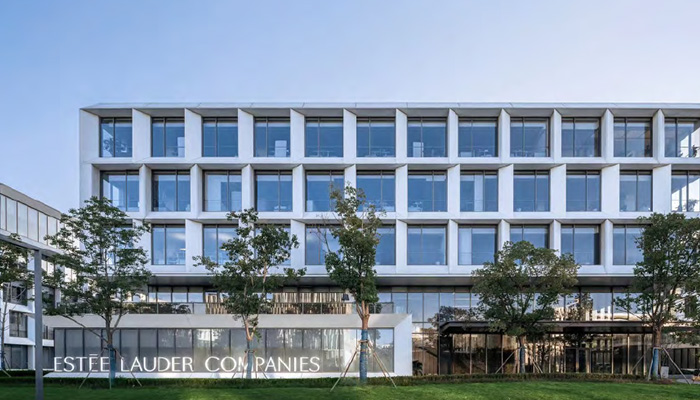
Estée Lauder shares plummeted 22.6% to $92.60 on Wednesday, erasing over $8.5 billion in market value despite the beauty giant posting strong second-quarter results and raising its full-year outlook. The dramatic selloff—one of the largest single-day drops in the company's history—came as investors focused on $100 million in tariff headwinds and ongoing disruption in Asian travel retail.
The crash sent shares to their lowest level since August 2025, reversing a rally that had brought the stock near its 52-week high of $121.64 just days earlier.
Strong Quarter, Weak Reaction
Estée Lauder's fiscal Q2 results were objectively solid. The company reported:
| Metric | Q2 2026 | Q2 2025 | Change |
|---|---|---|---|
| Revenue | $4.23B | $4.00B | +6% |
| Organic Sales Growth | 4% | — | — |
| Adjusted Operating Margin | 14.4% | 11.5% | +290 bps |
| Adjusted EPS | $0.89 | $0.62 | +43% |
| Gross Margin | 76.5% | 76.1% | +40 bps |
Adjusted EPS of $0.89 beat the $0.83 consensus estimate, and the company raised its full-year adjusted EPS guidance to $2.05-$2.25 from $1.90-$2.10.* Management narrowed organic sales growth guidance to 1-3% and lifted operating margin expectations to 9.8%-10.2%.
"We reported strong second quarter results, marked the one-year anniversary of Beauty Reimagined, and raised our fiscal 2026 outlook," CEO Stéphane de La Faverie said on the earnings call .
So why the crash?
 Ask Fintool AI Agent
The $100 Million Tariff Problem
The answer lies in the company's tariff disclosure. Estée Lauder faces a complex web of trade barriers that management expects will cost approximately $100 million in fiscal 2026 profitability, mostly in the second half .
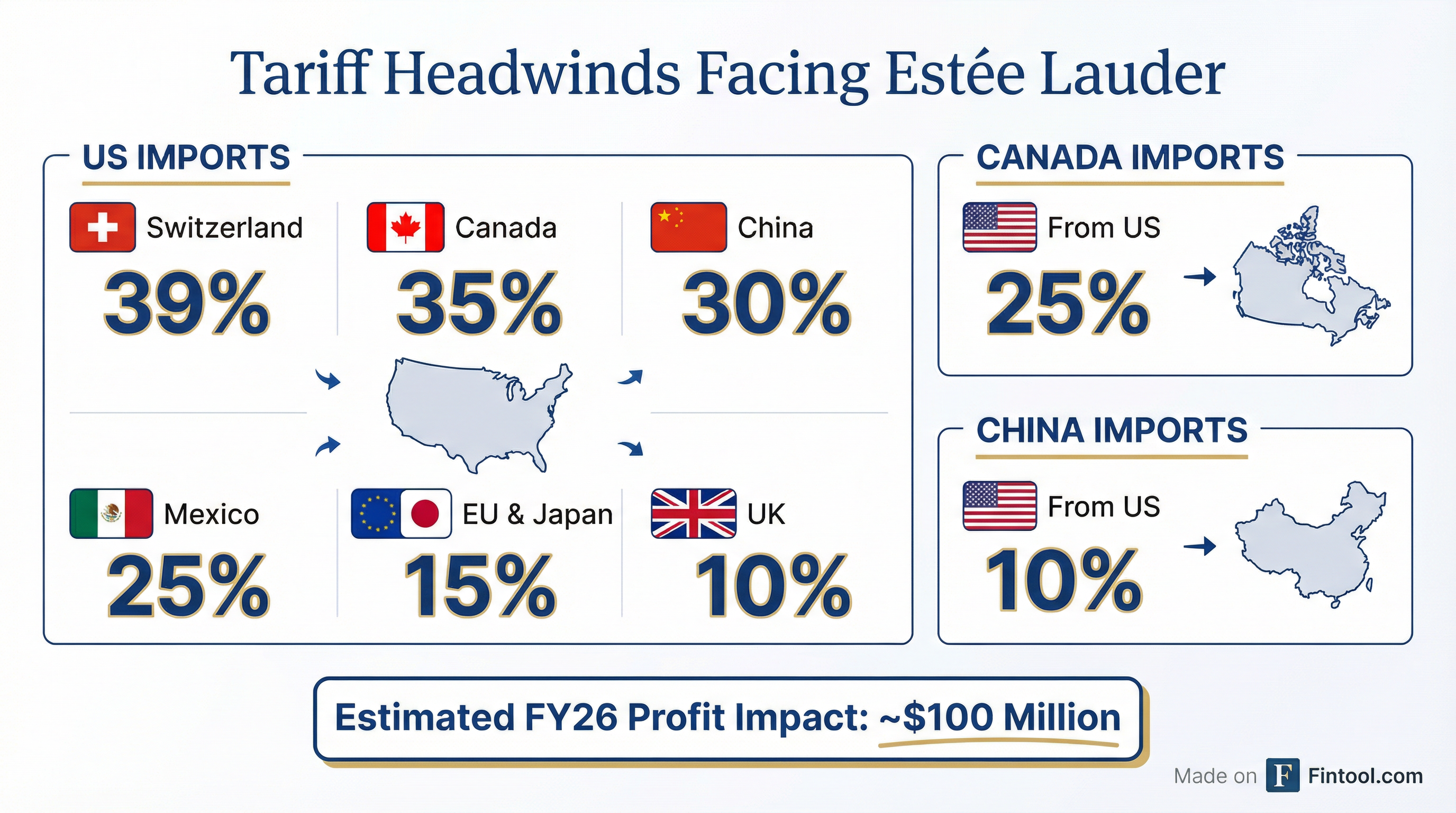
The company's tariff exposure spans multiple geographies :
U.S. Imports:
- Switzerland: 39%
- Canada: 35%
- China: 30%
- Mexico: 25%
- European Union & Japan: 15%
- United Kingdom: 10%
Canada Imports from U.S.: 25%
China Imports from U.S.: 10%
Estée Lauder has implemented mitigation strategies, including "leveraging available trade programs and further optimizing its regional manufacturing footprint to bring production closer to the consumer—including through its facility in Japan" . These efforts are helping offset "more than half of the expected impacts."
The tariff concern is particularly acute given the company's global supply chain. With Swiss imports facing a 39% tariff rate—likely affecting products from facilities supplying high-end brands—the pressure on margins is substantial.
Travel Retail Turmoil
Beyond tariffs, Estée Lauder flagged "an incremental transitory headwind from the change of duty-free retailers servicing the Beijing and Shanghai airports, including the related online businesses" .
On the earnings call, CEO de La Faverie explained the disruption: "All the operation have been transferred with a mix of China Duty Free, Wangfujing and Avolta. So there's a little bit of a transition that we felt in Q2 that goes into Q3" .
The universal app for duty-free purchases was "shut down in Q2 and remains shut down as we speak," limiting the company's ability to convert travelers into customers .
However, there were bright spots in travel retail. Hainan delivered "high single digit" retail sales growth in Q2, with January posting "high double digit" gains . The company is gaining market share in the channel, led by La Mer and Estée Lauder brands.
Ask Fintool AI AgentQ3 Margin Contraction Expected
Perhaps most concerning to investors: the company expects operating margin to contract approximately 50 basis points in Q3 compared to last year . This is driven by:
- Timing of consumer-facing investments to support second-half innovation
- Tariff headwinds building in the second half
"We expect contraction in the third quarter of approximately 50 basis points, owing to the timing of consumer-facing investments to support second-half innovation, with a higher year-over-year increase expected in the third quarter, and tariff headwinds," the company stated .
The China Bright Spot
Amid the concerns, China remained a genuine success story. The company outperformed prestige beauty in mainland China for the quarter, with double-digit organic skincare growth .
"It is now the fourth consecutive quarter that we grew share in all four categories in China," CEO de La Faverie noted .
La Mer became the #1 brand in luxury on Tmall, Estée Lauder was #1 in prestige on Tmall and Douyin, and Jo Malone captured the top spot in prestige fragrances on Tmall .
The company is also reducing discounts while maintaining growth: "Our discount levels in China are coming down while we are driving this outstanding growth and outperformance of the market," CFO Akhil Shrivastava said .
One-Year Stock Performance
The dramatic drop brings Estée Lauder's stock back near levels seen last summer, erasing months of recovery gains.
The stock had rallied from a 52-week low of $48.37 to near its 52-week high, lifted by optimism around the "Beauty Reimagined" turnaround and improving China trends. Today's crash represents a capitulation of that optimism.
What to Watch
Near-Term Catalysts:
- Q3 FY26 results (expected May 2026) to assess tariff impact
- Resolution of Beijing/Shanghai airport duty-free transitions
- China consumer sentiment through Lunar New Year
Longer-Term Factors:
- Tariff policy evolution under current administration
- Travel retail recovery trajectory
- PRGP (Profit Recovery and Growth Plan) execution
The company remains confident in its trajectory. CEO de La Faverie was emphatic: "We are going for the top end of the new guidance that we are giving, both in top line and bottom line for this fiscal year" .
Whether the market shares that confidence will depend on how the next few quarters unfold.
Ask Fintool AI AgentRelated
*Values retrieved from S&P Global